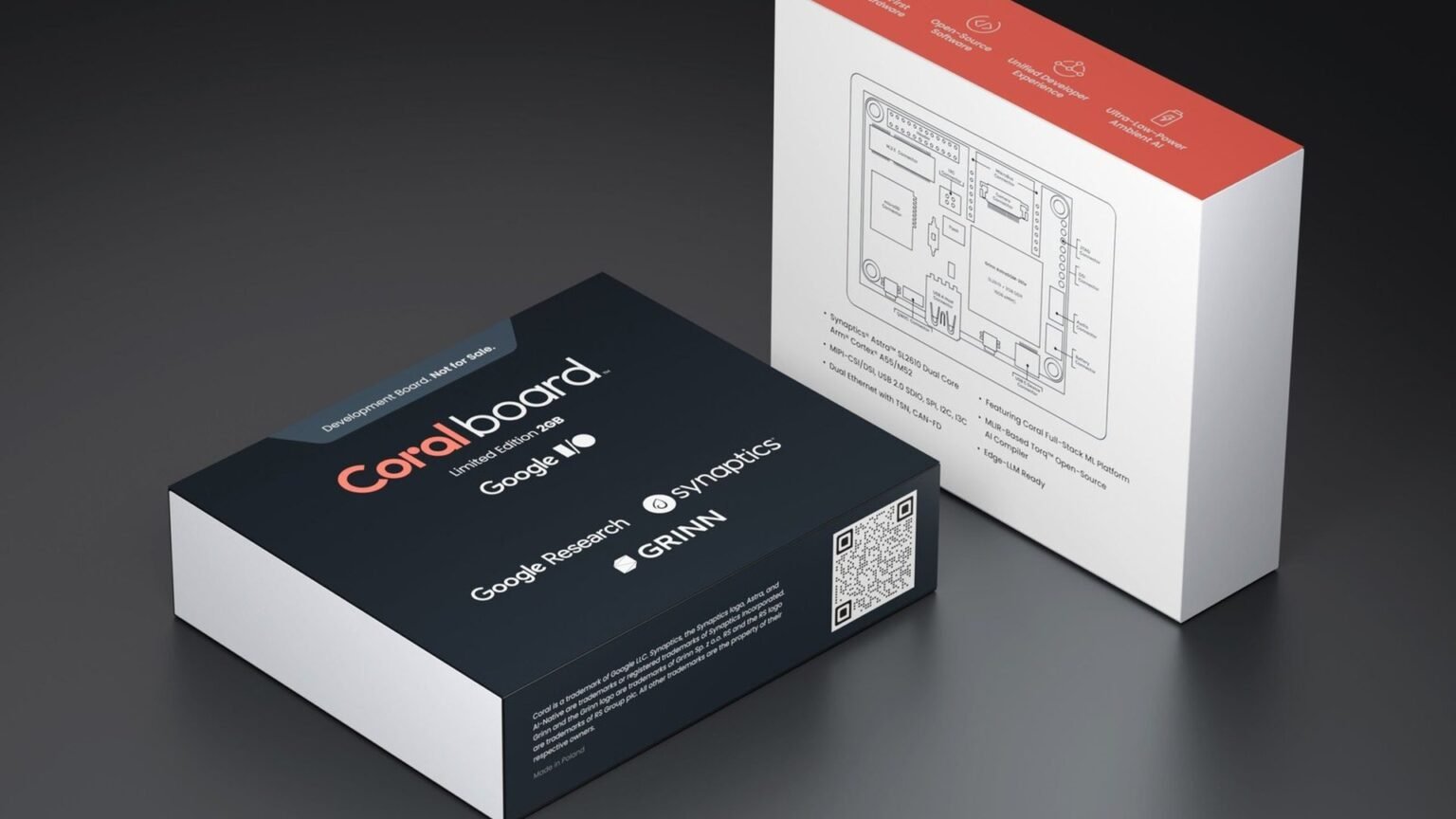

Google’s Coral brand is back, this time through a partnership with Synaptics rather than a Google-built dev board. At Google I/O 2026, the companies introduced the Coralboard, a single-board computer built on Synaptics’ Astra SL2619 and aimed at multimodal on-device AI. The hardware specs are modest next to higher-end edge systems, but the strategic message is clearer: Coral is being repositioned as a practical developer platform for low-power inference, with explicit support for both CNN and transformer workloads.
Coral returns at Google I/O, but the silicon story has changed
May 19, 2026
Announcement date
Timed to Google I/O 2026
2 companies
Launch partners
Synaptics and Google Research
Synaptics and Google Research on May 19 used Google I/O 2026 to introduce the Coralboard, a development board and single-board computer for on-device AI. Synaptics described it as an “open, feature-rich and standards-based platform for bringing multimodal on-device AI experiences to life”, and framed the launch as a way to help developers move faster from prototyping to real-world edge AI products.
That makes the announcement notable for two reasons. The Synaptics Coralboard edge AI story matters because of what it implies for builders downstream. First, it revives the Coral name, which had been closely associated with Google’s earlier Coral Dev Board and Edge TPU era. Second, the new board is not built around Google’s own application silicon. The hardware is based on the Synaptics Astra family, with Google Research contributing Coral NPU technology rather than shipping a standalone Google-designed board.
The official release and follow-on coverage all point to the same positioning: this is a partner-led reboot of Coral for the current edge AI cycle, where developers want local inference, multimodal pipelines, and at least some transformer support without moving up to much larger and more power-hungry systems.
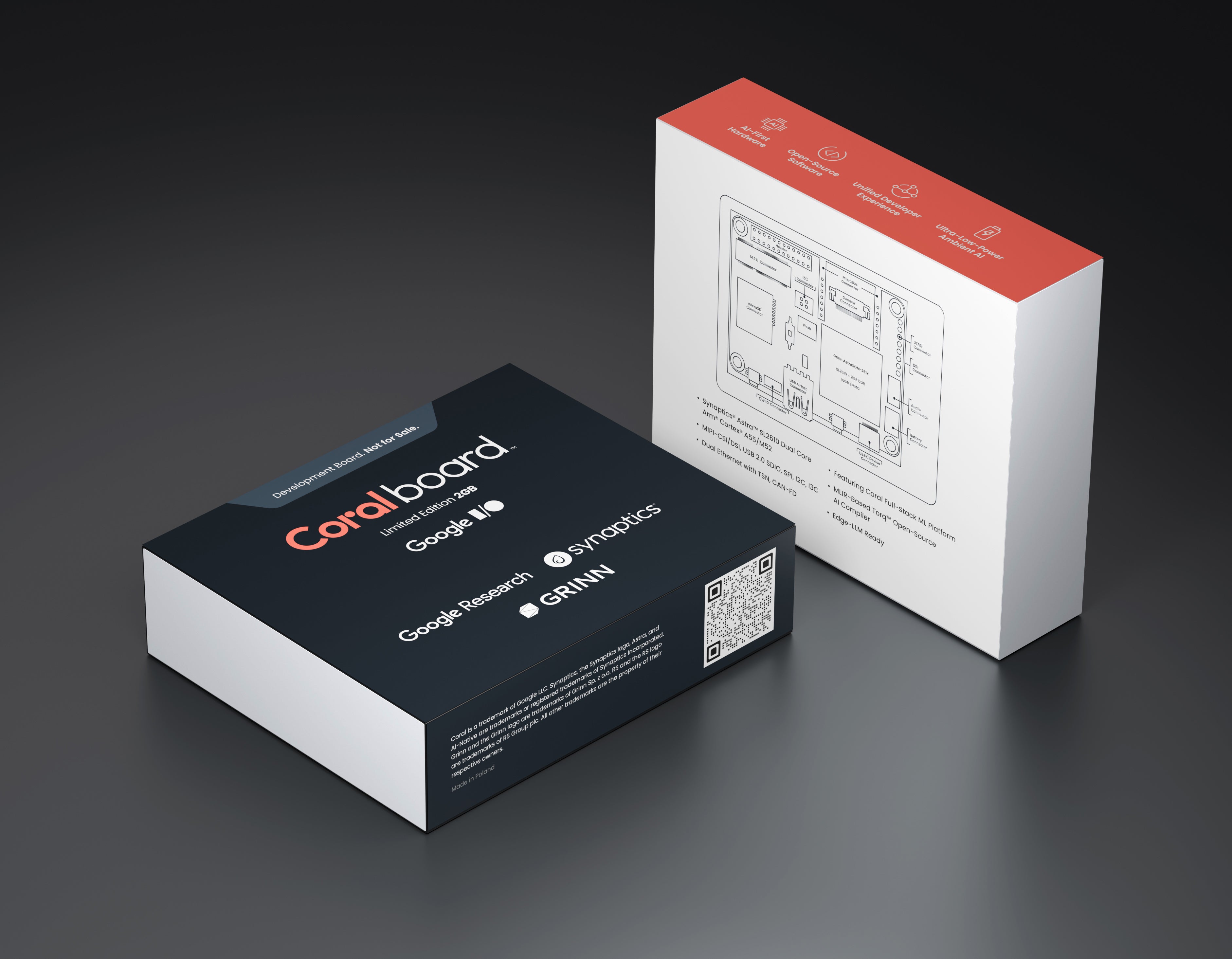
The Coralboard is best read as a strategic reset for Coral: Google Research keeps the Coral brand and NPU technology in play, while Synaptics supplies the production SoC platform and board-level path to market.
“An open, feature-rich and standards-based platform for bringing multimodal on-device AI experiences to life.”
Synaptics press release
The hardware: Astra SL2619, 2GB RAM, and a 1 TOPS NPU
1 TOPS
NPU rating
CNN + transformer capable
2GB
DDR4 memory
System RAM disclosed by Synaptics
2GHz
Dual-core CPU
Synaptics Astra SL2619
The Coralboard is powered by the Synaptics Astra SL2610 product line, using the SL2619 SoC variant. Synaptics says the board includes a 2GHz dual-core Synaptics Astra SL2619, 2GB DDR4, and an NPU stack that combines the Synaptics Torq NPU with Coral NPU technology from Google Research.
The headline accelerator number is 1 TOPS. Synaptics also says the NPU is CNN + transformer capable. That wording is important. Earlier edge AI accelerators, including the original Coral generation in the public imagination, were often discussed primarily in the context of CNN-based vision inference. Here, Synaptics and Google are signaling that the baseline expectation for a modern edge board is no longer just image classification or object detection. Even at modest throughput, developers want support for smaller transformer-style workloads as part of the software story.
There is still a clear ceiling. A 1 TOPS NPU and 2GB of system memory place the Coralboard in the low-power inference class, not the mini-workstation class. The announcement does not claim the board is meant for large local generative models, and it does not disclose support for any particular on-device Gemma configuration. Readers should treat this as a practical edge development platform for compact models and sensor-driven pipelines, not as a substitute for heavier edge compute modules.
Pros
Cons
Synaptics and Google Research did not disclose Coralboard pricing, a general-availability timeline, whether Gemma runs on-device, or the practical transformer model size limits imposed by 2GB of RAM.
| Component | What Synaptics disclosed |
|---|---|
| Board type | Development board / single-board computer |
| SoC family | Synaptics Astra SL2610 product line |
| SoC variant | SL2619 |
| CPU | 2GHz dual-core Synaptics Astra SL2619 |
| NPU | Synaptics Torq NPU + Coral NPU technology from Google Research |
| NPU rating | 1 TOPS |
| Model support positioning | CNN + transformer capable |
| Memory | 2GB DDR4 |
The Jellectronica demo shows Google’s preferred edge AI narrative
At I/O 2026, the companies did not settle for a standard industrial vision demo. Their pre-show installation, called Jellectronica, used the Coralboard to run an NPU-accelerated YOLOv8 object detection model that tracked the movement of jellyfish from the Monterey Bay Aquarium via live stream. The system then converted that motion data into control signals for a generative music performance powered by Google DeepMind’s Lyria Realtime.
That matters because it broadens the edge AI pitch beyond the usual factory-floor examples. Most edge hardware launches lean on familiar demos: defect detection, people counting, occupancy analytics, maybe a smart camera pipeline. Synaptics and Google instead used a sensory, consumer-friendly installation that links local perception to a cloud or hybrid creative system. The message is that edge AI can be part of immersive experiences, not just compliance dashboards and machine-vision checkpoints.
The split in the demo is also revealing. The Coralboard handled the local perception task, with YOLOv8 inference running on-device. The music generation piece came from Lyria Realtime. That division of labor is realistic. It shows where a 1 TOPS board fits today: capture, detect, track, classify, trigger, and orchestrate. It does not imply that the board itself is meant to host heavyweight generative audio models.
“The unusual part of Jellectronica is not the object detection model. It is the choice to turn edge perception into a live creative interface.”
Alatirok analysis
| Demo stage | Role of the Coralboard |
|---|---|
| Live jellyfish video stream | Input source from Monterey Bay Aquarium |
| YOLOv8 object detection | Runs on the Coralboard with NPU acceleration |
| Motion-to-control conversion | Transforms detected movement into control signals |
| Music generation | Driven by Google DeepMind Lyria Realtime |
Where Coralboard fits in the edge stack
The real comparison is deployment style, not benchmark bragging
The easiest mistake with this launch is to read it as a performance contest. It is not. The Coralboard’s 1 TOPS rating puts it well below higher-end edge modules such as NVIDIA’s Jetson Orin Nano family, which NVIDIA markets at much higher AI throughput depending on configuration. That does not make the Coralboard irrelevant. It places it in a different design space: lower-power inference, simpler deployments, and development flows where cost, thermals, and integration matter more than chasing the largest possible local model.
That puts the board into a crowded but still active category. Developers evaluating edge AI hardware today often look at systems such as NVIDIA Jetson for richer local AI stacks, Raspberry Pi plus an accelerator path for hobbyist and light commercial deployments, and vendors like Hailo for dedicated edge inference acceleration. Synaptics is entering that conversation from a different starting point. The company is better known for touch, connectivity, and embedded silicon than for headline-grabbing AI accelerators, and the Astra brand is its push to become legible as an edge AI platform supplier.
The Coralboard’s differentiator is not raw TOPS. It is the combination of a recognizable Coral lineage, Google Research involvement, and a standards-based board positioned for multimodal edge development. For teams that want to prototype local vision or sensor pipelines and connect them to broader application logic, that may be enough. For teams trying to run larger multimodal or generative workloads entirely on-device, the published specs suggest they will still need to look elsewhere.
Coralboard is best compared with low-power edge inference platforms, not workstation-class edge boxes. The board’s role is local perception and control, not heavyweight local generation.
Why the transformer-capable label matters more than the TOPS number
The most forward-looking phrase in the announcement may be “CNN + transformer capable.” On paper, 1 TOPS is a modest figure. In practice, the support statement tells developers what class of software stack Synaptics and Google want this board associated with. Edge AI in 2026 is no longer only about classic computer vision graphs. Even when the actual deployed models are small, teams increasingly want token-based architectures somewhere in the pipeline: compact language interfaces, lightweight multimodal encoders, or transformer-derived perception models.
That does not mean the Coralboard is about to become an on-device LLM powerhouse. With 2GB DDR4, memory is the immediate constraint. The announcement does not specify supported model sizes, quantization paths, or any benchmark for transformer inference. It also does not say whether the SL2619 setup can run Gemma locally. Those omissions matter. They keep the launch grounded in what is actually disclosed rather than what the market might wish it implied.
Still, the wording marks a shift in the Coral lineage. The original Coral era was strongly tied to efficient edge vision. The new Coralboard keeps that heritage, as the YOLOv8 demo makes clear, while acknowledging that developers now expect some transformer-era compatibility even on small edge systems. That is less about chasing buzzwords than about staying relevant in a market where software frameworks and model architectures have moved on.
“Transformer-capable is the new minimum signal for an edge AI platform that wants to look current, even when the hardware remains firmly in the low-power class.”
Alatirok analysis
Why Synaptics is the partner, and what still is not announced
Coral is back, but still partly in teaser mode
The partnership itself may be the biggest strategic clue. Google Research is attached to the Coralboard through Coral NPU technology and the Coral brand, but Synaptics is the company supplying the actual SoC platform and board. That arrangement lets Google keep Coral visible in edge AI without having to re-enter the market with a fully Google-owned dev board stack. It also gives Synaptics a higher-profile launch vehicle for Astra, its edge AI product line.
For Synaptics, the move helps reposition the company beyond the categories many developers still associate it with, such as touch controllers and embedded interface silicon. For Google, it creates a path to keep Coral relevant through ecosystem partnerships rather than a solo hardware push. Embedded.com’s coverage and the company statements both reinforce that this is about accelerating the path from prototype to product, not just showing a reference design on stage.
There are still major blanks. Synaptics has not disclosed pricing. It has not published a general-availability timeline beyond the I/O showcase. It has not said whether the board will run Gemma on-device, and it has not detailed the practical memory ceiling for transformer workloads on a 2GB system. Those are not minor footnotes. They are the questions that determine whether Coralboard becomes a real developer platform or remains an interesting signal about where Google and Synaptics want edge AI to go next.
Until Synaptics publishes pricing, availability, software support details, and model compatibility guidance, Coralboard remains more of a strategic launch than a fully evaluable product.
Frequently asked questions
The Coralboard is a development board / single-board computer for on-device AI announced by Synaptics and Google Research on May 19, 2026 at Google I/O 2026. Synaptics says it is built on the Astra SL2610 product line using the SL2619 SoC, with a 2GHz dual-core CPU, 2GB DDR4, and a 1 TOPS NPU that combines Synaptics Torq NPU hardware with Coral NPU technology from Google Research. See the official Synaptics announcement.
Synaptics and Google Research did not use the phrase “successor” in the product name, but the launch clearly revives the Coral brand for edge AI hardware. The original Coral developer platform remains documented at Coral.ai, while the new Coralboard shifts the silicon foundation to Synaptics’ Astra platform. That makes it a spiritual continuation of Coral, with a different hardware partnership model.
The companies showcased a pre-show installation called Jellectronica. According to Synaptics, it used an NPU-accelerated YOLOv8 object detection model running on the Coralboard to track jellyfish movement from a Monterey Bay Aquarium live stream, convert that motion into control signals, and drive a generative music performance powered by Google DeepMind’s Lyria Realtime. The details are in the official release.
No public pricing or general-availability date was disclosed in the May 19 announcement materials cited here. The official Synaptics release confirms the I/O 2026 showcase, but it does not provide a purchase price or a ship timeline. Readers should monitor Synaptics and the company’s news page for updates.
Primary sources
- Synaptics press release on Coralboard at Google I/O 2026 — Synaptics
- GlobeNewswire release mirroring the announcement — GlobeNewswire
- Embedded.com coverage of the Coralboard launch — Embedded.com
- Edge AI and Vision Alliance coverage — Edge AI and Vision Alliance
- Stock Titan item on the Synaptics announcement — Stock Titan
- Original Coral Dev Board product page — Coral
Last updated: May 22, 2026. Related: Agent Infrastructure.