
A vendor-neutral builder’s breakdown of Circle’s 2-of-2 MPC custody, per-agent spending controls, and how it stacks up against Coinbase x402 and the Stripe Agent Toolkit.
What is Circle Agent Stack, in one paragraph?
Circle Agent Stack is financial infrastructure that lets an AI agent hold, send, trade, and earn USDC autonomously — but only inside spending policies a human defines, and without the agent ever touching a signable private key. Circle launched it on May 12, 2026 as its bid to put USDC at the center of the agentic economy, and the most important design choice is that custody never collapses into the agent itself.
Practically, Agent Stack is a bundle of components. The piece builders care about most is Agent Wallets: permissionless, policy-controlled USDC wallets your agent operates through the Circle CLI from any agent framework, no custom integration code required. Around it sit Agent Nanopayments (gasless, sub-cent USDC transfers powered by Circle Gateway, as small as $0.000001), an Agent Marketplace, and Circle Skills.
This guide answers the three questions the launch-summary articles skip: how the custody model actually protects you, whether it’s safe to point a non-deterministic LLM at real money, and when you should reach for Circle versus Coinbase x402 or the Stripe Agent Toolkit. We keep it vendor-neutral — Circle is one good answer, not the only one.
Circle Agent Stack = USDC agent wallets with 2-of-2 MPC custody (the agent never holds a signable key), per-agent transfer limits, allowlists, blocklists, and sanctions screening before every onchain transfer. Best for machine-to-machine USDC. For card-on-file retail, use Stripe; for the HTTP pay-per-call handshake, use x402 — often alongside Circle.
How does the 2-of-2 MPC custody model keep funds safe?
Agent Wallets are built on Circle’s user-controlled wallets with 2-of-2 MPC key management, and the critical guarantee is that key shares are never exposed to the agent — and Circle cannot unilaterally move funds without the user’s involvement. That single sentence is the whole security story, so it’s worth unpacking what MPC buys you.
Multi-party computation (MPC) splits a private key into shares held by different parties; a signature is computed jointly without any party ever reconstructing the full key. In a 2-of-2 scheme, both shares must cooperate to sign. Circle’s design puts those shares with the user and Circle — not the agent. The agent requests a transaction; the policy engine and the MPC parties decide whether to sign it.
Why this matters for AI specifically: an LLM agent is a giant, manipulable text-prediction system. If you give a conventional hot wallet’s seed phrase to an agent, a single successful prompt injection can exfiltrate it and drain everything. With 2-of-2 MPC where the agent holds no share, a fully compromised agent can leak its entire context window and still not produce a valid signature on its own. The blast radius of ‘agent gets jailbroken’ shrinks from ‘all funds gone’ to ‘agent can attempt transactions the policy will reject.’
“A prompt-injected agent can leak its whole context and still not move a dollar — because it never held a key to begin with.”
On why MPC custody changes the agent threat model
What spending controls and guardrails can you set per agent?
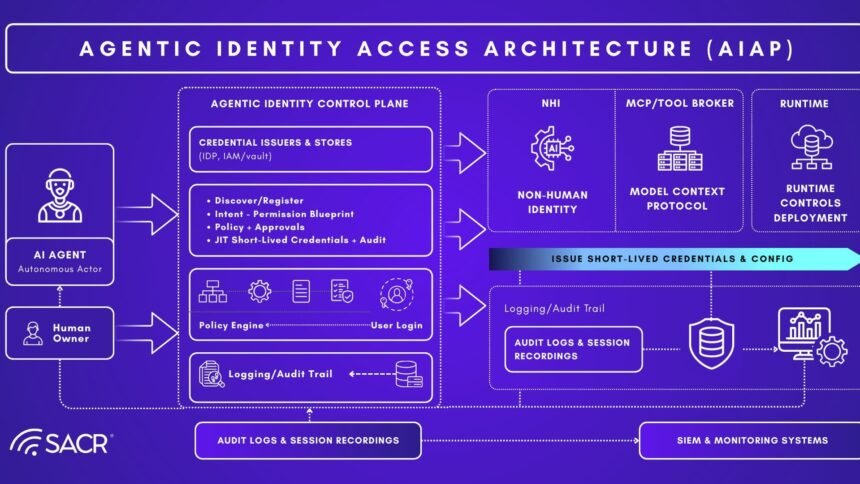
Each Agent Wallet enforces policy at the wallet layer: time-bound USDC spending limits, recipient allowlists, contract blocklists, and per-action caps on both transfers and x402 payments — all checked before a transaction is signed, plus sanctions screening before anything goes onchain. These are not suggestions to the model; they are enforced below the agent, where no clever prompt can renegotiate them.
Concretely, you can scope a wallet so that it may spend at most, say, $50/day, only to addresses on an allowlist, never to contracts on a blocklist, and only via approved x402 services. Time-bounding (daily, monthly) means a runaway loop hits a ceiling instead of burning your treasury. Because enforcement is at the wallet layer, the same guardrails hold whether the agent is well-behaved, buggy, or actively hijacked.
The compliance layer is what makes this enterprise-viable rather than a hobbyist toy: every transfer is screened against sanctions controls before submission onchain, blocking transactions involving sanctioned entities. For a regulated business letting software move money autonomously, ‘we screen before it touches the chain’ is the line a compliance team needs to hear.
Supported assets: USDC is primary for transfers, bridging, and x402, but Agent Wallets also handle EURC, other ERC-20 tokens, and native tokens like ETH and MATIC for gas and trading.
| Control | What it does | Where it’s enforced |
|---|---|---|
| Time-bound spend limits | Cap USDC outflow per day/month for transfers and x402 | Wallet layer, pre-signature |
| Recipient allowlists | Agent can only send to approved addresses | Wallet layer, pre-signature |
| Contract blocklists | Block interaction with disallowed contracts | Wallet layer, pre-signature |
| Sanctions screening | Block transfers involving sanctioned entities | Before onchain submission |
| 2-of-2 MPC custody | Agent never holds a signable key share | Key management layer |
How do AI agents pay with USDC using Circle Agent Stack?
The agent never signs raw transactions itself — it issues high-level commands through the Circle CLI, the policy engine validates them against your guardrails, the MPC parties co-sign approved transactions, and USDC settles onchain. For high-frequency micro-spend, Agent Nanopayments routes gasless, sub-cent USDC through Circle Gateway so an agent can pay per API call without per-transaction gas friction.
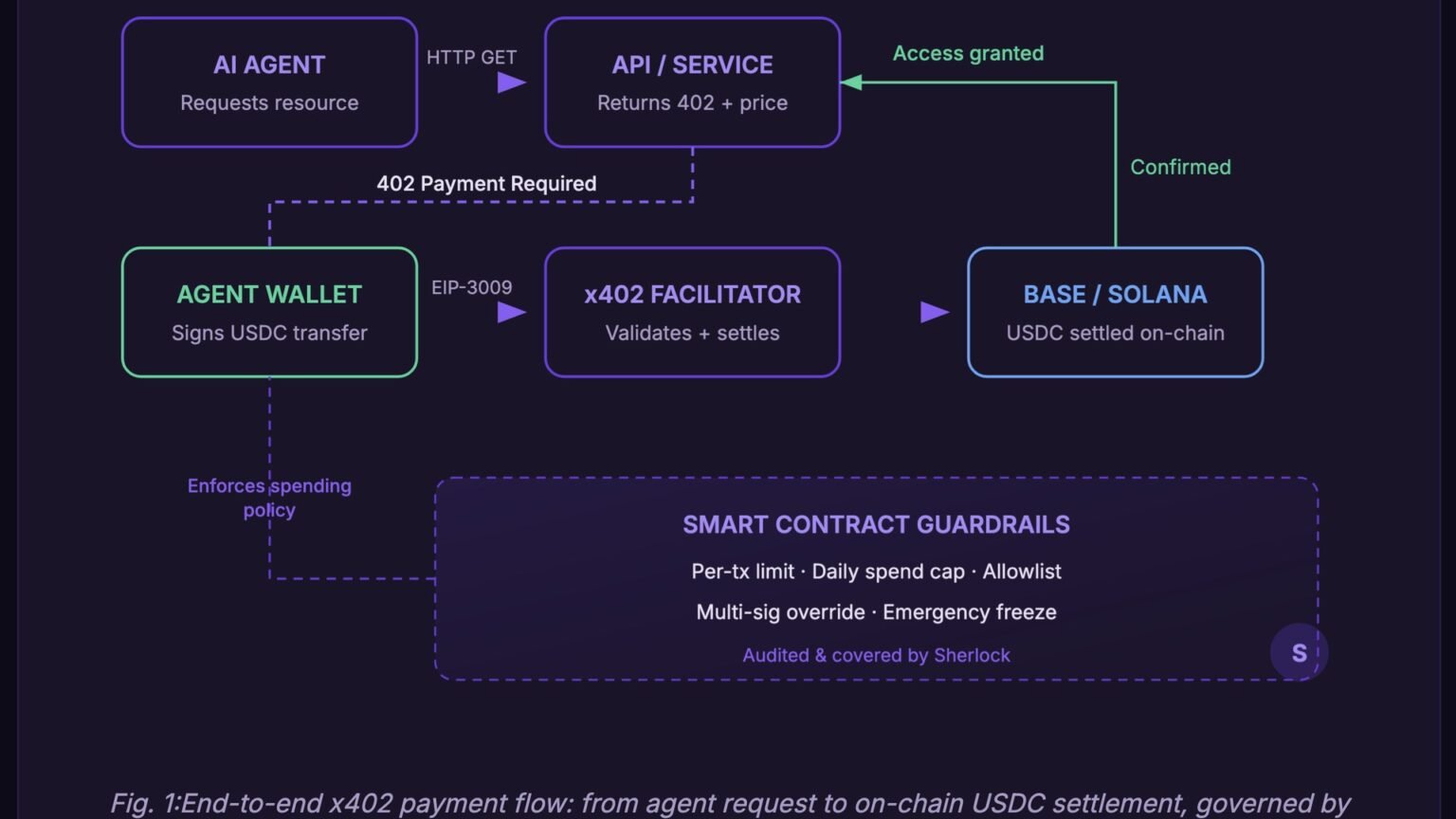
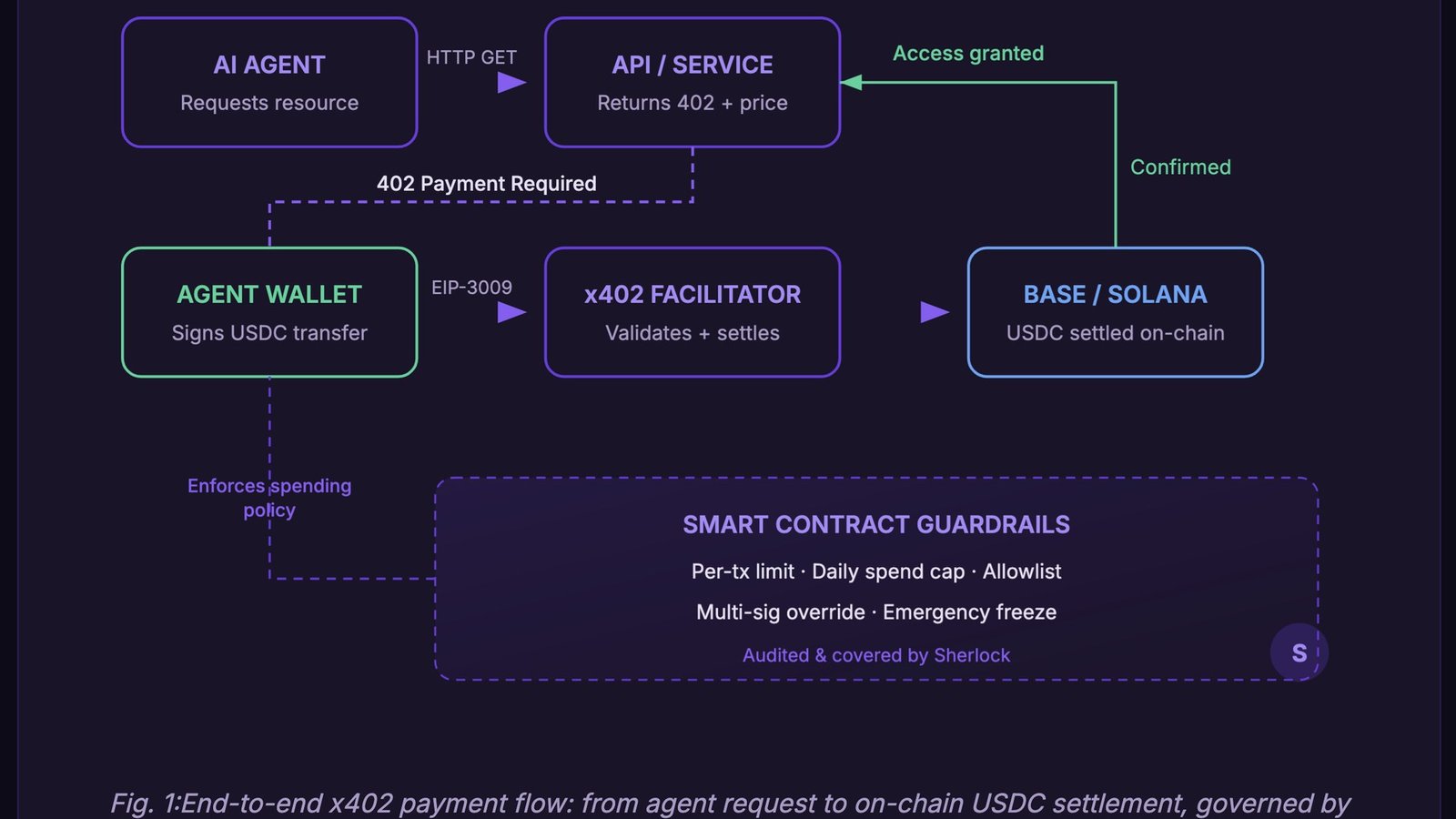
A typical machine-to-machine flow: your agent needs paid data from an x402-enabled service. It calls the service, gets back an HTTP 402 with the price, and instead of holding a key to sign the payment, it asks its Agent Wallet to pay. Circle checks the amount against the wallet’s x402 limit and allowlist, co-signs if it’s within policy, and the agent retries the request with proof of payment. The agent orchestrates; Circle custodies and enforces.
This is why Circle and x402 are best understood as complementary, not competing. x402 is the request/response handshake for ‘pay to access this resource.’ Circle is the funded, policy-controlled wallet doing the paying. Circle is a member of the x402 Foundation alongside Coinbase, Google, Visa, AWS, Anthropic, and others — the ecosystem is built to interoperate.
# Illustrative Circle CLI flow — an agent operating a policy-controlled USDC wallet
# 1) Create a wallet scoped to one agent
circle agent-wallet create \
  --name "research-agent" \
  --blockchain BASE

# 2) Attach guardrails (enforced at the wallet layer, not in the prompt)
circle agent-wallet policy set \
  --wallet research-agent \
  --daily-limit 50USDC \
  --x402-limit 5USDC \
  --allowlist 0xDataProvider,0xCompute \
  --blocklist 0xSketchyContract

# 3) The agent pays an x402 service; Circle validates + co-signs if within policy
circle agent-wallet pay \
  --wallet research-agent \
  --x402-url https://api.example.com/premium-dataset
Circle Agent Stack vs Coinbase x402 vs Stripe Agent Toolkit
Use Circle Agent Stack when you need a funded, policy-controlled USDC wallet with custody guarantees; use Coinbase x402 when you need the HTTP pay-per-call handshake; use the Stripe Agent Toolkit when agents are buying from human merchants with cards. They solve different layers, and the Circle Agent Stack vs x402 question is really a ‘which layer’ question, not an either/or.
x402 is a protocol, not a wallet — it standardizes how an agent gets a 402, signs a payment, and retries, settling primarily in USDC on Base in roughly 200ms. It doesn’t custody your funds or enforce your spend policy; it assumes the agent can pay. That’s exactly the gap Circle fills with MPC custody and wallet-layer guardrails. Pair them.
Stripe’s lane is different again: its Agentic Commerce Protocol (ACP, built with OpenAI and Meta) and Shared Payment Tokens let agents transact against a buyer’s saved card without exposing credentials, scoped to a seller and bounded by time and amount. That’s card-on-file retail checkout — fiat, human merchants, disputes, chargebacks. Circle is stablecoin, machine-to-machine, settlement-final. Pick by what your agent is buying and who it’s paying.
On protocol fit: Circle maps cleanly to both Google’s AP2 (whose cryptographically-signed Mandates pair naturally with policy-bound wallets) and to x402 for stablecoin settlement. Stripe anchors on ACP. None of these is wrong — they’re optimized for different commerce.
| Dimension | Circle Agent Stack | Coinbase x402 | Stripe Agent Toolkit |
|---|---|---|---|
| What it is | Policy-controlled USDC agent wallet | HTTP 402 payment protocol | Card/fiat agent commerce SDK + ACP |
| Custody model | 2-of-2 MPC, agent holds no key | N/A (protocol, not custody) | Card-on-file via Shared Payment Tokens |
| Asset | USDC primary; EURC, ERC-20, ETH/MATIC | USDC (primarily, on Base) | Fiat cards / Link wallet |
| Spend controls | Limits + allowlists + blocklists, pre-sign | Per-request price in the 402 | Tokens scoped by seller, time, amount |
| Compliance | Sanctions screening before onchain | Left to wallet/facilitator | Card-network rails (chargebacks, disputes) |
| Protocol fit | AP2 + x402 | x402 (it is the protocol) | ACP (OpenAI/Stripe/Meta) |
| Best for | M2M USDC with custody + policy | Pay-per-call API access | Agents buying from human merchants |
Is Circle Agent Stack safe, and when should you use it?
It is as safe as your wallet policy is strict — the MPC custody removes key-theft as a failure mode, but you still own the job of setting tight limits, allowlists, and blocklists, because a permissive policy is the new attack surface. The honest framing: Circle moves the risk from ‘agent steals the key’ (largely solved) to ‘agent does something dumb but technically within policy’ (your responsibility).
Use it when: your agents pay other agents or machines in USDC; you need autonomous spend with hard, non-promptable ceilings; you operate in a context where sanctions screening before settlement is non-negotiable; or you want stablecoin finality without card chargebacks. Skip it when your agent’s job is buying retail goods from human sellers — that’s card territory and Stripe’s ACP fits better.
The agentic-payments market context is why this category is heating up: Visa reported stablecoin settlement at roughly a $3.5B annualized run rate on Nov 30, 2025, rising to about $4.5B by mid-January 2026. AWS launched Bedrock AgentCore Payments with Coinbase and Stripe in the same window. Circle Agent Stack is a serious, custody-first entrant — but the smart build is layered: Circle for the funded wallet, x402 for the handshake, and the right protocol (AP2 or ACP) for the commerce shape you’re in.
Pros
Cons
How Circle Agent Stack fits the broader agentic-payments stack
Think in layers: intent (AP2 Mandates) sits on top, access/settlement handshake (x402) in the middle, and a funded, policy-bound wallet (Circle Agent Stack) underneath — with Stripe occupying a parallel fiat/card lane for human-merchant checkout. Almost no production agent stack will be single-vendor; the winners compose these.
A concrete composition: a user signs an AP2 Mandate authorizing an agent to spend up to $200/month on research data. The agent discovers a paid API, hits a 402 (x402), and pays from its Circle Agent Wallet, which enforces the $200 ceiling, the allowlist, and sanctions screening before co-signing. The Mandate proves intent, x402 carries the payment, Circle custodies and enforces. Each layer does one job well.
That layered reality is exactly what the launch-recap articles miss — they frame Circle as a competitor to x402 or Stripe when it’s mostly a complement to one and a clean alternative to the other depending on whether you’re paying machines or humans. Decide by your payee and your asset, not by the loudest launch headline.
Paying a machine in USDC? Circle wallet + x402, intent via AP2. Paying a human merchant with a card? Stripe ACP. Don’t force one tool to do the other’s job.
Builder’s take
I build agents that need to move money, so the question isn’t ‘is stablecoin agent payments cool’ — it’s ‘where does the custody boundary sit and who eats the loss when an agent goes rogue?’ Circle Agent Stack is the first mainstream answer where the agent literally cannot exfiltrate the key, and that changes the threat model in a way the hype posts skip.
- The headline feature is not USDC, it’s the 2-of-2 MPC split — the agent never holds a signable key, so a prompt-injected agent can leak its whole context and still not drain the wallet.
- Treat the wallet-layer policy (limits + allowlists + blocklists) as your real security perimeter, not the agent’s system prompt. Policies you can’t talk an LLM out of are the only ones worth trusting.
- Circle owns the asset and the rails; Coinbase x402 owns the request/response handshake. They are complements, not substitutes — most serious stacks will run both.
- If your agent buys from human merchants with cards, this is the wrong tool. Circle is for machine-to-machine USDC, not card-on-file retail checkout — that’s Stripe’s lane.
- The sanctions-screening-before-onchain step is the unsung enterprise unlock. It’s the difference between a demo and something a compliance team will actually sign off on.
Frequently asked questions
Circle Agent Stack is financial infrastructure, launched May 12, 2026, that gives AI agents permissionless, policy-controlled USDC wallets. Agents can hold, send, trade, and earn USDC autonomously within spending limits a human defines, and the agent never holds a signable private key thanks to 2-of-2 MPC custody.
The agent issues high-level commands through the Circle CLI rather than signing transactions directly. Circle’s policy engine validates the request against your spending limits and allowlists, the MPC parties co-sign if it’s within policy, and USDC settles onchain. Agent Nanopayments handle gasless, sub-cent payments for high-frequency machine-to-machine flows.
The 2-of-2 MPC model means key theft via prompt injection is effectively off the table — a compromised agent can’t reconstruct a key it never held. Safety then depends on how tightly you set wallet-layer controls (time-bound limits, allowlists, blocklists). All transfers are also sanctions-screened before going onchain.
They’re complementary, not competing. x402 is the HTTP handshake for pay-per-access (an agent gets a 402, signs a payment, retries). Circle Agent Stack is the funded, policy-controlled wallet that does the paying and custodies the funds. Most serious builds run both: x402 for the request, Circle for custody and spend enforcement.
You can set time-bound USDC spending limits (daily, monthly) for both transfers and x402 services, recipient allowlists, and contract blocklists. All of these are enforced at the wallet layer before a transaction is signed, so the agent’s prompt can’t override them.
Use Stripe’s Agent Toolkit and Agentic Commerce Protocol when agents buy from human merchants using cards or fiat — its Shared Payment Tokens let agents pay from a saved card scoped by seller, time, and amount. Use Circle when payments are machine-to-machine in USDC and you want MPC custody with hard spending controls and settlement finality.
Primary sources
- Introducing Circle Agent Stack: Financial Infrastructure for the Agentic Economy — Circle
- Agent Wallets — Circle Docs — Circle Developers
- Circle Launches Agent Stack to Put USDC at the Centre of Machine-to-Machine Payments — Blockhead
- Introducing x402: a new standard for internet-native payments — Coinbase
- Announcing Agent Payments Protocol (AP2) — Google Cloud
- Introducing our agentic commerce solutions — Stripe
- AWS taps Coinbase and Stripe to power USDC payments for AI agents — The Block
Last updated: June 6, 2026. Related: Commerce.