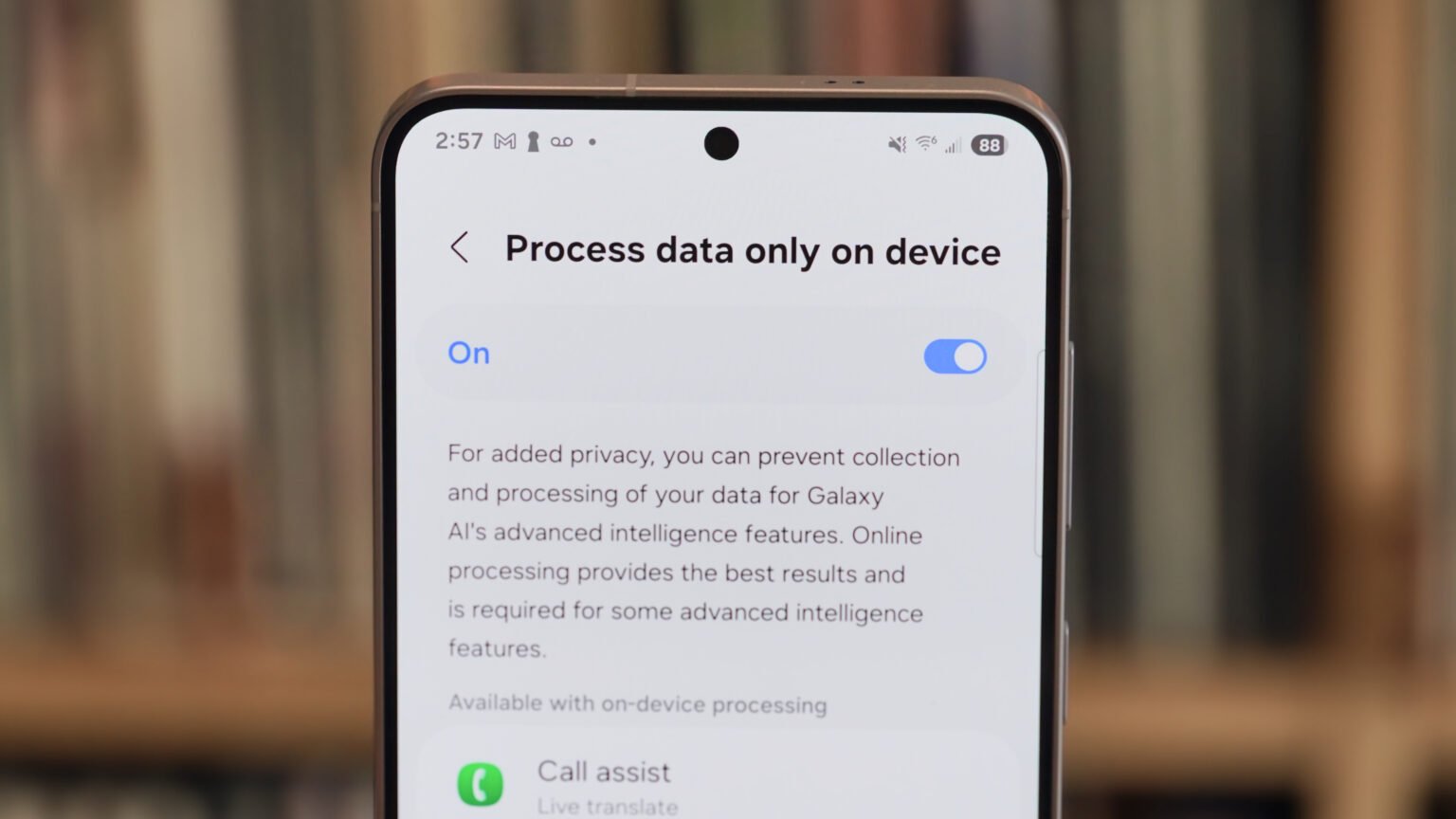

On-device AI agents are now a frontline platform battle. Apple, Google, and Samsung all argue that more intelligence should run locally on the phone, tablet, or laptop, but they define the category differently. Apple’s pitch centers on Apple Intelligence and privacy-preserving system integration, with optional ChatGPT access for harder requests. Google’s Pixel strategy combines Gemini Nano and Pixel AI features with first-party apps such as Recorder and Photos. Samsung’s Galaxy AI wraps translation, search, and writing tools into a broad Android hardware footprint. This is less a feature comparison than a contest over where consumer agent infrastructure lives.
The new fight is not AI on your phone. It is what stays there.
3
major mobile platforms pushing local AI
Apple Intelligence, Pixel AI/Gemini Nano, and Galaxy AI all market on-device capabilities
2
layers in Apple’s fallback path
Private Cloud Compute first for complex Apple Intelligence tasks, ChatGPT available with user permission
1
shared strategic goal
Make AI assistance feel native to the operating system rather than a standalone chatbot
The latest phase of the mobile AI race is about execution boundaries. Apple, Google, and Samsung all now present local inference as a core product principle, not a niche optimization. Their shared claim is straightforward: if more of the assistant stack runs on device, responses can be faster, more private, and available even when connectivity is weak. Their differences show up in what each company is willing to process locally, when each system reaches for the cloud, and how visible that handoff is to the user.
Apple’s current framing is the most explicit. On its Apple Intelligence page, the company says many models run entirely on device and that more complex requests can be sent to its Private Cloud Compute system. Apple also says users can access ChatGPT from Siri and Writing Tools, with permission asked before information is shared. That gives Apple a layered architecture: local first, Apple-managed cloud second, third-party frontier model only when the user approves.
Google’s Pixel story is more product-led than architecture-led. The Pixel 9 Pro product page highlights Gemini built in, while Google’s AI feature pages emphasize capabilities such as Recorder summaries, Magic Editor, and assistance across apps. Google has also documented Gemini Nano for on-device use in Android. The message is that Pixel is where Google can ship model-native experiences first, then widen them through Android and Gemini.
Samsung takes a third route. Galaxy AI is presented as a suite of practical features, including Live Translate, Note Assist, Interpreter, and Circle to Search with Google. Samsung’s consumer messaging is less about model topology and more about everyday utility across calls, messages, search, and productivity. That may sound less ambitious, but it is a strong distribution strategy: package AI as a device benefit, not a research milestone.
📌 Why this matters. For agent infrastructure, the important line is no longer local versus cloud in the abstract. It is task routing: which requests can be completed privately on device, which require retrieval or larger models, and how much friction the user sees when the system escalates.
Apple’s bet: trust, system access, and selective escalation
Apple entered the race later than Google in public AI branding, but it has a cleaner narrative. Apple Intelligence is built into iPhone, iPad, and Mac, and the company repeatedly anchors the pitch in personal context and privacy. The official product page says Apple Intelligence can help users write, express themselves, and get things done, while understanding personal context across apps and actions. That matters because agent behavior is only useful if the system can see enough of the user’s environment to act.
The strongest part of Apple’s position is architectural coherence. Apple controls the silicon, operating systems, and many of the core apps where assistant actions happen. It can expose AI features in Writing Tools, notifications, image generation, and Siri without forcing users into a separate destination. Its support documentation also details how ChatGPT integration works in Siri and Writing Tools, including the option to use ChatGPT without an account and controls over when data is sent.
That selective handoff is central to Apple’s argument. The company is not claiming every task should run locally. It is claiming the user should know when a request leaves the device and should not have to trust an opaque pipeline by default. Apple’s Private Cloud Compute security overview goes further, describing how the system is designed so independent experts can inspect the software running on Apple silicon servers. Few consumer AI launches have made verifiability such a visible part of the product story.
The limitation is also visible. Apple’s system still depends on external model access for some hard queries, and Siri’s broader overhaul has been a long-running expectation rather than a fully settled reality in the market. Apple has the best privacy narrative of the three, but privacy alone does not guarantee the best assistant. Users still judge these systems on whether they can actually complete multi-step tasks reliably.
Pros
Cons
📌 Apple’s edge. Apple has the clearest trust model: on-device processing where possible, Apple-run cloud for heavier private compute, and explicit permission before sending a request to ChatGPT.
“Apple Intelligence draws on personal context to give you intelligence that’s most helpful and relevant to you, while protecting your privacy at every step.”
Apple Intelligence
Google’s bet: ship the model, then turn Pixel into the showcase
Google’s advantage is obvious: it has spent years building both frontier models and consumer AI surfaces. On mobile, Pixel is the company’s fastest path from model capability to product. The Pixel line has become the reference device for Google’s AI-first UX, from call handling and transcription to image editing and Gemini assistance. The company’s Pixel 9 Pro page and broader Pixel marketing put Gemini at the center of the experience rather than treating AI as a hidden subsystem.
For on-device AI agents, Google’s most important move is Gemini Nano. Google documents Nano in Android developer materials as an on-device foundation model intended for low-latency, privacy-preserving use cases. That gives Google a credible local inference story beyond marketing copy. It also creates a path for Android developers to think about agentic features that do not require every interaction to hit a remote API.
Pixel’s best examples are narrow but tangible. Recorder summaries show how local or hybrid AI can compress long-form speech into useful notes. Magic Editor and related photo tools show Google’s strength in multimodal consumer workflows. Gemini integration across Android surfaces points toward a broader assistant layer that can reason over user intent and app context. Google is often strongest when the AI feature is embedded in an existing workflow rather than presented as a blank chat box.
The tradeoff is consistency. Google’s AI stack spans Android, Gemini apps, cloud services, and Pixel-exclusive features. That breadth creates velocity, but it can also make the product boundary feel less crisp than Apple’s. Users may not always know which features are on-device, which are cloud-backed, and which are limited to certain hardware generations. For developers and operators, Google looks like the most aggressive shipper. For consumers, the experience can still feel distributed across brands and layers.
Pros
Cons
📌 Google’s edge. Google has the shortest path from model research to consumer deployment. Pixel is where Gemini capabilities can become product features quickly, then influence the wider Android ecosystem.
| Platform | Positioning | Representative features | Main constraint |
|---|---|---|---|
| Apple Intelligence | Privacy-first system intelligence | Writing Tools, Siri, personal context, ChatGPT handoff | Some advanced tasks still require cloud or partner model access |
| Pixel AI / Gemini Nano | Model-led assistant and app features | Recorder summaries, Magic Editor, Gemini integration | Experience can feel fragmented across device and service layers |
| Galaxy AI | Utility-first device features | Live Translate, Interpreter, Note Assist, Circle to Search | Less differentiated model narrative than Apple or Google |
Samsung’s bet: make AI feel useful before it feels magical
Samsung’s Galaxy AI strategy is less about claiming the most advanced assistant and more about making AI visible in daily phone use. The company’s Galaxy AI page foregrounds features people can understand instantly: Live Translate for calls, Interpreter for in-person conversation, Note Assist for summarization and formatting, and Circle to Search through Google. This is a practical framing of on-device AI agents, even if Samsung does not always market it in agent language.
That matters because most consumers still adopt AI through narrow tasks, not open-ended autonomy. Translation, summarization, search, and writing help are easier to trust than a freeform assistant that might take actions across apps. Samsung’s packaging reflects that reality. It is turning AI into a layer of utilities attached to premium hardware, and that can be a powerful commercial move in a mature smartphone market.
Samsung also benefits from scale and channel presence. Galaxy AI is not confined to a single flagship narrative in the way Pixel often is. Samsung can spread AI branding across phones, foldables, tablets, and broader Galaxy marketing. For the market, that means Galaxy AI may shape user expectations even when Samsung is not seen as the primary model innovator.
The limitation is strategic distinctiveness. Many of Samsung’s headline AI experiences rely on partnerships or shared Android capabilities, including Circle to Search with Google. Samsung has done a strong job productizing AI, but it has less ownership over the underlying model story than Apple or Google. In infrastructure terms, Samsung is closer to an elite distributor than a full-stack AI platform.
Pros
Cons
⚠️ Samsung’s constraint. Galaxy AI is broad and commercially effective, but Samsung’s differentiation often comes from packaging and distribution rather than a uniquely owned model stack.
What this means for agent infrastructure in 2026
Bottom line: three different definitions of on-device AI agents
The deeper story is not about whose phone has the flashiest demo. It is about where consumer agent infrastructure is settling. All three companies are converging on the same architectural pattern: small or medium models on device for speed and privacy, larger models in the cloud for harder reasoning, and system-level integration to make the routing invisible. That is the consumer version of a broader agent stack already familiar in enterprise tooling.
This has implications beyond smartphones. If users get comfortable with local models handling personal context, notifications, writing, media, and communication, then laptops, wearables, cars, and home devices become natural extension points. Apple is best positioned to extend that pattern across tightly integrated hardware. Google is best positioned to spread it through Android and its cloud AI ecosystem. Samsung is best positioned to normalize AI as a standard expectation in premium consumer hardware.
There is also a capital-markets angle. The more useful on-device AI becomes, the more value shifts toward silicon optimization, operating-system hooks, and app-level orchestration rather than raw model access alone. That does not reduce the importance of frontier labs. It changes where the moat sits in consumer distribution. Readers tracking the model layer should also see our analysis of Anthropic vs OpenAI in 2026, because the mobile platform battle increasingly depends on how those model ecosystems are packaged and routed.
The near-term winner may not be the company with the smartest model. It may be the one that makes escalation feel seamless: local when possible, cloud when necessary, partner model only when it adds clear value. In that sense, on-device AI agents are becoming less about autonomy and more about orchestration. Apple, Google, and Samsung are all building that future. They are just starting from different control points.
“The key product question is no longer whether AI runs on device. It is whether the system can decide, quietly and correctly, when it should not.”
Alatirok analysis
Frequently asked questions
On-device AI agents are assistant features that run some model inference locally on a phone, tablet, or computer instead of sending every request to a remote server. Apple describes many Apple Intelligence models as running on device, with more complex requests handled by Private Cloud Compute. Google documents Gemini Nano as an on-device foundation model for Android use cases.
No. Apple says Apple Intelligence uses on-device processing for many tasks and can use Apple’s own cloud system for more complex requests. ChatGPT is available for certain requests through Siri and Writing Tools, and Apple says it asks permission before sharing information. See Apple’s Apple Intelligence overview and support documentation for ChatGPT integration.
Samsung markets Galaxy AI as a mix of AI-powered features across communication, productivity, and search, including Live Translate, Interpreter, and Note Assist. Samsung’s consumer pages do not present every feature as purely local, so the safest reading is that Galaxy AI includes both on-device and cloud-assisted experiences depending on the task and device.
Running inference locally can reduce round-trip delays and limit how much personal data needs to leave the device. Apple makes this a central part of its pitch for Apple Intelligence, while Google positions Gemini Nano for low-latency, privacy-preserving Android experiences.
Primary sources
- Apple Intelligence — Apple
- Apple Support: Use ChatGPT with Apple Intelligence — Apple
- Apple Security Blog: Private Cloud Compute — Apple
- OpenAI and Apple announce partnership — OpenAI
- Google Store: Pixel 9 Pro — Google
- Android Developers: Gemini Nano — Google
- Samsung Galaxy AI — Samsung
Last updated: May 20, 2026. Related: Agent Infrastructure.