
I spent time reviewing how AI for HR 2026 is actually showing up across vendor product lines, not in keynote slides. The pattern is clearer than the hype: HR AI splits into three buckets — talent matching, candidate experience, and system-of-record automation — with real traction in six workflows and clear legal limits around decision-making.
I looked for where HR AI is real, repetitive, and already inside the stack
6
workflows where adoption is most concrete
Sourcing, screening, scheduling, mobility, feedback, onboarding
2023
year NYC Local Law 144 took effect
Bias-audit and notice rules for automated employment decision tools
High-risk
EU AI Act category for employment-related AI uses
Employment, worker management, and access to self-employment are covered
Best overall: Eightfold
For this review, I did not treat HR AI as one market. I looked at the product surfaces from Eightfold, HireVue, Paradox, Workday AI, Greenhouse AI, BambooHR, and Gloat to answer a narrower question: where does AI already fit into repeatable HR work without pretending to replace the accountable human?
My conclusion is that AI for HR 2026 lands in six workflows that are structured, high-volume, and easy to instrument: sourcing, screening, scheduling, internal mobility, performance-feedback drafting, and onboarding. Those workflows also map neatly to three product categories. Talent matching is where Eightfold and Gloat sit. Candidate experience is where HireVue and Paradox are strongest. System-embedded automation is where Workday, Greenhouse, and BambooHR have the clearest advantage because they already live in the system of record or the ATS.
That framing matters because the best HR AI products are not trying to own every step. They are trying to remove the repetitive work around the decision, not the decision itself. In practice, that means ranking, summarizing, drafting, matching, and coordinating. It does not mean legally safe autonomous hiring.
Eightfold ⭐ Editor’s Pick
Best for: Large employers that need talent matching across external candidates and internal employees
What works
Watch out for
Paradox
Best for: High-volume recruiting teams that need faster candidate response and interview coordination
What works
Watch out for
HireVue
Best for: Enterprises standardizing structured interviews and assessments at scale
What works
Watch out for
Workday AI
Best for: Organizations already standardized on Workday for HCM workflows
What works
Watch out for

This review is based on official product pages, public compliance materials, and vendor positioning for the workflows each company explicitly claims to support.
The six workflows where AI actually lands
The easiest way to understand AI for HR 2026 is to ignore broad claims and follow the workflow. In sourcing, the useful products search existing talent pools, infer adjacent skills, and surface likely matches. Eightfold and Greenhouse both position AI around finding and ranking candidates more efficiently, though they approach the problem from different places: Eightfold from talent intelligence, Greenhouse from inside the ATS.
In screening, the products narrow the field before a recruiter or hiring manager spends live time. HireVue does this through structured video interviewing and assessments. Paradox does it through conversational screening over chat and messaging. Greenhouse also frames AI around screening and ranking inside the recruiting workflow. These are all forms of triage, not final selection.
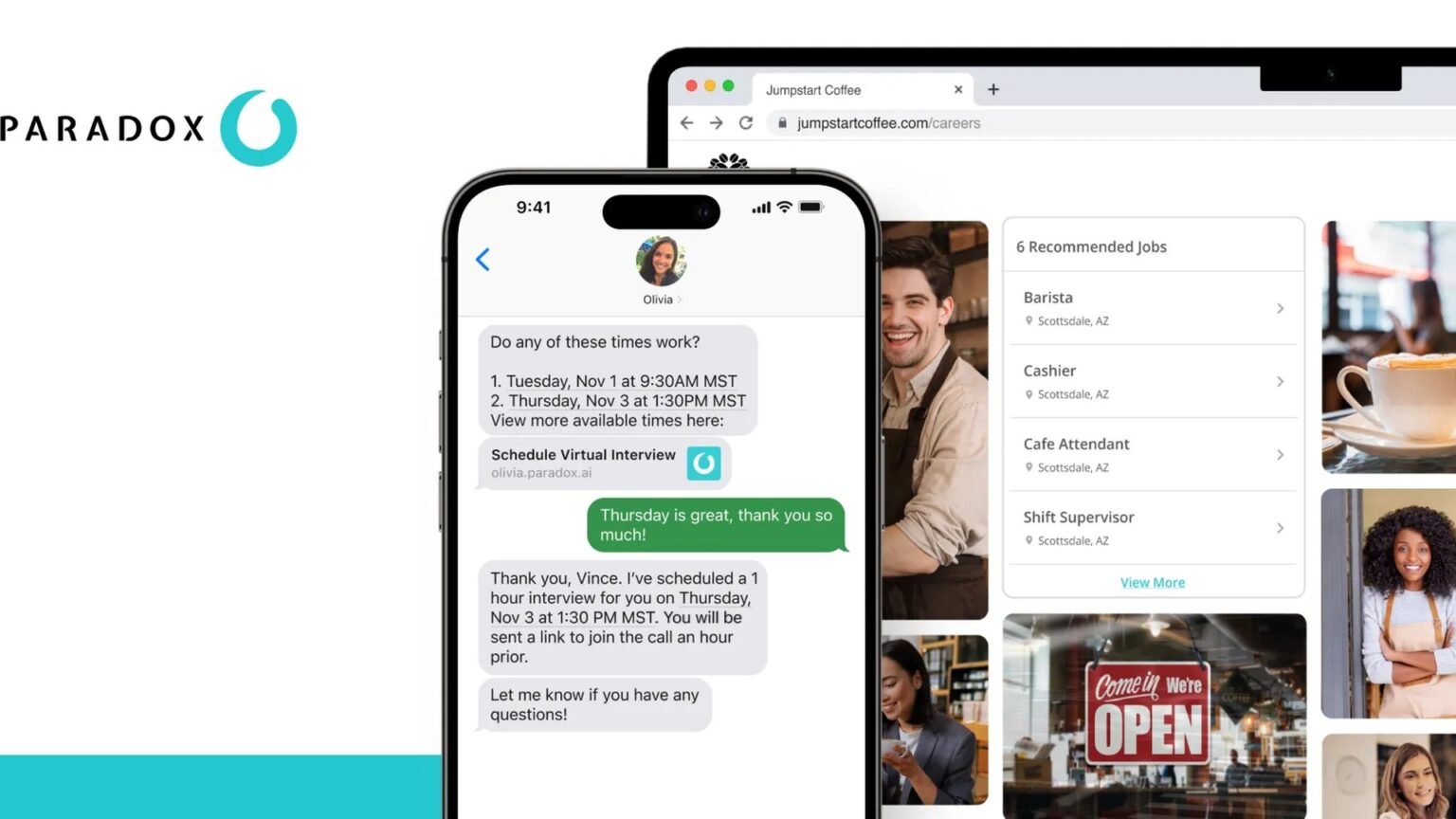
Scheduling is the least glamorous workflow and maybe the most obviously automatable. Paradox stands out here because candidate communication over SMS and WhatsApp is not a side feature; it is the product. If a team hires at volume, reducing back-and-forth on interview coordination is often a cleaner win than trying to automate judgment.
Internal mobility is where the market gets more interesting. Eightfold and Gloat both make the case that the same matching logic used for external candidates can be applied to current employees, open roles, projects, and skills adjacency. This is one of the strongest use cases in AI for HR 2026 because the data is already inside the company and the business case is broader than recruiting alone.
Performance feedback and onboarding sit closer to the HR suite than to recruiting tech. Workday’s AI positioning is broad, and its March 2026 launch of role-based AI agents under the AI Workforce branding pushes directly into HR workflows such as drafting, summarizing, and assisting inside the platform. BambooHR’s value is simpler: workflow automation and content support around onboarding rather than a grand theory of autonomous HR.
| Workflow | Where AI helps | Vendors most associated |
|---|---|---|
| Sourcing | Search, match, rank candidates | Eightfold, Greenhouse |
| Screening | Pre-qualify before live interview | HireVue, Paradox, Greenhouse |
| Scheduling | Coordinate interviews via chat | Paradox |
| Internal mobility | Match employees to roles or projects | Eightfold, Gloat |
| Performance feedback | Summarize and draft review inputs | Workday |
| Onboarding | Automate tasks and generate content | BambooHR, Workday |
Eightfold is the clearest deep-dive because matching is where the ROI is easiest to see
If I were buying one category in this market first, I would start with matching. That is why Eightfold comes out ahead in this review. Its pitch is not vague assistant language. It is talent intelligence: matching people to roles, surfacing adjacent skills, and extending that logic to internal mobility. That is a more durable wedge than generic copilots because it ties directly to open reqs, candidate databases, and workforce planning.
What I like about Eightfold’s positioning is that it treats external recruiting and internal mobility as connected problems. A company that can identify likely internal candidates for a role may reduce time-to-fill, improve retention, and avoid unnecessary external searches. That is a stronger story than simply generating recruiter copy. For large enterprises, this is where AI for HR 2026 looks most mature.
The trade-off is that a matching platform is only as useful as the surrounding process. If job architecture is messy, skills data is incomplete, or recruiters do not trust the recommendations, the product can become another layer of software instead of a decision-support system. Eightfold also reads as enterprise-first. That is not a flaw, but it does narrow the ideal buyer profile.
Pros
Cons
Internal mobility is one of the few HR AI use cases where the same model logic can improve recruiting, retention, and workforce planning.
“The Talent Intelligence Platform helps organizations retain top performers, upskill and reskill the workforce, recruit top talent efficiently, and reach diversity goals.”
Eightfold homepage
HireVue and Paradox win when candidate experience is the bottleneck
HireVue and Paradox solve different parts of the same pain point: too many candidates, too little recruiter time, and too much coordination overhead. HireVue is built around structured video interviews and assessments. Paradox is built around conversational engagement, screening, and scheduling. If Eightfold is about finding the right people, these two are about moving people through the funnel without drowning the recruiting team.
Paradox feels easier to defend because scheduling is such a visible operational drag. A chat-first assistant that can screen basic fit and book interviews over SMS or WhatsApp is not trying to replace judgment. It is trying to eliminate dead time. For hourly, frontline, or high-volume hiring, that is a very practical value proposition.
HireVue is more complicated. The company has spent years under scrutiny over AI in hiring, and it stopped using facial analysis in 2021. Today the product emphasis is on language-based analysis, structured interviews, and assessments. That makes it more governable than the earlier public narrative around interview AI, but it still sits in one of the most heavily scrutinized parts of AI for HR 2026: pre-employment evaluation. Any buyer here needs validation, documentation, and legal review, not just a demo.
The closer a tool gets to evaluating candidates before a human interview, the more compliance, validation, and auditability matter.
“HireVue does not use facial analysis and does not infer emotions from video interviews.”
HireVue product and company materials
Workday, Greenhouse, and BambooHR have the distribution advantage
The third bucket is the most strategically important even if it is less flashy: AI embedded inside the system teams already use. Workday’s AI platform and 2026 AI agent push matter because HR teams do not want to swivel between five copilots. If summarization, drafting, workflow assistance, and role-based automation are already inside HCM, adoption friction drops.
Greenhouse has a similar advantage inside recruiting. AI-assisted sourcing, screening, and ranking are easier to operationalize when they live in the ATS rather than in a separate layer. BambooHR is not making the same sweeping AI claim as Workday, but onboarding is exactly the kind of workflow where automation and content generation can remove repetitive admin work without creating the same level of regulatory risk as candidate scoring.
This is the part of AI for HR 2026 I expect to expand fastest: not standalone magic, but embedded assistance in the systems of record. The reason is simple. The data, permissions, workflows, and user habits are already there.
“Workday Illuminate is the next generation of Workday AI that transforms business by elevating humans, accelerating finance, and managing an entire fleet of AI agents.”
Workday AI platform page
The regulatory line is the real product differentiator
Compliance is part of the product
The reason HR AI cannot be reviewed like a normal productivity category is that employment decisions are regulated. New York City’s Local Law 144 requires bias audits and notice obligations for automated employment decision tools used in hiring and promotion. The EU AI Act classifies AI systems used in employment, worker management, and access to self-employment as high-risk. The EEOC has also made clear that existing anti-discrimination law applies when employers use algorithmic tools.
That means the best products are not just the ones with the slickest AI layer. They are the ones that can explain what the model is doing, what data it uses, how outcomes are validated, and where the human reviewer remains accountable. In hiring, the legal and operational question is not whether a model can rank candidates. It is whether the employer can defend the process.
This is also why vendor-side exposure matters. Software vendors are increasingly part of the conversation when regulators and plaintiffs examine how automated tools shape employment outcomes. For buyers, governance is not a procurement appendix. It is part of product fit.
“Employers are responsible for their use of software, algorithms, and artificial intelligence in employment selection procedures and other employment decisions.”
U.S. EEOC guidance
What should an NYC Local Law 144 compliance checklist include?
At minimum: confirm whether the tool qualifies as an automated employment decision tool, obtain or review an independent bias audit, publish the required summary information, provide notice to candidates or employees, and document the data retention and accommodation process. The city maintains the official rulemaking and compliance materials at nyc.gov.
What do bias audits for hiring tools actually measure?
Under NYC’s framework, a bias audit examines selection or scoring outcomes across categories such as sex, race, and ethnicity and reports impact ratios. That is not the same thing as proving a tool is universally fair. It is a structured statistical check tied to the law’s disclosure requirements. Buyers still need validation, monitoring, and legal review.
What AI still has not replaced, and would I keep paying for this?
The hard boundary is still intact. AI has not replaced hiring decision sign-off. It has not replaced compensation and leveling decisions. It has not replaced calibration in performance management. And it should not be treated as a substitute for accountable human review in any workflow that falls into high-risk employment decision-making.
That is the final lesson of AI for HR 2026. The category works best when it handles search, summarization, coordination, drafting, and matching around the human decision. It works worst when vendors imply the model itself can absorb legal accountability.
Would I keep paying for this? Yes, but only selectively. I would pay for Eightfold if I had enough hiring volume and internal talent complexity to justify a real matching layer. I would pay for Paradox if interview scheduling and candidate response times were killing recruiter productivity. I would pay for Workday AI if I was already deep in Workday and wanted embedded assistance rather than another standalone tool. I would be most cautious with any product that materially influences candidate screening without strong validation and governance. In other words: I would keep paying for HR AI that removes friction, not HR AI that asks me to outsource judgment.
Automation helps; accountability stays humanFrequently asked questions
Employers should not assume that. In the U.S., the EEOC says existing anti-discrimination law applies to AI tools, and in New York City Local Law 144 imposes bias-audit and notice requirements for covered hiring tools.
Because they sit inside systems teams already use. Workday AI, Greenhouse AI, and BambooHR all benefit from existing workflow, permissions, and data context.
Primary sources
- Eightfold — Eightfold
- HireVue — HireVue
- Paradox — Paradox
- Workday AI Platform — Workday
- Greenhouse AI — Greenhouse
- BambooHR — BambooHR
- Gloat — Gloat
- NYC Automated Employment Decision Tools — NYC Department of Consumer and Worker Protection
- EU AI Act overview — EU AI Act
- EEOC AI and Algorithmic Fairness Initiative — U.S. Equal Employment Opportunity Commission
Last updated: May 26, 2026. Related: Products.