
A quantified, region-by-region map of where election deepfakes land, how they spread across platforms, and what the numbers mean for the November 2026 US midterms.
What the election deepfakes 2026 data actually shows
38
Countries hit by election deepfakes since 2021
Combined population 3.8 billion (Surfshark)
33 of 87
Countries with elections since 2023 that saw deepfakes
More than one in three
92%
Share of election deepfake incidents that touched social media
The dominant distribution layer
78%
North America’s population living in an affected country
Highest of any region
The election deepfakes 2026 data shows that 38 countries with a combined population of 3.8 billion people have already faced an election-related deepfake incident since 2021, and that exposure is heavily concentrated by region — 78% of North America’s population lives in a country that has been hit, versus just 12% in Oceania. Those are the headline figures from Surfshark Research, which tracked deepfake incidents in countries with populations over one million and cross-checked each against media reporting.
The same dataset reframes the question from “will deepfakes appear” to “how many already have.” Of the 87 countries that held elections from 2023 onward, 33 experienced at least one documented deepfake incident. That is more than one in three national elections touched by synthetic media — and the figure only counts incidents that surfaced publicly and got reported. The true denominator is almost certainly higher.
What makes the 2026 US midterms different is not novelty but maturation. The earliest election deepfakes were curiosities: clumsy face-swaps, obviously synthetic robocalls. By March 2026, the National Republican Senatorial Committee had published an ad featuring an AI-generated James Talarico speaking to camera, realistically, for more than a minute — what CNN called the first political deepfake of a candidate talking lifelike for that long. The technology stopped being the story. The distribution is now the story.
This article maps two things the data lets us quantify with confidence: where election deepfakes land, measured by population exposure across six regions, and how they spread, measured by the channels and platforms that carry them. Both come from real incident counts, not projections.
Where election deepfakes land: the regional exposure map
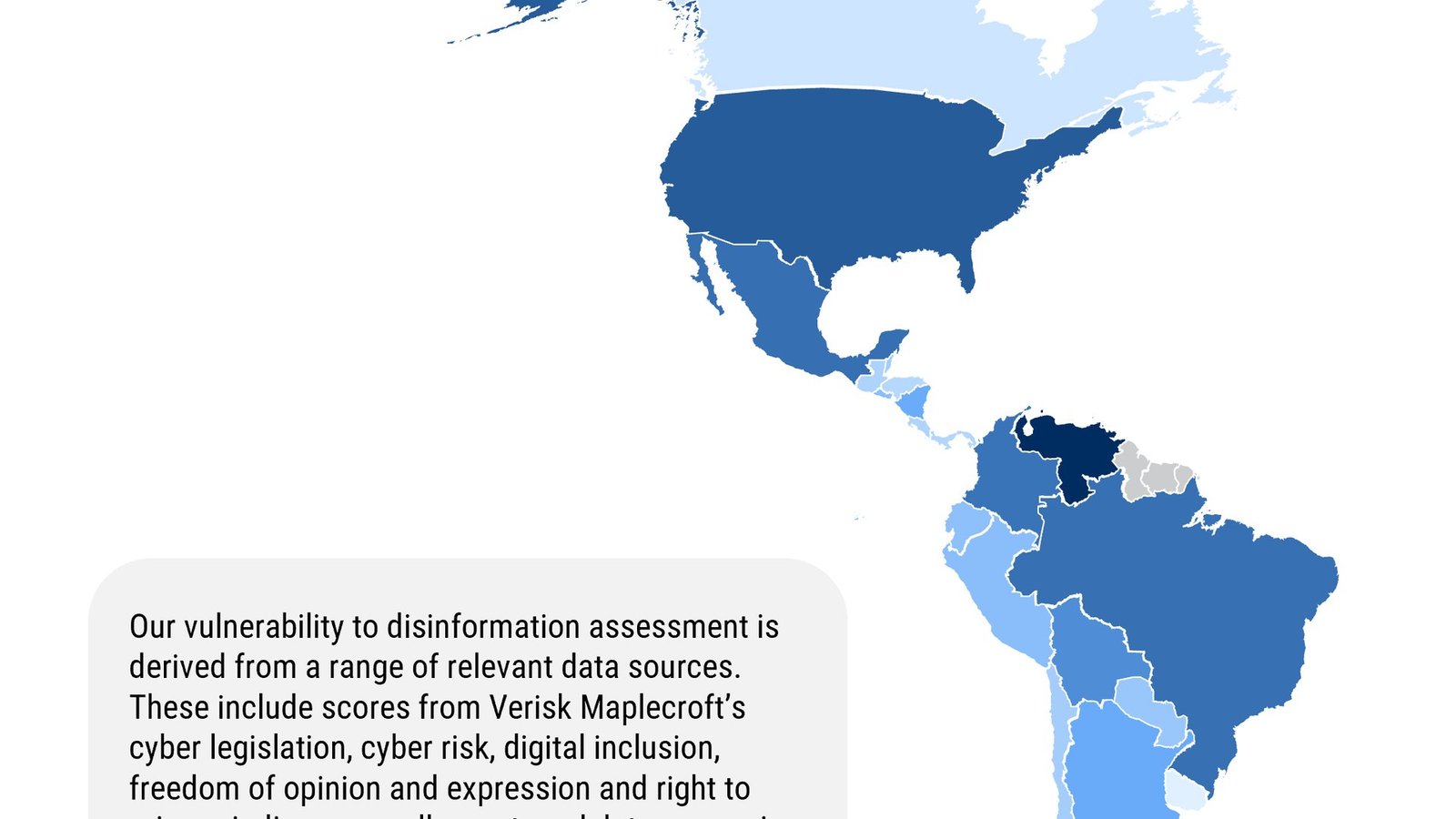
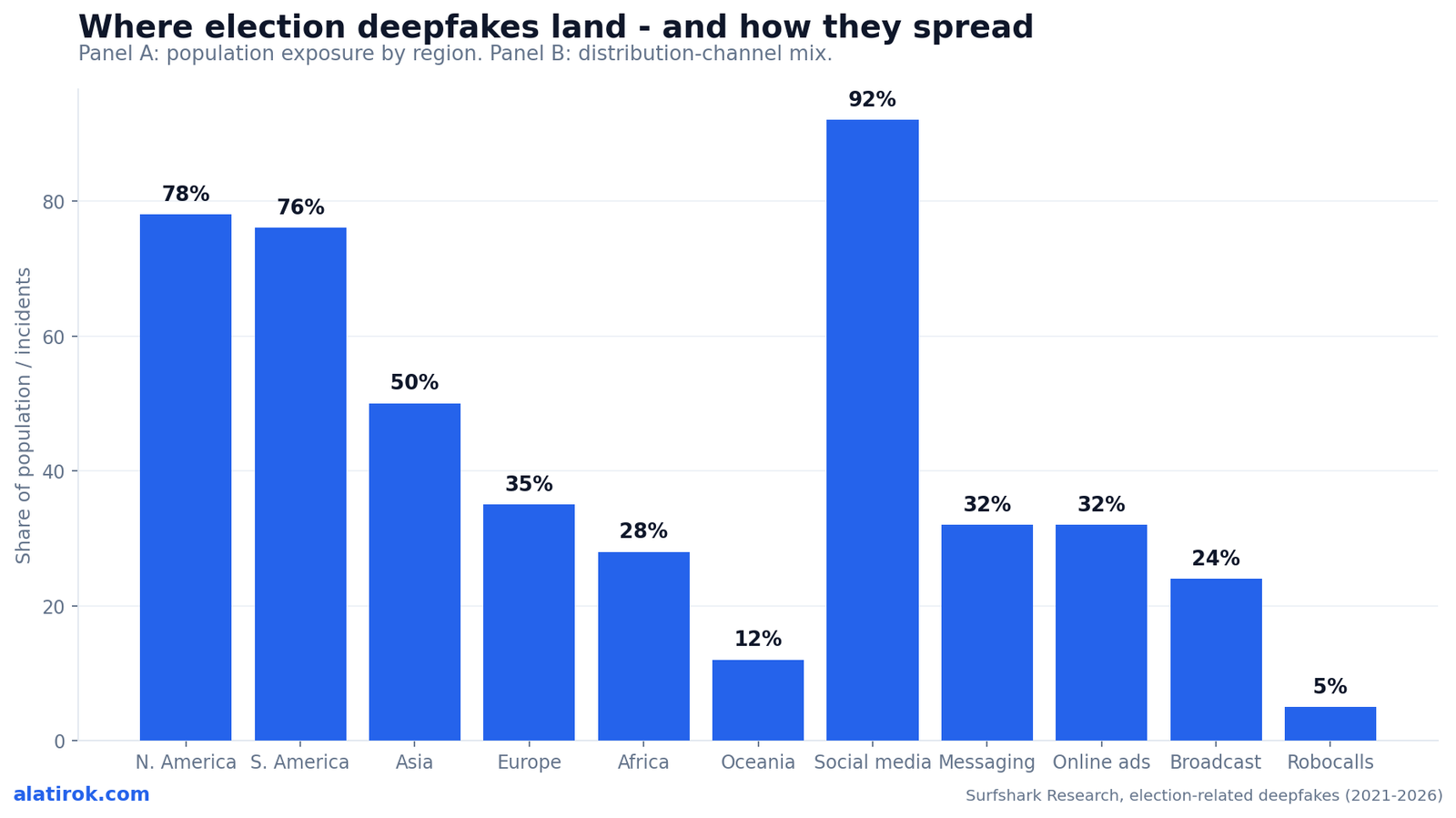
Population exposure to election deepfakes is wildly uneven by region: North America 78%, South America 76%, Asia 50%, Europe 35%, Africa 28%, and Oceania 12%. The two Americas sit in a class of their own, with roughly three in four people living in a country that has experienced a documented incident. This is the single most important pattern in the election deepfakes 2026 data, because it tells defenders where to concentrate.
The gap between population exposure and the share of countries affected is the subtle part. By country count, South America (40%), Oceania (33%), and Europe (31%) rank highest, while North America’s country-level figure is only 13%. The reason exposure flips for North America is population concentration: a small number of very large countries — chiefly the United States — drag the population-weighted number to 78%. One big election in a high-population, high-connectivity country exposes hundreds of millions of people at once.
That dynamic matters enormously for the midterms. The US is not just another country on the list; it is the country whose media environment is dense enough that a single fabricated clip can reach a national audience before any correction circulates. Exposure is a function of how much real content is flowing, because a fake hides best inside a flood of genuine political video. The US in an election year is precisely that flood.
Europe’s 35% and Africa’s 28% should not be read as safety. Recorded Future’s Insikt Group documented 82 pieces of AI deepfake content targeting public figures across 38 countries in a single year (July 2023 to July 2024), with 30 of those nations either holding elections in the window or planning them — and the content was disproportionately election-focused. Lower regional exposure often reflects lower detection and reporting capacity, not lower activity.
How they spread: channels, platforms, and the 92% problem
Election deepfakes spread overwhelmingly through social media, which appears in 92% of incidents, followed by messaging apps and online targeted ads at 32% each, traditional broadcast media at 24%, and robocalls at just 5%. Because a single incident usually travels on more than one channel, these shares add to well over 100% — and that overlap is the whole threat model. The same clip is rarely confined to one surface.
At the platform level, the concentration is stark. X carries 53% of incidents, Facebook 39%, WhatsApp 29%, Instagram 18%, YouTube 16%, and Telegram 8%. The top three account for the bulk of distribution, and they span three different moderation regimes: an open broadcast network (X), a closed social graph (Facebook), and an encrypted messaging system (WhatsApp) where no platform-side detection is possible at all.
The robocall figure — 5% — is easy to underrate. The infamous fake Biden primary robocall in New Hampshire was a single incident, but it triggered the first FCC ruling that AI-generated voice in robocalls is illegal. Low frequency does not mean low impact; a robocall reaches the one voter segment least equipped to verify and arrives through the channel they trust most.
For the 2026 midterms, the 92% social figure collides with a specific weakness: detection and correction live inside individual platforms, but content does not. By the time X flags a clip, it has been screenshotted to Facebook, forwarded on WhatsApp, and clipped into a YouTube short. The Talarico ad demonstrated the playbook — produced once, then seeded across paid and organic surfaces simultaneously.
A single deepfake incident is counted once but can appear on social media, in a paid ad, and via broadcast simultaneously. The overlap is the point: defenders who fix one channel have not slowed the asset. Provenance signals that travel with the file — not platform-level takedowns — are the only intervention that survives a jump between surfaces.
| Channel / Platform | Share of incidents | Defender’s hardest problem |
|---|---|---|
| Social media (all) | 92% | Cross-platform spread outpaces any single moderation queue |
| Messaging apps | 32% | WhatsApp/Telegram encryption blocks platform-side detection |
| Online targeted ads | 32% | Microtargeting means few people see the same fake |
| Broadcast / traditional | 24% | Legitimizes the fake via trusted news framing |
| Robocalls | 5% | Reaches least-verifiable voters on a high-trust channel |
| X (platform) | 53% | Open virality, weakened trust-and-safety capacity |
| Facebook (platform) | 39% | Closed graph hides spread from outside researchers |
| WhatsApp (platform) | 29% | End-to-end encryption; no content scanning |
The 2026 US midterms: from robocall era to candidate-grade fakes
The 2026 US midterms are the first American election where professionally produced, candidate-grade deepfakes are being deployed by national party committees with full budgets — a qualitative jump from the amateur fakes of 2024. The OECD.AI Incidents Monitor logged the shift on March 28, 2026, classifying AI-generated deepfake videos used to mislead voters as a realized, ongoing harm violating transparency and democratic-autonomy principles.
The defining example: the NRSC’s ad putting words into an AI-generated James Talarico, the Democratic US Senate nominee in Texas. The fabricated Talarico read excerpts of his own past social-media posts to camera for over a minute. A small “AI GENERATED” label appeared for about three seconds early in the ad, then shrank to fainter text in the corner for the remainder — technically disclosed, practically invisible. CNN noted it was the first political deepfake in which a candidate appeared to speak realistically for that long.
This is the inflection the earlier data anticipated. Surfshark’s broader incident tracking shows total deepfake incidents climbing from 42 in 2023 to 150 in 2024, with 179 logged in Q1 2025 alone — already above the entire prior year. Election-related incidents are a persistent slice: in one twelve-month window, 27 of 121 logged AI incidents concerned elections, more than a fifth. The curve was always pointing here.
The strategic concern for November is not a single viral fake. It is the “liar’s dividend” — once voters know convincing fakes exist, real footage becomes deniable too. A candidate caught on genuine video can now plausibly cry deepfake. The 78% North American exposure figure means most US voters are already primed to distrust what they see, which corrodes the evidentiary value of all political video, fake or not.
“Once voters know convincing fakes exist, every real clip becomes deniable. The damage is not one fabricated video — it is the erosion of video itself as evidence.”
On the liar’s dividend in the 2026 midterms
The legal map: a 30-state patchwork and a federal void
Heading into the 2026 midterms, 30 US states have laws regulating election deepfakes — Maryland became the 30th on May 13, 2026 — but there is no federal law governing AI in political advertising, leaving a patchwork that synthetic content routes around easily. Most state laws require disclosure rather than imposing bans, which is exactly the standard the barely-visible Talarico label was designed to satisfy.
The patchwork is a routing problem more than a coverage gap. An ad that violates a disclosure rule in one state is legal in another, and the content itself lives on servers tied to neither. Public Citizen, which tracks the legislation, notes that progress has been bipartisan but that 20 states still have no protections — and that federal AI-preemption efforts could nullify the state laws that do exist without putting anything in their place.
The constitutional terrain is unsettled. A California deepfake-ad law was struck down by a federal judge as overly broad and content-discriminatory, foreshadowing First Amendment challenges to any rule that restricts political speech. The federal TAKE IT DOWN Act, with platform-compliance obligations live as of May 19, 2026, addresses non-consensual intimate deepfakes — a real harm, but not political misinformation. The political-ad gap remains wide open.
This is where provenance technology stops being optional. With no reliable legal backstop before November, the burden of proving authenticity falls on content itself. Cryptographic signing standards like C2PA and watermarking like SynthID let honest media carry a verifiable origin signal — a defense that works even on WhatsApp, where no moderator can intervene, and across the 30-state legal map where the rules disagree.
Pros
Cons
Treat unexpected candidate video as unverified by default. Check for a C2PA “content credentials” signal, look for the original source rather than the reshared clip, and be most skeptical of content that arrives via messaging apps or robocalls — the two channels where no platform can flag a fake for you.
Reading the map: what the numbers tell defenders
The combined data tells defenders to invest where exposure and spread overlap: high-population, high-connectivity regions (North and South America at 76-78%) and the social-plus-messaging channel stack that carries over 90% of incidents. Spending detection budget on broadcast (24%) or robocalls (5%) optimizes for the smallest surfaces while the real volume moves through X, Facebook, and WhatsApp.
Three numbers should anchor any 2026 strategy. First, 92% — social media is not one channel among five, it is effectively the channel, and any plan that does not start there is mis-scoped. Second, 78% — the North American population exposure figure means US defenders are protecting the largest single bloc of already-exposed voters in the dataset. Third, 29% — WhatsApp’s platform share, the portion of spread that is structurally invisible to content moderation and can only be addressed by provenance signals that ride inside the file.
The honest conclusion is that detection-after-the-fact has already lost the speed race. Production cost for a candidate-grade fake is now near zero, distribution is instantaneous and multi-channel, and the legal backstop is a 30-state patchwork with a federal hole in the middle. The only interventions that scale to the problem are ones that attach to the content itself: cryptographic provenance, watermarking, and platform-independent verification that survives the jump from X to WhatsApp.
For November 2026, the realistic goal is not to stop election deepfakes from being made — that ship sailed. It is to keep the cost of believing a fake higher than the cost of verifying it. That means making authentic content easy to prove, making the act of checking provenance a normal voter behavior, and treating the 38-country map not as a forecast but as a baseline that the midterms will extend.
Builder’s take
I build AI systems that scrape, synthesize, and publish at machine speed, so I read this data as an operator, not a spectator. The election deepfakes 2026 data is not a warning about some future capability. It is a map of an attack surface that is already saturated.
- The 92% social-media figure is the whole game. Detection that lives inside one platform is theater; the same clip is on X, WhatsApp, and a robocall within hours. Provenance has to ride with the asset, not the platform.
- North America at 78% population exposure is not because the US is uniquely targeted. It is because the US has the densest media graph on Earth. Volume of true content is exactly what makes a single fake travel.
- I have watched my own pipelines surface a plausible-looking quote in seconds. The cost of producing the NRSC-grade Talarico clip is now a rounding error. Defenders should assume production cost is zero and budget entirely for distribution-side response.
- The 30-state legal patchwork is a routing problem, not a coverage problem. An ad illegal in California is legal in Texas and lives on a server in neither. Build for the worst jurisdiction, because that is where the content originates.
- If you ship anything that generates synthetic media, sign it. C2PA and SynthID are not compliance overhead in 2026; they are the only thing that lets honest content prove it is honest when 179 incidents a quarter is the new baseline.
Frequently asked questions
According to Surfshark Research, 38 countries with a combined population of 3.8 billion people have faced an election-related deepfake incident since 2021. Of the 87 countries that held elections from 2023 onward, 33 — more than one in three — experienced at least one documented deepfake incident.
By share of population living in an affected country, North America leads at 78%, followed by South America at 76%, Asia at 50%, Europe at 35%, Africa at 28%, and Oceania at 12%. North America’s high figure reflects population concentration in large, highly connected countries like the United States, where one election exposes hundreds of millions of people at once.
Social media appears in 92% of election deepfake incidents, far ahead of messaging apps and online targeted ads (32% each), traditional broadcast media (24%), and robocalls (5%). Because incidents typically use multiple channels, these shares exceed 100% — the cross-channel overlap is the core of the threat.
By platform share of incidents, X carries 53%, Facebook 39%, WhatsApp 29%, Instagram 18%, YouTube 16%, and Telegram 8% (Surfshark Research). The top three span an open network, a closed social graph, and an encrypted messaging app — three very different moderation environments, with WhatsApp’s encryption making platform-side detection impossible.
In March 2026, the National Republican Senatorial Committee published an ad featuring an AI-generated version of James Talarico, the Democratic US Senate nominee in Texas, appearing to read his own past social-media posts to camera for more than a minute. CNN described it as the first political deepfake of a candidate speaking realistically for that long. The OECD.AI Incidents Monitor logged it on March 28, 2026 as a realized harm.
As of May 13, 2026, 30 US states have laws regulating election deepfakes, with Maryland the most recent. However, there is no federal law governing AI in political advertising, most state laws require only disclosure rather than banning the content, and a California statute was struck down by a federal judge on First Amendment grounds — leaving a patchwork that synthetic content routes around.
Primary sources
- 38 countries have faced deepfakes in elections — Surfshark Research
- One in five AI incidents relates to elections — Surfshark Research
- Deepfake statistics 2025 — Surfshark Research
- AI Deepfakes Used to Mislead Voters in 2026 US Midterm Campaigns — OECD.AI Incidents Monitor
- Republicans release AI deepfake of James Talarico — CNN Politics
- 2024 Deepfakes and Election Disinformation Report — Recorded Future (Insikt Group)
- From Deepfake Scams to Poisoned Chatbots — CETaS, Alan Turing Institute
- 30 States Now Have Laws to Regulate Election Deepfakes — Public Citizen
Last updated: June 1, 2026. Related: Governance.