
Every hyperscaler has now signed nuclear power. We map the 13 announced AI nuclear power deals 2026 by gigawatt, developer, and the multi-year gap between signing and first electrons.
What are the AI nuclear power deals 2026, in one number?
9.8 GW
Committed nuclear capacity
Across 13 announced hyperscaler projects (smrintel.com)
13
Announced projects
Spanning 7 hyperscalers and operators
835 MW
First power, 2027
TMI Unit 1 / Crane restart for Microsoft
2027
First nuclear electrons
Earliest dedicated AI-data-center supply
As of May 2026, 13 announced hyperscaler nuclear projects commit more than 9.8 GW of capacity to AI data centers, and every major hyperscaler — Meta, Amazon, Microsoft and Google — has now signed at least one nuclear deal. That is the headline from the running tracker maintained by smrintel.com, and it marks the moment nuclear stopped being a press-release talking point and became a line item in hyperscaler capacity planning. Together these AI nuclear power deals 2026 form the clearest map yet of how the AI buildout gets powered.
The number is real but it hides a structural detail that matters more than the gigawatts: almost none of it is flowing yet. The AI nuclear power deals 2026 are dominated by capacity that arrives between 2027 and 2035, while the data centers buying it are being energized now. A 9.8 GW commitment with a weighted-average first-power year somewhere past 2030 is not the same thing as 9.8 GW of dispatchable baseload on the meter today.
This piece is a deal-by-deal map. We break the 9.8 GW down by hyperscaler and by developer, separate the deals that buy existing electrons from the ones that bet on reactors that do not exist yet, and then put a timeline next to the signatures so you can see the lead-time gap that every operator is quietly managing around.
Who signed what: the deal-by-deal map
Meta leads with up to 6.6 GW, Amazon holds 1.92 GW from Susquehanna plus an SMR allotment, Microsoft locked 835 MW via the Three Mile Island restart, and Google committed 500 MW from Kairos Power small modular reactors. Those four buyers account for the overwhelming majority of the 9.8 GW total, and each chose a different risk profile to get there.
Meta’s package, announced January 9, 2026 to feed its Prometheus AI supercluster in New Albany, Ohio, is the broadest. It blends a roughly 2.1 GW power-and-capacity agreement with Vistra (Perry and Davis-Besse in Ohio, plus uprates and Beaver Valley in Pennsylvania), a 1.2 GW Oklo Aurora campus in Pike County, Ohio, and up to 2.1 GW of TerraPower Natrium sodium-fast reactors (345 MW per unit), with additional Constellation supply rounding the commitment toward 6.6 GW. The catch: the Oklo and TerraPower units do not deliver until 2030-2035.
Amazon’s spine is the 1.92 GW, 17-year PPA with Talen Energy from the 2.5 GW Susquehanna plant in Pennsylvania — worth roughly $18 billion to Talen over its life and running through 2042. It ramps from 840-1,200 MW in 2029 to the full 1,680-1,920 MW by 2032, layered on top of a $500M-plus stake in X-energy and the Cascade facility (an initial 320 MW of Xe-100 SMRs, scalable to 960 MW). Microsoft’s deal is the simplest and the soonest: a 20-year PPA to restart Three Mile Island Unit 1, rebranded the Crane Clean Energy Center, for its full 835 MW output. Google‘s 500 MW Kairos Power fleet — anchored by the 50 MW Hermes 2 reactor on the TVA grid — is the smallest but the most novel, the first U.S. utility offtake for a Gen IV reactor.
The table below is the full ledger of the headline commitments, with developer, reactor technology, structure and the year electrons are expected to flow.
Capacity ranges (e.g. Amazon’s 1.92 GW ramp, Cascade’s 320-960 MW) reflect phased delivery, not uncertainty about whether the deal exists. The single number that is contractually firm and near-term is Microsoft’s 835 MW in 2027.
| Hyperscaler | Project / Plant | Developer | Reactor type | Capacity | Structure | First power |
|---|---|---|---|---|---|---|
| Microsoft | Crane / TMI Unit 1 | Constellation | PWR restart | 835 MW | 20-yr PPA | 2027 |
| Amazon | Susquehanna campus | Talen Energy | Existing PWR | 1.92 GW | 17-yr PPA (~$18B) | 2029-2032 ramp |
| Amazon | Cascade | X-energy / Energy Northwest | Xe-100 HTGR SMR | 320-960 MW | Equity + offtake | early 2030s |
| Hermes 2 + fleet | Kairos Power / TVA | KP-FHR Gen IV SMR | 500 MW | Utility PPA | 2030+ | |
| Meta | Vistra fleet | Vistra | Existing PWR + uprates | ~2.1 GW | PPA | 2026+ |
| Meta | Oklo campus, Ohio | Oklo | Aurora SFR | 1.2 GW | PPA / prepay | 2030-2034 |
| Meta | Natrium units | TerraPower | Sodium fast reactor | up to 2.1 GW | Funding + offtake | 2032-2035 |
Restarts and uprates vs. net-new SMRs: where AI nuclear power deals 2026 actually split
Roughly 3.5 GW of the 9.8 GW total comes from restarting or uprating existing reactors that can deliver this decade, while the larger remainder rides on small modular reactors that have not yet built a single commercial unit in the United States. That divide is the most important thing to understand about the AI nuclear power deals 2026, because the two halves carry completely different probabilities of arriving on schedule.
The fast, boring, and most-likely-real half is the existing fleet. Microsoft’s 835 MW Crane restart, Amazon’s 1.92 GW from Susquehanna, and most of Meta’s ~2.1 GW Vistra agreement are electrons that already spin on the grid or that come from uprates of operating plants. Constellation’s TMI restart even pulled forward from 2028 to 2027 after a $1 billion DOE loan in November 2025 — the only date in this entire map that got faster instead of slower.
The slow, exciting, and unproven half is the SMR bet: Google’s Kairos KP-FHR, Amazon’s X-energy Xe-100, Meta’s Oklo Aurora and TerraPower Natrium. These are first-of-a-kind designs, mostly targeting 2030 and beyond, dependent on NRC licensing, fuel supply chains (TerraPower’s HALEU, for instance) and construction execution that has no commercial track record. The hyperscalers are not naive about this — they are using their PPAs and equity to finance the supply chain into existence. But a signed offtake for a reactor that has not poured concrete is a financing instrument first and a power source second.
Pros
Cons
“A signed offtake for a reactor that has not poured concrete is a financing instrument first and a power source second.”
Alatirok analysis
The chart: 9.8 GW of AI nuclear power deals 2026 by hyperscaler
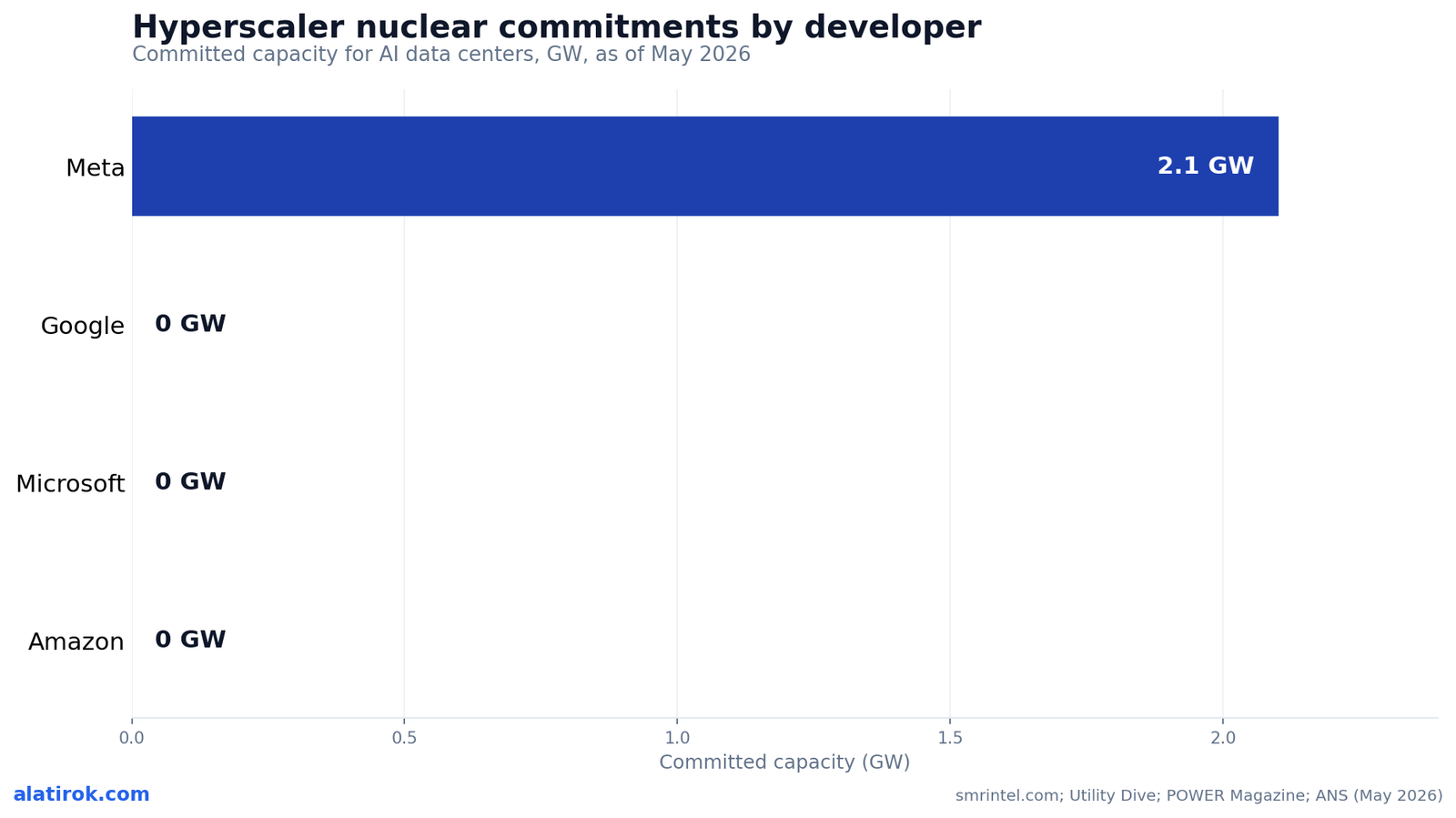
Stacked by buyer, the committed capacity shows Meta at roughly 6.6 GW dwarfing Amazon’s ~2.9 GW, Microsoft’s 0.835 GW and Google’s 0.5 GW — but stacked by delivery year, almost the entire bar shifts to 2030 and beyond. The visual below segments each hyperscaler’s commitment by developer so you can see both the scale and the technology mix at a glance.
Note what the chart does not show on its own: time. Meta’s tall bar is mostly Oklo and TerraPower capacity arriving 2030-2035; Amazon’s includes a Susquehanna ramp that does not reach full 1.92 GW until 2032. The only segment that is both firm and near-term is Microsoft’s 835 MW slice landing in 2027. Read the chart for who is betting biggest, then read the timeline in the next section for who is getting power first.
The lead-time gap: signing year vs. first-power year
~3 yrs
Microsoft TMI gap
Signed 2024 → power 2027 (restart)
2032
Amazon full ramp
1.92 GW Susquehanna reaches peak
2030
Google first SMR
Hermes 2, fleet to 500 MW by 2035
2035
Meta full capacity
Oklo + TerraPower gigawatts online
The first nuclear electrons dedicated to an AI data center arrive in 2027 from the Three Mile Island Unit 1 restart — and for most of the 9.8 GW, the gap between signing and delivery is three to nine years. This is the single most operationally important fact in the AI nuclear power deals 2026: the announcements cluster in 2024-2026, but the power clusters in 2030-2035.
Walk the timeline. Microsoft signed the TMI PPA in September 2024 for 2027 power — a roughly three-year gap, and the shortest in the dataset, only because it is reusing a licensed reactor. Amazon’s Talen deal (June 2025) ramps to full 1.92 GW by 2032. Google’s Kairos agreement (August 2025) targets first Hermes 2 power in 2030 and a 500 MW fleet by 2035. Meta’s January 2026 package puts Vistra electrons on the meter soonest but its Oklo and TerraPower gigawatts at 2030-2035. Across the board, the SMR deals carry the widest gaps precisely because they are building new.
The implication for anyone running compute is blunt: nuclear is a 2030s solution to a 2026 demand spike. The hyperscalers know this, which is why the same companies are simultaneously signing gas turbines, grid PPAs and on-site batteries as bridge power. Treat any nuclear gigawatt with a post-2030 first-power year as a forward commitment, not as capacity you can schedule a training run against.
If you read only the gigawatt headlines, you will overstate 2026-2029 nuclear supply by roughly 6 GW. The contractually firm, near-term number for dedicated AI nuclear is closer to 1 GW until the Susquehanna ramp and SMR fleets arrive.
Why nuclear, and why now: the demand math behind the deals
Hyperscalers turned to nuclear because AI data centers need gigawatt-scale, 24/7, carbon-free baseload that wind and solar cannot reliably provide and the grid cannot quickly expand — and nuclear is the only mature source that checks all four boxes. A single frontier training cluster now draws hundreds of megawatts continuously, and the buyers have public decarbonization commitments they do not want to abandon to gas.
The procurement structures tell you how serious this is. These are not green tariffs or unbundled RECs; they are 17-to-20-year PPAs and direct equity stakes that function as project finance. Amazon’s Talen contract restructured from behind-the-meter to a grid-connected, front-of-the-meter retail model to clear regulatory hurdles — a sign the buyers will redesign the deal to get the electrons. Meta’s funding for TerraPower’s Natrium units and Amazon’s stake in X-energy are explicitly meant to drag a domestic SMR supply chain into commercial existence.
But nuclear alone does not close the 2026 gap, and the deals quietly admit it. The same hyperscalers are stacking gas, grid power and storage as bridge capacity, because the reactors that matter most for AI scale-up are years away. The honest framing of the AI nuclear power deals 2026 is that they are a structural answer to the back half of the decade, bought now to lock in scarce, firm, clean power before competitors do — not a fix for the power crunch happening on today’s interconnection queue.
Nuclear is the back-half-of-the-decade answer. The hyperscalers signed it now to lock in scarce firm clean power — and are bridging 2026-2029 with gas, grid and batteries.The verdict: real money, real reactors, deferred electrons
9.8 GW signed, ~1 GW flowing: nuclear is AI’s 2030s baseload, not its 2026 fix
The AI nuclear power deals 2026 are genuine and large — 9.8 GW, 13 projects, every hyperscaler in — but they are weighted toward capacity that arrives in the 2030s, so the right way to read them is as a financing-led bet on the decade ahead, not as power on today’s meter.
If you strip the announcements down to what is contractually firm and near-term, you get Microsoft’s 835 MW in 2027 and the front end of Amazon’s Susquehanna ramp. Everything else — the Oklo and TerraPower gigawatts, the Kairos and X-energy SMR fleets — is a forward commitment whose value depends on first-of-a-kind reactors hitting schedules that nuclear has historically missed. The hyperscalers are buying scarcity insurance and underwriting a supply chain. That is a smart, capital-rich move. It is not a 2026 power solution.
Builder’s take
As someone who runs inference workloads at Cyntr and Loomfeed, I read these nuclear announcements as a tell about how the buyers actually think about the next decade. A few things stand out from the trenches:
- The press releases quote nameplate gigawatts; your capacity plan should quote first-power years. A 6.6 GW headline that delivers in 2032-2035 does nothing for a cluster you are lighting up this quarter. The honest number on the page today is 0.835 GW in 2027.
- The split between restarts/uprates (fast, boring, real) and net-new SMRs (slow, exciting, unproven) is the single most useful lens. Microsoft and Amazon bought electrons that already exist; Google and the Oklo/TerraPower side of Meta bought a bet on a supply chain that has not poured first concrete on a commercial unit.
- PPAs are being used as project finance, not just procurement. Meta and Google effectively underwrote developers’ balance sheets. For a smaller operator that means the cheap nuclear electron is spoken for years before it exists, so plan your bridge power (gas, grid, batteries) accordingly.
- Watch the interconnection queue and the grid-vs-behind-the-meter fight, not the reactor. Amazon’s Susquehanna deal got restructured front-of-the-meter for regulatory reasons. The bottleneck for AI power in 2026 is permitting and transmission, not the physics.
Frequently asked questions
As of May 2026, 13 announced hyperscaler nuclear projects commit more than 9.8 GW of capacity to AI data centers, according to the smrintel.com tracker. Every major hyperscaler — Meta, Amazon, Microsoft and Google — has signed at least one nuclear deal. Meta leads with up to 6.6 GW, Amazon holds about 2.9 GW including 1.92 GW from Susquehanna, Microsoft has 835 MW, and Google has 500 MW.
Meta, with up to 6.6 GW announced January 9, 2026 to power its Prometheus AI supercluster in New Albany, Ohio. The package combines roughly 2.1 GW from Vistra’s existing plants and uprates, a 1.2 GW Oklo Aurora campus in Pike County, Ohio, up to 2.1 GW of TerraPower Natrium reactors, and additional Constellation supply. Most of the new-build capacity arrives between 2030 and 2035.
In 2027, from the restart of Three Mile Island Unit 1 — rebranded the Crane Clean Energy Center — under Microsoft’s 20-year, 835 MW power purchase agreement with Constellation. A $1 billion DOE loan approved in November 2025 helped pull the date forward from 2028 to 2027. It is the earliest and firmest near-term nuclear supply dedicated to AI.
Three to nine years for most deals in the AI nuclear power deals 2026 dataset. Microsoft’s restart has the shortest gap at about three years (2024 signing to 2027 power) because it reuses a licensed reactor. SMR deals from Oklo, TerraPower, Kairos and X-energy carry the widest gaps, with first power targeted for 2030 and full fleets by 2035, because they require building first-of-a-kind reactors.
Both. Roughly 3.5 GW comes from restarting or uprating existing reactors that can deliver this decade — Microsoft’s TMI restart, Amazon’s 1.92 GW Susquehanna PPA with Talen, and most of Meta’s Vistra agreement. The larger remainder rides on small modular reactors (Oklo Aurora, TerraPower Natrium, Kairos KP-FHR, X-energy Xe-100) that have not yet built a commercial unit in the U.S. and mostly target 2030 and beyond.
Because AI data centers need gigawatt-scale, 24/7, carbon-free baseload power, and nuclear is the only mature source that delivers firm clean energy at that scale. Wind and solar are intermittent, the grid cannot expand fast enough, and hyperscalers have decarbonization commitments. The deals are structured as long-term PPAs and equity stakes that double as project finance to bring scarce firm power — and a domestic SMR supply chain — into existence.
Primary sources
- Every Nuclear-Powered Data Center Deal (tracker) — smrintel.com
- Meta inks nuclear deals for up to 6.6 GW from Oklo, Vistra, TerraPower — Utility Dive
- Constellation plans 2028 restart of Three Mile Island unit 1, spurred by Microsoft PPA — Utility Dive
- DOE loans Constellation $1B to restart Three Mile Island nuclear unit — Utility Dive
- Talen to sell Amazon 1.9 GW from Susquehanna nuclear plant — Utility Dive
- Amazon Unveils Cascade — Energy Northwest’s Xe-100 SMR Project — POWER Magazine
- TVA Inks First U.S. Utility PPA for Gen IV Nuclear Power with Google, Kairos — POWER Magazine
- Meta’s new nuclear deals with Oklo and TerraPower: The details — American Nuclear Society
Last updated: June 1, 2026. Related: Capital.