
We normalized Agentforce, Microsoft Copilot, M365 E7, and ServiceNow to one unit and ran 50,000 monthly interactions through each. Here is the apples-to-apples table and the break-even chart no vendor will show you.
Enterprise AI agent pricing in 2026, normalized to one unit
Enterprise AI agent pricing in 2026 comes in four incompatible shapes — per-conversation ($2), per-action ($0.10), per-seat ($60-$99/user/month), and “contact us” — and the only way to compare them is to convert every model to cost-per-interaction at your real volume. Vendors design their units so you cannot do this. Salesforce sells “conversations” and “Flex Credits,” Microsoft sells “seats” and “Copilot Credits,” and ServiceNow sells “assists” — none of which line up. This article does the conversion the rate cards refuse to.
Coverage elsewhere is fragmented. SaaStr and Medium write opinion pieces about Salesforce’s pricing flip-flops; WebProNews ran one headline about the Copilot increase; MindStudio explains “work units” in the abstract. Nobody builds the single normalized table. So we built it: what 50,000 monthly interactions actually cost across Salesforce Agentforce, Microsoft Copilot, Microsoft 365 E7, and ServiceNow — plus the break-even chart that shows exactly which model wins at which volume.
The headline that should stop every CIO cold: a mid-size firm running 50,000 customer-service interactions a month would spend roughly $100,000 per month on Agentforce conversation fees alone — before Service Cloud seat licenses, before Data Cloud, before implementation. That is the difference between reading a rate card and modeling it. Below, we model it for all four vendors so your enterprise AI agent pricing decision in 2026 rests on arithmetic, not a sales deck.
What does Agentforce cost per conversation vs per action?
Salesforce Agentforce charges $2 per conversation under its original fixed model, or about $0.10 per action under Flex Credits ($500 per 100,000 credits, where one action consumes 20 credits) — and a conversation typically runs 5-15 actions, so Flex Credits is cheaper for most workloads. Salesforce also offers flat per-user add-ons around $125/user/month for employee-facing agents.
The Flex Credits model, announced May 15, 2025 per Constellation Research, was Salesforce’s correction to a $2-per-conversation scheme that punished customers for deflecting tickets. Under Flex Credits, a standard action is 20 credits ($0.10) and a voice action is 30 credits ($0.15). Salesforce’s April 2026 rate card confirms the $500-per-100,000-credit price. The catch: you cannot run conversations and Flex Credits in the same org, so you must commit to one meter.
Here is the break-even inside Agentforce itself: 20 actions × $0.10 = $2.00. If your average conversation involves more than 20 actions, the flat $2 conversation is cheaper; under 20 actions, Flex Credits wins. Most service conversations land at 5-15 actions, which is why Flex Credits ($0.50-$1.50 per conversation) beats the conversation model for typical support volume. The conversation model only makes sense for long, multi-step agentic workflows.
Per-conversation pricing means every ticket your agent successfully deflects now carries a $2 meter charge. The better your agent performs, the higher your Salesforce bill climbs. At 50,000 monthly interactions that is ~$100,000/month in conversation fees alone, on top of Service Cloud seats and Data Cloud credits.
What is the Microsoft Copilot price per seat in 2026, and what do Copilot Credits cost?
Microsoft doubled Copilot enterprise pricing from $30 to $60 per seat per month in 2026 (WebProNews, March 2026) — that is $720 per employee per year, or $7.2M annually for a 10,000-person org. Autonomous agent activity is metered separately in Copilot Credits at $200 per 25,000 credits per month.
This is the structural fork buyers miss. The $60 seat license buys a human-in-the-loop assistant inside Word, Excel, Teams, and Outlook. It does not pay for autonomous agents that run without a person in the chair — those consume Copilot Credits through Copilot Studio, billed on top of the seat. So a fully agentic Copilot deployment is $60/seat plus a consumption meter, not a flat fee.
Microsoft’s rationale is explicit: tens of billions in AI infrastructure spend, largely through OpenAI, that needs to return. For competitors, the doubling is a gift — every vendor pitching against Microsoft now opens with “comparable capability at half the cost.” For buyers, the lesson is that Copilot’s predictable per-seat sticker hides a variable agent meter underneath, and Microsoft has not published expected consumption per agent, making the agentic portion as hard to forecast as Salesforce’s.
What is Microsoft 365 E7 pricing and how does it meter agents?
Microsoft 365 E7 is $99/user/month, generally available May 1, 2026, bundling E5, Microsoft 365 Copilot, the Entra Suite, and Agent 365 into one SKU — but autonomous agent execution still sits outside the seat price, metered in Copilot Credits at $200 per 25,000 credits per month.
E7 is Microsoft’s “Frontier Suite,” announced March 9, 2026. Buy the components à la carte and you pay E5 ($60) + Copilot ($30) + Entra Suite ($12) + Agent 365 ($15) = $117/user; E7 at $99 saves about 15%. That is real money at scale. But read the fine print SAMexpert flags: Agent 365 is a governance and observability layer — it does not build agents and it does not run them. Building and running agents still draws on Copilot Studio or Microsoft Foundry consumption, billed independently.
So E7 collapses your security, identity, and Copilot line items into one predictable per-seat number — genuinely useful for procurement — while quietly keeping the agent-execution meter running off-bill. The bundle is a discount on the seat, not a cap on the agent. Treat the $99 as your floor, not your ceiling, and model the credit consumption on top exactly as you would for standalone Copilot.
What is ServiceNow AI agent pricing in 2026?
ServiceNow does not publish standard pricing for its AI agent capabilities in 2026 — every plan is quoted through sales. Now Assist is billed per “assist,” where small generative tasks consume ~25 assists and large agentic actions ~150 assists, governed by a confidential rate card.
ServiceNow’s product pages terminate in “Get Custom Quote” rather than a number, and as of April 2026 roughly half of new revenue comes from non-seat consumption models — tokens, connectors, and per-assist AI usage — per TechTarget’s reporting on the company’s AI pricing shift. The practical effect is that ServiceNow is the one vendor in this comparison you cannot model from public data, which is itself a negotiating signal.
Field reports peg the consumption rate at roughly $25-$75 per user-month equivalent depending on assist volume, but that is directional, not a list price. Our advice: walk into the ServiceNow conversation with the normalized per-interaction numbers from this article in hand. If you can show that Agentforce Flex Credits land near $0.50-$1.50 per conversation and Copilot agent credits at $0.008 per credit, you anchor the per-assist negotiation instead of letting ServiceNow anchor it for you.
Apples-to-apples: 50,000 monthly interactions across every model
At 50,000 monthly interactions, Agentforce conversations cost ~$100,000/month, Agentforce Flex Credits ~$50,000/month, and per-seat models like Copilot or E7 cost far less if a seat handles many interactions — the cheapest model depends entirely on interactions-per-seat. This is the table no incumbent publishes.
The normalization trick is interactions-per-seat. Per-conversation and per-action models scale linearly with volume regardless of headcount. Per-seat models (Copilot $60, E7 $99) are fixed per licensed user, so their effective cost-per-interaction collapses as each seat handles more work. A Copilot seat handling 250 interactions/month costs $0.24 per interaction; the same seat handling 25 interactions costs $2.40. That single variable flips the entire ranking.
Read the table below as a decision tool, not a leaderboard. If your interactions are concentrated among a few power users, per-seat wins decisively. If they are spread thin across an automated, customer-facing channel where no human “seat” maps to the work, per-action or per-conversation is the only honest meter — and there, Flex Credits at $0.10/action is your floor and the $2 conversation is your ceiling.
| Model | Unit price | Cost @ 50k interactions/mo | Effective cost/interaction | Predictable? |
|---|---|---|---|---|
| Agentforce — Conversations | $2 / conversation | ~$100,000 | $2.00 | Linear, uncapped |
| Agentforce — Flex Credits | $0.10 / action (~10 actions/conv) | ~$50,000 | $1.00 | Linear, uncapped |
| Agentforce — Flat add-on | $125 / user / mo (200 users) | ~$25,000 | $0.50 | Fixed per seat |
| Microsoft Copilot | $60 / seat / mo (200 seats) + agent credits | ~$12,000 + credit meter | $0.24 + variable | Seat fixed, agents variable |
| Microsoft 365 E7 | $99 / seat / mo (200 seats) + agent credits | ~$19,800 + credit meter | $0.40 + variable | Seat fixed, agents variable |
| Copilot Credits (agent meter) | $200 / 25,000 credits | varies by credits/interaction | ~$0.008 / credit | Linear, uncapped |
| ServiceNow Now Assist | Per-assist, unpublished (~25-150 assists/task) | Quote only | Unknown — sales-gated | Opaque |
Break-even: at what volume does per-action beat per-seat beat flat-fee?
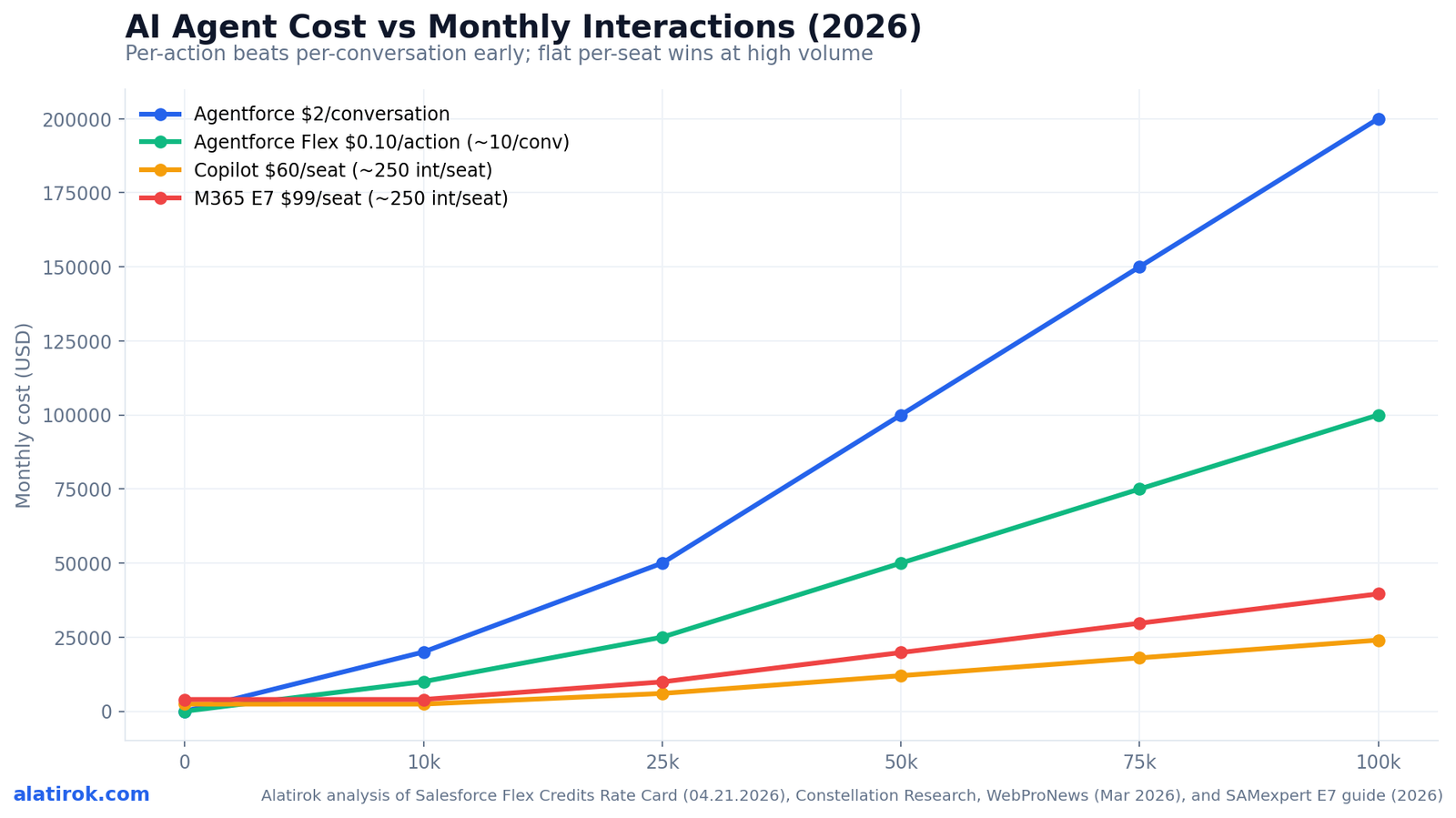
Per-action pricing wins for low, spiky, or customer-facing volume; per-seat wins when each licensed user drives high interaction counts; and flat per-user add-ons sit in between — the crossover for Agentforce conversations versus Copilot seats lands near 5,000-10,000 interactions per month at typical utilization.
The chart above plots monthly cost against interaction volume for each model. Three rules fall out. First, per-conversation pricing ($2) is the steepest line and never caps — it is the most expensive model at every volume above a few thousand interactions and should be avoided unless your conversations are genuinely long agentic workflows exceeding 20 actions. Second, Flex Credits run at roughly half the per-conversation slope for typical 10-action conversations, making them the default for any consumption-style customer channel. Third, per-seat models start with a fixed floor (200 Copilot seats = $12,000/month before a single interaction) but flatten out, so they win decisively once utilization per seat climbs.
The decision rule for your enterprise AI agent pricing in 2026: count your monthly interactions, divide by the number of humans who would actually hold a license, and compute interactions-per-seat. Above roughly 200-300 interactions per seat per month, per-seat licensing (Copilot or E7) is almost always cheaper than per-action. Below that — especially for fully automated, customer-facing agents with no human seat behind them — per-action or per-conversation is the only meter that maps to the work, and Flex Credits beat conversations every time your average interaction stays under 20 actions.
Pros
Cons
How to pick a model and negotiate it in 2026
There is no cheapest vendor — only the cheapest model for your interactions-per-seat
Pick per-seat (Copilot $60 or E7 $99) when interactions concentrate among high-utilization employees, pick Flex Credits per-action when volume is spiky or customer-facing, and always contract a monthly spend cap on any consumption meter. The model is not a brand loyalty decision — it is an interactions-per-seat calculation you can run today.
Three negotiating moves that pay for themselves. First, run a 30-day telemetry audit before licensing the whole org on per-seat; you will almost always find a tail of users who do not justify a $60-$99 seat, and Salesforce even lets you convert seats to credits without penalty. Second, demand a contractual monthly cap and overage alerting on every consumption meter — Flex Credits, Copilot Credits, and Now Assist are all uncapped by default. Third, renegotiate the unit price annually; consumption rate cards move (Salesforce republished its Flex Credits card in April 2026), and your volume gives you leverage.
Finally, do not let any vendor compare units for you. Convert everything to dollars-per-interaction at your real volume — exactly as the table above does — before you sign. That single discipline is the difference between a budgeted $20,000/month agent program and a surprise $100,000 invoice. This article links naturally from our deeper pieces on outcome-based pricing for AI agents, agentic commerce terms explained, and 2026 LLM API pricing for teams modeling the underlying token economics.
Builder’s take
I price agentic features for a living at Cyntr and Loomfeed, so I read these rate cards the way a buyer does: where does the meter run, and who controls it. A few things the marketing decks bury.
- Per-conversation pricing is a tax on your own success. Every deflected ticket that used to be free now costs $2. The better your agent gets, the more you pay Salesforce — that incentive is backwards for the buyer.
- Per-seat pricing (Copilot, E7) is predictable but lies about utilization. You pay $60 or $99 for the analyst who opens Copilot twice a week the same as the power user. Run a 30-day telemetry audit before you license the whole org.
- The credit unit is the real product. A ‘Copilot Credit’, a ‘Flex Credit’, and a ‘Now Assist’ are deliberately non-comparable so you cannot run the table I ran above. Always convert to dollars-per-interaction before you sign.
- ServiceNow refusing to publish a number is a negotiating posture, not an accident. Walk in with a modeled per-assist cost from this article and anchor the conversation there.
- Build a kill-switch into the contract. Consumption pricing with no monthly cap is how a 50,000-interaction month becomes a $100,000 invoice. Cap it, alert on it, and renegotiate the unit annually.
Frequently asked questions
Salesforce Agentforce costs $2 per conversation under its original fixed model. Alternatively, Flex Credits charge about $0.10 per action ($500 per 100,000 credits, with one action consuming 20 credits). Since a typical conversation runs 5-15 actions ($0.50-$1.50), Flex Credits is cheaper than the $2 conversation for most support workloads. You cannot use both models in the same org.
Microsoft doubled Copilot enterprise pricing from $30 to $60 per seat per month in 2026 (WebProNews, March 2026), which works out to $720 per employee per year. That seat license covers the human-in-the-loop assistant; autonomous agent activity is billed separately in Copilot Credits at $200 per 25,000 credits per month.
Microsoft 365 E7 is $99 per user per month, generally available May 1, 2026. It bundles E5, Microsoft 365 Copilot, the Entra Suite, and Agent 365 into one SKU, saving about 15% versus buying the components à la carte ($117). However, building and running autonomous agents still consumes Copilot Studio or Foundry credits on top of the $99 seat.
At 50,000 monthly interactions, Agentforce conversations cost roughly $100,000/month at $2 each, Agentforce Flex Credits about $50,000/month at ~10 actions per conversation, and per-seat models like Copilot (200 seats at $60) only about $12,000/month plus a variable agent-credit meter. The cheapest model depends entirely on how many interactions each licensed seat handles.
No. As of 2026 ServiceNow does not publish standard pricing for its AI agent capabilities; every plan is quoted through sales. Now Assist is billed per ‘assist’ — small generative tasks consume about 25 assists and large agentic actions about 150 assists — governed by a confidential rate card, with field estimates around $25-$75 per user-month equivalent.
It depends on interactions-per-seat. Per-action pricing (Flex Credits, Copilot Credits) is cheaper for low, spiky, or fully automated customer-facing volume where no human seat maps to the work. Per-seat pricing (Copilot $60, M365 E7 $99) is cheaper once each licensed user drives high interaction counts — typically above roughly 200-300 interactions per seat per month. Always model your own volume before deciding.
Primary sources
- Salesforce revamps Agentforce pricing with Flex Credits — Constellation Research
- Flex Credits Rate Card (04.21.2026) — Salesforce
- Microsoft Doubles Copilot Pricing to $60 Per Seat — WebProNews
- Microsoft 365 E7: $99 Bundle Breakdown — SAMexpert
- Introducing the First Frontier Suite built on Intelligence + Trust — Microsoft
- A Complete Guide to ServiceNow AI Pricing in 2026 — eesel AI
- ServiceNow AI pricing change takes on enterprise ROI struggles — TechTarget
- Salesforce Agentforce Pricing Guide: Plans & Costs — getgenerative.ai
Last updated: June 2, 2026. Related: Commerce.