
They sound like rival enterprise AI agent platforms. They are not. Frontier, Agent 365, and Bedrock AgentCore sit at three different layers of the stack — and most orgs need two of them.
OpenAI Frontier vs Agent 365 vs Bedrock AgentCore: are they even competitors?
No. The single biggest mistake buyers make when comparing OpenAI Frontier vs Agent 365 vs Bedrock AgentCore is treating them as three substitutable “enterprise AI agent platforms.” They are not rivals — they sit at three different layers of the agent stack. Frontier is an intelligence and shared-context layer. Microsoft Agent 365 is a governance control plane. AWS Bedrock AgentCore is a serverless runtime. Calling them competitors is like asking whether you should buy a database, an identity provider, or a Kubernetes cluster — the honest answer for most enterprises is “probably two of the three.”
Every ranking page that put this comparison in front of you — OpenAI’s own marketing, the SEO blogs, the launch coverage — describes each product in isolation or implies you must pick one. None of them resolves the actual confusion, which is structural: these tools occupy different positions in the architecture, price on completely different meters, and are designed to stack rather than displace each other. That is the gap this guide closes.
Here is the one-sentence version you can carry into your next vendor call. OpenAI Frontier makes your agents smarter about your business; Microsoft Agent 365 makes your agents governable no matter where they came from; AWS Bedrock AgentCore makes your agents cheap and safe to run at scale. The rest of this article is the layer diagram, a decision tree keyed to your actual pain, and the per-unit cost contrast the incumbent pages won’t give you.
Intelligence layer = OpenAI Frontier. Governance control plane = Microsoft Agent 365. Serverless runtime = AWS Bedrock AgentCore. They are stackable, not substitutable. If you’re forcing a single winner, you’re asking the wrong question.
The layer diagram: where each platform actually sits
The cleanest way to compare OpenAI Frontier vs Agent 365 vs Bedrock AgentCore is to stop comparing products and start comparing layers. An enterprise agent needs three things that map almost perfectly onto these three vendors: context to reason over (intelligence), oversight so security can sleep (governance), and a place to execute (runtime). Lay the products against those layers and the supposed three-way fight dissolves.
Read the table top-to-bottom, not left-to-right. Left-to-right invites a scorecard; top-to-bottom shows you a stack. The Intelligence row and the Runtime row don’t conflict — an agent built and contextualized in Frontier can absolutely execute on AgentCore and be inventoried by Agent 365 via its Entra Agent ID. That’s three layers cooperating, not three vendors competing.
Pricing is on three different axes, which is exactly why naive comparisons mislead. Frontier is a custom, undisclosed, almost certainly six-figure enterprise engagement bundled with Forward Deployed Engineers. Agent 365 is a flat per-user governance license ($15/user/mo standalone) plus separate consumption credits. AgentCore bills serverless compute by the vCPU-second and GB-second, with the headline benefit that I/O wait time is free.
“Read the comparison top-to-bottom and the three-way fight dissolves into a three-layer stack.”
The core argument of this guide
| Dimension | OpenAI Frontier | Microsoft Agent 365 | AWS Bedrock AgentCore |
|---|---|---|---|
| Layer | Intelligence / shared context | Governance / control plane | Runtime / compute |
| Core job | Make agents smart about your business | Manage agents from any source | Run agents serverlessly at scale |
| Pricing model | Custom (undisclosed, six-figure+) | $15/user/mo standalone; $200 / 25K credits consumption | ~$0.0007 per typical session; $0.0895/vCPU-hr + $0.00945/GB-hr |
| Identity model | Scoped agent identities (no over-permissioning) | Entra Agent ID + Conditional Access | AWS IAM SigV4 / OAuth + per-session microVM isolation |
| Multi-vendor agents | Yes — open standards, any origin | Yes — manages agents from any source | Yes — CrewAI, LangGraph, LlamaIndex, Strands, any model |
| Human support | Forward Deployed Engineers included | Self-serve via M365 admin + Copilot Studio | Self-serve / AWS Solutions Architects |
| Status (June 2026) | Limited availability, rolling out | GA May 1, 2026 | GA |
| Substitute for the others? | No — stackable | No — stackable | No — stackable |
What is OpenAI Frontier — and is it a control plane?
OpenAI Frontier, launched February 5, 2026, is an intelligence and shared-context layer for building and managing AI agents as “AI coworkers” — it is not primarily a control plane, even though it includes identity and governance features. Its defining move is connecting siloed data warehouses, CRM systems, ticketing tools, and internal applications so agents share a common understanding of your business. Where Agent 365 leads with oversight, Frontier leads with capability.
Three things distinguish Frontier in the OpenAI Frontier vs Agent 365 comparison. First, shared business context: Frontier onboards institutional knowledge so agents speak your company’s language. Second, Forward Deployed Engineers — OpenAI staff who design, deploy, and operationalize your agent workflows and give you a direct feedback loop into OpenAI Research. Third, it is open: Frontier integrates the apps you already use via open standards and works with agents “regardless of their origin,” not only OpenAI-built ones.
So is OpenAI Frontier a control plane? It has control-plane ingredients — scoped agent identities so coworkers act without over-permissioning, plus auditability — but its center of gravity is making agents competent, not policing a fleet. Think of it as the layer that gives an agent a brain and a memory of your business. If your problem is “our agents are dumb about our data,” Frontier is the answer. If your problem is “we have 50 agents and no oversight,” you want Agent 365 — possibly alongside Frontier.
On pricing, OpenAI has declined to disclose figures and the platform is in limited availability, rolling out more broadly over the coming months. Named early customers include HP, Oracle, State Farm, and Uber. The combination of undisclosed pricing plus dedicated Forward Deployed Engineers is the market’s clearest signal that Frontier is a six-figure-and-up enterprise commitment, not a swipe-a-card SaaS tier.
Frontier’s tell is the Forward Deployed Engineers. You don’t assign human engineers to a $30/month product. FDEs + undisclosed pricing = a bespoke, high-touch, six-figure intelligence-layer engagementWhat is Microsoft Agent 365 — the governance control plane
Microsoft Agent 365 is a governance-first control plane that inventories, secures, and governs AI agents from any source — it became generally available on May 1, 2026, and starts at $15 per user per month standalone. Its entire reason for existing is the problem the other two layers create: once you have agents from OpenAI, AWS, Copilot Studio, and three startups, who can see them all, and who stops them from over-permissioning? Agent 365 is Microsoft’s answer — extend Entra, Purview, and Defender to treat agents as first-class identities alongside humans.
The mechanism is Entra Agent ID. Any agent published through Microsoft 365 channels — and increasingly any agent registered via Graph — gets an Entra Agent ID and automatically appears in the Agent 365 registry. From there you apply Conditional Access policies scoped to agent contexts, Purview for compliance, and Defender for threat detection. That is the control-plane job: not running agents, not making them smart, but knowing they exist and constraining what they can do.
A pricing clarification the ranking pages routinely fumble: Agent 365 standalone is $15/user/mo (available since May 1, 2026), while the $30/user figure that circulates belongs to Microsoft 365 Copilot, a separate product. Agent 365 is also bundled into the new Microsoft 365 E7 plan at $99/user/mo (E5 at $60 + Copilot at $30 + Entra Suite at $12 + Agent 365 at $15, a roughly 15% saving). Crucially, building and running agents draws additional Copilot Studio consumption credits — $200 per 25,000 credits/month, or $0.01 per credit pay-as-you-go on the Azure invoice. So the per-user license is the governance tax; the credits are the compute, billed separately.
In the OpenAI Frontier vs Agent 365 framing, the cleanest distinction is this: Frontier wants to be the place your best agents are born; Agent 365 wants to be the place every agent — yours, OpenAI’s, a vendor’s — is registered, badged, and watched. They are complementary by design.
Pros
Cons
What is AWS Bedrock AgentCore — the serverless runtime
AWS Bedrock AgentCore is a serverless runtime for deploying and running AI agents, billing by the vCPU-second and GB-second with I/O wait time free — a typical agent session costs around $0.0007. It is the layer the other two assume but don’t provide: a secure, scalable place for the agent’s code to actually execute. AgentCore is also the most framework-agnostic of the three, working with CrewAI, LangGraph, LlamaIndex, Strands Agents, and any foundation model.
The economics are the headline. Because agentic workloads spend 30–70% of their time waiting on LLM responses, tool calls, and API round-trips, AgentCore’s consumption model charges only for active CPU and peak memory — that I/O wait is free. AWS’s own worked example: an agent session running 60 seconds with 70% I/O wait (so ~18 seconds of real compute) on 1 vCPU costs about $0.0004475 CPU + $0.000276 memory = roughly $0.0007235 total per session. At 10 million sessions a month, that is the kind of unit cost no per-user license can express.
Security is handled through isolation rather than policy paperwork. Each user session runs in a dedicated microVM with isolated CPU, memory, and filesystem; when the session ends, the microVM is terminated and memory is sanitized, so one agent can’t reach another’s data. Identity comes via AgentCore Identity — distinct agent identities, IAM SigV4 inside AWS boundaries, and OAuth/JWT for enterprise IdPs. Note the hidden costs the calculators flag: idle-session memory from the default 15-minute timeout, uncapped CloudWatch observability charges, and per-request AgentCore Policy authorization at $0.000025 each.
In the OpenAI Frontier vs Bedrock AgentCore comparison, the contrast is almost total: Frontier is high-touch, custom-priced, and context-centric; AgentCore is self-serve, metered-to-the-second, and execution-centric. You could build an agent’s intelligence in Frontier, then run it on AgentCore, and govern it through Agent 365 — three vendors, three layers, zero conflict.
Most agent runtime is spent idling on the model and APIs. Pay-per-second runtimes that bill that idle time can cost 2–3x more than AgentCore for the same work. For high-volume, bursty agent traffic, the runtime layer is where your real cloud bill is won or lost.
Frontier vs Agent 365 vs AgentCore pricing: an honest per-unit contrast
$15/user/mo
Agent 365 standalone
Governance license; $30 figure that circulates is actually Copilot
~$0.0007
AgentCore per session
AWS example: 60s session, 70% I/O wait, I/O time free
Six-figure+
Frontier deals (signaled)
Custom pricing + Forward Deployed Engineers
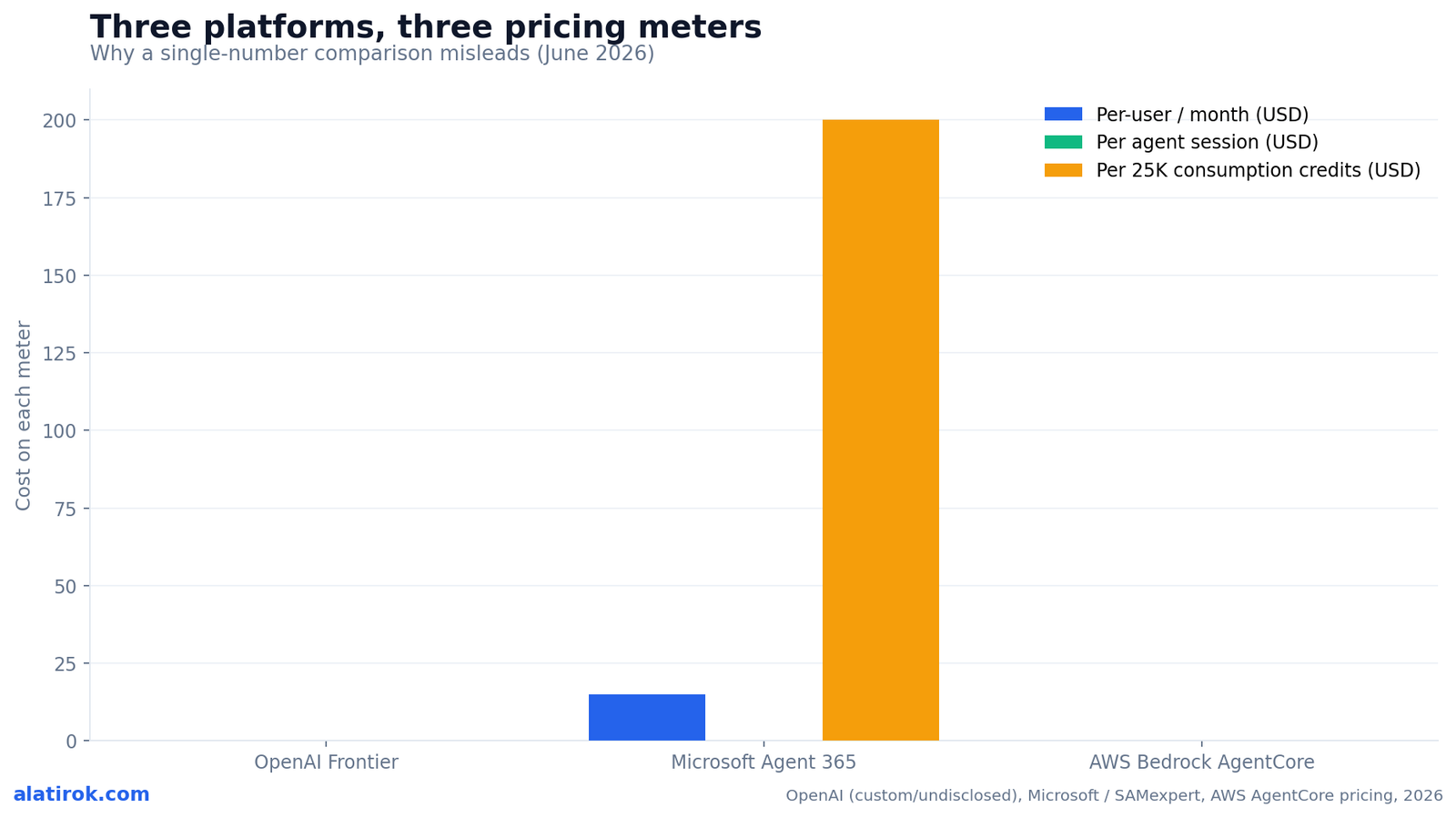
You cannot compare Frontier, Agent 365, and AgentCore pricing on a single number, because they bill on three incompatible meters — per-engagement, per-user, and per-session — and that incompatibility is the whole point. The incumbent ranking pages dodge this by quoting one figure each and implying you choose the cheapest. The honest move is to show all three meters side by side and let you see why you might pay all three.
Frontier: custom and undisclosed, signaling six-figure-plus annual deals, and bundled with Forward Deployed Engineers — you are buying a relationship and an intelligence layer, not a line item. Agent 365: $15/user/mo standalone (or inside M365 E7 at $99/user/mo), plus Copilot Studio consumption at $200 per 25,000 credits — a per-human governance tax with a separate per-agent-work meter. AgentCore: pure consumption, ~$0.0007 per typical session, $0.0895/vCPU-hr and $0.00945/GB-hr, with I/O wait free.
Here’s the contrast made concrete. Govern 1,000 employees with Agent 365 standalone and you’re at roughly $15,000/month, flat, before any agents run a single task. Run 1 million AgentCore sessions and you’re at roughly $700/month of runtime — a wildly different shape of cost. Frontier sits outside both as a strategic line item. The chart below puts the three meters on one canvas precisely so you can see they don’t line up — which is the proof they aren’t substitutes.
Practical takeaway: budget for these in different cost centers. Agent 365 is an IT/security per-seat line. AgentCore is a cloud-engineering variable cost that scales with agent traffic. Frontier is a strategic, executive-sponsored investment. Three budgets, three owners, three meters — and frequently, all three in the same enterprise.
Which do you buy first? A decision tree keyed to your pain
Don’t pick by vendor — pick by which pain is loudest, because each platform cures a different one: Frontier cures a capability problem, Agent 365 cures a control problem, and AgentCore cures a compute problem. Name your pain honestly and the first purchase chooses itself; the other two become a roadmap, not a rejected alternative.
Start here. Is your loudest complaint that agents are dumb about your business — they can’t reason over your CRM, your warehouse, your tribal knowledge — and you want a partner to fix it? Buy Frontier first; the Forward Deployed Engineers exist for exactly this. Is your loudest complaint that you already have a sprawl of agents from multiple vendors and security can’t see or constrain them? Buy Agent 365 first; Entra Agent ID and Conditional Access give you the fleet view immediately. Is your loudest complaint that you’ve built the agent and now need it to run cheaply, securely, and at scale? Buy AgentCore first; serverless microVMs and I/O-wait-free billing are the point.
Two combinations cover most real enterprises. Build + run on AWS, govern with Microsoft: AgentCore as the runtime, Agent 365 as the control plane — extremely common for AWS-native shops that are also Microsoft 365 tenants. Intelligence + governance: Frontier to make agents capable, Agent 365 to keep the fleet accountable — common in large, regulated firms that can fund a strategic OpenAI engagement. The all-three stack (Frontier intelligence, AgentCore runtime, Agent 365 governance) is entirely coherent and increasingly where ambitious programs land.
If you remember one rule: buy the layer where you’re bleeding, then add layers as the program matures. The wrong move — the one every “pick a winner” article nudges you toward — is choosing a single platform to do all three jobs and discovering six months later that your runtime is overpriced, your governance is a spreadsheet, or your agents still don’t understand your business.
Pain = capability (“our agents are dumb about our data”)
Buy OpenAI Frontier first. It’s the intelligence/shared-context layer, it connects your CRM/warehouse/ticketing/internal apps, and the Forward Deployed Engineers operationalize the workflows. Expect a custom six-figure engagement and limited availability. Add Agent 365 later for fleet governance; run the resulting agents wherever you like, including AgentCore.Pain = control (“we can’t see or govern our agent sprawl”)
Buy Microsoft Agent 365 first. $15/user/mo standalone, GA since May 1, 2026, governs agents from any source via Entra Agent ID + Conditional Access + Purview + Defender. It inventories agents that run anywhere — including on AgentCore — so it slots in over an existing runtime without rebuilds.Pain = compute (“we built it, now run it cheaply at scale”)
Buy AWS Bedrock AgentCore first. Serverless, ~$0.0007/session, I/O wait free, per-session microVM isolation, and framework-agnostic (CrewAI, LangGraph, LlamaIndex, Strands). Adopt it without buying any suite. Layer Agent 365 on top for governance whenever security asks for fleet visibility.Pain = all three at once (large, regulated, ambitious)
Stack them. Frontier for intelligence, AgentCore for runtime, Agent 365 for governance — three meters, three budget owners, zero architectural conflict. This is the end-state for serious agent programs, and it’s why ‘which one wins’ was never the right question.OpenAI Frontier alternatives and the verdict
Not substitutes — a stack. Buy the layer where you’re bleeding first.
The verdict on OpenAI Frontier vs Agent 365 vs Bedrock AgentCore is that there is no single winner — there’s a correct layer for each job, and the right answer for most enterprises is two of the three. Treating them as alternatives is the category error the entire first page of search results commits. They are an intelligence layer, a governance control plane, and a serverless runtime, designed to stack.
If you’re specifically hunting OpenAI Frontier alternatives, be precise about what you’re replacing. If you want Frontier’s intelligence/shared-context role, the nearest analogs are Google’s Gemini Enterprise / Agentspace and Microsoft’s Foundry IQ context layer — not Agent 365 or AgentCore, which live at different layers. If you actually wanted a governance control plane, the alternative is Agent 365 itself (or Google’s emerging governance tooling). If you wanted a runtime, the alternatives are AgentCore, Azure’s Foundry Agent Service, or self-hosting on Kubernetes. Match the alternative to the layer, not to the brand.
The market is converging on this layered reality even as the marketing resists it. OpenAI made Frontier open to multi-vendor agents; Microsoft built Agent 365 to govern agents from any source; AWS made AgentCore framework-and-model-agnostic. Every vendor is implicitly admitting it owns one layer and must interoperate at the others. The smartest buyers are reading that admission and assembling a stack on purpose.
Builder’s take
I build agent infrastructure for a living at Cyntr and Loomfeed, and the question I hear most from buyers right now is some version of “which of these three do we standardize on?” That question has a wrong premise baked in. Here is how I’d actually reason about it.
- Map your pain before you map your vendors. If your blocker is capability (the agent can’t reason over your messy business context), that’s a Frontier-shaped problem. If it’s control (you have 40 agents from five vendors and security can’t see them), that’s Agent 365. If it’s compute (you’ve built the agent and need it to run cheaply at scale), that’s AgentCore. Three different departments are usually unhappy for three different reasons.
- The honest cost story the ranking pages dodge: these don’t price on the same axis, so a per-user vs per-session comparison is apples-to-engine-blocks. Agent 365 is a flat $15/user/mo governance tax on your humans; AgentCore is ~$0.0007 per agent session of variable compute; Frontier is a custom six-figure relationship. You can easily run all three and pay each on its own meter.
- AgentCore is the only one of the three you can adopt without buying into a suite. That’s a feature. If you’re already on AWS and framework-agnostic, you can put agents in production this quarter and decide on a governance plane later — Agent 365 will happily inventory agents that run anywhere via Entra Agent ID.
- Identity is where the layers actually meet, and it’s the part to get right first. Frontier scopes agent identities so coworkers don’t over-permission; Agent 365 issues Entra Agent IDs with Conditional Access; AgentCore isolates each session in its own microVM with SigV4/OAuth. Pick your identity spine deliberately — retrofitting it after you have 100 agents is the migration nobody budgets for.
- Don’t let a vendor’s ‘platform’ framing collapse the stack in your head. The marketing wants you to believe you’re choosing one winner. The architecture wants you to assemble a stack. Trust the architecture.
Frequently asked questions
Not directly. OpenAI Frontier is an intelligence and shared-context layer — it makes agents smart about your business and ships with Forward Deployed Engineers. Microsoft Agent 365 is a governance control plane that inventories and secures agents from any source via Entra Agent ID. They sit at different layers and are commonly used together: Frontier builds capable agents, Agent 365 governs the fleet. The supposed Frontier vs Agent 365 rivalry is mostly a framing error.
Not primarily. Frontier includes control-plane ingredients — scoped agent identities so coworkers don’t over-permission, plus auditability — but its center of gravity is intelligence: connecting CRM, warehouses, ticketing, and internal apps so agents share business context. A dedicated agent control plane like Microsoft Agent 365 leads with governance (registry, Conditional Access, Purview, Defender). Frontier leads with capability. If you need fleet-wide oversight, pair Frontier with Agent 365 rather than expecting Frontier to be the control plane.
They bill on three different meters. OpenAI Frontier is custom and undisclosed, signaling six-figure-plus deals bundled with Forward Deployed Engineers. Microsoft Agent 365 is $15/user/mo standalone (the $30 figure often quoted is actually Copilot), or inside Microsoft 365 E7 at $99/user/mo, plus Copilot Studio consumption at $200 per 25,000 credits. AWS Bedrock AgentCore is pure consumption — roughly $0.0007 per typical agent session, at $0.0895/vCPU-hr and $0.00945/GB-hr, with I/O wait time free.
Buy the layer where you’re bleeding. If agents are dumb about your business (a capability problem), buy Frontier first. If you can’t see or govern a sprawl of multi-vendor agents (a control problem), buy Agent 365 first. If you’ve built the agent and need it to run cheaply at scale (a compute problem), buy AgentCore first. Most enterprises end up with two of the three; large, ambitious programs run all three as a stack.
Yes — they’re designed to. An agent’s intelligence can be built in OpenAI Frontier, its code can execute on AWS Bedrock AgentCore’s serverless runtime, and the whole fleet can be inventoried and governed through Microsoft Agent 365 via Entra Agent ID. All three are explicitly multi-vendor: Frontier works with agents of any origin, Agent 365 governs agents from any source, and AgentCore supports any framework and model. Three layers, three vendors, no architectural conflict.
It depends which of Frontier’s roles you want to replace. For its intelligence/shared-context role, the nearest alternatives are Google’s Gemini Enterprise / Agentspace and Microsoft’s Foundry IQ context layer. For governance, the alternative is Microsoft Agent 365 itself. For runtime, alternatives include AWS Bedrock AgentCore, Azure Foundry Agent Service, or self-hosting on Kubernetes. Agent 365 and AgentCore are not true Frontier alternatives because they live at different layers — match the alternative to the layer, not the brand.
Primary sources
- Introducing OpenAI Frontier — OpenAI
- OpenAI Frontier — enterprise platform for AI agents — OpenAI
- OpenAI launches a way for enterprises to build and manage AI agents — TechCrunch
- OpenAI Launches Frontier, a Platform to Build, Deploy, and Manage AI Agents — InfoQ
- Microsoft Agent 365 — the control plane for agents — Microsoft
- Microsoft Agent 365 overview — Microsoft Learn
- Agent 365 Licensing: What It Covers and Costs — SAMexpert
- Amazon Bedrock AgentCore Pricing — Amazon Web Services
- Securely launch and scale your agents on Amazon Bedrock AgentCore Runtime — AWS Machine Learning Blog
- Use isolated sessions for agents — Bedrock AgentCore — AWS Documentation
Last updated: June 3, 2026. Related: Governance.