
The $15 governance seat is the smallest line on the invoice. Here is the worked, four-layer math that turns ‘Agent 365 included’ into a real dollar figure per agent.
How much does Microsoft Agent 365 cost per agent?
The real Microsoft Agent 365 cost is not $15 per agent — that figure only covers the governance seat. Once you stack Copilot Studio credit consumption, Azure AI Foundry token pass-through and mandatory Dataverse, a single realistic autonomous agent (500 self-triggered runs per day) lands near $5,900 per month all-in. The $15 is the smallest of four numbers, not the whole bill.
Here is the trap every other ranking page walks into. TeamsFox, SAMexpert, Nerova and CloudZero all quote the $15/user/month headline — and most quote it accurately. Agent 365 went GA on May 1, 2026 at $15 per user per month standalone, and is bundled into the new Microsoft 365 E7 suite at $99 per user per month. But the $15 buys governance: identity (Entra Agent ID), audit logs, lifecycle and access control. It does not buy a single unit of agent work. The work runs on a completely separate consumption meter that bills you in Copilot Studio credits, and that meter is where the actual Microsoft Agent 365 cost lives.
Think of it like a parking permit versus fuel. The $15 seat is the permit that says this agent is allowed to operate inside your tenant and is being watched. The fuel — every answer it generates, every action it takes, every time it wakes itself up — is metered, pooled across the tenant, and lands on a different invoice. This article builds the one thing none of the incumbents publish: a single worked example stacking all four layers into a real per-agent dollar figure, plus the chart that wins the ‘cost per agent’ question outright.
What are the four layers of Agent 365 hidden costs?
The four billing layers are: (1) the Agent 365 governance seat at $15/user/mo, (2) Copilot Studio credit consumption metered per interaction and per autonomous trigger, (3) Azure AI Foundry token pass-through if you bring your own model, and (4) Dataverse, which Copilot Studio runs on and you cannot opt out of. Only the first layer is fixed and predictable. The other three scale with how hard the agent works.
The reason ‘agent 365 hidden costs’ is even a search term is that these layers bill on different meters, in different units, on different cadences, and Agent 365’s governance plane does not roll them into one number for you. Microsoft itself has signaled that Agent 365 was not built to govern consumption spending — it governs behavior and identity. The gap between what the governance seat controls and what shows up on the Azure invoice is exactly where the cost surprises land. Here is each layer in plain terms before we stack them.
Buying Agent 365 seats and budgeting $15 per agent is like buying license plates and budgeting nothing for the cars. The governance seat is real and useful — but the consumption meter underneath it is uncapped by that seat and bills separately in Azure.
| Layer | What it bills | Unit / rate | Predictable? |
|---|---|---|---|
| 1. Agent 365 seat | Governance: identity, audit, lifecycle | $15 / user / month (flat) | Yes — fixed |
| 2. Copilot Studio credits | Every interaction + every autonomous trigger | $0.008/credit (pack) or $0.01 (PAYG) | No — scales with usage |
| 3. Azure AI Foundry tokens | Your own model’s inference (BYO model) | GPT-5.4: $2.50/1M in, $15/1M out | No — scales with tokens |
| 4. Dataverse | Underlying data store (mandatory) | Capacity-based; cannot opt out | Partly — baseline + growth |
What does Copilot Studio credit cost per agent — and what is the autonomous trigger trap?
Copilot Studio bills in credits at $0.008 each (prepaid $200 pack of 25,000) or $0.01 each (pay-as-you-go). Credits stack per interaction — 1 for a classic answer, 2 for a generative answer, 5 per agent action, 10 for tenant-graph grounding — and critically, every autonomous (self-triggered) run costs a flat 25 credits with no exceptions, even for Microsoft 365 Copilot–licensed users. That last rule is the trap that defines the real Microsoft Agent 365 cost for any automated agent.
Per Microsoft Learn’s billing-rates page, a single human-facing interaction is cheap: a grounded generative answer is about 12 credits (10 for tenant graph grounding + 2 for the generative answer), or roughly $0.10 at pack rate. Add two agent actions (5 credits each) and you’re at 22 credits — pennies. The problem is not the per-interaction price. The problem is the autonomous trigger.
An autonomous trigger fires whenever the agent activates itself on an event or schedule — a new order arrives, a dashboard threshold trips, a cron tick lands — with no human invoking it. Each one is 25 credits before the agent does anything. There is no Microsoft 365 Copilot waiver on this line; the included-usage carve-out that zeroes out human-facing interactions for licensed users does not apply to self-initiated runs. So a ‘set it and forget it’ automation that fires 500 times a day is paying a 25-credit cover charge 500 times a day, on top of the work it then performs.
Do the arithmetic on one busy agent. Each run = a 25-credit autonomous trigger + a 12-credit grounded generative answer + two 5-credit agent actions = 47 credits per run. At 500 runs/day that’s 23,500 credits/day, ~705,000 credits/month. At the prepaid pack rate of $0.008, that single agent burns roughly $5,640/month in credits alone — and $7,050/month if you’re on pay-as-you-go at $0.01. The $15 seat is now 0.27% of the bill.
“Every autonomous run pays a 25-credit cover charge before the agent does a single useful thing. At 500 runs a day that cover charge alone is the bill.”
Modeled from Microsoft Learn billing rates
What is the true all-in Microsoft Agent 365 cost per agent?
$5,883
True all-in cost per agent / month
vs. the $15 seat headline
47
Credits per autonomous run
25 trigger + 12 answer + 10 actions
390x
All-in cost vs. governance seat
for a 500-run/day agent
25
Credits per autonomous trigger
no Copilot-license waiver
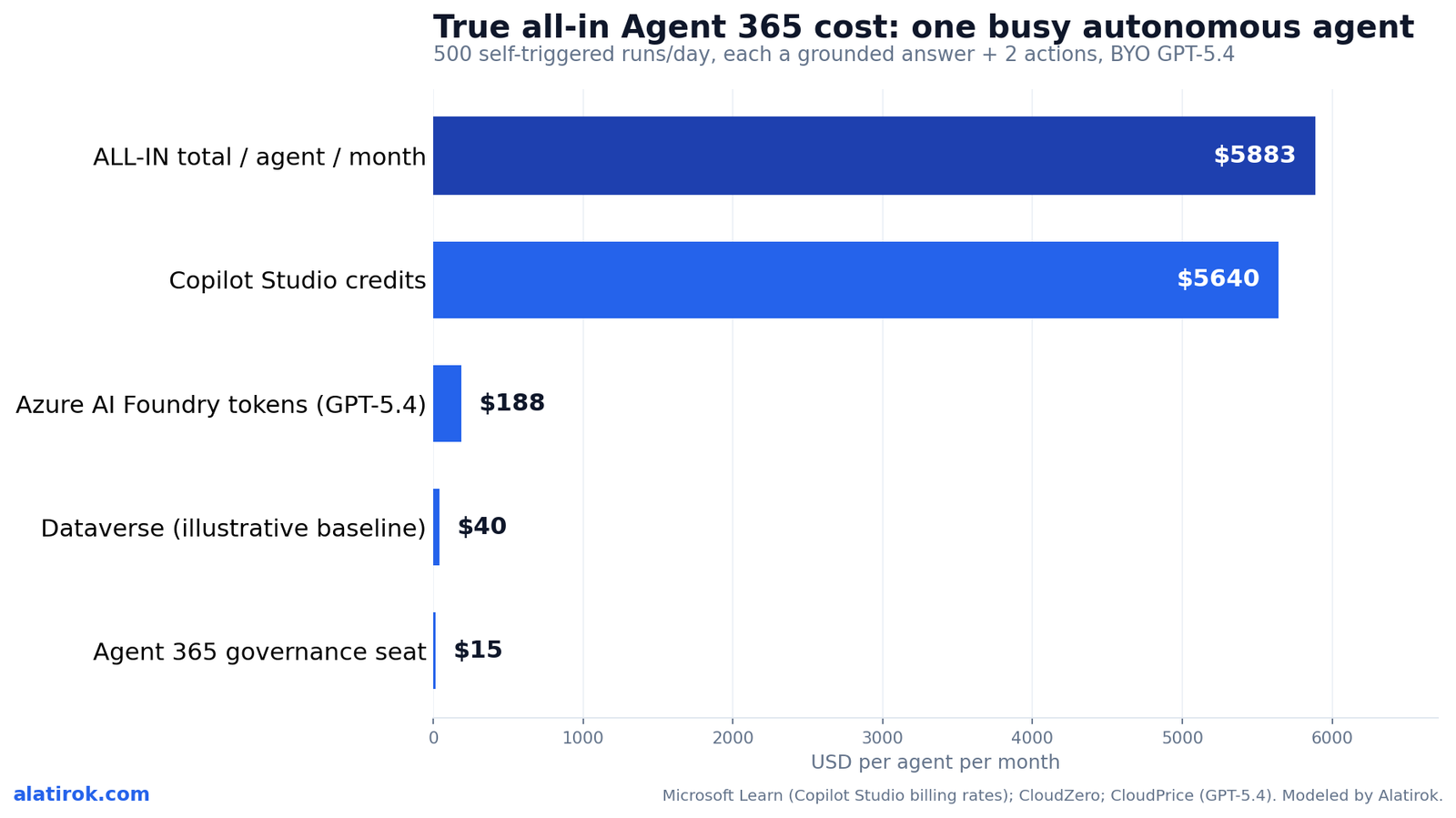
Stacking all four layers for one realistic autonomous agent — 500 self-triggered runs/day, each a grounded generative answer plus two actions, with a bring-your-own GPT-5.4 model — the true all-in Microsoft Agent 365 cost is approximately $5,885 per agent per month at prepaid pack rates. The $15 governance seat is 0.25% of that. The chart below is the worked breakdown, every input drawn from published Microsoft and vendor rates.
The fourth layer, Azure AI Foundry token pass-through, only applies if you bring your own model into the agent — Copilot Studio’s standard models are covered by credits, but BYO Foundry models like GPT-5.4 bill separately on top, at $2.50 per 1M input tokens and $15 per 1M output tokens. Model a modest 2,000 input + 500 output tokens per run: 15,000 runs/month yields 30M input tokens ($75) + 7.5M output tokens ($112.50) ≈ $188/month. The Dataverse line is harder to pin to one number because it’s capacity-based and shared, but it is mandatory and non-optional; we model a conservative ~$40/month illustrative environment baseline so it doesn’t silently disappear the way it does on every other cost page.
Add it up: $15 seat + $5,640 credits + $188 Foundry tokens + $40 Dataverse ≈ $5,883/month for one agent. The headline ‘Agent 365 — included’ becomes a real, defensible figure: a busy autonomous agent costs roughly 390x its governance seat. Multiply across a fleet and the consumption layer, not the seat count, is your budget.
How does the Microsoft 365 E7 price change the math?
The Microsoft 365 E7 price is $99/user/month ($90.45 without Teams), bundling M365 E5, M365 Copilot, Agent 365 and Entra Suite for about a 15% discount versus buying the four separately. But E7 only discounts the seat layer — it does zero to the Copilot Studio credit, Foundry token and Dataverse consumption that dominates the real Microsoft Agent 365 cost. A cheaper permit does not lower the fuel bill.
The bundle economics are genuinely good if you’d buy all four components anyway. Bought separately you’re looking at roughly: M365 E5 (~$60/user/mo after the July 1, 2026 increase from $57), M365 Copilot ($30), Agent 365 ($15) and Entra Suite ($12) — about $117 combined, so E7’s $99 saves around 15% at list. That’s a real saving on per-user governance and productivity licensing.
But notice what E7 does not touch. Every dollar in our $5,883 worked example except the $15 seat sits outside E7. The credits, the tokens, the Dataverse — none of it is bundled, discounted, or capped by upgrading to E7. So the honest framing for a buyer is: E7 is a seat-licensing decision, and it can be a smart one. The per-agent cost decision is a consumption-FinOps decision, and it’s a completely different exercise. Conflating the two is how organizations approve a ‘cheap’ agent rollout and get a five-figure Azure surprise.
Pros
Cons
Which is cheaper: prepaid credit packs or pay-as-you-go?
Prepaid Copilot Studio credit packs at $200 per 25,000 credits ($0.008/credit) are about 20% cheaper per credit than pay-as-you-go at $0.01/credit — but PAYG never blocks your agents, while prepaid capacity is hard-enforced: agents are disabled when a tenant hits 125% of prepaid capacity. The right answer depends on whether predictable cost or uninterrupted availability matters more for that workload.
For our 705,000-credit-per-month agent, the spread is material: $5,640/month at the pack rate versus $7,050/month on PAYG — a $1,410/month, or roughly 20%, difference for one agent. Across a fleet, prepaid is clearly the cheaper unit economics if your consumption is steady and forecastable. The catch is enforcement: when consumption exceeds 125% of prepaid capacity, Microsoft disables custom agents until you add capacity, and end users get a ‘this agent has reached its usage limit’ message. That’s fine for an internal helpdesk; it’s a production incident for a customer-facing order processor.
The pragmatic pattern most teams land on is a hybrid: size a prepaid pack to your reliable baseline for the cheaper rate, then attach a pay-as-you-go meter to absorb spikes without tripping enforcement. PAYG overage bills to your Azure subscription and is never blocked. The decision is FinOps, not licensing — and it’s a decision Agent 365’s governance seat doesn’t make for you.
| Model | Per credit | Monthly cost (705k credits) | Enforcement behavior |
|---|---|---|---|
| Prepaid pack ($200 / 25k) | $0.008 | $5,640 | Agents disabled at 125% of capacity |
| Pay-as-you-go | $0.01 | $7,050 | Never blocked; overage bills to Azure |
| Hybrid (baseline pack + PAYG spillover) | $0.008–$0.01 | ~$5,640 + spike overage | No hard cutoff if PAYG attached |
How do you keep the real Agent 365 cost per agent under control?
To control the true Microsoft Agent 365 cost, govern the consumption meter the seat doesn’t see: cap per-agent credits in the Power Platform admin center, slash autonomous-trigger frequency, prefer classic answers over generative where you can, and treat any bring-your-own Foundry model as a second budget that needs its own ceiling. The seat governs identity; you have to govern the spend yourself.
Five concrete levers, in rough order of impact. First, attack trigger frequency: an agent firing every 30 seconds at 25 credits a pop is your biggest line item — batch events, debounce, or move to a scheduled sweep instead of per-event triggers and you cut the 25-credit cover charge proportionally. Second, set monthly per-agent consumption limits in Power Platform admin (Licensing > Copilot Studio > Manage Agents) so a runaway agent caps out instead of running up the tenant pool. Third, prefer classic (1 credit) over generative (2 credits) answers where the response is deterministic, and turn off tenant-graph grounding (10 credits) on agents that don’t need fresh tenant data. Fourth, if you BYO a Foundry model, right-size it — GPT-5.4 Mini at $0.75/$4.50 per 1M tokens is a fraction of GPT-5.4’s $2.50/$15 for many tasks. Fifth, monitor credit consumption per agent in the admin center weekly, not at invoice time.
The deeper point for anyone building agent infrastructure: per-seat governance and per-token consumption are two different control planes, and Agent 365 deliberately owns only the first one. Until your FinOps tooling reconciles the Azure consumption invoice back to individual agents, your real cost per agent is invisible — which is precisely why a single autonomous agent can quietly cost 390x its seat.
Before buying seats, compute credits-per-run x runs-per-day x 30 x $0.008 for your busiest agent. That single figure, not the $15 seat, is your budget anchor. If it shocks you, fix trigger frequency first.
Builder’s take
I price agents for a living at Cyntr and Loomfeed, and the Agent 365 sticker is the most misleading number in enterprise AI right now. The $15 is real, but it buys you a clipboard, not a worker. Here is how I’d reason about it before signing anything:
- Separate the governance seat from the consumption meter in your head on day one. Agent 365’s $15 buys identity, audit and lifecycle control. It does not buy a single token of work. Those are different invoices that hit on different cadences.
- The autonomous-trigger line is the silent killer. 25 credits every time an agent wakes itself up, with no Copilot-license waiver, means a ‘set it and forget it’ agent firing 500x/day is structurally more expensive than a chatty human-facing one. Model frequency before features.
- Dataverse is a tax you cannot vote against. Copilot Studio sits on it, you can’t opt out, and most cost pages pretend it’s free. Put a real line item next to it.
- If you bring your own Foundry model, you’ve opened a second meter that Agent 365 governance does not see. The seat-level controls give you a false sense of a cap that doesn’t exist downstream.
- Run the worked example for YOUR busiest agent before you buy seats for a thousand. The all-in number per agent is 300-400x the seat price for high-frequency autonomous work. That ratio, not the $15, is the decision.
Frequently asked questions
The Agent 365 governance seat is $15 per user per month at GA (May 1, 2026), but that only covers identity, audit and lifecycle control. The true all-in cost adds Copilot Studio credit consumption, optional Azure AI Foundry token pass-through and mandatory Dataverse. For one realistic autonomous agent (500 self-triggered runs/day) the all-in figure is roughly $5,900 per agent per month — about 390x the seat price.
Every autonomous (self-triggered) run costs a flat 25 Copilot Studio credits, with no exceptions — even for Microsoft 365 Copilot–licensed users. At the prepaid pack rate of $0.008/credit that’s $0.20 per trigger before the agent does any work. An agent firing 500 times a day pays that 25-credit cover charge 500 times daily, which is the single biggest driver of real agent cost.
Credits cost $0.008 each when bought in prepaid packs ($200 for 25,000 credits) or $0.01 each on pay-as-you-go billed through Azure. Credits stack per interaction: 1 for a classic answer, 2 for a generative answer, 5 per agent action and 10 for tenant-graph grounding, plus the flat 25 credits for each autonomous trigger.
Microsoft 365 E7 is $99 per user per month ($90.45 without Teams) on annual commitment. It bundles Microsoft 365 E5, Microsoft 365 Copilot, Microsoft Agent 365 and the Entra Suite — about $117 if bought separately, so E7 saves roughly 15% at list. However, E7 discounts only the seat layer; it does nothing for Copilot Studio credits, Foundry tokens or Dataverse consumption.
No. Copilot Studio’s standard models are covered by credits, but if you bring your own Azure AI Foundry model — such as GPT-5.4 at $2.50 per 1M input and $15 per 1M output tokens — those tokens bill separately on top of the seat and the credits. The Agent 365 governance seat does not cap or even see this consumption.
No. Copilot Studio runs on Dataverse and you cannot opt out. Dataverse is capacity-based rather than a flat per-agent fee, so the exact number varies, but it is a mandatory layer that most cost breakdowns omit entirely. Treat it as a real, non-zero baseline when budgeting per-agent cost.
Primary sources
- Billing rates and management – Microsoft Copilot Studio — Microsoft Learn
- Microsoft Copilot Studio Pricing In 2026: Credits, Plans, And What It Actually Costs at Scale — CloudZero
- Microsoft Agent 365 Pricing Explained: Standalone vs Microsoft 365 E7 Costs in 2026 — Nerova
- Microsoft Agent 365 Pricing: Hidden Costs IT Teams Miss — TeamsFox
- Agent 365 Licensing: What It Covers and Costs — SAMexpert
- Microsoft 365 E7 Licensing Explained: Is Agent 365 Worth the Upgrade? — Valorem Reply
- GPT-5.4 pricing & specs — OpenAI — CloudPrice
- Microsoft 365 2026 Price Increase Is Nearly 20% — SAMexpert
Last updated: June 3, 2026. Related: Capital.