
A neutral, up-to-date breakdown of the two dominant enterprise agent builders after Microsoft Build 2026 and Salesforce’s Agentforce 360 release, where each one actually wins, and what they really cost.
Copilot Studio vs Agentforce: which enterprise agent builder should you buy in 2026?
Choose Copilot Studio if your work, data, and identity already live in Microsoft 365 and Dynamics; choose Agentforce if your system of record is Salesforce CRM and Data 360. That single sentence resolves most of the Copilot Studio vs Agentforce decision before you ever compare feature lists, because both platforms are fundamentally extensions of the data estate the vendor already controls. The agent builder is the easy part. Grounding the agent in trustworthy, permissioned enterprise data is the hard part, and that is exactly where each vendor’s gravity well pulls you in.
That said, 2026 has been a genuinely active year for both. Microsoft brought computer-using agents to general availability and folded GPT-5.5 plus third-party Claude models into Copilot Studio. Salesforce shipped Agentforce 360 with a new visual builder, a deterministic scripting language, and a flexible-credit pricing model. The platforms have converged on capabilities, so the comparison now turns on data gravity, pricing behavior, and governance, not on who has the flashier demo.
This is a neutral buyer’s comparison written for the person who has to defend the choice in a procurement review. We label every feature by its real availability status as of June 2026, and we show the two very different pricing models side by side with the vendors’ own published rates. Where the sources are unclear or a feature is still in preview, we say so rather than rounding up.
Feature labels GENERALLY AVAILABLE, PUBLIC PREVIEW, and ANNOUNCED reflect each vendor’s own 2026 documentation. Pricing figures are list prices from Microsoft and Salesforce; enterprise agreements routinely differ. Always model your specific workload before signing.
What is the core difference between Copilot Studio and Agentforce?
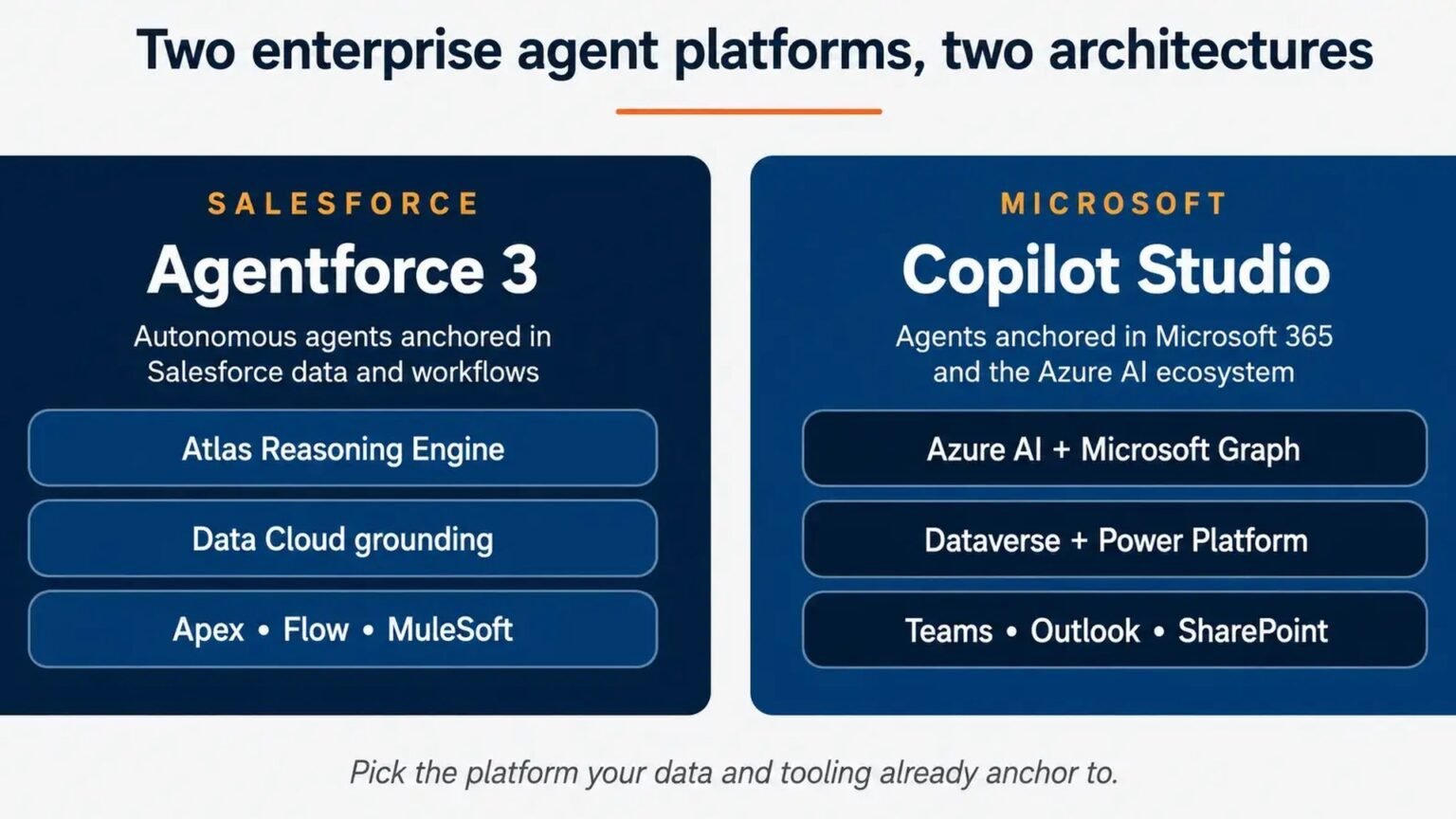
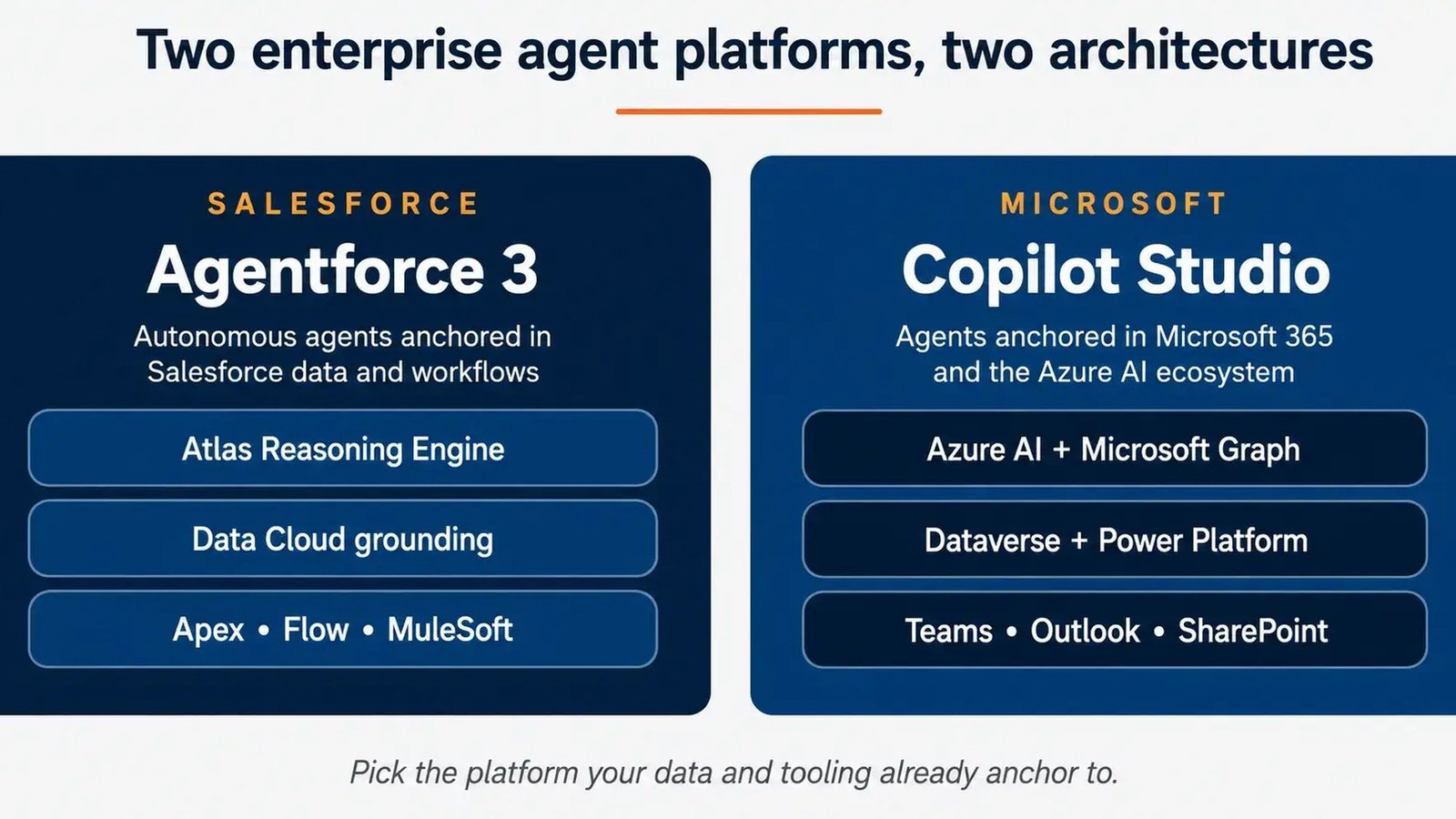
Copilot Studio is a horizontal agent builder anchored in the Microsoft 365 graph and Power Platform, while Agentforce is a CRM-native agent layer anchored in Salesforce customer data. Both let you build conversational and autonomous agents with knowledge grounding, tools, and human handoff, but they optimize for different centers of gravity. Copilot Studio assumes your knowledge lives in SharePoint, Outlook, Teams, and Dynamics, and it grounds answers against the tenant-wide Microsoft Graph. Agentforce assumes your truth lives in the Salesforce customer record and grounds answers against CRM objects and Data 360.
Architecturally, Copilot Studio agents are first-class citizens of the Power Platform: they share connectors, flows, Dataverse, and the Microsoft Entra identity model with the rest of your low-code estate. Agentforce agents are first-class citizens of the Salesforce platform: they share the data model, flows, permission sets, and the Salesforce trust layer with your CRM. Neither is wrong, but the choice cascades into everything downstream, including which model catalog, audit tooling, and pricing meter you inherit.
The practical test is simple. Ask where the agent will spend most of its time reading and writing. If the answer is ‘a customer’s case, opportunity, or account in Salesforce,’ Agentforce removes an enormous amount of integration work. If the answer is ‘documents, email threads, line-of-business apps, and the open web,’ Copilot Studio’s grounding and its new computer-using agents do the same.
| Dimension | Microsoft Copilot Studio | Salesforce Agentforce 360 |
|---|---|---|
| Center of gravity | Microsoft 365 graph + Power Platform + Dynamics | Salesforce CRM + Data 360 |
| Primary builder | Copilot Studio designer (low-code + pro-code) | Agentforce Builder (conversational + pro-code) |
| Deterministic control | Topics, agent flows, Power Fx | Agent Script (deterministic scripting language) |
| Grounding source | Tenant graph grounding (RAG over Microsoft Graph) | Intelligent Context over CRM + unstructured data |
| Identity model | Microsoft Entra agent identities | Salesforce permissions + trust layer |
| Computer-using agents | GENERALLY AVAILABLE (May 2026) | Not a comparable native feature as of June 2026 |
| Pricing meter | Copilot Credits (per feature event) | Flex Credits (per action) or per conversation |
What’s new in Copilot Studio in 2026?
The headline 2026 change is that computer-using agents reached general availability in May 2026, making Copilot Studio one of the first major platforms to ship production-grade UI automation, alongside GPT-5.5 model options and federated MCP connectors. Computer-using agents (CUA) let an agent drive websites and desktop applications through the user interface when no API exists, combining vision and reasoning to click, type, and navigate. Microsoft’s GA build pairs this with secure credential storage, configurable human-in-the-loop review, and audit logging with session replay.
On models, Microsoft added GPT-5.5 Instant as a faster conversational option across Copilot surfaces including Copilot Studio, and exposes third-party choices: ChatGPT-5, Claude Sonnet 4.5, Claude Sonnet 4.6, and Claude Opus are listed as generally available globally (excluding GCC environments) per Microsoft’s own documentation. GPT-5.5 Reasoning (Deep) is available as an experimental model for agents that need deep analytical reasoning, so treat it as preview-grade, not production-default.
Two more 2026 additions matter for buyers. Federated Copilot connectors, which query partner systems live at prompt time over the Model Context Protocol (MCP), reached general availability in the April-May 2026 window, with initial connectors including Canva, HubSpot, and Google Calendar. And the agent-to-agent (A2A) protocol reached general availability, letting agents delegate tasks to one another. A redesigned workflows experience with a unified canvas is rolling out in early-release environments, so label that one PUBLIC PREVIEW.
Computer-using agents being generally available means the feature is supported and billable, not that UI-driving automation is safe to run unsupervised. Microsoft’s own GA guidance ships human-in-the-loop review and session-replay logging for a reason. Start supervised.
Which models can a Copilot Studio agent use in 2026?
Per Microsoft Learn’s What’s New page: ChatGPT-5 is GA globally (excluding GCC); Claude Sonnet 4.5, Claude Sonnet 4.6, and Claude Opus are GA globally (excluding GCC); GPT-5.5 Instant was added across Copilot surfaces; and GPT-5.5 Reasoning (Deep) is an experimental (preview) model. Some external models may require data processing outside your geographic boundary, which is a governance flag worth checking.What is tenant graph grounding and why does it cost more?
Tenant graph grounding runs retrieval-augmented generation over your tenant-wide Microsoft Graph, including external data synced through connectors, for higher-quality, up-to-date answers. It is optional per agent and bills at 10 Copilot Credits per grounded message, the most expensive single line item in the standard rate card, because it is doing the most work.What’s new in Salesforce Agentforce in 2026?
Agentforce 360 is the 2026 story: a new Agentforce Builder for faster agent development, Agent Script for deterministic control, Agentforce Voice, and Intelligent Context for grounding agents in complex unstructured data. Where Copilot Studio’s marquee feature is computer use, Salesforce’s marquee feature is control and reliability inside the CRM. Agent Script is a human-readable scripting language that combines AI flexibility with deterministic, code-like guarantees, conditional logic, precise tool use, and guided controls, so agents behave exactly as intended on regulated workflows.
Agentforce Voice brings natural, on-brand voice conversations with live transcription into the Salesforce console, enabling instant human takeover when an agent escalates. On the operations side, Agent Health Monitoring (part of the Spring 2026 release) lets teams watch error rate, latency, and escalation rate with near real-time alerts, the kind of observability you need before you trust an agent in production. Salesforce also opened Agentforce 360 to ISVs, so partners can build and distribute agents.
On models, Agentforce is no longer single-model: through Agentforce Vibes 2.0 and broader model support, Salesforce now offers multi-model choice including Claude Sonnet and GPT-5. That convergence is important for the buyer narrative, because it means ‘which frontier model’ is largely neutralized between the two platforms in 2026. The differentiation is the surrounding platform, not the LLM.
Pros
Cons
How does Copilot Studio pricing compare to Agentforce pricing in 2026?
Copilot Studio bills per feature event using Copilot Credits pooled across your tenant, while Agentforce bills either per action with Flex Credits or a flat $2.00 per conversation, and the two models reward opposite usage patterns. This is the single most important section for a commercial decision, because the rate card you pick determines whether a successful agent is cheap or ruinous at scale. The platforms are close on capability; they are far apart on how the meter spins.
Copilot Studio’s currency is the Copilot Credit. Microsoft sells prepaid capacity packs at $200/month for 25,000 credits ($0.008/credit with commitment) or pay-as-you-go at $0.01/credit with no commitment, pooled at the tenant level. Critically, internal (B2E) usage by Microsoft 365 Copilot-licensed employees is included at no extra credit cost. The catch is design sensitivity: per Microsoft’s published rates, a classic scripted answer costs 1 credit, a generative answer 2, an agent action (including computer use) 5, tenant graph grounding 10, and a premium reasoning-model response bills as 100 credits per 10 tokens of premium tool usage on top of the feature rate. The same agent can run $8 or $800 a month depending entirely on how it’s built.
Agentforce gives you two mutually exclusive consumption models. Per-conversation pricing is a flat $2.00 per conversation regardless of how many actions occur inside it, predictable for chatty sessions, expensive at volume. Flex Credits instead charge per action: a standard Agentforce action is 20 credits ($0.10) and a voice action is 30 credits ($0.15), with credits sold at $500 per 100,000 ($0.005/credit). Salesforce Foundations, the free tier on Enterprise Edition or above, includes 200,000 Flex Credits to start. Note the org-level constraint: Flex Credits and Conversations cannot both run in the same org, so you commit to one billing philosophy per org.
Per-event credit pricing punishes heavy reasoning; per-conversation pricing punishes high volume. Estimate your real traffic mix (scripted vs generative vs reasoning, attended vs autonomous) before comparing list prices. Microsoft publishes a Copilot Studio usage estimator; for Agentforce, separate a chatty-low-volume scenario from a high-volume-customer-facing one, they land very differently.
| Metric | Copilot Studio | Agentforce |
|---|---|---|
| Billing currency | Copilot Credits (pooled per tenant) | Flex Credits or per-conversation |
| Entry rate | $200/mo for 25,000 credits ($0.008/credit); PAYG $0.01/credit | $2.00 per conversation; or Flex at $0.005/credit |
| Cost of one scripted answer | 1 credit (~$0.008-$0.01) | 20 credits per action (~$0.10) or rolled into $2 conversation |
| Cost of one voice interaction | Standard voice 35 credits/min; real-time 75 credits/min | Voice action 30 credits (~$0.15) |
| Premium reasoning answer | +100 credits per 10 tokens (on top of feature rate) | Varies by model; bundled in action/conversation |
| Free / included tier | Included for M365 Copilot-licensed employees (B2E) | Salesforce Foundations: 200,000 Flex Credits free |
| Mutual exclusivity | N/A (single credit pool) | Flex Credits and Conversations cannot coexist in one org |
Which platform wins for governance, identity, and audit?
Neither platform wins outright on governance; each gives you a mature control plane inside its own estate, so the right answer is whichever ecosystem your security team already operates. In 2026, governance is the real battleground because frontier models have largely converged. The differentiator is the identity, audit, and policy you can enforce on every tool call, and both vendors have invested heavily here.
Copilot Studio leans on the Microsoft Entra identity stack, including automatically provisioned Microsoft Entra agent identities, plus Microsoft Purview audit logging and sensitivity-label enforcement. Its computer-using agents add session-replay logging and Azure Key Vault credential storage, which is exactly the evidence trail you want when an unattended agent does something surprising. Federated connectors respect the calling user’s identity and permissions, so grounding does not become an oversharing vector.
Agentforce leans on the Salesforce trust layer and permission model, with Agent Script giving deterministic, auditable behavior and Agent Health Monitoring providing near real-time error, latency, and escalation telemetry. For regulated workflows where you must prove the agent could only do what policy allowed, Agent Script’s deterministic controls are a genuine strength. The honest verdict: if your SOC lives in Microsoft Defender and Purview, Copilot Studio reduces friction; if your compliance team lives in Salesforce, Agentforce does. Do not let a feature checklist override where your evidence and your auditors already are.
“Frontier models have converged. In 2026 the enterprise agent decision is won on data gravity, predictable cost, and the control plane you can defend in an incident review, not on which LLM is under the hood.”
Alatirok analysis, June 2026
Copilot Studio vs Agentforce: the verdict for 2026 buyers
There is no universal winner, only a fit. Follow your data estate, then model the meter.
For most organizations the Copilot Studio vs Agentforce decision is decided by your existing data estate, not by a feature scorecard, so lead with where your work and your customer records already live. If your knowledge and identity sit in Microsoft 365 and Dynamics, Copilot Studio’s tenant-graph grounding, included employee usage, and GA computer-using agents make it the lower-friction, lower-incremental-cost choice. If your system of record is Salesforce, Agentforce’s CRM-native grounding, deterministic Agent Script, and generous free Flex Credits remove integration work you would otherwise pay for in engineering time.
The pricing models deserve a separate decision. Copilot Studio’s per-event credits reward simple, scripted agents and punish heavy reasoning; the same agent can swing 100x in cost on design alone. Agentforce’s per-conversation pricing caps a single session but climbs at high customer-facing volume, while Flex Credits give you per-action granularity. Pick the meter that matches your traffic shape, and remember that Agentforce forces a one-or-the-other choice per org.
Our scoring below reflects fit, not absolute superiority, because there is no universal winner. Both are credible enterprise platforms in 2026. The losing move is buying the keynote demo instead of the boring production path: an agent that fails safely, escalates cleanly, and leaves an audit trail.
Microsoft Copilot Studio
Best for: Organizations grounded in Microsoft 365, Dynamics, and the Power Platform that want UI automation and included employee usage
What works
Watch out for
Salesforce Agentforce 360
Best for: Organizations whose system of record is Salesforce CRM and Data 360, especially regulated customer-facing workflows
What works
Watch out for
Builder’s take
I build agent infrastructure for a living at Cyntr and Loomfeed, and I evaluate both of these platforms the same way I’d evaluate a vendor for my own stack. The headline feature race matters less than two things people underweight: where the agent’s center of gravity lives, and how predictable the bill is at 10x scale.
- The real question is not ‘which is better’ but ‘where does your data and your work already live.’ If your knowledge is in Microsoft 365 and Dynamics, Copilot Studio’s tenant-graph grounding is a moat you cannot replicate cheaply elsewhere. If your customer record is in Salesforce, Agentforce’s grounding in CRM/Data 360 is the same kind of moat pointed the other way.
- The two pricing models punish different behaviors. Copilot Credits bill per feature event, so a reasoning-model answer can cost 100x a scripted one, your bill scales with agent design. Agentforce per-conversation pricing at $2 caps the blast radius of a single chatty session but gets expensive at high volume. Model the workload, not the rate card.
- Computer-using agents are the genuinely new capability in 2026, and Copilot Studio shipped them to GA first. But GA does not mean ‘reliable for unattended production’ yet, treat UI-driving agents as supervised automation with human-in-the-loop until you have weeks of session-replay logs.
- Both vendors now let you bring Claude and GPT-5-class models, so ‘which model’ is no longer the differentiator it was in 2025. The differentiator is governance: identity, audit, and the policy you can enforce on every tool call. Pick the platform whose control plane you’d be comfortable defending in an incident review.
- Avoid the trap of buying the demo. A 90-second keynote agent and a production agent that touches money, customer records, and external systems are different animals. Pilot the boring path: an agent that fails safely, escalates cleanly, and leaves an audit trail.
Frequently asked questions
It depends entirely on your workload. Copilot Studio bills per feature event in Copilot Credits ($0.008-$0.01 each, pooled per tenant), and internal usage by Microsoft 365 Copilot-licensed employees is included, but a premium reasoning answer can cost 100x a scripted one. Agentforce bills $2.00 per conversation or per action via Flex Credits (standard action 20 credits / about $0.10), with 200,000 free Flex Credits in Salesforce Foundations. Model your real traffic mix before comparing list prices.
Not as a comparable native feature as of June 2026. Microsoft brought computer-using agents (which drive websites and desktop apps through the UI) to general availability in May 2026. Salesforce’s 2026 focus has been Agentforce 360, Agent Script, Agentforce Voice, and Intelligent Context rather than native UI automation, so for screen-driving automation Copilot Studio currently leads.
Both have become multi-model. Copilot Studio lists ChatGPT-5 and Claude Sonnet 4.5/4.6 and Claude Opus as generally available (excluding GCC), added GPT-5.5 Instant, and offers GPT-5.5 Reasoning (Deep) as an experimental model. Agentforce, via Vibes 2.0 and broader model support, offers multi-model choice including Claude Sonnet and GPT-5. The frontier model is largely neutral between them now.
Copilot Credits (Microsoft) are pooled at the tenant level and billed per feature event, 1 for a classic answer, 2 for a generative answer, 5 for an agent action, 10 for tenant graph grounding, and 100 per 10 tokens for premium reasoning. Flex Credits (Salesforce) are billed per action, 20 credits (about $0.10) for a standard action and 30 (about $0.15) for a voice action, sold at $500 per 100,000 credits. Agentforce also offers flat $2.00 per-conversation pricing as an alternative.
No. Per Salesforce’s 2026 pricing, Flex Credits and Conversations cannot run in the same org, so you must commit to one billing model per org. Per-conversation pricing ($2.00 each) is predictable for sessions with many actions; Flex Credits give per-action granularity and suit lower-action or high-control workloads. Choose based on your dominant traffic pattern.
Whichever ecosystem your security team already runs. Copilot Studio uses Microsoft Entra agent identities, Microsoft Purview audit logging, sensitivity labels, and session-replay logging for computer-using agents. Agentforce uses the Salesforce trust layer, deterministic Agent Script controls, and Agent Health Monitoring for near real-time error, latency, and escalation alerts. Both are mature; the friction comes from which control plane your auditors already use.
Primary sources
- New and improved computer-using agents, a new workflows experience, and real-time voice (Copilot Studio blog, May 2026) — Microsoft
- Computer-using agents in Microsoft Copilot Studio are now generally available — Microsoft Community Hub
- What’s new in Copilot Studio (model availability and feature status) — Microsoft Learn
- Billing rates and management – Copilot Studio (Copilot Credit rates) — Microsoft Learn
- Available today: GPT-5.5 Instant in Microsoft 365 Copilot — Microsoft Community Hub
- Salesforce Agentforce Pricing — Salesforce
- Agentforce 360 Announcements (what’s new) — Salesforce
- Salesforce Agentforce Credits & Cost Model: Complete Guide 2026 — Jitendra Zaa
- Microsoft Copilot Studio Pricing in 2026: Credits, Plans, and What It Costs at Scale — CloudZero
Last updated: June 2, 2026. Related: Commerce.