
The hard distribution numbers vendor blogs bury: per-seat down to 15%, hybrid at 41%, outcome-based only 9% live and the real per-resolution price points from Zendesk, Intercom, and HubSpot.
What do the AI agent pricing models statistics for 2026 actually show?
The AI agent pricing models statistics for 2026 show a clear three-way split: pure per-seat pricing has fallen to roughly 15% of vendors (down from 21% a year earlier), hybrid base-plus-usage pricing has become the de facto standard at about 41%, and true outcome-based pricing is real but small, with only about 9% of companies having it fully live and another 47% piloting or exploring it. Almost every other article on this keyword quotes the same exciting forecasts and stops there. The numbers that matter for a budget or a pricing page are the current-state distribution and the actual per-unit rates, and those get buried.
This piece assembles them in one place. The vendor-share figures come from the Bessemer Venture Partners 2026 AI Pricing Playbook tracking more than 200 AI vendors, as summarized by Korix. The buyer-preference figures come from Futurum Group’s 1H-2026 Enterprise Software Decision Makers survey. The per-resolution price points come straight from Zendesk, Intercom (Fin), HubSpot, and Salesforce. We reconcile all of it, then flag the single most important gap: the distance between what analysts forecast for 2026-2028 and what is actually shipped today.
If you are a buyer, this tells you what leverage you have at renewal. If you are a vendor, it tells you where the herd is moving and how far ahead of it you would be if you switched models now. Either way, the headline is the same: the per-seat era is ending, but it is ending in slow motion, and the replacement is not the pure outcome model the headlines promise.

How much have per-seat, hybrid, consumption, and outcome shares moved in 2026?
In the twelve months into 2026, pure per-seat pricing among AI vendors dropped from 21% to 15%, hybrid (a base fee plus usage) jumped from 27% to 41%, and outcome-based pricing remained a small slice that only about 9% of companies have fully implemented. That is the per-seat collapse in one line: a roughly six-point fall in a single year, with hybrid absorbing most of the migrants rather than pure usage or pure outcome.
The buyer side tells a complementary story. In Futurum’s 1H-2026 survey, the share of enterprise buyers reporting they actually use an outcome-based model for AI features rose to 22% from 18% the year before, while reported use of pure consumption-based pricing fell to 30% from 36%. Preference and reality diverge: more buyers say they prefer consumption-based billing than have it, and fewer than one in five still prefer classic per-user pricing. The market is voting against the seat with both its mouth and its wallet, just not at the same speed.
The chart below stacks the vendor-share shift so the direction of travel is unmistakable. Per-seat is shrinking, hybrid is swelling, and outcome-based is the thin wedge that every forecast says will balloon but that has not yet.
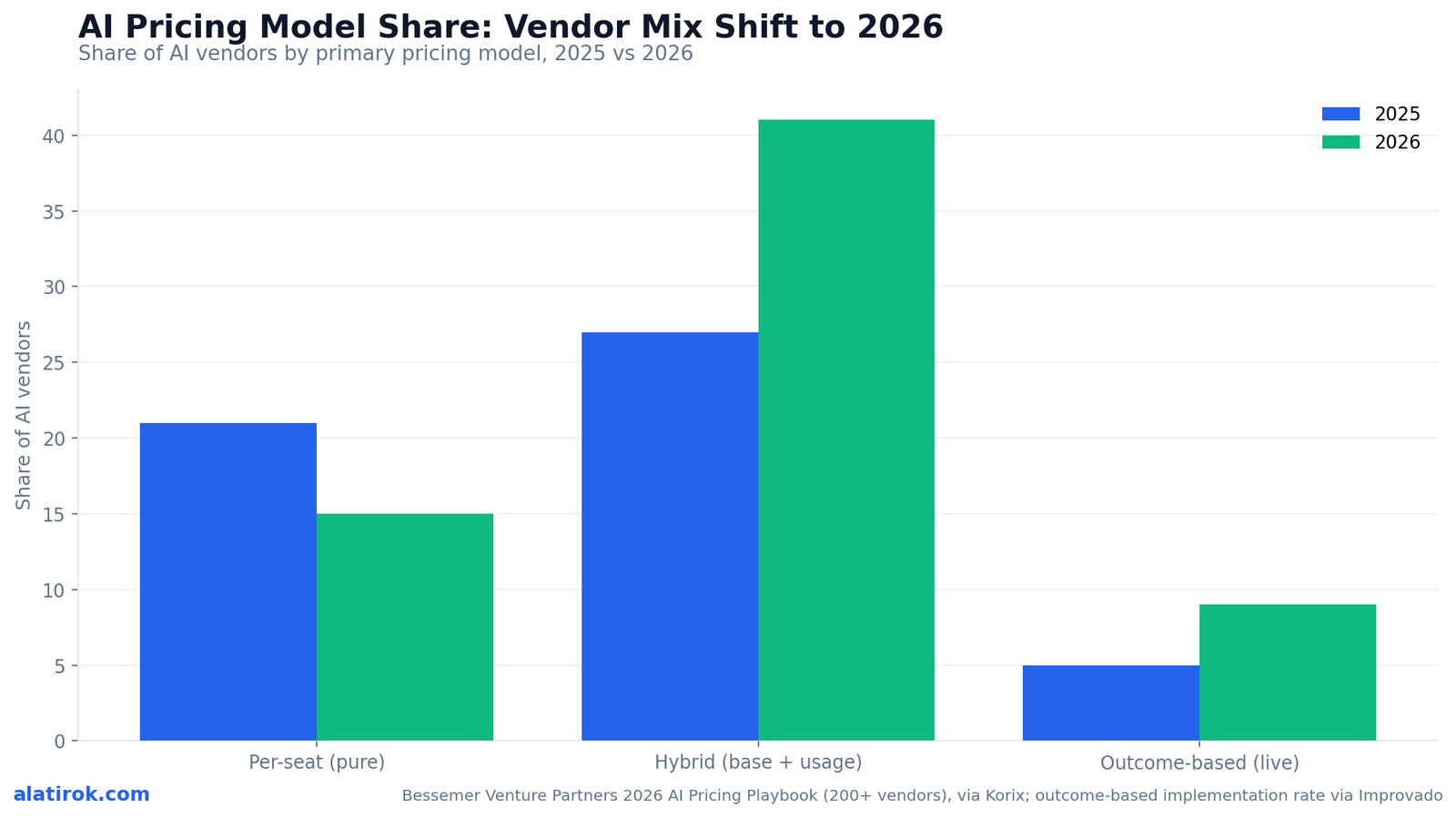
Hybrid is not a way station everyone is passing through on the way to pure outcome pricing. For most vendors it is the destination. It gives buyers a predictable floor and vendors a revenue floor, which is exactly why it is winning the migration.
How much do AI agents charge per resolution in 2026?
In 2026, the headline per-resolution rates are: Zendesk at $1.50 per automated resolution on a committed plan or $2.00 pay-as-you-go, Intercom’s Fin at $0.99 per resolution, HubSpot’s Breeze Customer Agent at $0.50 per resolved conversation (cut from $1.00 in April 2026), and Salesforce Agentforce at $2.00 per conversation, billed whether or not the issue is resolved. That last distinction is the one buyers miss most: per-conversation and per-resolution are not the same metric, and the gap between them is your risk.
Zendesk was the first major incumbent to move, launching per-automated-resolution pricing in August 2024 and retiring its old monthly-active-user bot packages. An automated resolution is counted only when the AI closes a query with no human intervention. Intercom’s Fin uses the same shape at a lower sticker, $0.99 per resolution with no platform fee required. HubSpot undercut both in April 2026, moving Breeze Customer Agent to $0.50 per resolved conversation and Breeze Prospecting Agent to roughly $1 per lead recommended for outreach, a deliberate land-grab on price.
Salesforce sits apart. Agentforce launched at $2 per conversation in October 2024, then added Flex Credits at about $0.10 per action in 2025 and per-user licenses above $125 per month later that year, with the 2026 Agentic Work Unit framework metering AI actions via consumption credits. Three models run at once. The lesson for buyers: the per-unit number on the slide means nothing until you know what unit is being counted and whether you pay for misses.
“The per-unit number on the slide means nothing until you know what unit is being counted and whether you pay for misses.”
Alatirok pricing analysis, 2026
| Vendor / agent | Unit billed | List price | What counts | Notable detail |
|---|---|---|---|---|
| Zendesk AI agents | Automated resolution | $1.50 committed / $2.00 PAYG | AI closes query, no human handoff | First incumbent to move (Aug 2024); retired MAU bot pricing |
| Intercom Fin | Resolution | $0.99 | Resolved conversation | No platform fee required to start |
| HubSpot Breeze Customer Agent | Resolved conversation | $0.50 | Issue resolved end to end | Cut from $1.00 in April 2026; pay-on-completion |
| HubSpot Breeze Prospecting Agent | Lead recommended | ~$1.00 | Qualified lead surfaced for outreach | Shifted from per-enrolled-contact monthly charge |
| Salesforce Agentforce | Conversation | $2.00 | Any interaction, resolved or not | Flex Credits (~$0.10/action) and $125+/user seats also offered |
| Freshdesk (Freddy AI) | Session | ~$0.10 | Per session, not per resolution | $100 per 1,000 sessions |
What is the forecast-vs-actual gap in outcome-based pricing adoption?
15%
Vendors on pure per-seat in 2026
Down from 21% a year earlier (Bessemer)
41%
Vendors on hybrid base + usage
Up from 27% in 12 months (Bessemer)
9%
Companies with outcome pricing fully live
vs 47% piloting or exploring (Improvado)
$0.50
HubSpot per resolved conversation
Cut from $1.00 in April 2026
The forecast-vs-actual gap is the single most important and most under-reported number in AI agent pricing: analysts project outcome-based components in 40% of enterprise SaaS by 2026 (Gartner) and 70% of vendors abandoning pure per-seat by 2028 (IDC), yet only about 9% of companies have outcome-based pricing fully implemented today, with another 47% merely piloting or exploring it. The forecasts describe a destination; the 9% describes the current address. Most articles quote the first and imply the second, which is how a 2028 projection gets read as a 2026 fact.
Gartner’s framing is that 40% of enterprise SaaS will include outcome-based components by 2026, up from roughly 15% in 2022. IDC’s is blunter: by 2028 pure seat-based pricing becomes obsolete as agents replace repetitive manual work, forcing about 70% of vendors to refactor their value proposition. Both are credible directional calls. Neither means a typical buyer can walk in today and put a vendor on pure outcome pricing; in practice that conversation ends in a hybrid or a pilot.
Why the lag? Outcome pricing requires three hard things at once: an agreed, auditable definition of the outcome; metering both sides trust; and a vendor willing to absorb revenue variance when the agent underperforms. Support resolution is the rare case where all three roughly exist, which is exactly why per-resolution shipped there first and almost nowhere else. Until those preconditions generalize, expect the 9% to climb slowly toward the forecasts rather than leap.
Forecasts: Gartner sees outcome-based components in 40% of enterprise SaaS by 2026 (from ~15% in 2022); IDC sees ~70% of vendors leaving pure per-seat by 2028. Actual today: only ~9% of companies have outcome-based pricing fully implemented, with ~47% piloting or exploring. Quote both numbers or you are quoting a projection as a fact.
Why is per-seat pricing declining for AI agents specifically?
Per-seat pricing is declining for AI agents because the model assumes one human equals one unit of value, and an autonomous agent breaks that assumption the moment it does the work of many seats without occupying any. When software can resolve a ticket, qualify a lead, or close a books-reconciliation task on its own, charging per logged-in human stops tracking the value delivered, and buyers notice fast.
The pressure is sharpest in categories with high-volume, repetitive work where one agent visibly displaces many seats of labor: customer support, SDR prospecting, tier-1 IT. That is precisely where per-resolution and per-action pricing appeared first. In categories where a human still drives the workflow and the agent assists, seats remain sticky because the one-human-one-value mapping still roughly holds. Per-seat is not dying uniformly; it is dying fastest where agents are most autonomous.
There is also a vendor-incentive problem that buyers are now alert to. Per-seat and per-ticket pricing reward the buyer’s own inefficiency: more headcount or more inbound volume means more revenue for the vendor, regardless of whether anything got better. Per-resolution flips that, aligning vendor revenue with buyer value. The catch is that the alignment only holds if resolution is defined honestly, which is why metering definitions are now the real negotiation.
Pros
Cons
What do buyers actually prefer: consumption-based or outcome-based pricing?
Buyers prefer consumption-based pricing over outcome-based pricing on stated preference, but both decisively beat per-seat: in Futurum’s 1H-2026 survey, consumption-based remains the most-preferred AI pricing model while outcome-based is the fastest-rising, and fewer than one in five buyers still prefer classic per-user pricing. The consumption-based pricing buyer-preference survey data and the outcome-based pricing adoption statistics point the same direction even when the exact percentages differ by source.
The nuance is that preference and adoption are not the same line. Futurum found reported use of outcome-based models rose to 22% (from 18%) while reported use of pure consumption-based fell to 30% (from 36%), suggesting some buyers are migrating from raw consumption toward outcome guarantees even though consumption still leads on preference. Enterprise buyers in particular weight outcome and risk-share terms heavily when the spend is large, because nobody wants to pay full freight for an agent that underperforms.
Practically, this is why hybrid wins. A base fee plus metered usage, sometimes with an outcome-linked component, satisfies the buyer who wants predictability and the buyer who wants value alignment at the same time. The pure models each ask one side to absorb too much variance. Hybrid splits the difference, which is exactly what a 41% share looks like.
Why do the percentages differ across reports?
Different surveys count different populations (all SaaS vs AI vendors vs enterprise buyers) and ask different questions (preference vs current use vs primary model). Bessemer’s vendor-share figures, Futurum’s buyer survey, and Improvado’s implementation rate measure related but distinct things. The directions agree across all of them: per-seat down, hybrid up, outcome-based small but rising. Treat any single percentage as one instrument in a chord, not the whole note.Is outcome-based the same as per-resolution?
Per-resolution is one specific, shipped form of outcome-based pricing where the outcome is a closed support query. Outcome-based is the broader category and can mean per qualified lead, per recovered invoice, per closed ticket, or a contractually defined business result. Per-resolution is popular precisely because the outcome is easy to define and meter; most other outcomes are not, which is why the broader category is still only ~9% live.| Pricing model | Signal | Direction | Reading |
|---|---|---|---|
| Consumption-based | Most preferred; reported use 30% (down from 36%) | Falling on use | Still leads preference, but some buyers migrating to outcome |
| Outcome-based | Reported use 22% (up from 18%); fastest-rising | Rising | Gaining hardest where spend and risk are large |
| Per-seat (per-user) | Preferred by fewer than 1 in 5 buyers | Falling | The model buyers are actively moving away from |
| Hybrid (base + usage) | De facto vendor standard at ~41% | Rising | Wins by splitting predictability and value-alignment |
What should buyers and vendors do about AI agent pricing in 2026?
Per-seat is collapsing, hybrid is the destination, and outcome-based is real but mostly a 2027-2028 story
Buyers should negotiate the metering definition before the rate, default to hybrid for spend predictability, and treat any pure outcome offer as a pilot to validate rather than a finished SKU; vendors should ship hybrid now, instrument outcomes from day one, and only move to pure outcome pricing in categories where the outcome is auditable. That is the actionable read of the AI agent pricing models statistics for 2026: the herd is at hybrid, the frontier is outcome, and the gap between them is where the negotiating leverage lives.
For buyers, the single highest-value question is not what is the per-unit price but what counts as a resolution and who audits it. A $0.50 resolution that the vendor defines generously can cost more than a $1.50 resolution defined strictly. Ask for the metering logic in writing, cap monthly spend, and benchmark cost-per-outcome against the loaded cost of the seats the agent replaces. If a vendor will only sell per seat, that is a signal about how confident they are in their agent’s outcomes.
For vendors, the path is clearer than the noise suggests. Ship hybrid to ride the 41% wave and de-risk both sides. Instrument every outcome even while you bill per seat, because you cannot retroactively price on outcomes you never logged. Then graduate specific high-autonomy workflows to per-resolution or per-action pricing where you can defend the metering. Skipping straight to pure outcome pricing in a category without an auditable outcome is how you end up in the 47% who are still piloting.
Builder’s take
I price two products on opposite ends of this debate, so I watch these numbers like a hawk. The gap between the forecasts everyone quotes and the share that is actually shipped is the whole story.
- Per-seat is not dying everywhere at once. It is collapsing fastest in categories where one agent replaces many seats of work, like support. In categories where a human still drives, seats are sticky.
- The forecast-vs-actual gap is real money. When a vendor tells you they are outcome-based, ask whether outcome pricing is their default SKU or a pilot behind a sales call. Today it is almost always the latter.
- Hybrid (base + usage) is winning because it de-risks both sides. The buyer gets a floor on spend predictability, the vendor gets a floor on revenue. Pure usage and pure outcome both transfer too much risk to one party.
- Per-resolution is the cleanest outcome metric anyone has shipped, and even it is contested. Whose definition of resolved counts? Read the metering clause before you read the headline rate.
- If you build agents, instrument outcomes from day one even if you bill per seat. You cannot switch to outcome pricing later if you never logged what an outcome was.
Frequently asked questions
There are four in play: per-seat (a flat fee per human user, now ~15% of vendors), consumption-based (per action, token, or session), outcome-based (per result, such as per resolution, ~9% fully implemented), and hybrid (a base fee plus usage), which is now the de facto standard at ~41% of AI vendors. Hybrid dominates because it gives buyers predictability and vendors a revenue floor.
Published per-resolution rates in 2026 are Zendesk at $1.50 (committed) or $2.00 (pay-as-you-go) per automated resolution, Intercom’s Fin at $0.99 per resolution, and HubSpot’s Breeze Customer Agent at $0.50 per resolved conversation after an April 2026 cut from $1.00. Salesforce Agentforce charges $2.00 per conversation, billed whether or not the issue is resolved, which is a different and riskier metric.
Per-seat pricing fell from 21% to 15% of AI vendors in twelve months into 2026, according to Bessemer Venture Partners’ 2026 AI Pricing Playbook tracking 200+ vendors. Most of the migration went to hybrid base-plus-usage pricing, which rose from 27% to 41% over the same period, rather than to pure usage or pure outcome models.
Only about 9% of companies have outcome-based pricing fully implemented as of 2026, while roughly 47% are piloting or exploring it. That is far below the forecasts: Gartner projects outcome-based components in 40% of enterprise SaaS by 2026, and IDC projects 70% of vendors leaving pure per-seat by 2028. The gap between the 9% live rate and those forecasts is the most under-reported number in the space.
On stated preference, consumption-based pricing still leads, but outcome-based is the fastest-rising model and both decisively beat per-seat, which fewer than one in five buyers now prefer (Futurum 1H-2026 survey). Reported use of outcome-based models rose to 22% from 18%, while pure consumption-based use fell to 30% from 36%, suggesting some buyers are migrating from raw consumption toward outcome guarantees, especially on large, high-risk spend.
Per-resolution is better aligned for high-volume, autonomous work because it ties spend to value delivered rather than headcount, and it scales down automatically when volume drops. The trade-offs are less predictable spend and a vendor-set definition of ‘resolved’ that can be gamed, so negotiate the metering logic in writing. Per-seat remains reasonable where a human still drives the workflow and the agent only assists.
Primary sources
- Futurum: Enterprise Software Buyers Prefer Consumption and Outcome-Based Pricing — Futurum Group
- Futurum: Are Outcome-Based and Hybrid AI Pricing Models Rewriting the Vendor Playbook? — Futurum Group
- AI Pricing Models: Per-Seat vs Per-Use vs Outcome (2026) — Korix
- Fin AI: AI Customer Service Agent Pricing Comparison — Fin AI (Intercom)
- HubSpot: Customer Agent and Prospecting Agent now pay-on-completion — HubSpot
- Understanding Zendesk’s New Outcome-Based Pricing for AI Resolutions — Premium Plus
- About automated resolutions for AI agents — Zendesk
- SaaS Is Not Dead: Why Per-Seat Pricing Is Being Replaced by Outcomes — Improvado
- HubSpot Switching AI Pricing From Per Use to Per Resolution — SaaStr
Last updated: June 3, 2026. Related: Commerce.