
OpenAI shut Instant Checkout on March 5, 2026 after five months. The data shows demand was real, the buy button was not. A single-failure autopsy.
Why OpenAI killed Instant Checkout in one sentence
Mar 5, 2026
Instant Checkout discontinued
~5 months after launch (CNBC)
~30
peak Shopify merchants live
of a promised 1M+ (CNBC)
8%
US adult ChatGPT users who tried it
first month; usage stayed low (Webinterpret)
3x
lower in-chat conversion at Walmart
vs Walmart’s own site (Stellagent/Wired)
OpenAI Instant Checkout was discontinued on March 5, 2026 because it could not convert: shoppers happily researched products inside ChatGPT but consistently left to complete the purchase on the retailer’s own site, so OpenAI scrapped the in-chat buy button and pivoted to dedicated retailer apps that route the transaction back to the merchant. The failure was not lack of demand and not the underlying protocol. It was a mismatch between where a horizontal AI agent is strong (discovery) and where commerce actually closes (a trusted, full-featured checkout the merchant controls).
This is worth dwelling on because the headline writes itself as “AI shopping flopped,” and that reading is wrong. In the exact months OpenAI Instant Checkout was dying, AI-referred retail traffic was converting better than any other channel. The story is therefore one of the cleanest single-failure autopsies in agentic commerce: one company, one buy button, one well-documented cause of death, and a control group (the retailers’ own sites) sitting right next to the patient.
Below is the full timeline, the numbers that sealed it, the specific functionality that was missing, and what the pivot to retailer-run apps tells builders about where the value in agentic commerce actually sits.
What Instant Checkout was and how it worked
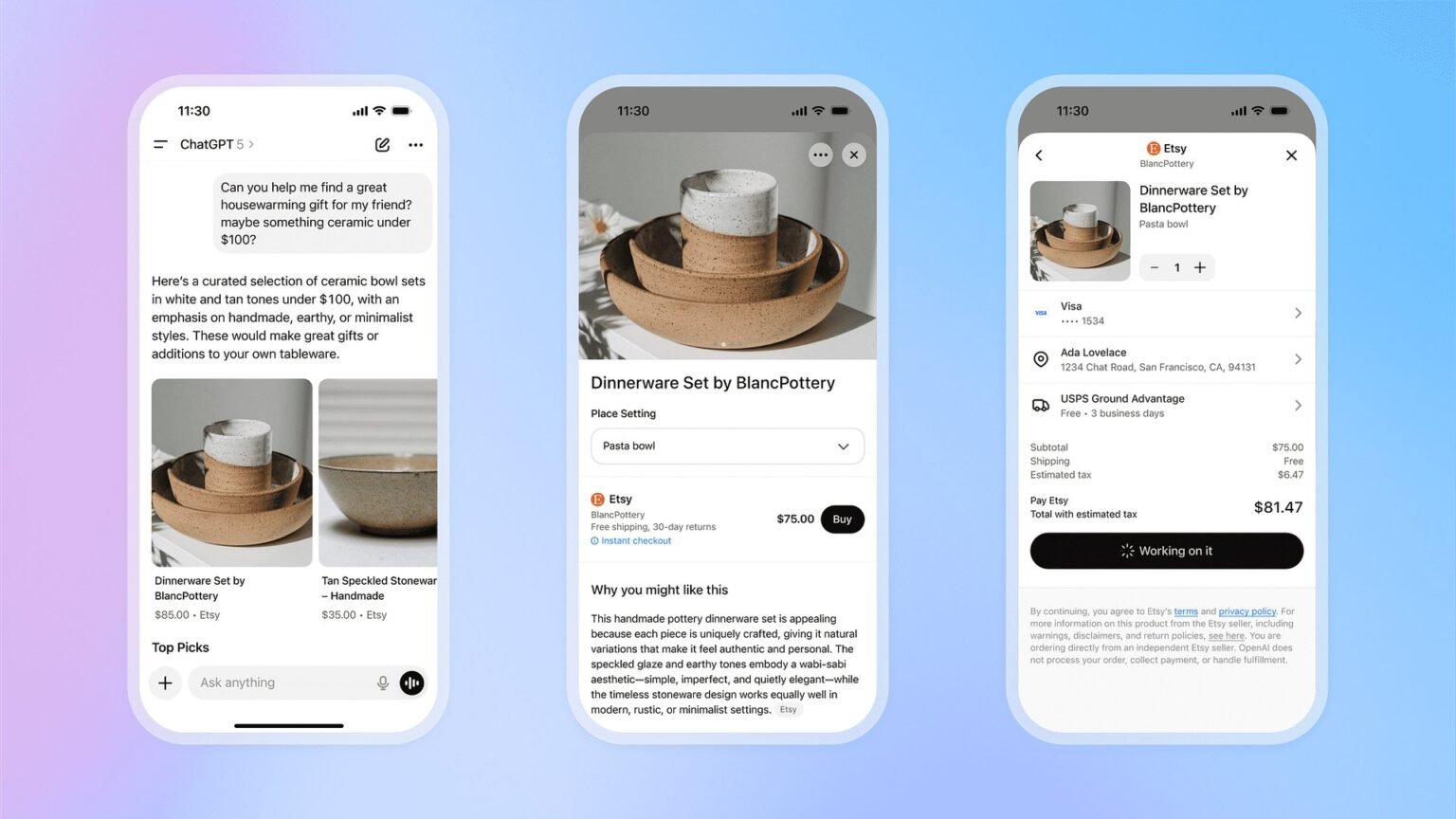
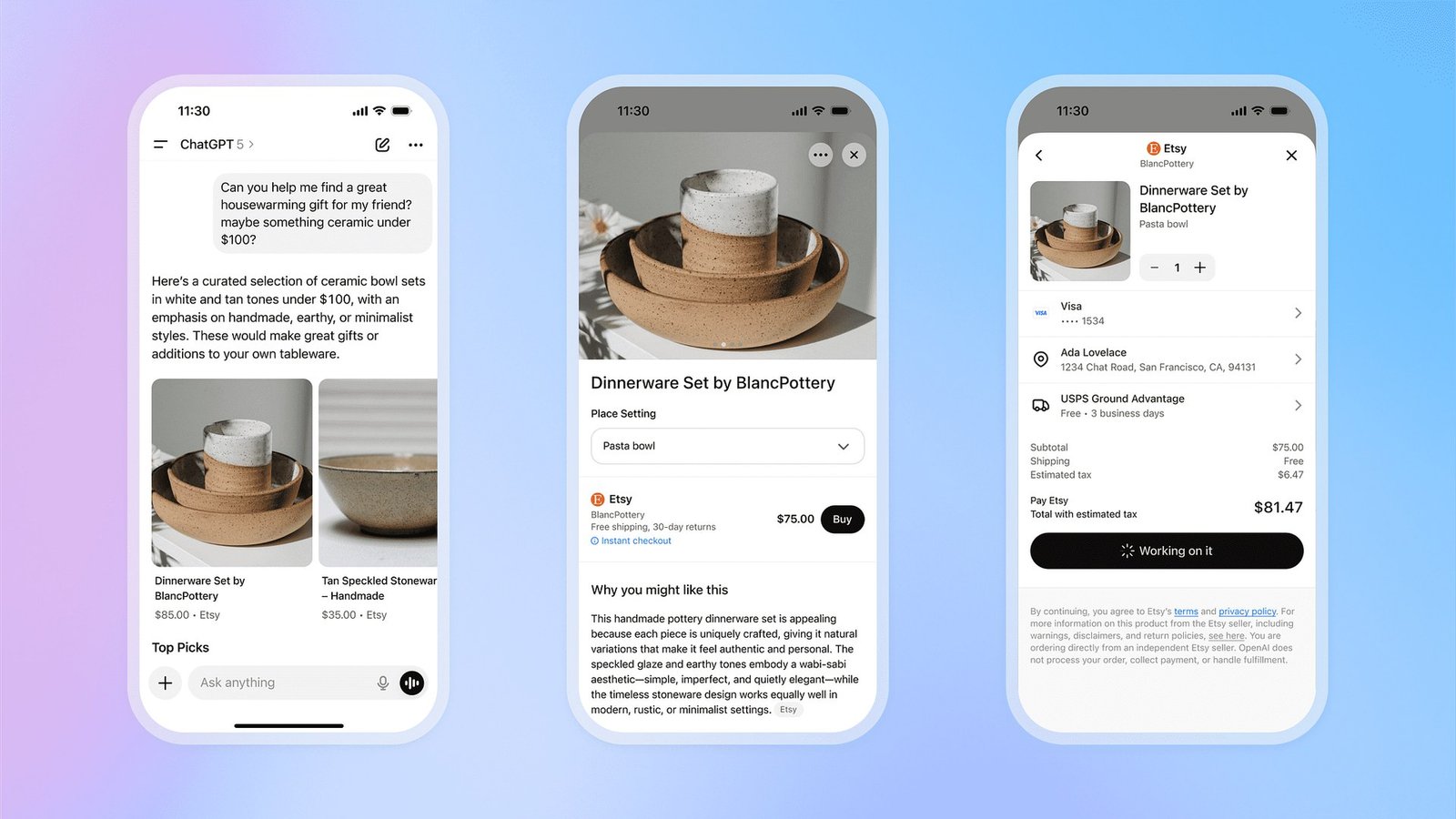
Instant Checkout, branded “Buy it in ChatGPT,” launched September 29, 2025 and let US ChatGPT users buy directly inside a conversation, powered by the Agentic Commerce Protocol (ACP) that OpenAI co-developed with Stripe. At launch it covered US Etsy sellers, with “over a million” Shopify merchants, including names like Glossier, SKIMS, Spanx and Vuori, promised as “coming soon,” per OpenAI’s announcement.
The technical pitch was genuinely elegant. ACP was open-sourced, and any merchant already processing on Stripe could turn on agentic payments in “as little as one line of code,” according to Stripe’s newsroom. Payment was secured through Stripe’s Shared Payment Token, so the card details never had to live with OpenAI. On October 28, 2025, PayPal joined as a second wallet and processing partner, widening the funnel further.
Architecturally the experience was single-item and auto-fire. You asked ChatGPT for a product, it surfaced a card, you confirmed, and the order was placed through the merchant’s Stripe account without leaving the chat. That last detail, single-item and immediate, looks minor. It turned out to be one of the load-bearing reasons the whole thing collapsed.
Crucially, the protocol was never the problem. ACP shipped, partners integrated quickly, and the standard survives the product that introduced it. Everything that failed sat one layer up, in the merchant experience and the agent UX.
ACP is an open standard, co-developed by OpenAI and Stripe, that lets AI agents place orders with merchants on the merchant’s behalf. It is payment-processor agnostic: Stripe merchants can enable it in roughly one line of code, but businesses on other providers can adopt it too. ACP outlived Instant Checkout and now underpins the dedicated retailer apps that replaced it.
The OpenAI Instant Checkout timeline, launch to shutdown
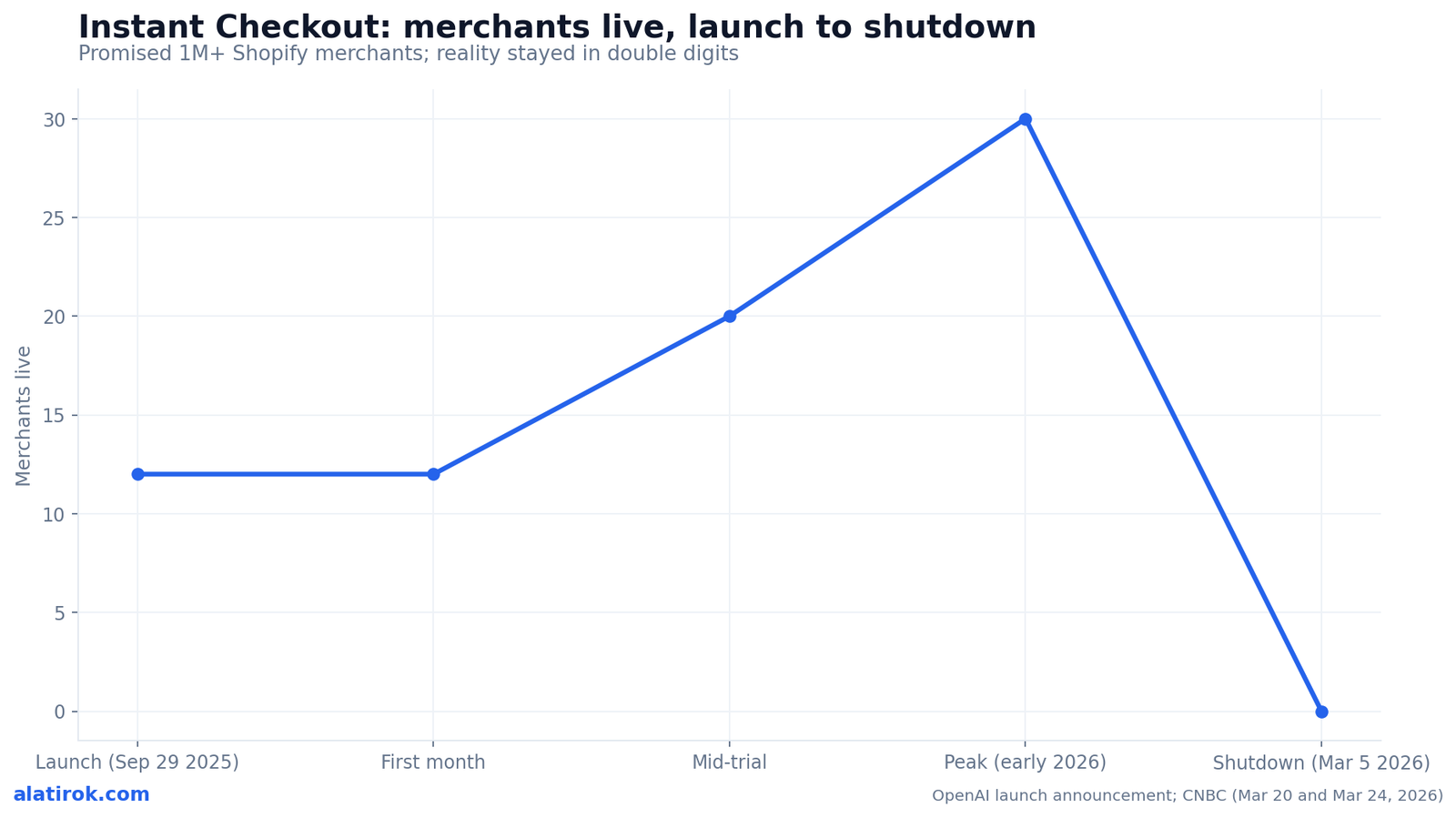
The OpenAI Instant Checkout lifecycle ran almost exactly five months, from a high-profile September 2025 launch to a quiet March 5, 2026 shutdown, and the merchant count never came close to the promised scale. The shape of the curve tells the story: a loud start, a flat middle where adoption simply refused to compound, and an abrupt end.
The merchant numbers are the clearest tell. OpenAI dangled “over a million” Shopify merchants. Reality landed at roughly a dozen integrated at first and only about 30 Shopify merchants live at peak, per CNBC. Etsy, an early partner, confirmed it “did not end up seeing a large volume of sales from Instant Checkout,” even as it valued the discovery traffic. When the supply side of a marketplace stays in the double digits for five months, the demand side never gets a reason to form a habit.
On the demand side, only about 8% of US adult ChatGPT users tried Instant Checkout in its first month, and usage stayed low across the entire roughly five-month trial, according to Webinterpret. There was no viral inflection, no holiday spike that stuck. By March 5, 2026 OpenAI pulled the buy button and reframed ChatGPT’s role in shopping around discovery plus retailer-run apps.
The number that killed it: Walmart’s 3x conversion gap
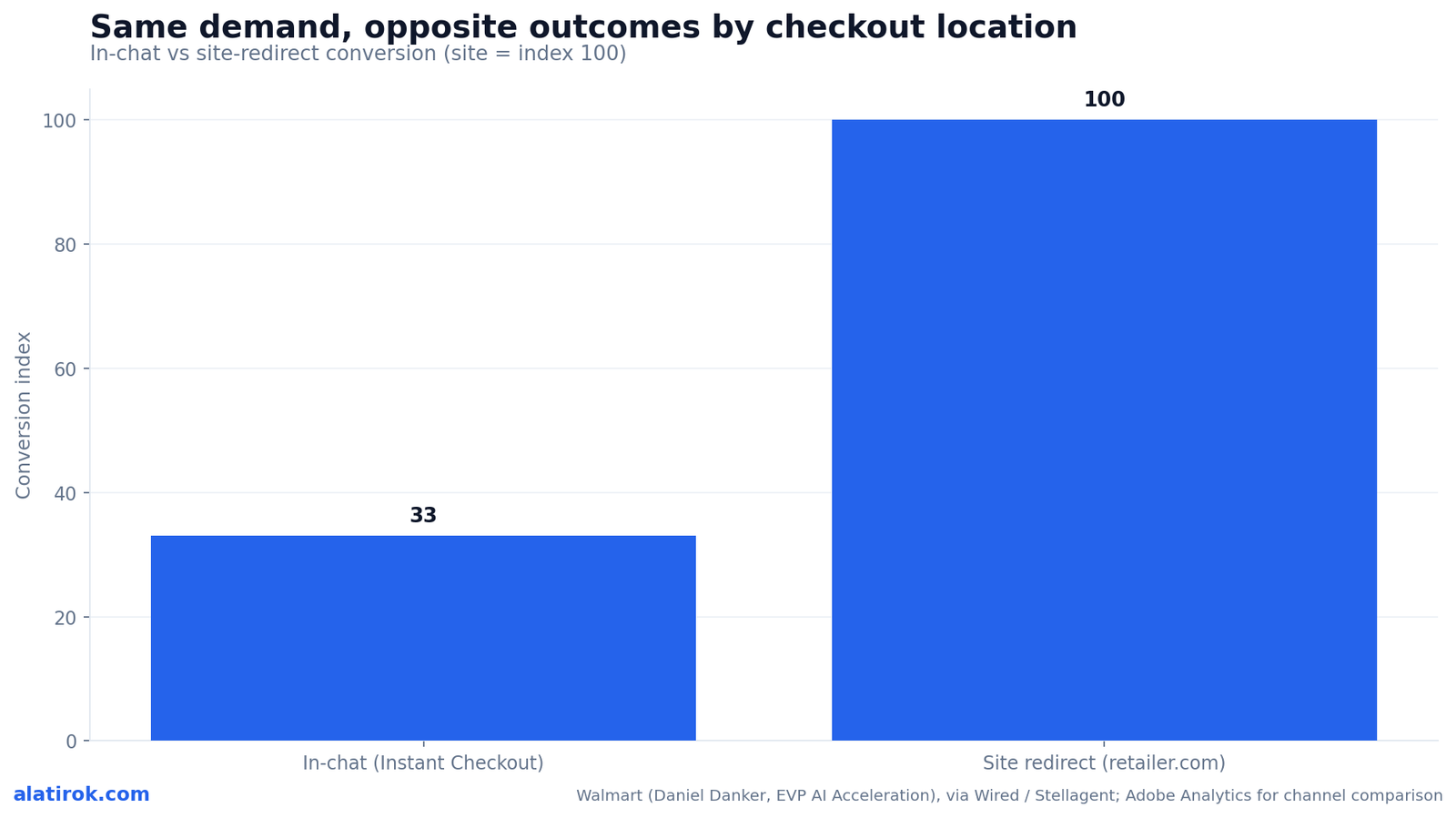
The decisive data point was conversion: Walmart found that products bought directly inside ChatGPT converted at roughly one-third the rate of the same products bought after clicking out to Walmart’s own site, a 3x gap that no amount of traffic could overcome. Daniel Danker, Walmart’s EVP of AI Acceleration, attributed the underperformance to a specific fear created by the single-item, auto-fire design.
His explanation, reported via Wired, is the most quotable diagnosis of the whole episode: customers worried that “when checkout happens automatically after every single item, they’re going to receive five boxes when they actually just want it all in one.” That is not a UI nitpick. It is shoppers correctly reading that the checkout primitive did not match how people actually buy, in baskets, with one shipment and one order they can track and return.
Set that 3x in-chat penalty against the macro trend and the tragedy sharpens. By March 2026, Adobe Analytics data showed AI-referred traffic converting about 42% better than non-AI traffic to US retail sites, a record high and a roughly 80-point swing from a year earlier when AI traffic converted worse. AI-driven retail traffic itself was up around 393% year over year in Q1 2026. Demand routed through AI was the best-converting channel retailers had, as long as the actual purchase happened on the retailer’s site.
So the patient died of a very specific cause. It was not that AI shoppers do not buy. It was that they would not buy through this particular buy button, in this particular place, with this particular single-item flow.
Missing functionality: the unglamorous 80% of commerce
Instant Checkout was missing the boring machinery that real retail runs on: no multi-item cart, no promo-code entry, no loyalty integration, no store pickup, plus weak handling of sales tax, fraud, and real-time inventory across merchants at scale. Individually each gap sounds patchable. Together they meant the in-chat flow could only serve the narrow case of a single, full-price, ship-to-home item with no coupon and no rewards, which is almost nobody’s actual shopping trip.
Webinterpret’s breakdown highlighted the absence of promotional-code entry and multi-item carts specifically. Commentary around the Walmart data added the missing loyalty programs, store-pickup options, and real-time inventory and pricing sync. OpenAI itself reportedly had not built sales-tax collection or fraud prevention into the flow, and struggled to keep inventory accurate across many merchants at once.
This is the part builders should tattoo somewhere visible. A protocol that places an order is maybe 20% of commerce. The other 80%, the carts, codes, taxes, fraud checks, loyalty, returns, and inventory truth, is exactly the substrate retailers have spent two decades hardening. An agent that wants to own the last click has to either rebuild all of it or borrow it. Instant Checkout did neither well enough, fast enough.
OpenAI’s own postmortem language was diplomatic but unambiguous: the initial version “did not offer the level of flexibility that we aspire to provide.” Flexibility, here, is a polite word for all the commerce features that were not there.
| Capability | Instant Checkout (in-chat) | Retailer’s own site |
|---|---|---|
| Multi-item cart / one shipment | No (single-item, auto-fire) | Yes |
| Promo / coupon codes | No | Yes |
| Loyalty program | No | Yes |
| Store pickup / BOPIS | No | Yes |
| Saved card and order history | No (no account) | Yes |
| Sales tax and fraud handling | Limited | Mature |
| Real-time inventory and pricing | Hard to sync at scale | Native |
The pivot: dedicated retailer apps on ACP rails
OpenAI replaced the universal in-chat buy button with dedicated retailer apps inside ChatGPT, where the merchant runs its own checkout and payment processing while OpenAI keeps the discovery layer, and ACP remains the underlying rail. Announced around March 24, 2026, the new model flips the ownership of the transaction back to the brand that already owns the customer relationship.
In practice, retailers like Walmart (with its “Sparky” app), Etsy, and Sephora build apps that surface their catalog inside ChatGPT and then route the actual purchase to their own controlled checkout, with their loyalty, accounts, taxes, and inventory intact. CNBC and others reported a growing roster of major names adopting ACP for this app-based model, including Target, Best Buy, Lowe’s, The Home Depot, Nordstrom, and Wayfair. OpenAI simultaneously rolled out richer discovery tooling to all ChatGPT tiers: visual product browsing, side-by-side comparisons of price, reviews and specs, and image-upload search.
Forrester, which had called OpenAI the leader in agentic commerce, framed the retreat as a strategic pullback rather than a defeat, and that is the right read. The discovery business is real and lucrative: AI traffic that converts 42% better than other channels is worth a referral or commission relationship even if OpenAI never touches the money. The lesson OpenAI internalized is that being the front door is a better, more defensible position than trying to also be the cash register.
Notably, the protocol won. ACP did not die with Instant Checkout; it became the connective tissue for the app model. OpenAI killed a product and kept a platform, which is usually the sign of a company that understood its own postmortem.
“OpenAI killed a product and kept a platform. The buy button died; the protocol that placed the order became the rail under everything that replaced it.”
Alatirok analysis
What builders should take from the autopsy
The reusable lesson is that in agentic commerce, discovery and settlement are different businesses with different trust requirements, and a horizontal agent should usually own the former and rent the latter. Instant Checkout failed by trying to own both at once before it had built the commerce substrate that makes settlement trustworthy.
Three structural takeaways generalize beyond OpenAI. First, the checkout primitive matters more than the model. A single-item, auto-fire design produced a rational customer fear (“five boxes”) that capped conversion at a third of the site rate, and no LLM upgrade fixes a wrong primitive. Second, trust at checkout is local. Shoppers convert where their saved card, order history, and recourse already live, which is the retailer’s site, not a chat window. Third, the protocol is the cheap part. ACP shipping in one line was never the bottleneck; tax, fraud, inventory, loyalty, and multi-item carts were.
If you are building an agent that wants to transact, the OpenAI Instant Checkout autopsy argues for a humbler architecture: be the intelligence and the front door, expose actions through an open protocol like ACP, and let the system that already owns the customer relationship own the money and the messy 80% of commerce. That is precisely the shape OpenAI landed on after five expensive months.
Pros
Cons
The verdict: demand was real, the buy button was not
OpenAI Instant Checkout did not fail because AI shoppers will not buy; it failed because the in-chat buy button was the wrong place and the wrong shape for closing a sale. Adobe’s data shows AI-referred traffic was the best-converting channel retailers had by March 2026. The product still died, because a single-item, auto-fire checkout missing carts, codes, loyalty, tax and inventory converted roughly 3x worse than the retailers’ own sites, while merchant supply stalled near 30 of a promised million-plus.
The pivot to discovery plus retailer-run apps on ACP rails is the correct correction, not a surrender. Own the front door, rent the cash register. That is the line every team shipping a transacting agent should write on the wall before they build their own version of the buy button.
Bottom line: the OpenAI Instant Checkout autopsy proves agentic shopping demand is real and rising, but settlement belongs to the merchant. Be the front door, not the cash register.Builder’s take
I build agentic systems for a living at Cyntr and Loomfeed, and the Instant Checkout postmortem reads less like a product failure and more like a category lesson. Here is what I took away as a builder.
- The protocol was the easy part. ACP shipped, Stripe wired it in one line, PayPal joined inside a month. What never shipped at scale was the boring merchant plumbing: tax, fraud, real-time inventory, multi-item carts, promo codes. Agents do not get to skip the unglamorous 80% of commerce.
- A horizontal agent is a terrible place to own the last click. ChatGPT is brilliant at discovery and disastrous at trust-at-checkout because shoppers have no saved card, no order history, and no recourse there. Owning the funnel top does not entitle you to own the funnel bottom.
- The conversion data killed it, not the vision. Adobe showed AI-referred traffic converting 42% better than non-AI by March 2026 while Walmart saw 3x worse conversion inside the chat. Same demand, opposite outcomes depending on where the buy button lived.
- Single-item, auto-fire checkout is an architecture, not a bug you patch. Walmart’s own EVP said customers feared five separate boxes. When your primitive is wrong, no amount of UX polish saves it.
- The pivot to retailer-run apps on ACP rails is the correct humility move: be the front door, let merchants keep the cash register. At Cyntr I treat every external action the same way, policy and discovery on my side, settlement on the system that already owns the customer relationship.
Frequently asked questions
OpenAI discontinued Instant Checkout on March 5, 2026, about five months after its September 29, 2025 launch. The stated reason was that it was not generating conversions: shoppers used ChatGPT to research products but completed purchases on retailers’ own sites. OpenAI said the initial version “did not offer the level of flexibility that we aspire to provide.”
Despite OpenAI promising “over a million” Shopify merchants, only about a dozen integrated initially and roughly 30 Shopify merchants were live at peak, per CNBC. Early partner Etsy confirmed it did not see a large volume of sales from the feature, though it valued the discovery traffic.
Walmart reported that products purchased directly inside ChatGPT via Instant Checkout converted at roughly one-third the rate of the same products bought after clicking through to Walmart’s own site. Walmart EVP Daniel Danker attributed this to customer fear that auto-firing checkout per item would arrive as several separate shipments instead of one order.
Because demand and the buy button are different things. Adobe Analytics found AI-referred traffic converting about 42% better than non-AI traffic to US retail sites by March 2026, with AI-driven traffic up roughly 393% year over year in Q1 2026. The demand routed through AI was strong; it just converted on the retailer’s site, not inside the chat. Instant Checkout’s in-chat flow was the part that underperformed.
OpenAI pivoted to dedicated retailer apps inside ChatGPT. Retailers such as Walmart, Etsy and Sephora build apps that surface their catalog for discovery and then route the actual purchase to their own checkout, where they control payment, loyalty, tax and inventory. The Agentic Commerce Protocol remains the underlying rail, and major names including Target, Best Buy, Lowe’s and Home Depot adopted the app model.
No. ACP, co-developed by OpenAI and Stripe and open-sourced, outlived Instant Checkout. It is processor-agnostic, so merchants on Stripe (in about one line of code) or other providers can adopt it, and it now underpins the dedicated retailer apps that replaced the in-chat buy button. OpenAI killed a product but kept the platform.
Primary sources
- OpenAI revamps shopping experience in ChatGPT after Instant Checkout — CNBC
- OpenAI’s first crack at online shopping stumbled — CNBC
- Buy it in ChatGPT: Instant Checkout and the Agentic Commerce Protocol — OpenAI
- Stripe powers Instant Checkout in ChatGPT and releases ACP — Stripe
- OpenAI and PayPal Team Up to Power Instant Checkout — PayPal Newsroom
- OpenAI’s reversal on Instant Checkout and the future of agentic commerce — Webinterpret
- Why ChatGPT Instant Checkout Failed — Walmart’s 3x Lower Conversion — Stellagent
- AI traffic to US retailers rose 393% in Q1, boosting revenue — TechCrunch
- Ecommerce Trends: AI’s key conversion metric is improving — Digital Commerce 360
- What It Means That The Leader In Agentic Commerce Just Pulled Back — Forrester
Last updated: June 1, 2026. Related: Commerce.