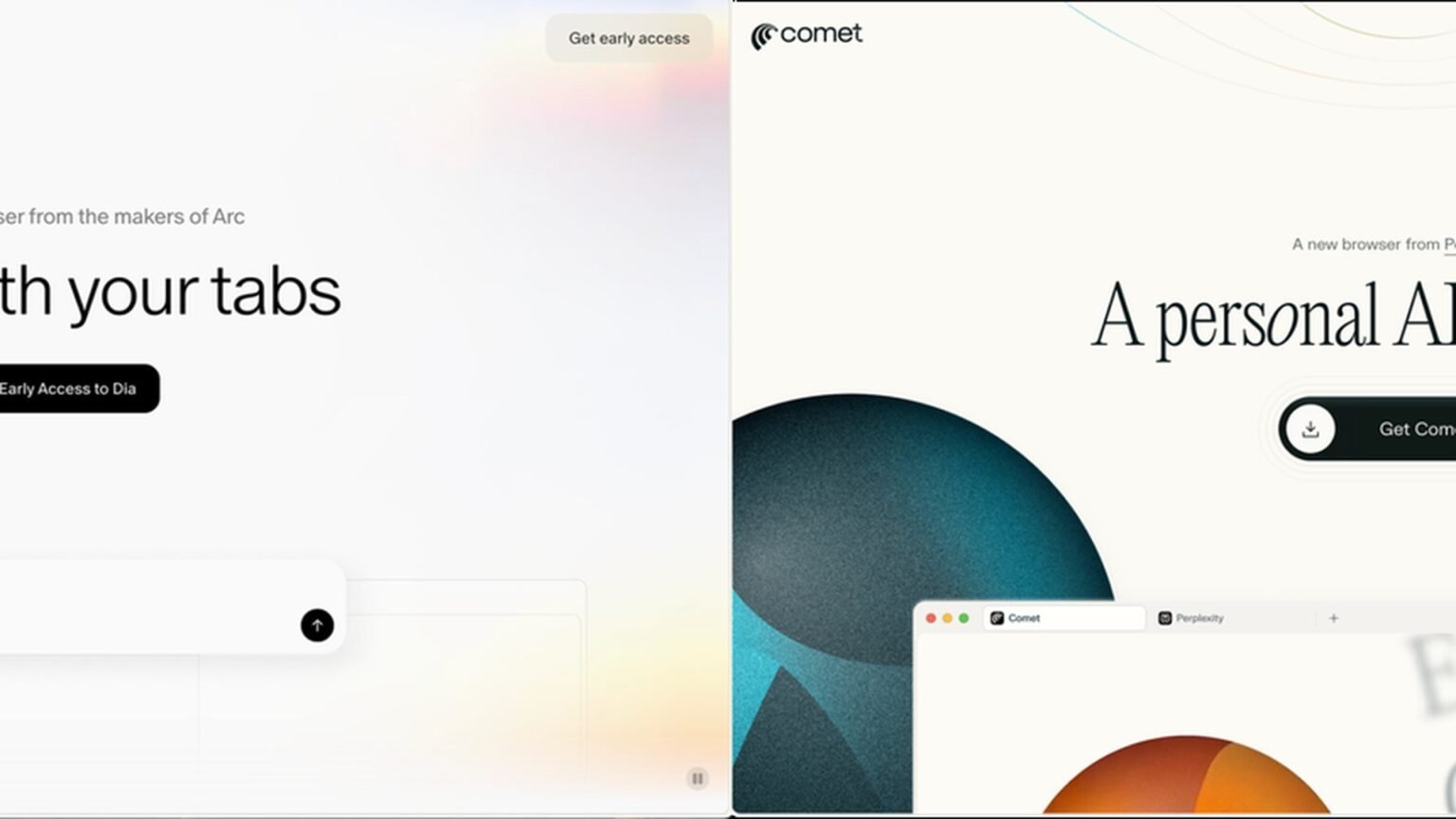

Agentic browsers are no longer a thought experiment. In 2026, the category has sharpened around a simple thesis: the browser is the best place to host AI that can read, reason, and act across the web. The Browser Company is now centered on Dia, Perplexity is rolling out Comet, Brave keeps extending Leo, and Opera has previewed Neon as an agentic browser concept. This matters because the browser already owns tabs, sessions, cookies, forms, and user context. For more on the underlying action layer, see our coverage of Anthropic Computer Use vs. OpenAI Operator and browser agents head-to-head.
The browser wars have shifted from tabs to agents
1
Core thesis
The browser is becoming the default control plane for web agents
4
Major products in view
Dia, Comet, Brave Leo, and Opera Neon
2
Winning jobs to watch
Answer-first navigation and action-taking automation
The recent event is not one launch but a category turn. The Browser Company, once identified almost entirely with Arc, now presents Dia as its next act. Perplexity has introduced Comet as a browser organized around its answer engine. Brave continues to position Leo as built-in browser AI, while Opera has put forward Neon as a browser that can chat, do, and make.
That shift matters because it reframes the browser from a passive rendering layer into an active execution surface. Search, navigation, summarization, form filling, shopping, and task completion all become candidates for one interface. The strategic bet is blunt: if AI is going to mediate how people use the web, the company that owns the browser can sit one layer closer to user intent than a standalone chatbot can.
This is why the category deserves attention now. The products differ in maturity and availability, and hard adoption data remains sparse. Still, the product direction is converging. Every serious entrant is trying to collapse three things into one place: discovery, reasoning, and action.
📌 Why now. Browsers already hold the context agents need: page state, identity, cookies, navigation history, and the UI surface where actions happen.
Dia is The Browser Company’s clearest statement yet
The Browser Company’s own messaging makes the pivot visible. On its Arc site, the company says it is now focused on building Dia. That alone is one of the strongest signals in the category: a startup that spent years trying to reinvent the browser UI now appears to believe the larger opportunity is an AI-native browser rather than another tab-management breakthrough.
Dia’s public positioning centers on AI integrated directly into browsing rather than bolted on as a sidebar. The product page frames it around writing, learning, shopping, and planning with help that understands what is open in the browser. That is the key design move in agentic browsers. Context is not imported manually into a chat window; it is ambient, drawn from the pages and tasks already in front of the user.
Where Dia looks strongest is interface ambition. The Browser Company has a track record of rethinking browser ergonomics, and Dia extends that instinct into AI mediation. The risk is also obvious. Arc built a passionate audience, but passion is not the same thing as mass migration. Dia still has to prove that AI-native browsing is compelling enough to justify switching costs from Chrome, Safari, Edge, or Brave.
Pros
Cons
“The strongest signal around Dia is not a feature list. It is that The Browser Company now presents it as the center of gravity.”
alatirok analysis
| Product | Company | Public positioning | Current strength |
|---|---|---|---|
| Dia | The Browser Company | AI-native browser built around contextual assistance | Product design and integrated browsing context |
| Comet | Perplexity | Answer-first browser tied to Perplexity search and assistant workflows | Search-native UX and existing Perplexity user base |
| Brave Leo | Brave | Built-in browser AI inside a privacy-focused browser | Distribution through an established browser |
| Opera Neon | Opera | Agentic browser concept focused on chat, doing tasks, and making content | Clear agent framing from an incumbent browser vendor |
Comet gives Perplexity a path beyond search
Comet’s advantage: a search habit it can extend
Perplexity’s Comet may be the most strategically legible move in the category. Perplexity already owns a strong association with answer-first search. A browser lets it move from answering questions to shaping the full session: what users open, how they compare sources, and eventually what actions they take next.
That matters because search economics reward default surfaces. If Perplexity wants to compete with Google at the workflow level rather than only at the query level, a browser is the natural expansion. Comet can combine search, assistant behavior, and browsing context in one loop. The company does not need to teach users a new habit from scratch; it can extend a behavior many already know from Perplexity’s core product.
Where Comet looks strongest is distribution through an existing AI brand with mainstream awareness. Perplexity has already built a consumer habit around asking and refining questions. The browser gives it a way to capture the next click, the next tab, and the next action. The challenge is whether answer-first UX can scale into a full browser experience without feeling like a search product wrapped around Chromium.
📌 Strategic edge. Perplexity enters the browser race with an existing consumer behavior: users already treat it as a place to start research.
Brave Leo and Opera Neon show two different incumbent responses
Brave’s approach is less theatrical but arguably more grounded. Leo is built into a browser that already has a real installed base, a strong privacy identity, and adjacent products including search and VPN. That gives Brave a practical advantage in the agentic-browser race: it does not need users to adopt a new browser concept before they can try AI features.
The company’s public materials emphasize that Leo can summarize pages, answer questions, create content, and interact with webpages, while Brave continues to foreground privacy controls. For users and teams wary of routing all browsing through a new AI-native startup, that combination may be more attractive than the flashier entrants. Brave’s weakness is that Leo can still feel like an integrated assistant inside a browser rather than a browser rebuilt around agency from first principles.
Opera is taking a more explicit category-marketing route with Neon. Its messaging divides the product into chat, do, and make. That language is notable because it maps neatly onto the three layers the whole category is chasing: conversational assistance, delegated actions, and generated outputs. Opera has not yet shown the same level of market pull around Neon as Brave has around its core browser, but it has articulated the agentic thesis in unusually direct terms.
⚠️ Category caveat. Not every browser with AI qualifies as truly agentic. The dividing line is whether the AI can reliably use browser context and take meaningful actions, not just summarize pages.
| Dimension | Brave Leo | Opera Neon |
|---|---|---|
| Go-to-market | Extend AI into an existing browser and privacy stack | Launch a browser concept explicitly framed around agents |
| Public emphasis | Built-in AI with privacy positioning | Chat, do, and make |
| Likely buyer appeal | Users who want AI without leaving a familiar browser brand | Early adopters drawn to agent-first workflows |
What counts as real adoption signal in this category
The metric that matters next: trusted actions
The category’s biggest analytical problem is evidence. Browser companies and AI startups are happy to show demos, waitlists, and product pages. Much fewer are publishing durable metrics that let outsiders compare traction cleanly. That means readers should separate three kinds of signal: installed browser distribution, active AI usage inside the browser, and evidence that users trust the product with actions rather than just summaries.
On that framework, Brave has the clearest distribution base because it is extending AI inside an established browser. Perplexity has a strong top-of-funnel brand because many users already begin research there. The Browser Company has outsized mindshare among design-conscious power users and developers, which gives Dia a disproportionate influence on the conversation even without public mass-market numbers. Opera has incumbent browser history and a recognizable brand, though Neon’s market proof still looks earlier.
The harder signal to find is repeated delegated action. It is one thing for a browser assistant to summarize ten tabs. It is another for users to trust it with shopping flows, travel booking, CRM updates, or repetitive back-office work. That is where the category intersects with the broader browser-agent stack discussed in our analysis of Anthropic Computer Use vs. OpenAI Operator. The browser can be the front end, but reliability on real tasks remains the gating factor.
“The real adoption test is not whether users ask the browser questions. It is whether they let the browser do work.”
alatirok analysis
Why the browser is the natural home for web agents
There is a structural reason this category keeps resurfacing. The browser already has the ingredients that standalone assistants struggle to assemble cleanly: authentication state, page-level visibility, user navigation history, form fields, and a direct rendering layer for feedback and correction. In practical terms, that means an agentic browser can observe what the user is trying to do and act in the same environment where the task lives.
That architecture also explains why so many AI companies want browser control. If your assistant lives outside the browser, every action requires handoff friction. If it lives inside the browser, the assistant can move from answer to action with less context loss. This is also why the category overlaps with computer-use systems and browser automation frameworks. The browser is becoming both interface and runtime.
For developers and infrastructure vendors, this creates a second-order opportunity. Agentic browsers will need observability, permissioning, replay, policy controls, and secure ways to handle credentials and payments. If the consumer-facing products succeed, the enterprise tooling layer behind them will become a serious market of its own.
📌 Infrastructure implication. If browsers become agent runtimes, the next wave of value may accrue to identity, observability, and governance layers that sit behind delegated actions.
{
  "agentic_browser_stack": {
    "surface": ["search", "chat", "tab context", "page controls"],
    "runtime": ["navigation", "DOM interaction", "session state"],
    "trust_layer": ["permissions", "identity", "audit logs", "policy"]
  }
}
What happens next
Bottom line: the browser is becoming an AI surface, not just a window
The next 12 months will likely decide whether agentic browsers become a durable category or remain a premium niche for early adopters. The winning products will need more than polished demos. They will need clear permission models, reliable task execution, and enough everyday utility to justify a browser switch. That is a high bar because browsers are sticky products and Chrome remains the default environment for much of the web.
Still, the direction of travel is hard to miss. The Browser Company is betting its future on Dia. Perplexity is moving from search into the browser itself. Brave is using distribution and privacy to make AI feel safer and more practical. Opera is trying to define the category in explicit agent terms. None of those moves looks accidental.
For readers tracking the AI stack, the takeaway is simple: agentic browsers are becoming the consumer edge of browser automation and computer-use systems. If they work, they could reshape not just search and browsing, but how software is discovered, compared, and operated on the open web. For a deeper product comparison, see our companion piece on browser agents head-to-head in 2026.
Frequently asked questions
An agentic browser is a web browser designed to do more than render pages or answer questions. It uses built-in AI to understand page context, help users navigate, and in some cases take actions across websites. Public examples include Dia, Comet, Brave Leo, and Opera Neon.
The Browser Company’s public messaging now points readers toward Dia, and the company has stated on its Arc site that it is focused on building Dia. That makes Dia the clearest expression of its current AI-native browser strategy.
Comet extends Perplexity beyond answer-first search into the browser itself. The strategic difference is that a browser can combine search, page context, and user actions in one environment rather than handing users off from a search result to a separate browsing workflow.
On publicly visible evidence, Brave Leo benefits from being integrated into Brave’s existing browser distribution. That does not automatically make it the category leader in agentic behavior, but it gives Brave a practical path to user adoption without requiring a fresh browser install for every AI feature.
Primary sources
- Dia — The Browser Company
- Arc by The Browser Company — The Browser Company
- Perplexity Comet — Perplexity
- Brave Leo — Brave
- Opera Neon — Opera
Last updated: May 20, 2026. Related: Agent Infrastructure.