
AI in education 2026 is no longer one market. Schools and families are choosing among four different jobs: student tutoring, teacher productivity, classroom-safe AI access, and adaptive curriculum. That makes Khanmigo, Synthesis, MagicSchool, and Brisk Teaching less like direct substitutes and more like competing answers to different adoption bottlenecks.
The market has split into four buying decisions
4M+
teachers worldwide using MagicSchool
Claimed on MagicSchool site
$35/yr
Khanmigo for Teachers
Listed on Khanmigo site
$60–90/mo
Synthesis subscription range
Per editor-provided verified context
The cleanest way to read AI in education 2026 is by buyer intent, not by model quality. Parents tend to ask whether a tool can help a child learn math or writing without doing the thinking for them. Teachers ask whether it saves time on lesson plans, rubrics, feedback, and communication. Districts ask whether students can use AI inside a monitored environment that fits procurement, privacy, and safety requirements. Curriculum leaders still care about adaptive learning systems that tune pace and practice over time.
That framing matters because the products in this comparison sit in different lanes. Khanmigo spans tutoring and teacher assistance. Synthesis is a premium K-8 tutoring bet. MagicSchool is a teacher workflow platform. Brisk lives inside the browser and classroom workflow. School AI and DreamBox are not the main scored products here, but they matter because they define the classroom-safe and adaptive categories that shape district decisions.
The most important competitive reality is simple: teacher tools have moved faster than student tutors. MagicSchool and Brisk fit existing teacher workflows and can be tried without a district-wide curriculum rewrite. Student-facing tutors face a harder trust question from parents and schools, even when the product quality is strong.
Compare these tools by job-to-be-done first: tutor, teacher productivity, classroom-safe access, or adaptive curriculum.
Khanmigo verdict: best student-learning brand trust
Khanmigo has the strongest trust advantage in this set because it extends Khan Academy’s existing learning brand rather than asking schools and parents to adopt a net-new education company. On its product page, Khan Academy positions Khanmigo as both an AI tutor for learners and an AI-powered teaching assistant for educators. The site also says Khanmigo is built with support from both OpenAI and Anthropic, which is notable in a market where model-provider concentration can become a procurement concern.
For AI in education 2026, Khanmigo’s biggest edge is not just the model layer. It is the combination of curriculum familiarity, nonprofit credibility, and a pricing posture that is easier to explain than premium tutoring subscriptions. Khan Academy lists Khanmigo for Teachers at $35 per year, which makes it legible as a teacher-assistant purchase even when a district is not ready to roll out student-facing AI broadly.
The trade-off is that Khanmigo sits in the most contested part of the market: AI tutoring. Parents and educators still debate whether a conversational tutor scaffolds learning or creates dependency. Khan Academy’s own messaging leans toward guided questioning and coaching rather than answer-spitting, which is the right product posture, but the adoption hurdle remains real.
Khanmigo ⭐ Editor’s Pick
Best for: Parents, teachers, and schools already aligned with Khan Academy content
What works
Watch out for
Choose Khanmigo when trust, curriculum familiarity, and flexible teacher-plus-student use matter more than premium live tutoring.
“Khanmigo is your AI-powered guide for teaching and learning.”
Khanmigo homepage
Synthesis verdict: strongest premium tutor positioning
Synthesis is the clearest premium bet in this comparison. Its positioning centers on K-8 math learning, and the company has long leaned into a higher-touch experience than generic chatbot tutoring. The editor-provided verified context places the subscription in the $60 to $90 per month range per student, which immediately separates it from teacher-productivity tools and from lower-cost schoolwide options.
That premium posture can be an advantage. Families that are already paying for enrichment often want something that feels more structured than open-ended AI chat. Synthesis also benefits from a brand halo tied to Sam Altman’s backing, though that alone will not win district procurement. In practice, Synthesis looks more like a parent-purchased or supplemental-learning product than a default district platform.
In AI in education 2026, Synthesis is compelling when the buyer wants a focused math experience and is comfortable paying for it. It is less compelling as a broad school operating layer. The product can win on perceived quality and engagement, but it does not have Khan Academy’s nonprofit familiarity or MagicSchool’s teacher workflow footprint.
Synthesis
Best for: Parents willing to pay for structured K-8 math support
What works
Watch out for
Synthesis can be excellent for motivated families, but its premium pricing narrows the addressable school market.
MagicSchool verdict: best teacher productivity platform
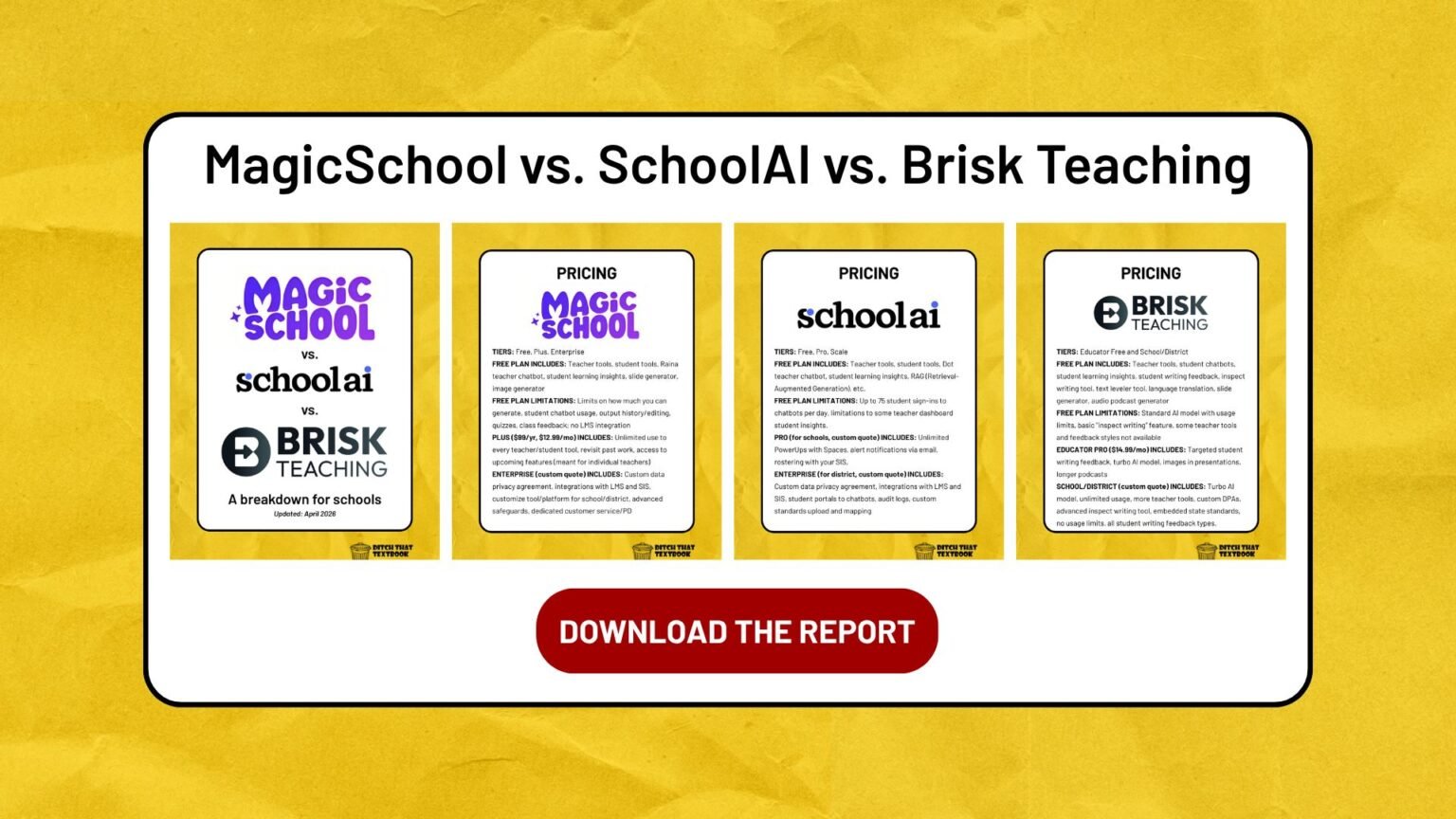
MagicSchool has the strongest evidence of teacher-side distribution. The company says it is used by 4 million+ teachers worldwide and markets more than 80 tools for common educator tasks such as lesson planning, rubrics, IEP support, and parent communication. That is a different adoption story from student tutoring. It is about reducing administrative and planning load in a workflow teachers already own.
This is why MagicSchool may be the clearest example of what has actually crossed the chasm in AI in education 2026. Teachers do not need to believe AI can replace instruction to value a faster first draft of a rubric or a parent email. The product’s free tier and Pro plan, listed at $9.99 per month, make it easy to test at the individual-teacher level before a school or district standardizes.
The risk is platform pressure. Google Classroom, Microsoft, and other incumbents are steadily adding AI features where teachers already work. MagicSchool’s defense is specialization: purpose-built education workflows, not generic office copilots. Whether that remains enough will depend on how much schools prefer dedicated education UX over bundled platform AI.
MagicSchool AI
Best for: Teachers and schools standardizing AI for planning, communication, and classroom prep
What works
Watch out for
If your main goal is saving teacher time today, MagicSchool is the strongest default pick.
“Join 4M+ educators using MagicSchool.”
MagicSchool homepage
Brisk verdict: best embedded workflow tool, with School AI as the district-safe complement
Brisk Teaching takes a different route from MagicSchool. Rather than becoming a destination platform, it embeds into the browser and classroom tools teachers already use, including Google Docs and Google Classroom, according to the company’s site. That matters because many teachers do not want another tab, another workspace, or another migration project. They want AI where grading, commenting, and assignment review already happen.
That makes Brisk one of the more practical products in AI in education 2026. If MagicSchool is the broad teacher toolkit, Brisk is the workflow-native assistant. Its value proposition is strongest around feedback on student work and in-context teacher actions. For schools standardized on Google-heavy workflows, that can be a simpler adoption path than a separate planning hub.
School AI belongs in the same conversation even though it is not one of the four scored products. Its pitch is classroom-wide, teacher-supervised student interaction with AI, which is exactly the kind of product districts evaluate when they want student access without opening the door to unmanaged consumer chatbots. In other words, Brisk wins on teacher embed; School AI wins on supervised student access.
Brisk Teaching
Best for: Google Classroom and Docs-centric teachers who prioritize in-context feedback
What works
Watch out for
Pros
Cons
Brisk is a teacher workflow layer. School AI is a classroom-governance layer.
Parent demand and district demand are diverging
One reason this market feels noisy is that parents and districts are not buying for the same reason. Parents evaluate learning outcomes, engagement, and whether the product helps a child think independently. Districts evaluate policy fit, safety controls, procurement complexity, and whether the tool can be deployed consistently across classrooms. Those are different filters, and they produce different winners.
That split is the core story of AI in education 2026. Teacher productivity tools have an easier path because they solve a visible labor problem without requiring schools to hand more autonomy to students. Student tutors are more emotionally charged. Even when a tutor is designed to coach rather than answer, families and educators still worry about overreliance, screen time, and whether the product substitutes for human support.
This is also why platform incumbents remain a threat. If Google and Microsoft add enough AI to the systems schools already use, standalone vendors will need to prove they are not just model wrappers. The strongest defenses are trust, workflow depth, and policy-aware deployment.
What does a typical district procurement flow look like?
District adoption usually moves through curriculum review, privacy and legal review, IT/security review, pilot approval, and then purchasing. Products that can start with teacher-side use often move faster because they avoid immediate student-data and classroom-supervision questions.
COPPA and FERPA are still the gatekeepers
Any serious discussion of school adoption has to start with privacy law and student data handling. In the U.S., COPPA and FERPA are not side issues. They are procurement gates. A product can have excellent UX and still stall if a district cannot get comfortable with data practices, parental consent requirements, or how student records are handled.
For buyers evaluating AI in education 2026, this means the product demo is only half the story. Districts need documentation, admin controls, and clear answers on what data is collected, how it is used, and whether it is retained. Teacher-led pilots can open doors, but districtwide deployment usually depends on privacy review as much as pedagogy.
This is one reason classroom-safe and teacher-supervised products have gained traction. They fit the institutional need for visibility and control. Open consumer AI tools may be easy to access, but they are much harder to govern in a school setting.
If a vendor cannot answer privacy, retention, and supervision questions clearly, the sales cycle slows down fast.
Why does COPPA matter for student-facing AI tools?
The Children’s Online Privacy Protection Rule governs online collection of personal information from children under 13. For student-facing AI, that raises questions about consent, data collection, and how interactions are stored or processed.
Why is FERPA central in school procurement decisions?
The U.S. Department of Education explains that FERPA protects the privacy of student education records. Districts therefore examine whether a tool touches education records, who can access them, and what contractual controls are in place.
What AI still has not replaced in the classroom
Best overall: Khanmigo for broad adoption, MagicSchool for teacher ROI
The strongest vendors in this category are careful not to claim that AI replaces teachers. That restraint is justified. AI can help with drafting, tutoring prompts, feedback scaffolds, and adaptive pacing. It still does not replace social-emotional support, peer learning, hands-on labs, physical activity, or the moment-to-moment judgment teachers use to respond to a student who is confused, disengaged, or overwhelmed.
That is the right closing lens for this comparison. In AI in education 2026, the winning products are not the ones that promise full automation. They are the ones that fit around human teaching: saving time, adding practice, or creating safer access patterns without pretending software can absorb the full job of a school.
| Use case | Best fit | Why |
|---|---|---|
| Parent wants a trusted general AI tutor | Khanmigo | Best mix of tutoring, brand trust, and approachable pricing |
| Parent wants premium K-8 math support | Synthesis | Focused premium tutoring experience |
| Teacher wants lesson plans, rubrics, and admin help | MagicSchool AI | Broadest teacher-task coverage |
| Teacher wants AI inside Google workflow | Brisk Teaching | Embedded in classroom tools and feedback flow |
| District wants supervised student-AI access | School AI | Built around teacher-supervised classroom interaction |
| District wants adaptive math curriculum | DreamBox or Khan Academy stack | Better fit for pacing and curriculum alignment than generic chat |
Frequently asked questions
For teacher productivity, MagicSchool is the strongest broad platform because it offers educator-specific tools for planning, rubrics, IEP support, and communication. Brisk Teaching is a better fit if you want AI embedded directly in browser-based classroom workflows.
Because school adoption depends on privacy and student-data handling, not just product quality. The FTC’s COPPA rule and the U.S. Department of Education’s FERPA guidance shape how districts evaluate student-facing AI.
Primary sources
- Khanmigo official site — Khan Academy
- Synthesis official site — Synthesis
- MagicSchool official site — MagicSchool
- Brisk Teaching official site — Brisk Teaching
- School AI official site — School AI
- DreamBox official site — DreamBox
- FTC COPPA Rule — Federal Trade Commission
- U.S. Department of Education FERPA FAQ — U.S. Department of Education
Last updated: May 26, 2026. Related: Products.