
1 project, up to $500 billion, and one confirmed first site in Abilene, Texas: that is the verified core of the Stargate compute project announced by OpenAI, Oracle, SoftBank, and MGX in January 2025. The rest needs careful separation between signed commitments, public disclosures, and forward-looking rhetoric. This news analysis maps what the partners have actually said on the record, what Oracle has disclosed in filings, and why the buildout matters for the future of OpenAI’s infrastructure strategy, cloud bargaining power, and the broader AI capex race. For background on OpenAI’s product arc, see our OpenAI timeline. For the competitive context, see our Anthropic vs. OpenAI analysis.
The verified headline: a new AI infrastructure company with a Texas starting point
$500B
Stated four-year investment target
OpenAI said Stargate “intends to invest” this amount
$100B
Immediate deployment figure cited at launch
OpenAI said the project would begin deploying this amount immediately
1
Confirmed first site named by OpenAI
Abilene, Texas
OpenAI announced The Stargate Project on January 21, 2025 as “a new company which intends to invest $500 billion over the next four years building new AI infrastructure for OpenAI in the United States.” The announcement named SoftBank, OpenAI, Oracle, and MGX as the initial equity funders, with SoftBank handling financial responsibility and OpenAI handling operational responsibility. Arm, Microsoft, NVIDIA, and Oracle were listed as key initial technology partners.
That launch statement remains the cleanest primary source for what was formally announced. It verifies the project structure, the participants, the US focus, and the “intends to invest” wording. It does not prove that the full $500 billion had already been contractually committed on day one. That distinction has mattered ever since, because much of the public conversation has treated the top-line number as if it were already equivalent to fully financed, shovel-ready spend.
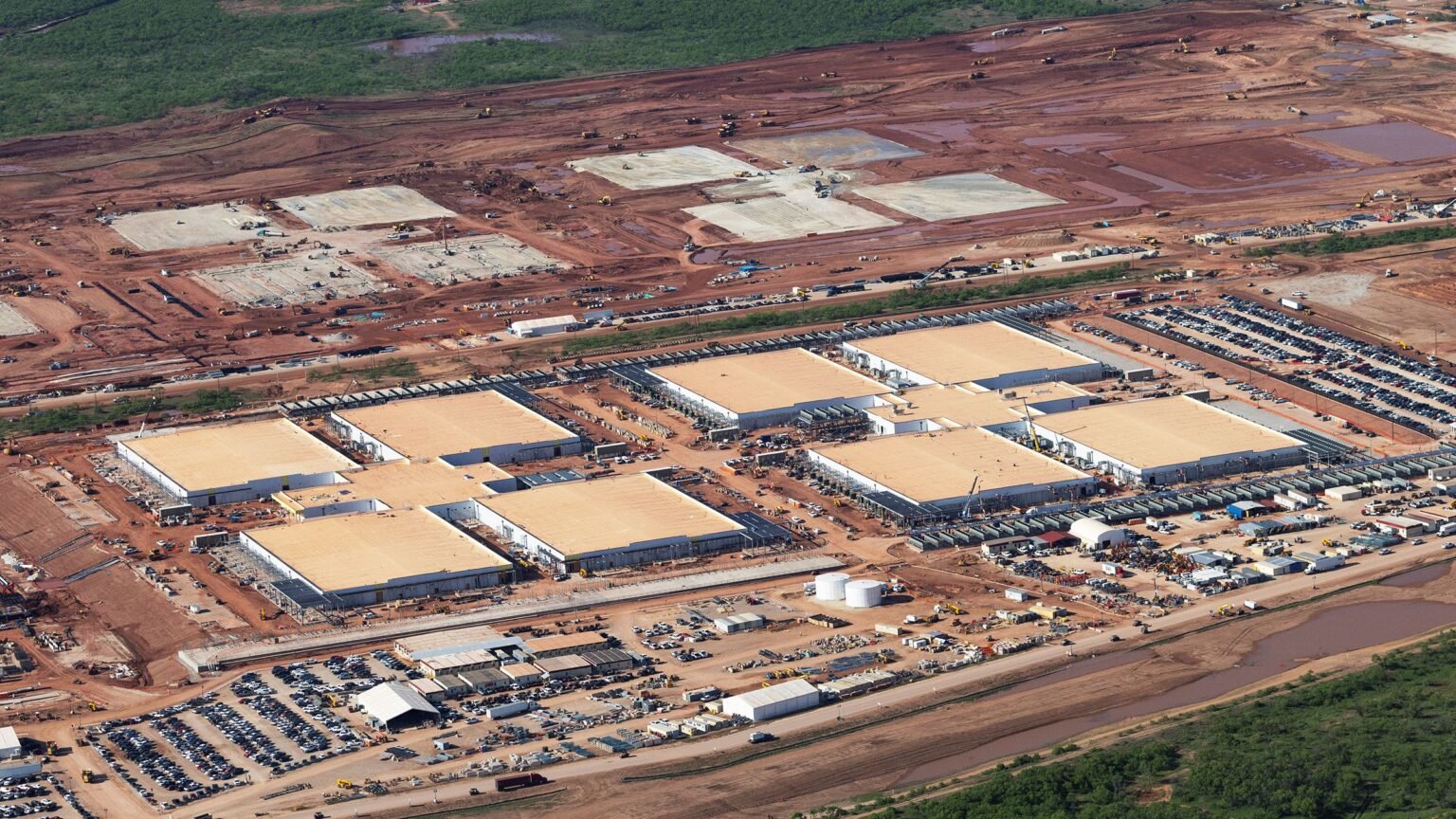
OpenAI also said construction was already underway in Texas at the time of announcement and that the company was evaluating potential campuses across the country. Later, OpenAI identified Abilene, Texas as the first Stargate site in a broader infrastructure post published in 2025. That gives readers one confirmed anchor: Stargate is not just a concept deck. At least one Texas buildout was publicly tied to the project by OpenAI itself.

Verified: Stargate was announced by OpenAI, SoftBank, Oracle, and MGX; OpenAI said it intends to invest up to $500 billion over four years; Abilene, Texas was later identified by OpenAI as the first site. Not verified from primary sources: a fixed final site count, a fully committed $500 billion on day one, or a complete public map of every campus.
What the White House event established — and what it did not
The launch was staged with unusual political weight. President Donald Trump appeared with Masayoshi Son, Sam Altman, and Larry Ellison at the White House in January 2025, framing Stargate as a major domestic infrastructure push. The White House archived a readout under its official archive, and the event helped cement Stargate as a national industrial policy story rather than a normal cloud procurement announcement.
The political theater mattered because it signaled federal support for accelerated AI infrastructure buildout, especially around permitting, energy, and domestic competitiveness. It also elevated Stargate above the level of a bilateral vendor contract. The message was that this was a strategic US compute program with private capital behind it and government enthusiasm around it.
Still, the White House event did not publish a project finance schedule, a site-by-site construction plan, or a detailed capex waterfall. Readers should resist treating the ceremony as evidence that every dollar had already been allocated. The event verified political backing and participant alignment. It did not settle the harder questions around timing, debt, equity, power procurement, or the exact sequence of campuses.
“The public launch proved Stargate was politically real. It did not prove every dollar in the headline had already been contractually locked.”
Alatirok analysis of OpenAI and Oracle primary disclosures
Abilene is the clearest confirmed site
Among all the speculation around Stargate campuses, Abilene is the site with the strongest public confirmation trail. OpenAI’s Introducing OpenAI for Countries post described Stargate as “our first supercomputing campus in Abilene, Texas.” That wording is unusually direct. It ties a named location to the Stargate program and frames the site as a supercomputing campus rather than a generic colocation footprint.
Oracle has also pointed to major OpenAI-related capacity expansion. In its fiscal 2025 annual report, Oracle said it signed a cloud agreement with OpenAI that can generate more than $30 billion in annual revenue beginning in fiscal year 2028. Oracle did not label that filing disclosure “Stargate” in the sentence itself, but the timing and partnership structure line up with Oracle’s central role in OpenAI’s new infrastructure stack.
There are also local and partner-level reports around the Abilene buildout, but the safest way to state the story is narrow: OpenAI has publicly named Abilene as the first Stargate supercomputing campus, and Oracle has disclosed a very large OpenAI cloud contract that supports the thesis that substantial dedicated capacity is being built. Anything beyond that — exact megawatt figures, final GPU counts, or the complete campus topology — should be treated cautiously unless sourced to official filings or company statements.
Abilene is not rumor. OpenAI publicly identified it as the first Stargate supercomputing campus.
| Claim | Status | Primary source |
|---|---|---|
| Stargate is a new company for US AI infrastructure | Verified | OpenAI announcement |
| Up to $500B over four years | Verified as stated intention | OpenAI announcement |
| Abilene, Texas is the first Stargate site | Verified | OpenAI infrastructure post |
| Oracle is a key operating/cloud partner | Verified | OpenAI announcement and Oracle filings |
| Exact final number of Stargate campuses | Not publicly verified | No definitive primary-source list |
| Entire $500B fully committed at launch | Not publicly verified | Announcement used “intends to invest” |
Oracle’s role is larger than a normal cloud supplier relationship
If there is one partner whose role looks most concrete in the public record, it is Oracle. OpenAI named Oracle as a key initial technology partner at launch. Oracle then gave investors a much more tangible signal in its annual report, disclosing a cloud agreement with OpenAI expected to contribute more than $30 billion in annual revenue starting in fiscal 2028.
That disclosure matters for two reasons. First, it suggests the OpenAI-Oracle relationship is not a sidecar to Microsoft Azure. It is large enough to become financially material to Oracle’s cloud business. Second, the fiscal 2028 timing implies a multi-year ramp in infrastructure delivery. That fits the idea of phased campus construction and staged capacity activation rather than one giant all-at-once deployment.
Oracle’s positioning also helps explain why Stargate should be understood as a compute and data center buildout, not only a financing vehicle. Oracle brings cloud operations, data center experience, and a route to commercializing dedicated capacity for OpenAI workloads. In practical terms, Stargate appears to be one of the clearest examples yet of an AI lab trying to secure bespoke infrastructure outside the traditional hyperscaler dependency model.
Pros
Cons
OpenAI is the lead workload, which changes the Microsoft equation
The launch announcement was explicit that Stargate is being built “for OpenAI.” That is the strategic hinge. For years, the market treated Microsoft Azure as the default home of OpenAI’s largest training and inference workloads. Stargate does not erase Microsoft’s importance overnight, but it clearly broadens OpenAI’s compute base and bargaining position.
OpenAI’s January 2025 post also said the company would “continue to increase our consumption of Azure as OpenAI continues to train leading models and deliver great products and services.” That line is easy to miss, but it is crucial. Stargate was introduced as additive, not as a public divorce filing. OpenAI was signaling a more plural infrastructure strategy while preserving the Microsoft relationship.
That shift has major implications for the AI platform stack. If OpenAI can source frontier compute from a combination of Azure and Oracle-backed Stargate capacity, it gains more leverage over pricing, scheduling, and deployment architecture. It also reduces the strategic risk of having one cloud provider sit too close to the center of its product roadmap. We explored the competitive side of that dynamic in our Anthropic vs. OpenAI breakdown and in our analysis of the Microsoft-OpenAI relationship.
Stargate changes OpenAI’s compute posture, but OpenAI also said it would continue increasing Azure consumption. The evidence supports diversification, not a clean break.
The $500 billion figure is best read as an ambition with phases
Best reading of the capex number: directional, not fully de-risked
The most repeated number in the Stargate story is also the one most likely to be misunderstood. OpenAI’s own wording was that Stargate “intends to invest $500 billion over the next four years,” with $100 billion to be deployed immediately. That is a statement of planned scale and near-term mobilization. It is not the same thing as a public filing showing every tranche of capital already closed.
That does not make the number meaningless. In infrastructure, especially power-hungry AI infrastructure, top-line targets often function as a directional commitment around land, power, equipment, and financing pipelines that come together in stages. The immediate deployment language suggests the consortium wanted to signal that this was not merely a memorandum of understanding. Yet the absence of a fully public financing schedule means readers should avoid treating the full four-year figure as if it were all equally de-risked.
This is where Stargate sits between two narratives. One narrative says the project is overhyped because the full amount was not visibly committed at launch. The other says skepticism misses the point because projects of this size are always phased. The primary-source view lands in the middle: the ambition is real, the first site is real, Oracle’s commercial tie-in is real, and the exact pace and total realized spend remain contingent.
Site count, geography, and timing remain less settled than headlines imply
Since launch, a steady stream of reports and local speculation has tried to map Stargate’s eventual footprint. Some of that may prove accurate. The problem for a careful reader is that the public primary-source record still does not provide a definitive list of every campus, every state, or every delivery milestone. OpenAI’s announcement said the company was evaluating potential sites across the country. That is not the same as confirming them.
The temptation to overstate site count is understandable. AI infrastructure reporting often moves faster than permits, utility interconnects, and formal company disclosures. But in a project this large, there can be a wide gap between a scouted location, a negotiated power arrangement, a signed lease, and an operating supercomputing campus.
For now, the cleanest formulation is simple: Abilene is confirmed; broader national expansion is part of the stated plan; the final footprint is still not fully public. That may frustrate readers looking for a neat map, but it is a more accurate picture than pretending the entire network has already been disclosed.
Why this matters beyond OpenAI: power, chips, and the new AI industrial stack
Stargate matters because it pushes AI competition down into the physical layer. Frontier model leadership is no longer just about research talent and product distribution. It is about who can secure power, cooling, networking, land, and enough accelerator supply to keep training and inference pipelines moving. That is why the project drew not only software attention but also national political attention.
The launch announcement named NVIDIA and Arm as key initial technology partners. Even without a public bill of materials, that points to the broader industrial stack behind Stargate: chip design, accelerator systems, cloud operations, and financing all have to line up. The result is a model of AI competition that looks more like telecom or energy infrastructure than classic SaaS scaling.
This is also why Stargate should be read alongside the wider capex race among hyperscalers and model labs. The frontier is increasingly set by access to sustained compute, not just access to one-off clusters. We have covered that shift in our AI agent infrastructure stack analysis and in our look at observability for large-scale AI systems. The labs that can lock in infrastructure will have an advantage not only in training but in serving agentic products at scale.
The financing structure tells its own story
The participant list is unusual enough to deserve its own reading. SoftBank was assigned financial responsibility, OpenAI operational responsibility, Oracle a central technology and cloud role, and MGX a place among the initial equity funders. That is not a standard cloud resale arrangement. It is a consortium model built to spread capital intensity across different kinds of strategic actors.
For SoftBank, the fit is obvious: large-scale infrastructure bets have long matched Masayoshi Son’s appetite for category-shaping capital deployment. For Oracle, Stargate creates a path to become a much more consequential AI infrastructure provider. For OpenAI, it offers a route to dedicated capacity without owning every layer of the stack outright. For MGX, it aligns with the Gulf’s broader push into strategic AI investment.
The structure also reflects a hard truth about frontier AI economics. No single model lab wants to carry all the capex burden alone if it can avoid it. Shared financing and operating partnerships are becoming the norm because the cost of staying at the frontier is converging with the cost profile of heavy infrastructure industries.
What reactions got right — and where they ran ahead of the facts
The middle view is the accurate one
Supporters of Stargate got one big thing right immediately: the project marked a new ceiling for AI infrastructure ambition. Even if the full four-year target is phased, no other single announced AI infrastructure effort matched its scale at launch. The symbolism alone changed expectations for what frontier labs and their partners are willing to spend to secure compute.
Critics also got something right: the public record did not justify treating every headline number as already locked and funded. In that sense, skepticism improved the conversation by forcing a distinction between announced intent and disclosed commitments. That distinction is healthy, especially in a market where AI narratives can outrun construction realities.
Where commentary often went too far was in collapsing the story into either hype or certainty. The evidence does not support either extreme. Stargate is neither a vaporous press release nor a fully transparent, fully mapped national buildout. It is a real infrastructure program with one confirmed campus, a major Oracle commercial tie-in, and substantial unanswered questions about final scale and timing.
What to watch next
The next phase of reporting on Stargate should focus less on launch rhetoric and more on operational proof points. The most important signals will be additional official site confirmations, utility and power disclosures, Oracle updates that sharpen the OpenAI revenue ramp, and any new OpenAI statements clarifying how Stargate capacity is being used for training versus inference.
Readers should also watch the Microsoft angle. If OpenAI continues to deepen Oracle-backed dedicated capacity while still expanding Azure usage, the result could be a more modular frontier compute strategy than the market expected in 2023 and 2024. That would have implications for cloud competition, model deployment economics, and the balance of power between labs and hyperscalers.
One more thing matters: whether Stargate becomes a one-off flagship or the template for future sovereign and semi-sovereign AI infrastructure partnerships. OpenAI’s later OpenAI for Countries framing hints at a broader playbook in which dedicated national or regional AI infrastructure becomes part of how leading labs expand. If that happens, Stargate will look less like an exception and more like the first mature expression of a new compute era.
The strongest future evidence will come from official site confirmations, utility/power disclosures, Oracle investor filings, and OpenAI statements on workload allocation.
Bottom line: what’s actually being built
What’s actually being built: a real first campus, a real Oracle tie-in, and a larger plan still unfolding
Here is the shortest accurate answer to the question in the headline. The Stargate compute project is a US-focused AI infrastructure company and buildout announced by OpenAI, SoftBank, Oracle, and MGX in January 2025, with political backing from the White House at launch. OpenAI is the lead workload. Oracle is the most visible cloud and operating partner in the public record. Abilene, Texas is the first confirmed Stargate supercomputing campus named by OpenAI.
What is not yet fully public is the complete national footprint, the exact timing of every phase, and the degree to which the often-cited $500 billion should be read as fully committed capital versus a four-year target executed in stages. Those are not minor details. They are the difference between a giant announcement and a giant realized asset base.
Even with those caveats, Stargate already stands as one of the most consequential compute stories in AI. It shows that frontier labs are moving beyond dependence on a single cloud relationship, that infrastructure financing is becoming central to model competition, and that the next chapter of AI will be written as much in data centers and power contracts as in model benchmarks. For readers tracking how OpenAI reached this point, our OpenAI timeline is the best companion piece.
Frequently asked questions
OpenAI describes Stargate as “a new company” that intends to invest in AI infrastructure for OpenAI in the United States. The launch announcement named SoftBank, OpenAI, Oracle, and MGX as the initial equity funders and said the project intends to invest up to $500 billion over four years. See OpenAI’s official announcement: The Stargate Project.
Yes. OpenAI later referred to Stargate as “our first supercomputing campus in Abilene, Texas” in its OpenAI for Countries post. That is the clearest public confirmation of a named Stargate site.
The public primary source does not show that every dollar was fully committed at launch. OpenAI’s wording was that Stargate “intends to invest $500 billion over the next four years” and would begin deploying $100 billion immediately. Readers should distinguish that stated intention from a fully public financing schedule. Source: OpenAI’s announcement.
Oracle was named by OpenAI as a key initial technology partner at launch, and Oracle later disclosed in its annual report a cloud agreement with OpenAI expected to generate more than $30 billion in annual revenue beginning in fiscal 2028. That makes Oracle the most concrete operating and cloud partner in the public record. See Oracle annual reports and OpenAI’s launch post.
No. OpenAI said in the Stargate announcement that it would “continue to increase” its consumption of Azure while building Stargate. The evidence supports diversification of OpenAI’s compute base, not a complete break with Microsoft. Source: OpenAI’s announcement.
Primary sources
- OpenAI — Announcing The Stargate Project — OpenAI
- OpenAI — Introducing OpenAI for Countries — OpenAI
- Oracle Investor Relations — Annual Reports — Oracle
- The White House Archive — The White House
Last updated: May 21, 2026. Related: Agent Infrastructure.