
Apple Foundation Models are the family of on-device and Private Cloud Compute models Apple introduced as the engine behind Apple Intelligence. Apple’s AI story is no longer just a WWDC concept reel. Apple Intelligence now spans an on-device foundation model, system features like Writing Tools and Genmoji, and a larger server-side path through Private Cloud Compute. The gap between what Apple showed in 2024 and what users and developers can actually use in 2026 is narrower than critics suggest, but it is still real. Here is what shipped, what Apple has documented, and what remains teased rather than fully delivered.
Apple’s foundation model stack is now a product, not just a promise
Verdict: the core stack shipped, the full assistant vision did not
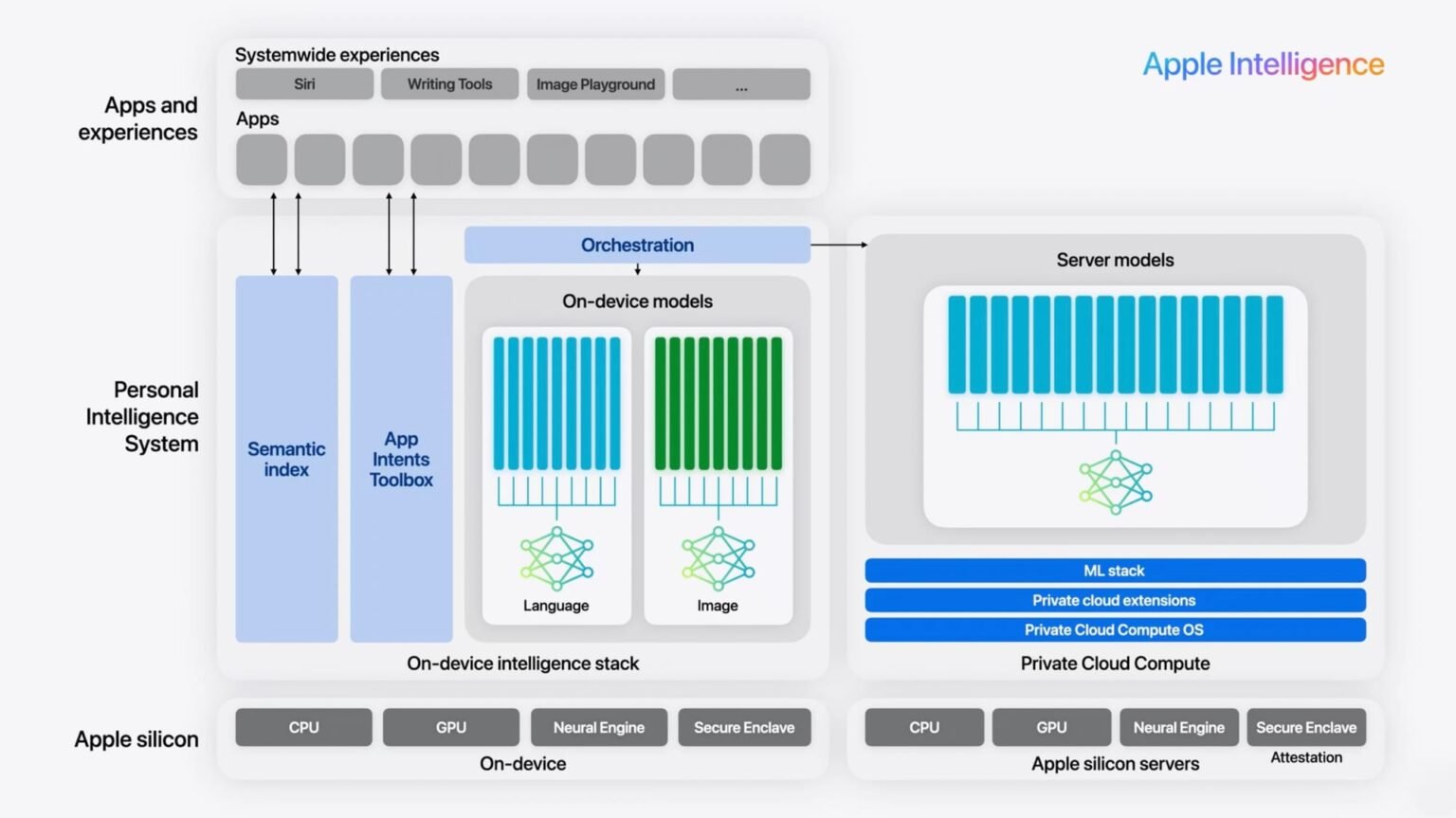
At WWDC 2024, Apple framed Apple Intelligence as a hybrid AI system: a compact model that runs on device for everyday tasks, and a larger model running in Private Cloud Compute for requests that need more capacity. That architecture has held. Apple’s developer materials now describe a Foundation Models framework that gives apps direct access to the on-device model, while Apple’s security documentation lays out how Private Cloud Compute handles more demanding workloads in Apple-designed server environments.
The practical question for developers and buyers has shifted from whether Apple has a model stack to what parts of that stack are actually usable today. On that score, Apple has shipped more than the early skeptics expected: system writing assistance, summarization, image generation through Image Playground, custom emoji generation through Genmoji, ChatGPT handoff for some requests, and developer access to the on-device model. Yet the broader vision Apple teased around a more expansive assistant layer and richer model choice is still only partly visible.
That matters because Apple is not competing on benchmark theater alone. Its pitch is that AI should be deeply integrated into the operating system, privacy-preserving by default, and available through stable developer APIs. For the agent infrastructure market, that makes Apple less of a chatbot vendor and more of a distribution and runtime platform.
📌 What changed. The biggest shift since WWDC 2024 is that Apple now publicly documents both the on-device Foundation Models framework and the security model behind Private Cloud Compute, making the architecture more concrete than the original keynote framing.
“Apple Intelligence draws on Apple silicon and Apple-built generative models to understand and create language and images, take action across apps, and draw from personal context to simplify and accelerate everyday tasks.”
Apple developer site
What Apple has clearly shipped on device
Apple’s public product and developer pages make the on-device portion of the stack fairly clear. The company says the Foundation Models framework gives developers access to Apple Intelligence’s on-device large language model, with support for guided generation, tool calling, and structured output. Apple positions that as local inference for app experiences that can work offline and avoid sending user data to external servers.
On the consumer side, the shipped feature set is broader than simple text completion. Apple’s Apple Intelligence pages list Writing Tools for rewriting, proofreading, and summarizing text across apps; notification summaries; priority messages in Mail; Image Playground for generating stylized images; and Genmoji for creating custom emoji-like images from prompts. Apple also markets natural-language search in Photos and other assistance features under the same umbrella.
For developers, the significance is that Apple is not exposing only a chat box. It is exposing a system model through native frameworks. The Foundation Models documentation shows APIs for generating text from prompts and schemas, which is a more app-native approach than wrapping a remote API call in a mobile client. That is a meaningful distinction for teams building lightweight agents or assistive workflows directly into iPhone, iPad, and Mac apps.
Apple has also tied eligibility to newer hardware, reflecting the compute and memory demands of local inference. The company’s Apple Intelligence pages describe support on select devices, including iPhone 16 models, iPhone 15 Pro, iPad mini with A17 Pro, and iPad and Mac models with M1 and later. That hardware gating is part of the product reality: Apple’s on-device AI strategy is only as broad as the installed base that can run it.
Pros
Cons
📌 Shipped on device. Writing Tools, summarization, Image Playground, Genmoji, and developer access to the on-device model through the Foundation Models framework are all documented by Apple as available parts of the Apple Intelligence stack.
import FoundationModels

// Pseudocode-style example based on Apple's Foundation Models framework concepts
// Check Apple's latest docs for exact API names and availability.

struct TaskSummary: Codable {
    let title: String
    let priority: String
}
| Capability | What Apple documents | Where it runs |
|---|---|---|
| Writing Tools | Rewrite, proofread, summarize text across apps | On device within Apple Intelligence-supported devices |
| Image Playground | Generate images in supported styles from prompts | Apple Intelligence-supported devices |
| Genmoji | Create custom emoji-like images from descriptions | Apple Intelligence-supported devices |
| Foundation Models framework | Developer access to Apple’s on-device model with guided generation and tool use | On device |
| Notification and text summaries | Summaries surfaced in system experiences | Apple Intelligence-supported devices |
Private Cloud Compute is Apple’s answer to larger workloads
Apple never claimed the on-device model would handle every request. Its answer for larger or more complex tasks is Private Cloud Compute, or PCC. Apple’s security team describes PCC as a cloud intelligence system built with Apple silicon servers, a hardened operating environment, and cryptographic attestation that allows security researchers and users to inspect what software is running. The company says user data is used only to fulfill the request and is not retained or made accessible to Apple.
That privacy posture is central to Apple’s differentiation. In its Private Cloud Compute security overview, Apple says requests sent to PCC are processed in stateless environments, with enforceable restrictions on privileged access and mechanisms intended to make the software image verifiable. Apple has also published a Private Cloud Compute Security Guide, which is unusually detailed for a consumer AI rollout.
For infrastructure watchers, PCC is the more interesting part of the stack. Apple is effectively arguing that cloud inference can be made compatible with its privacy brand if the server environment is narrow enough, attestable enough, and integrated tightly enough with the OS. That is not the same as open cloud AI. It is a vertically controlled inference layer where Apple owns the silicon, the software image, and the user entry points.
The tradeoff is obvious. Apple gains trust and platform control, but developers do not get a general-purpose hosted model platform in the way they would from OpenAI, Anthropic, Google, or AWS. Apple’s cloud intelligence layer exists primarily to support Apple Intelligence experiences, not to become the default external API for the broader market.
📌 Why PCC matters. Private Cloud Compute is not just a privacy feature. It is Apple’s infrastructure thesis for hybrid AI: keep simple tasks local, burst to Apple-controlled servers for harder requests, and make the cloud path auditable enough to preserve user trust.
“Private Cloud Compute extends the industry-leading security and privacy of Apple devices into the cloud.”
Apple Security Research
| Layer | Role | Apple’s public framing |
|---|---|---|
| On-device model | Everyday generation and assistance | Fast, private, available locally |
| Private Cloud Compute | Larger or more complex requests | Server-side processing with privacy and verifiability guarantees |
| ChatGPT integration | Fallback for some world-knowledge or broader generation requests | User permissioned external model access |
Siri, Visual Intelligence, and ChatGPT: what is live and what is narrower than the demos
The assistant layer is the unfinished part
Apple’s assistant story is where the gap between shipped and teased is easiest to see. Apple has rolled out a more capable Siri experience under the Apple Intelligence umbrella, and its product pages also promote Visual Intelligence on supported iPhone models. Visual Intelligence lets users point the camera at objects or places and get contextual help, including asking ChatGPT about what is on screen or searching with Google in some flows, according to Apple’s consumer pages.
ChatGPT integration is also real, not hypothetical. Apple says users can access ChatGPT through Siri and Writing Tools, with permission prompts before information is shared, and without requiring an account for basic access. Users who already subscribe to ChatGPT can connect their account to access paid features under OpenAI’s terms. That makes ChatGPT an explicit fallback and extension layer inside Apple’s AI UX, rather than a hidden backend.
Still, the broadest version of the Siri 2.0 narrative remains incomplete. Apple’s early framing emphasized richer personal context, deeper app actions, and a more fluid assistant that could understand what is on screen and act across apps. Some of that direction is visible in Apple’s current messaging, but the company’s public documentation is more concrete around discrete features than around a fully transformed general assistant. The result is a product that feels more like a collection of integrated AI capabilities than a finished agentic Siri overhaul.
That distinction matters for enterprise and developer audiences. A system that can summarize, rewrite, generate images, and hand off to ChatGPT is useful. A system that can reliably plan and execute multi-step actions across first- and third-party apps would be a different category of platform shift. Apple has not publicly documented that broader capability set as generally available in the same way it has documented Writing Tools or the Foundation Models framework.
⚠️ Still narrower than the keynote vision. Apple has shipped assistant-adjacent intelligence and camera-based Visual Intelligence experiences, but the fully agentic, deeply cross-app Siri many observers inferred from WWDC remains less concrete in public documentation.
What Apple still appears to be teasing rather than fully delivering
Two gaps stand out in Apple’s current public materials. The first is language breadth. Apple has expanded Apple Intelligence language support over time, but the multilingual story has arrived in stages rather than as a universal launch. That is normal for AI systems, yet it still means the global version of Apple’s pitch has lagged the original ambition.
The second is model choice. Apple has a visible integration with ChatGPT, but there is no broad system-level third-party model picker that lets users or developers swap among multiple external frontier models inside Apple Intelligence. Apple’s current approach is curated and tightly controlled. That fits the company’s platform instincts, though it falls short of the more open model-routing future some developers expected once Apple acknowledged external model fallback.
There is also a subtler limitation in the developer story. The Foundation Models framework is important, but it is not a general marketplace for arbitrary model providers. Developers get Apple’s on-device model through Apple’s APIs, not a neutral abstraction layer over many vendors. For teams that want deterministic privacy and native OS integration, that is attractive. For teams that want broad model experimentation, it is restrictive.
None of this makes Apple’s strategy weak. It makes it legible. Apple is building a managed AI substrate for its own ecosystem, not an open bazaar of interchangeable models. The missing pieces are missing by design as much as by execution.
⚠️ What remains teased. The biggest unresolved pieces are a broader multilingual rollout and a deeper, more flexible third-party model selection layer beyond the current ChatGPT integration.
| Area | What Apple has | What still looks limited |
|---|---|---|
| Language support | Documented rollout to supported languages and regions | Not yet a fully universal multilingual footprint |
| External models | ChatGPT integration via Siri and Writing Tools | No broad system-level multi-model picker |
| Assistant actions | Targeted AI features and some contextual assistance | No clearly documented general cross-app agent layer |
Why this matters for agent infrastructure in 2026
3 layers
On-device, Private Cloud Compute, ChatGPT fallback
Apple’s practical AI execution model
Apple’s Foundation Models strategy matters beyond iPhone features because it pushes a different architecture into the mainstream: hybrid inference with OS-level orchestration. In that model, the device handles lightweight generation and private context, a trusted first-party cloud handles heavier tasks, and an external model like ChatGPT is invoked only when needed and with user consent. That is a very different stack from the browser-based chatbot era.
For developers, this creates a new design constraint. If Apple’s on-device model is good enough for summarization, extraction, rewriting, and lightweight tool use, many mobile experiences no longer need to start with a remote API call. They can start local and escalate only when necessary. That has implications for latency, cost, privacy review, and product reliability.
For the broader market, Apple is also validating a thesis that competitors have been circling: the most durable AI products may be the ones embedded into operating systems and hardware rather than standalone apps. Readers looking at the wider device landscape should also see our comparison of on-device AI agents across Apple, Pixel, and Galaxy in 2026.
The open question is whether Apple’s managed approach can keep pace with the speed of cloud model innovation. If frontier capabilities continue to move fastest in external APIs, Apple may need to widen its model interop story. If local and privacy-sensitive inference becomes the default for everyday software, Apple’s current architecture could look prescient.
📌 Bottom line. Apple has already shipped enough of its Foundation Models stack to influence how mobile and desktop apps are built. The remaining debate is whether Apple’s tightly managed AI layer can evolve fast enough without becoming a broader model platform.
“The strategic significance of Apple Intelligence is not one feature. It is the normalization of local-first AI with a first-party cloud escape hatch.”
Alatirok analysis
Frequently asked questions
Apple uses the term in its developer documentation for the Foundation Models framework, which gives apps access to Apple’s on-device generative model as part of Apple Intelligence.
No. Apple says many tasks run locally, but larger requests can be sent to Private Cloud Compute, a server-side system Apple designed to extend its privacy and security model into the cloud.
Yes, in a limited and explicit way. Apple says users can access ChatGPT through Siri and Writing Tools, with permission before information is shared. Apple documents this on its Apple Intelligence product page.
Apple has shipped several Siri-adjacent and assistant features under Apple Intelligence, but the broadest vision of a deeply cross-app, highly agentic Siri is less concretely documented as generally available than features like Writing Tools, Genmoji, and Image Playground.
Primary sources
- Apple Intelligence for Developers — Apple
- Foundation Models framework documentation — Apple
- Apple Intelligence product page — Apple
- Private Cloud Compute: A new frontier for AI privacy in the cloud — Apple Security Research
- Private Cloud Compute Security Guide — Apple Security Research
Last updated: May 20, 2026. Related: Agent Infrastructure.