
1 company, 1 consumer app, and billions in capital turned xAI from a July 2023 startup into a central player in the frontier-model race by 2026. This timeline follows the milestones that mattered: xAI’s launch, Grok’s product rollouts, the company’s funding rounds and reported valuation jumps, and the Memphis compute buildout that became core to its strategy. For readers tracking the wider model market, see alatirok’s related timelines on Anthropic, OpenAI, and Google Gemini.
At a glance: the milestones that defined xAI
July 2023
xAI launch
Company announced by Elon Musk
$6B
Series B financing
Announced by xAI in May 2024
Feb. 2025
Grok 3 debut
Officially introduced by xAI
$50B+
Reported valuation
Reported in late 2024 coverage
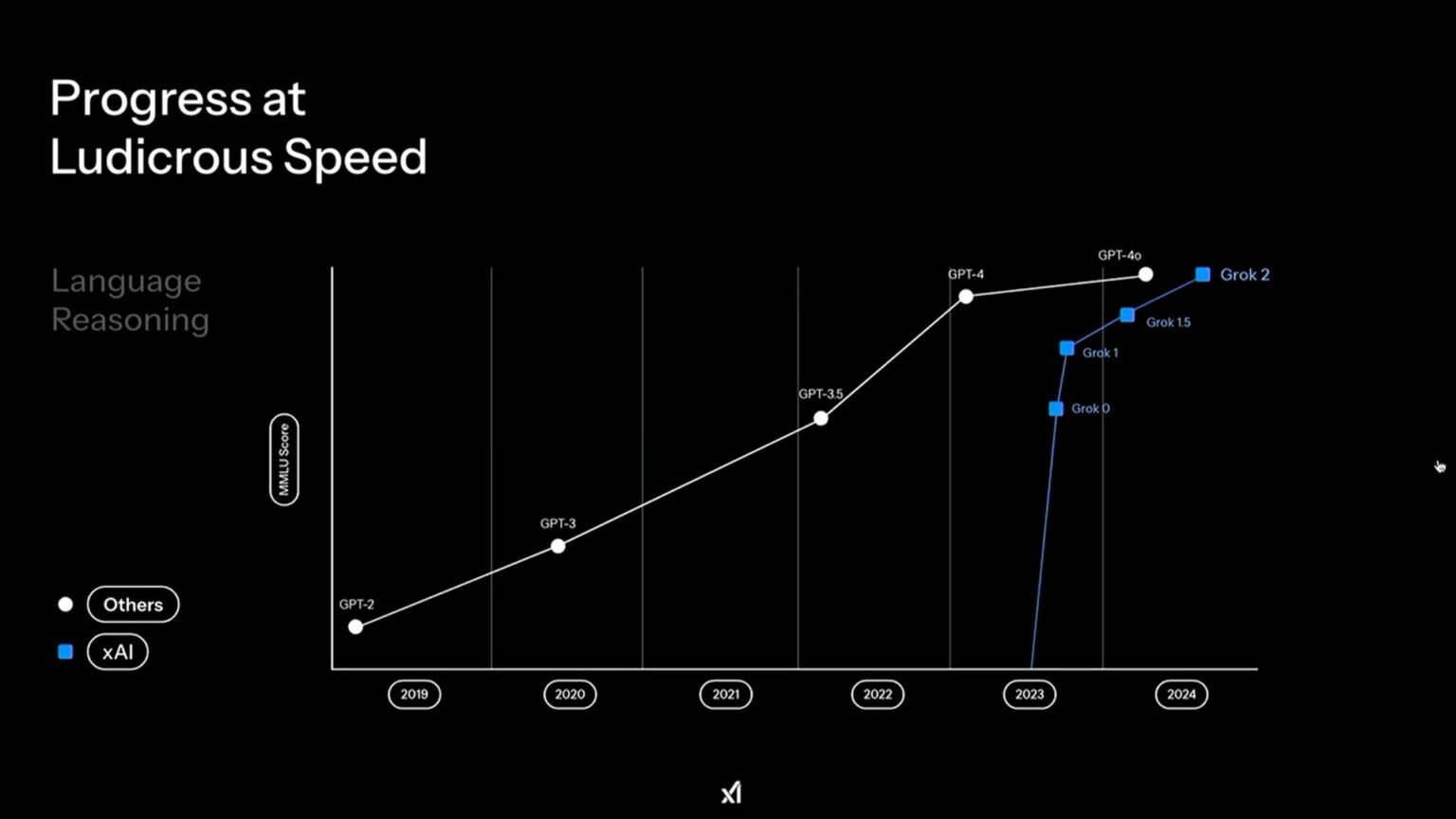
xAI’s trajectory has been unusually compressed. The company was announced in July 2023. Four months later, Grok began rolling out to X Premium+ subscribers. In 2024, xAI shipped Grok-1.5 and Grok-2, raised a $6 billion Series B, and became associated with one of the most aggressive GPU infrastructure builds in the market. By early 2025, Grok 3 arrived as the company pushed harder on both consumer reach and training scale.
The pattern is familiar across frontier labs: launch a flagship model, secure distribution, raise capital, then convert capital into compute. xAI followed that script quickly, but with a twist. Its tight relationship with X gave it a built-in consumer surface and a real-time data narrative that Musk repeatedly emphasized. That combination made xAI part model lab, part product company, and part infrastructure story.
For context on how that compares with rival labs, readers can also review alatirok’s coverage of Anthropic’s rise, OpenAI’s GPT-to-agent arc, and Google’s Gemini transition.
This article sticks to publicly verifiable milestones: company announcements, official product posts, and reported funding and valuation events from major outlets including TechCrunch, Bloomberg, and The Information.
“The race around xAI was never only about model quality. It was also about whether a new lab could buy, build, and operate enough compute fast enough to matter.”
Alatirok editorial analysis
| Date | Milestone | Why it mattered |
|---|---|---|
| July 2023 | xAI announced | Elon Musk formally launched the AI lab and introduced its founding team |
| November 2023 | Grok launched via X Premium+ | xAI moved from lab announcement to consumer distribution on X |
| March 2024 | Grok-1.5 announced | First major model upgrade with stronger reasoning and longer context claims |
| May 2024 | $6B Series B announced | Capital raise positioned xAI to scale models and infrastructure |
| August 2024 | Grok-2 announced | xAI advanced its flagship model line and image-generation integrations |
| 2024 to 2025 | Memphis Colossus buildout | Compute became a defining part of xAI’s competitive strategy |
| December 2024 | $50B+ valuation reported | Secondary-market and fundraising reporting signaled surging investor demand |
| February 2025 | Grok 3 launched | xAI tied a new model generation to its expanding training cluster |
| 2025 to 2026 | Grok 4 family era | The company shifted from proving viability to sustaining release cadence |
Q3 2023: xAI is announced
Elon Musk announced xAI on July 12, 2023. The company introduced itself as a new AI lab focused on understanding the universe and published a roster of founding team members with backgrounds spanning DeepMind, OpenAI, Google Research, Microsoft Research, Tesla, and the University of Toronto. The launch mattered because it formalized Musk’s return to the frontier-model race after his long-running criticism of OpenAI’s direction.
The initial xAI announcement did not come with a public consumer product. It came with a mission statement, a team, and a signal that Musk intended to build a separate AI stack rather than simply comment from the sidelines. The company also said it would work closely with X, Tesla, and other companies, while remaining distinct from X Corp.
At that point, the market context was already intense. OpenAI had turned ChatGPT into the defining consumer AI product of 2023. Anthropic was gaining enterprise traction with Claude. Google was reorganizing around Gemini. xAI entered as a late but well-capitalized contender with a founder who could command attention, distribution, and investor interest almost immediately.
Q4 2023: Grok arrives through X Premium+
On November 4, 2023, Musk said Grok was coming to a limited number of users and would later be available to all X Premium+ subscribers. xAI described Grok as an AI assistant with real-time access to information via the X platform and a more irreverent personality than rival chatbots. That positioning was not incidental. Grok was marketed as both useful and differentiated in tone, with X serving as the distribution layer.
The launch established the first durable link between xAI and X’s subscription business. Instead of debuting as a standalone developer platform, Grok first appeared as a premium feature inside a social product. That gave xAI immediate reach, but it also tied the model’s public identity to the politics, moderation debates, and product volatility surrounding X.
For the broader AI market, the release showed that frontier labs were beginning to split into two camps: those prioritizing APIs and enterprise adoption first, and those using consumer surfaces to drive awareness and usage. xAI leaned hard into the second path. Readers comparing that strategy with other labs can see alatirok’s related analysis of open-source model competition and AI agent infrastructure.
Launching through X Premium+ gave Grok immediate exposure, but it also meant xAI’s first product narrative was inseparable from X’s subscriber strategy and platform reputation.
Q1 2024: Grok-1 goes open and Grok-1.5 is announced
The first quarter of 2024 brought two notable moves. In March, xAI open-sourced the base model weights and network architecture of Grok-1 under the Apache 2.0 license, publishing them on GitHub and Hugging Face. That was a meaningful step because it gave researchers and developers a concrete artifact to inspect, even if the company’s commercial momentum remained tied to hosted products.
Later in March, xAI announced Grok-1.5. The company said the new model improved reasoning performance and supported a context length of 128,000 tokens. It also previewed Grok-1.5 Vision, extending the line into multimodal input. Those claims fit a broader industry pattern in 2024: labs were no longer competing only on chatbot quality, but on reasoning, context windows, and multimodal capability.
This period also showed xAI trying to balance two identities. One was a Musk-led frontier lab racing for relevance against OpenAI, Anthropic, and Google. The other was a company willing to release model artifacts publicly, at least selectively, to build credibility with the developer and research communities.
git clone https://github.com/xai-org/grok-1.git
Q2 2024: xAI raises a $6 billion Series B
On May 26, 2024, xAI announced a $6 billion Series B financing round. The company said the capital would be used to take its first products to market, build advanced infrastructure, and accelerate research and development of future technologies. The investor list included Andreessen Horowitz, Sequoia Capital, Fidelity, Vy Capital, Prince Alwaleed Bin Talal and Kingdom Holding, and others named in the company announcement.
The round instantly placed xAI among the best-funded AI startups in the market. It also confirmed that investors were willing to back a company whose product and infrastructure ambitions were still unfolding in public. In practical terms, the money was about chips, data center capacity, talent, and time. Frontier-model development had already become a capital-intensive business by 2024, and xAI was now funded to compete on those terms.
Coverage from TechCrunch and other outlets framed the raise in the context of a broader AI financing boom. That framing was accurate. The market had moved beyond seed-stage experimentation. Capital was concentrating around a handful of labs that could plausibly train frontier systems, secure distribution, and convert fundraising into visible product velocity.
“The $6 billion raise was less a finish line than an admission price for the next phase of the race.”
Alatirok editorial analysis
Q3 2024: Grok-2 marks the next product step
In August 2024, xAI announced Grok-2 and Grok-2 mini in beta. The company said Grok-2 offered improvements over Grok-1.5 and described stronger chat, coding, and reasoning performance. xAI also linked the release to image-generation capabilities on X through FLUX.1 from Black Forest Labs, showing that Grok’s consumer experience would increasingly blend model inference with adjacent media tools.
This was an important transition point. Grok was no longer just the edgy chatbot attached to X Premium+. It was becoming a named model family with a clearer release cadence. The move also reflected a broader market reality: labs needed frequent, visible upgrades to stay in the conversation, even when benchmark comparisons remained contested or incomplete.
By late 2024, xAI’s challenge was no longer proving it could ship. It was proving that each release represented durable progress rather than a marketing beat. That distinction mattered because rivals were also accelerating. OpenAI was broadening its multimodal and agentic stack, Anthropic was strengthening enterprise positioning, and Google was integrating Gemini across products and infrastructure.
Late 2024: Memphis and the Colossus narrative take center stage
Through 2024, xAI’s infrastructure story became nearly as prominent as its model releases. Musk and xAI repeatedly highlighted a massive training cluster in Memphis, Tennessee, later branded Colossus. Reporting from outlets including Bloomberg and The Information described the buildout as one of the fastest large-scale AI supercomputer deployments in the industry, centered initially around roughly 100,000 Nvidia H100 GPUs, with plans for further expansion.
The exact numbers and timelines around these clusters have often been reported in stages, and they should be treated carefully. What is clear from company statements and major reporting is that xAI wanted Colossus to serve as proof of execution. In a market where access to chips and power had become strategic bottlenecks, a lab that could stand up a giant cluster quickly could change how investors, customers, and competitors viewed its odds.
Memphis also became a symbol of the new AI industrial stack. Frontier models were no longer just software products. They depended on land, power, cooling, networking, and supply-chain coordination. That is one reason xAI’s story belongs not only in model timelines but also in the infrastructure conversation alongside cloud providers, GPU vendors, and data-center operators.
For xAI, Colossus was not just a compute asset. It was a credibility asset. In 2024 and 2025, the ability to marshal GPUs and power at speed became a market signal in its own right.
Q4 2024: valuation reports jump above $50 billion
By December 2024, Bloomberg reported that xAI was discussing a funding round that could value the company at about $50 billion, a sharp increase from the valuation associated with its May 2024 financing. The report underscored how quickly investor expectations had moved. xAI had gone from newly launched lab to one of the market’s most richly valued private AI companies in roughly a year and a half.
That valuation jump reflected more than product adoption. It captured investor belief in three linked assets: Musk’s ability to attract capital, xAI’s access to distribution through X, and the company’s apparent willingness to spend aggressively on compute. In late 2024, those ingredients were enough to support a premium narrative even as the company was still proving out long-term enterprise and developer traction.
The valuation story also mirrored what was happening across the sector. Capital was flowing toward companies that could plausibly claim frontier status, even when revenue visibility lagged. For a deeper look at how money and infrastructure were reshaping the stack, see alatirok’s coverage of AI infrastructure startups and the vector database market.
Q1 2025: Grok 3 arrives
In February 2025, xAI introduced Grok 3. Musk had previewed the model in public appearances and tied it directly to the company’s growing compute footprint. The launch was framed as a major step up from earlier Grok versions, with xAI emphasizing stronger capabilities and the scale of training behind the release.
The significance of Grok 3 was partly technical and partly symbolic. Technically, it represented xAI’s attempt to show that its infrastructure investments were translating into a new model generation. Symbolically, it was the company’s chance to prove that it could sustain a frontier release cadence rather than rely on the novelty of Musk’s brand and X integration.
By this point, the competitive frame had sharpened. OpenAI, Anthropic, Google, and Meta were all pushing harder on multimodal systems, coding assistance, and agentic workflows. xAI needed Grok 3 to do more than keep up in headlines. It needed to show that the company could convert capital and compute into a product developers and consumers would keep using.
2025: xAI becomes a compute-and-distribution company
Across 2025, the xAI story broadened beyond model version numbers. The company was increasingly defined by two structural advantages it was trying to build at once: compute capacity and direct distribution. Compute came through Colossus and related expansion efforts. Distribution came through X, where Grok had a built-in path to users and a constant stream of public attention.
That combination made xAI different from labs that relied primarily on API ecosystems or enterprise sales. It also created tension. Consumer distribution can generate usage and visibility quickly, but it does not automatically produce the kind of developer lock-in or enterprise standardization that turns a model provider into core infrastructure. xAI’s challenge in 2025 was to show it could be more than a high-profile app feature.
This is where the company’s trajectory intersects with the rise of agents and tool use. As the market shifted from chat interfaces toward systems that browse, code, retrieve, and act, model labs needed stronger developer surfaces and operational reliability. Alatirok has covered that transition in pieces on agent frameworks and LLM observability. xAI’s long-term position depends on how well it participates in that layer, not only on how often Grok trends on X.
Late 2025: the Grok 4 family era begins
By the second half of 2025 and into 2026, discussion around xAI increasingly centered on the Grok 4 family rather than the company’s first-generation releases. The exact model packaging and feature set evolved over time, but the broader point was clear: xAI had moved into the phase where it needed a durable family of models, not just one headline launch every few quarters.
This stage matters because frontier-model competition eventually becomes operational. Customers want predictable upgrades, stable APIs, pricing clarity, safety controls, and integration paths. Public excitement can help a lab break through, but repeat adoption depends on product discipline. For xAI, the Grok 4 period represented a test of whether it could mature from a fast-moving challenger into a platform provider with staying power.
The company still benefited from Musk’s ability to command attention and from the strategic overlap with X. Yet by 2026, the market was less forgiving of pure spectacle. Buyers had more alternatives, open models were improving, and infrastructure costs remained punishing. That raised the bar for every new Grok release.
2026: what the xAI timeline says about the market
Looking back from 2026, xAI’s first three years tell a larger story about the AI market. First, speed matters. xAI compressed launch, productization, fundraising, and infrastructure expansion into a remarkably short window. Second, distribution matters almost as much as model quality. Grok’s tie to X gave xAI a consumer foothold that many labs would envy. Third, compute has become strategy, not just capacity planning.
The timeline also shows how much frontier AI now depends on narrative control. xAI benefited from a founder who could turn every product update, hiring move, and cluster expansion into a market event. That attention helped with recruiting, fundraising, and awareness. It also created pressure. Every delay, benchmark dispute, or product controversy landed in a brighter spotlight than it would for a quieter company.
For operators and investors, the lesson is straightforward. xAI is not only a model lab to benchmark against peers. It is a case study in how capital, chips, and consumer distribution can be assembled into a competitive position at unusual speed. Whether that position proves durable depends on execution in the layers beneath the headlines.
“xAI’s timeline is really a timeline of the modern AI race: money in, GPUs up, products out, and the market judging all of it in real time.”
Alatirok editorial analysis
Where does this go next
The next phase for xAI is likely to be judged on three fronts. One is model quality and release consistency: can Grok keep improving at a pace that changes buyer behavior rather than just social-media conversation? Another is infrastructure efficiency: can xAI keep scaling compute without letting cost and operational complexity overwhelm the business? The third is platform depth: can the company turn Grok into a dependable layer for developers, enterprises, and agents, not only a feature inside X?
There is also a governance question hanging over the entire category. As labs become more capital-intensive and more tightly linked to distribution platforms, the lines between research organization, product company, and political actor blur. xAI sits at that intersection more visibly than most. That visibility can be an advantage, but it also means every strategic move carries outsized scrutiny.
From here, the most credible way to evaluate xAI is not through a single benchmark or valuation headline. It is through the compound evidence of shipping cadence, infrastructure execution, developer adoption, and product reliability. The company moved fast from 2023 to 2026. The harder part is proving that speed can turn into durable position.
From 2023 to 2026, xAI established itself as a real frontier contender. The open question is whether its mix of Musk-led attention, X distribution, and massive compute spend can mature into a lasting platform advantage.
Frequently asked questions
xAI was announced on July 12, 2023, in an official post on the company site introducing its mission and founding team. See xAI’s announcement.
Grok began rolling out in November 2023 and was positioned for X Premium+ subscribers. Musk posted about the initial rollout on X, and xAI later documented the product on its site. For the official product context, see xAI’s Grok page.
xAI announced a $6 billion Series B in May 2024. Later valuation and fundraising discussions were reported by outlets such as Bloomberg, but readers should distinguish official company announcements from reported talks.
Colossus is the name xAI has used for its Memphis supercomputer cluster, a major part of the company’s training and infrastructure strategy. xAI discussed it on its blog in its Colossus post, while reporting from outlets including Bloomberg and The Information added context on scale and timing.
xAI is a newer entrant, but it has moved quickly on consumer distribution, fundraising, and compute buildout. For broader context, see alatirok’s timelines on OpenAI, Anthropic, and Google Gemini.
Primary sources
- xAI announcement — xAI
- Introducing Grok — xAI
- Open release of Grok-1 — xAI
- Announcing Grok-1.5 — xAI
- Series B announcement — xAI
- Announcing Grok-2 and Grok-2 mini — xAI
- Colossus — xAI
- Introducing Grok 3 — xAI
- TechCrunch on xAI’s $6B Series B — TechCrunch
- Bloomberg on xAI funding talks at about $50B valuation — Bloomberg
- Bloomberg on xAI supercomputer buildout — Bloomberg
- The Information on xAI’s Memphis supercomputer — The Information
- xAI homepage — xAI
- Grok product page — xAI
Last updated: May 21, 2026. Related: Agent Infrastructure.