
Cloudflare and Stripe have drawn one of the clearest diagrams yet for agentic software deployment with real money attached. In a joint launch centered on Stripe Projects and detailed by Cloudflare, the companies say an AI agent can now discover a cloud provider, authenticate, create an account, pay for services, buy a domain, deploy code, and configure production infrastructure without a human copying tokens or typing in a credit card. The human still approves the legal and financial edges. The rest is starting to look like infrastructure for software that buys and ships itself.
The lede: an agent can now buy, provision, and deploy
This is the first credible agent-commerce stack
Cloudflare and Stripe this week announced a workflow that closes one of the biggest gaps in AI coding agents: getting code from a generated app into a paid production environment. According to Cloudflare’s launch post, an agent can now create a Cloudflare account, start a paid subscription, register and purchase a domain, deploy an application to Cloudflare Workers, generate API tokens, configure DNS, and provision SSL certificates without a human visiting a dashboard or manually moving credentials between systems.
That matters because most coding agents have been strongest at writing code and weakest at crossing the operational boundary into real infrastructure. Sid Chatterjee and Brendan Irvine-Broque of Cloudflare framed the problem plainly in the announcement: “Coding agents are great at building software. But to deploy to production they need three things from the cloud they want to host their app: an account, a way to pay, and an API token.”
The new stack is built around Stripe Projects, which Stripe describes as an orchestrator in open beta. Cloudflare is one of the first concrete infrastructure targets in that flow. The result is not a vague promise about autonomous commerce. It is a documented path for an agent to complete the account, billing, and deployment steps that usually force a human back into the loop.

The novelty is not that agents can call APIs. It is that Cloudflare and Stripe combined discovery, authorization, and payment into a workflow that reaches a live production deployment.
“Coding agents are great at building software. But to deploy to production they need three things from the cloud they want to host their app: an account, a way to pay, and an API token.”
Sid Chatterjee and Brendan Irvine-Broque, Cloudflare
The protocol has three layers: discovery, authorization, payment
The architecture described by Cloudflare and Stripe is notable because it breaks agent commerce into three distinct layers rather than treating the problem as a single API integration. First comes discovery. Cloudflare says the agent starts with a REST API that returns JSON, allowing it to query a service catalog without prior provider-specific knowledge. That is a key design choice: the agent does not need a hardcoded Cloudflare playbook before it can understand what services are available.
Second comes authorization. Stripe acts as the identity provider through OAuth. In the Cloudflare flow, if the agent does not already have a Cloudflare account, the system can auto-provision one during authorization. That removes one of the most stubborn blockers in agent workflows, where an otherwise capable model stalls because the user has never created the target account or linked billing.
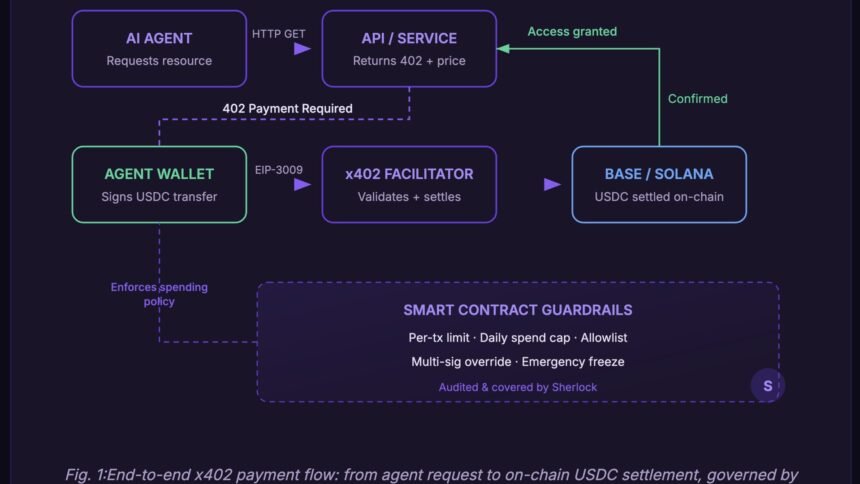
Third comes payment. Stripe handles tokenization so raw card data is never exposed to the agent. Stripe’s documentation says Projects uses spending controls, with a default cap of $100 per month per provider. The cap is a product decision as much as a safety measure: enough room for a small app or experiment, not enough room for an unattended infrastructure blowout.
InfoQ’s coverage of the launch captures why this structure matters. Discovery tells the agent what can be bought and provisioned. Authorization establishes who is allowed to act. Payment lets the action complete without handing sensitive financial data to the model. Put together, those layers form the minimum viable commerce stack for software agents.
{
  "provider": "cloudflare",
  "capabilities": [
    "create_account",
    "start_subscription",
    "purchase_domain",
    "deploy_workers_app",
    "generate_api_token",
    "configure_dns",
    "provision_ssl"
  ],
  "billing": {
    "payment_method": "tokenized_via_stripe",
    "default_monthly_spend_cap_usd": 100
  }
}| Layer | What it does | Role in the workflow |
|---|---|---|
| Discovery | REST API returns JSON service catalog | Lets an agent understand provider offerings without prior hardcoding |
| Authorization | Stripe acts as identity provider via OAuth | Authenticates the user and can trigger Cloudflare account provisioning |
| Payment | Stripe tokenization and spending controls | Completes purchases without exposing raw card data to the agent |
Stripe is making a larger play than payments
Stripe’s real wedge is identity
Stripe Projects is easy to read as a billing feature because money is the most visible part of the workflow. That undersells what Stripe is trying to become. In this launch, Stripe is not just charging a card. It is the identity and authorization layer that lets an agent act on behalf of a user across providers.
That is a much bigger strategic position. If developers and cloud vendors accept Stripe as the trusted broker for agent permissions, Stripe gains a role similar to what identity providers won in SaaS: the system that sits between users, applications, and policy. The Projects documentation emphasizes orchestration, permissions, and spending controls, not just checkout. The company is trying to define how an agent gets approved to do work with financial consequences.
The distinction matters because agent commerce needs a trust anchor. A cloud provider does not want to accept arbitrary requests from an LLM with no durable identity, no billing relationship, and no clear user authorization. Stripe already has the payment credentials, compliance posture, and merchant relationships to become that anchor. This launch suggests it wants to extend that trust into agent-native workflows.
There is also a developer distribution angle. Stripe says Projects can be used through the Stripe CLI with a Projects plugin, which gives the company a familiar path into developer workflows. If the CLI becomes the easiest way to let an agent discover providers, authenticate, and spend within limits, Stripe could become the default control plane for small-scale agent purchasing long before enterprises settle on a standard.
Stripe is positioning itself as an identity provider for AI agents, with payments as the enforcement mechanism rather than the whole product.
Cloudflare is exposing the account-side primitives agents actually need
Cloudflare’s role in the announcement is not just as a deployment target for Workers. It is the provider proving that agent commerce only works if the cloud side exposes the right primitives. The blog post lays out the tasks the agent can complete after authorization: account creation, token generation, DNS configuration, SSL provisioning, domain purchase, and deployment.
Those are the operational steps that usually break autonomous flows. A model may generate a complete app, but it cannot finish the job if the provider requires a human to click through account setup, manually create an API token, or copy values from one dashboard into another. Cloudflare has turned those steps into machine-addressable actions connected to a billing and identity layer.
That gives Cloudflare an early-mover advantage in a category that is still mostly discussed in protocol terms. The company has been vocal about agent-facing infrastructure and, in this launch, says it is implementing the agent side of emerging standards such as AP2 and A2A in production workflows. The practical point is less about standards branding than about readiness: Cloudflare is making itself easier for agents to choose and easier for developers to let agents use.
The implication for competitors is straightforward. If AWS, Google Cloud, Vercel, Render, and others do not expose comparable discovery, authorization, and billing flows for agents, they risk becoming harder defaults for the next generation of coding tools. Agents will route toward the providers they can actually transact with.
Pros
Cons
Cloud providers that still depend on dashboard-only setup and manual token handling may find themselves skipped by agent-driven developer workflows.
The $100 cap tells you who this is for right now
$100/mo
Default spend cap
Per provider in Stripe Projects
$100,000
Atlas startup credits
Mentioned in editor-provided source context and Stripe ecosystem positioning
Stripe Projects’ default spending cap of $100 per month per provider is one of the most revealing details in the launch. It signals a product aimed at indie developers, prototypes, internal tools, and small-team experiments rather than enterprise procurement. The cap is high enough for an agent to stand up a real service and low enough to keep risk bounded while the workflow matures.
That framing is reinforced by Stripe’s note that startups in Stripe Atlas can get up to $100,000 in credits. Credits are not the same thing as open-ended autonomous spending, but they fit the same go-to-market logic: make it cheap and easy for new companies to let software buy the infrastructure it needs, then grow with them if the workflow sticks.
The cap also answers a common objection to agent commerce. The first question from developers and finance teams is not whether an agent can buy something. It is how much damage it can do if it buys the wrong thing. A default ceiling creates a practical trust boundary. It does not solve every governance problem, but it turns autonomous purchasing from an unlimited liability into a constrained experiment.
That is why this announcement feels more real than many agent demos. The companies are not pretending the risk disappears. They are productizing around it.
| Signal | What it suggests |
|---|---|
| $100/month default cap | Early focus on small deployments and bounded risk |
| Open beta | The workflow is available but still in an iterative phase |
| Atlas startup credits | Stripe wants startup adoption and ecosystem pull-through |
Humans still gate the legal and financial edges
Autonomy stops where liability starts
The companies are not claiming full autonomy. The human still approves the initial Stripe authentication, terms-of-service acceptance, billing setup, and the merge decision that determines whether code actually ships. That division of labor is one of the more sensible parts of the design.
Cloudflare’s framing is that the human gates remain at the points of legal and financial consequence, while the agent handles the purely technical work of account wiring, credential management, and deployment setup. That is a useful model for the near term because it aligns with how organizations already think about control. Humans approve obligations. Software executes the implementation.
This boundary also keeps the launch grounded. It is not a story about agents replacing DevOps teams or bypassing governance. It is a story about removing the repetitive setup work that sits between generated code and a live application. The practical gain is speed and continuity, not the elimination of oversight.
The Hacker News discussion around the launch reflects that tension. Some commenters focused on the convenience of removing dashboard friction. Others raised the expected concerns about trust, spend control, and whether developers want a third party mediating cloud identity. Those reactions are a reminder that agent commerce will be adopted first where the upside is obvious and the blast radius is small.
The launch keeps people at the approval points that create legal obligations or financial exposure, while letting agents handle the technical execution path.
What this forces the rest of the cloud market to confront
The broader significance of the Cloudflare-Stripe launch is that it raises the bar for every cloud and developer platform that wants to stay relevant in agent-driven workflows. Once an agent can discover a provider, authenticate through a trusted identity layer, spend within policy, and complete deployment tasks end to end, every provider that lacks those hooks starts to look less accessible.
That does not mean AWS, Google Cloud, Vercel, or Render are suddenly behind in infrastructure. It means they now face a product question they can no longer ignore: should they expose comparable agent-accessible APIs and authorization flows, or accept that coding agents will prefer platforms with lower transaction friction? In developer tooling, the easiest path often becomes the default path.
There is a standards angle here too. Cloudflare’s references to AP2 and A2A suggest the market is moving toward explicit protocols for agent payments and inter-agent coordination, but the launch shows that implementation matters more than rhetoric. The first companies to make the workflow real will shape developer expectations before standards fully settle.
For now, the strongest takeaway is simple. The agent-commerce stack has moved from concept to product. Stripe supplied the identity and payment rails. Cloudflare supplied the account and deployment surface. Together they shipped a version of autonomous software purchasing that developers can actually test, and that is enough to force the rest of the market to respond.
“The first companies to make the workflow real will shape developer expectations before standards fully settle.”
Alatirok analysis
Frequently asked questions
Stripe Projects is a Stripe product in open beta that provides orchestration for agent-driven workflows involving provider discovery, authorization, and payment. Stripe documents it at docs.stripe.com/projects.
According to Cloudflare’s announcement, an agent can create a Cloudflare account, start a paid subscription, purchase a domain, deploy an application, generate API tokens, configure DNS, and provision SSL certificates. Cloudflare details the workflow in its post at blog.cloudflare.com/agents-stripe-projects/.
No. The payment layer uses Stripe tokenization, and the launch materials say raw card data is not exposed to the agent. Stripe’s documentation for Projects is the primary source: docs.stripe.com/projects.
No. The workflow still keeps humans at approval points such as initial authentication, terms acceptance, billing setup, and final merge decisions. Cloudflare describes those boundaries in its launch write-up: blog.cloudflare.com/agents-stripe-projects/.
Primary sources
- Cloudflare: Agents, Stripe, and Projects announcement — Cloudflare
- Stripe Projects documentation — Stripe
- InfoQ coverage of Cloudflare and Stripe agent commerce launch — InfoQ
- Hacker News discussion — Hacker News
Last updated: May 22, 2026. Related: Agent Infrastructure.