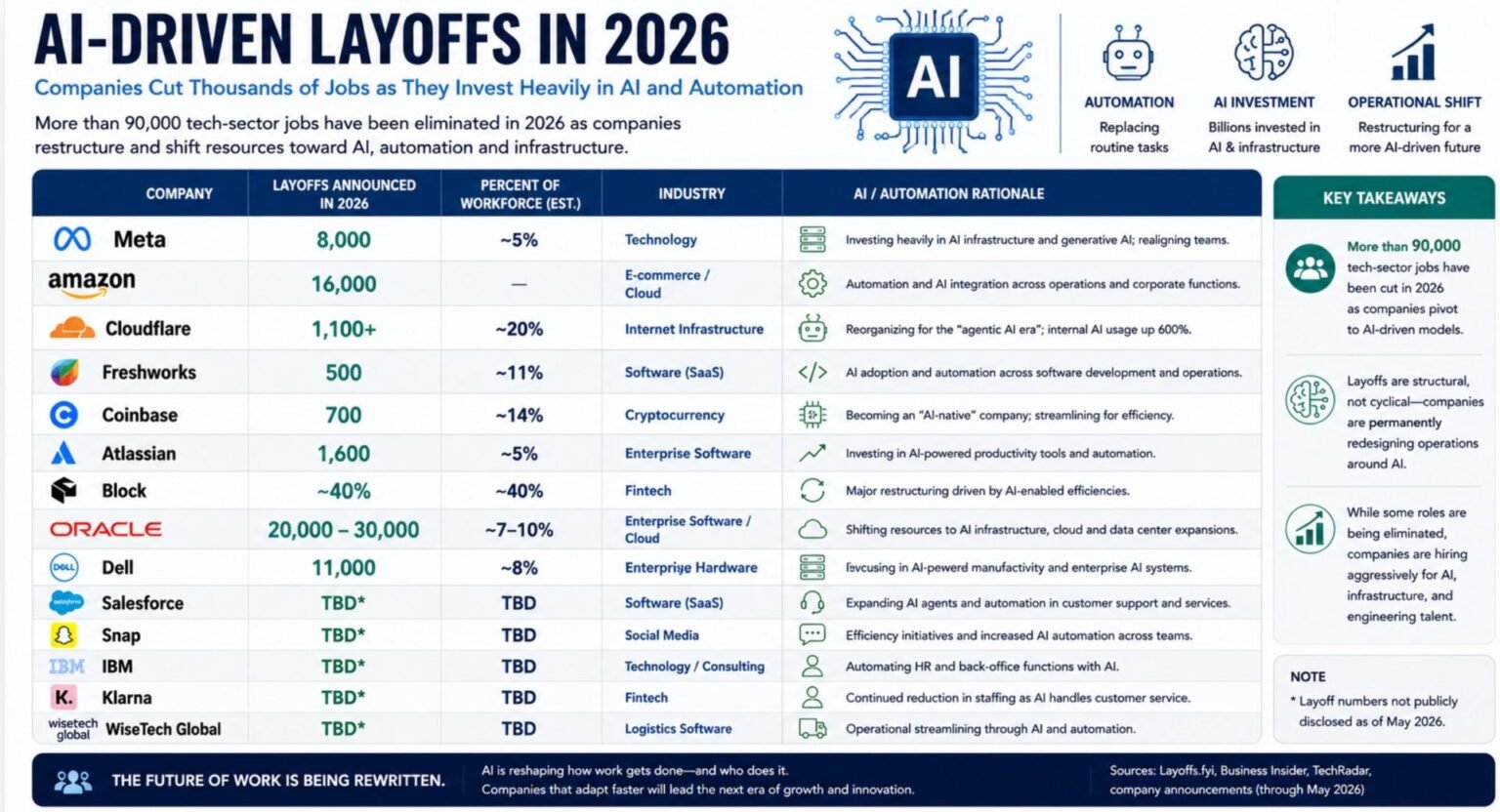

AI 2026 layoff split is the cleanest way to describe the market so far: more than 92,000 tech jobs were cut in the first five months of 2026 even as OpenAI and Anthropic continued to add talent, and one tracker says 48% of layoffs through April were tied to AI or workflow automation. The result is a bifurcated labor market, not a uniform downturn.
The headline numbers: 92K cuts, 48% AI-attributed, 8K at Meta
92K+
Tech jobs cut in first five months
Reported by TechJournal for 2026
48%
Layoffs through April tied to AI or automation
WorldMetrics attribution figure
8K
Meta jobs cut starting May 20
Reported by Intellectia
The core finding behind the AI 2026 layoff split is simple. TechJournal reported that more than 92,000 tech workers had been laid off in the first five months of 2026, while the same piece framed the year around a countervailing $725 billion in AI spending. That is the split in one snapshot: labor contraction in broad tech, capital expansion in AI infrastructure and model development.
A second data point sharpens the picture. WorldMetrics says that 48% of the 78,557 layoffs recorded through April 2026 were attributed to AI or workflow automation. That figure should be read carefully: it is not a causal proof generated from payroll microdata, but it is still a meaningful signal that companies themselves are increasingly naming automation and AI efficiency as reasons for cuts.
The most visible single-company marker came from Meta. Intellectia wrote that Meta began cutting about 8,000 jobs on May 20, 2026, describing it as roughly 10% of a 77,986-person workforce. Whether readers focus on the percentage or the absolute number, the symbolism matters: one of the biggest AI spenders in the market is also one of the biggest cutters.
These figures come from trackers and secondary reporting. The 48% AI-attributed number reflects reported reasons for layoffs, not a standardized econometric measure of AI displacement.
“48% of the 78,557 layoffs through April 2026 were attributed to AI/workflow automation.”
WorldMetrics, AI Layoffs Statistics
Where the cuts are visible: Meta, Cisco, and Coinbase
The company-level examples make the AI 2026 layoff split concrete. Intellectia’s 2026 roundup lists Meta at about 8,000 cuts starting May 20, Cisco at 4,000 cuts in May, and Coinbase at roughly 700 jobs, which it describes as a 14% workforce reduction. Those are not edge cases. They are large, recognizable employers cutting in public while AI remains the top strategic priority in earnings calls, product roadmaps, and capex plans.
Meta is the clearest case because it sits on both sides of the divide. It is spending heavily on AI models, infrastructure, and product integration, yet it is also reducing headcount at scale. That does not mean AI spending causes every cut. It does mean the old assumption that growth in AI automatically translates into net hiring across the company is no longer holding.
Cisco and Coinbase show the same pattern in different sectors. Cisco has spent years repositioning around software, security, and AI-era networking demand, but still cut 4,000 roles in May according to Intellectia. Coinbase, meanwhile, reduced around 700 jobs. In all three cases, investors can read the cuts as margin defense and operating leverage; workers experience them as a labor market that is getting narrower outside the highest-priority AI functions.
Pros
Cons
A layoff at an AI-investing company does not prove AI directly replaced those workers. It does show that AI spending and workforce reductions are increasingly happening at the same time.
| Company | Reported cuts | Timing | Source |
|---|---|---|---|
| Meta | ~8,000 | Starting May 20, 2026 | Intellectia |
| Cisco | 4,000 | May 2026 | Intellectia |
| Coinbase | ~700 | 2026 roundup | Intellectia |
What the 48% AI-attributed figure actually measures
Best reading: AI is changing management decisions now
The most debated number in this story is the 48% figure from WorldMetrics. It says that 48% of the 78,557 layoffs through April 2026 were attributed to AI or workflow automation. That is a powerful statistic because it suggests AI is no longer a background narrative attached to layoffs after the fact. It is now being named directly in the rationale behind a large share of cuts.
Still, readers should be precise about what this means. The figure is best understood as an attribution statistic drawn from layoff reporting and company explanations, not a rigorous decomposition of labor demand. A company can cite efficiency, restructuring, automation, or AI in overlapping ways. The number is useful because it captures how management teams are framing cuts, but it should not be mistaken for a clean estimate of jobs replaced one-for-one by models or agents.
That caveat does not weaken the broader conclusion. It strengthens it. The AI 2026 layoff split is not just about whether AI has technically displaced a given role. It is about how executives are reorganizing around the expectation that fewer people can produce the same output with better tooling, more automation, and tighter workflows. In labor markets, expectations often matter before full technical substitution arrives.
Treat 48% as evidence of management behavior and stated rationale, not as a definitive measure of direct AI replacement.
| Metric | Value | Interpretation |
|---|---|---|
| Layoffs through April 2026 | 78,557 | Base count cited by WorldMetrics |
| AI/workflow automation attributed share | 48% | Reported reason or framing for layoffs |
| Implication | High | AI is moving from narrative to operating logic |
The counter-trend: frontier labs are still hiring
The other half of the AI 2026 layoff split is that frontier labs are not behaving like the rest of tech. Futurism reported that OpenAI had doubled headcount while Anthropic was also expanding, citing the competition for top researchers and engineers. Fortune described the race between OpenAI and Anthropic in IPO terms and noted talent movement from Google DeepMind, underscoring that the most advanced labs are still in accumulation mode.
This is why the labor market feels contradictory depending on where a worker sits. Generalist software, operations, support, and middle-management roles are under pressure at many companies trying to flatten org charts and automate workflows. Research engineering, inference optimization, data systems, safety, and product roles tied directly to model deployment remain strategically scarce. In other words, the market is not freezing. It is reallocating.
That reallocation is also more concentrated than prior tech cycles. During earlier booms, hiring spread across cloud, SaaS, marketplaces, fintech, and consumer apps. In 2026, a disproportionate share of urgency sits with a smaller set of model labs, GPU and infrastructure vendors, and companies building AI-native products. The result is a narrower hiring funnel even while headline demand for elite AI talent stays high.
“OpenAI has doubled its headcount while Anthropic continues to grow.”
Futurism reporting on frontier lab hiring
| Trend | Direction | Evidence |
|---|---|---|
| OpenAI headcount | Up | Futurism reports headcount doubled |
| Anthropic hiring | Up | Futurism and Fortune describe aggressive talent competition |
| Broader tech employment | Down | Layoff trackers and 2026 layoff roundups |
How $725B in AI spending fits with mass layoffs
At first glance, the spending and employment numbers look incompatible. If AI spending is surging toward the $725 billion headline cited by TechJournal, why are so many workers being cut? The answer is that capital expenditure and payroll do not move together. AI buildouts are unusually capital-intensive: compute, data centers, chips, model training, inference capacity, and enterprise software contracts can all rise while labor intensity falls.
This is the macro logic behind the AI 2026 layoff split. Companies are redirecting budgets from broad-based hiring toward infrastructure, model access, and automation tooling. They are also betting that AI systems will let smaller teams ship more. For investors, that can look like operating leverage. For employees, it means the gains from AI adoption are being captured first in capex and productivity targets rather than in wider hiring.
There is also a timing issue. Spending booms often arrive before labor demand broadens. If AI eventually creates large new categories of work, those jobs may come later and in different functions than the ones now being eliminated. The current data does not show a balanced transition. It shows a front-loaded investment cycle paired with immediate pressure on existing headcount.
Rising AI spend is not evidence of broad labor demand. In 2026 it often reflects capex, model access costs, and productivity programs designed to support leaner teams.
| Variable | 2026 direction | Why |
|---|---|---|
| AI spending | Up | Compute, infrastructure, model access, deployment |
| Broad tech hiring | Down or selective | Efficiency targets and restructuring |
| Frontier lab hiring | Up | Scarcity of top AI talent |
What the data means for tech workers and what could change
What the data says now
The practical takeaway from the AI 2026 layoff split is that workers should stop treating ‘tech’ as one labor market. The data points in this piece suggest at least two markets now exist. One is shrinking or becoming more selective as companies automate workflows and defend margins. The other is concentrated around frontier labs, infrastructure vendors, and AI-native product teams that still need scarce technical talent.
That does not mean every worker needs to become a model researcher. It does mean role adjacency matters more than before. Teams closest to revenue, deployment, infrastructure, evaluation, and measurable productivity gains are likely to remain better insulated than functions whose output can be compressed, automated, or merged into AI-assisted workflows. The broad middle of the org chart looks more exposed than the strategic edge.
What would change the trajectory? A few things. First, a sustained expansion of AI-native hiring beyond the labs into the rest of software would matter. Second, evidence that AI tools are creating net-new product lines and support functions at scale would matter. Third, a slowdown in layoffs recorded by trackers like Layoffs.fyi would matter. Until then, the 2026 data points support a hard conclusion: this is not a normal cyclical reset. It is a structural split between firms building AI capacity and firms reorganizing around AI-driven efficiency.
The current evidence points to labor reallocation, not broad-based recovery. Hiring strength is concentrated; layoffs are diffuse.
Frequently asked questions
TechJournal reported that more than 92,000 tech jobs were cut in the first five months of 2026. Readers can also track ongoing company-by-company updates at Layoffs.fyi.
No. The WorldMetrics figure is best read as an attribution or stated-reason statistic, not a definitive causal estimate. It shows that AI and workflow automation are increasingly cited in layoff explanations, but it does not prove one-for-one replacement.
Primary sources
- TechJournal: 92,000+ tech jobs cut while AI spending rises — TechJournal
- WorldMetrics: AI layoffs statistics — WorldMetrics
- Fortune: OpenAI and Anthropic race to IPO — Fortune
- Futurism: OpenAI doubles headcount while Anthropic grows — Futurism
- Intellectia: AI layoffs 2026 tech workforce crisis — Intellectia
- Layoffs.fyi tracker — Layoffs.fyi
Last updated: May 22, 2026. Related: Capital.