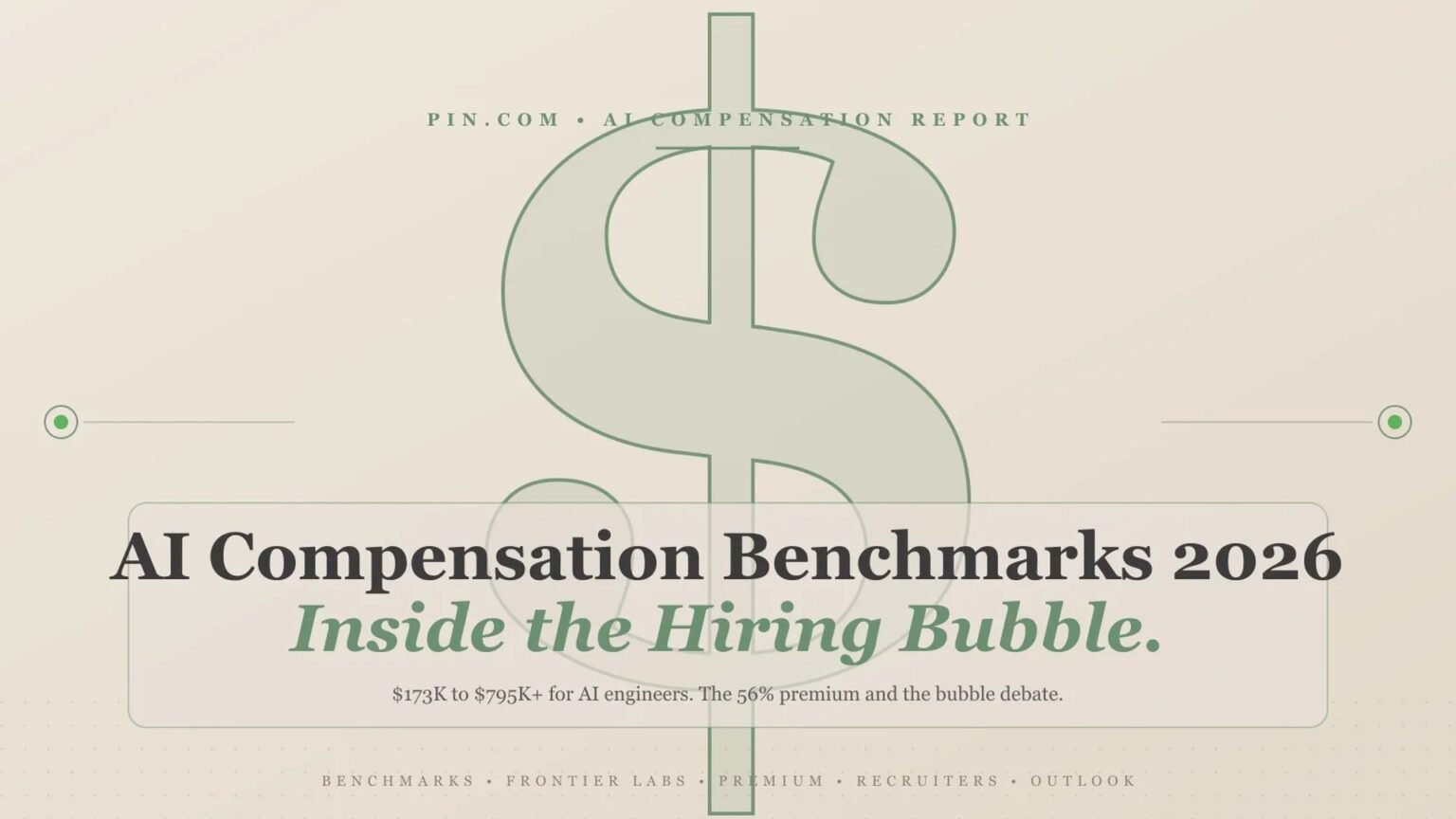

AI engineer salary 2026 headlines often imply every strong ML hire is making seven figures. The cleaner read from Levels.fyi OpenAI software-engineer data and Levels.fyi Anthropic software-engineer data is narrower: OpenAI software engineers show a median total compensation of $555K, while Anthropic software engineers show a median of $710K. Those are still extraordinary numbers, but they are self-reported, equity-heavy, and concentrated at a tiny set of frontier labs rather than the broader AI job market.
The headline finding: frontier labs pay far above the market, but median is not max
$555K
OpenAI software engineer median
Levels.fyi
$710K
Anthropic software engineer median
Levels.fyi
$1M
OpenAI research scientist median
Levels.fyi
$1.9M
Highest reported OpenAI research scientist package
Levels.fyi
The most useful way to answer the search query is simple: AI engineer salary 2026 can reach extraordinary levels at a handful of frontier labs, but the viral “$1M AI engineer” framing is not the median outcome. On the software-engineer side, OpenAI shows $251K at L2 up to $1.28M at L6, with a median of $555K. Anthropic shows $563K for Senior up to $785K for Lead, with a median of $710K.
That already tells you two things. First, frontier-lab compensation is real, not rumor. Second, the top package is not the typical package. The same pattern appears on the research side: OpenAI research scientists show $771K at L4 to $1.47M at L5, with a median of $1M and a highest reported package of $1.9M per year. Anthropic research scientists show a median of $746K and a highest reported package of $1.05M per year.
The broader market is lower. Pin’s AI compensation guide says frontier-lab median software-engineer compensation lands around $600K to $795K, while stock becomes the majority of the package above mid-level seniority. That aligns with the Levels.fyi snapshots and helps explain why search results for AI jobs often mislead readers: they mix elite-lab compensation with the much larger universe of companies merely adding AI features.

Every Levels.fyi figure here is self-reported total compensation, not guaranteed cash salary.
| Role | Company | Range | Median | Highest reported |
|---|---|---|---|---|
| Software Engineer | OpenAI | $251K (L2) → $1.28M (L6) | $555K | — |
| Software Engineer | Anthropic | $563K (Senior) → $785K (Lead) | $710K | — |
| Research Scientist | OpenAI | $771K (L4) → $1.47M (L5) | $1M | $1.9M/year |
| Research Scientist | Anthropic | — | $746K | $1.05M/year |
OpenAI breakdown: software-engineer pay runs from $251K to $1.28M
For readers searching AI engineer salary 2026, OpenAI is the cleanest example of how wide the spread can be inside one company. According to Levels.fyi’s OpenAI software-engineer page, total compensation starts at $251K for L2 and rises to $1.28M for L6, with a median of $555K.
That median matters more than the ceiling. It suggests OpenAI software-engineer pay is elite even by big-tech standards, but still well below the social-media shorthand that treats seven-figure compensation as normal. The same company page also sits inside the broader OpenAI compensation index, which shows how concentrated the very highest packages are in advanced technical roles.
OpenAI’s research-scientist data is where the million-dollar numbers become more common. Levels.fyi lists research-scientist total compensation from $771K at L4 to $1.47M at L5, with a median of $1M. The highest reported package on that page is $1.9M per year. That is a real data point, but it is not the same thing as saying the typical AI engineer at OpenAI makes $1M.
OpenAI’s software-engineer median is $555K, while its research-scientist median is $1M.
| OpenAI role | Level | Total compensation |
|---|---|---|
| Software Engineer | L2 | $251K |
| Software Engineer | L6 | $1.28M |
| Software Engineer | Median | $555K |
| Research Scientist | L4 | $771K |
| Research Scientist | L5 | $1.47M |
| Research Scientist | Median | $1M |
Anthropic breakdown: software engineers out-earn OpenAI peers on the median
Anthropic is the more surprising data point in this AI engineer salary 2026 picture. On software engineering, Levels.fyi shows $563K for Senior and $785K for Lead, with a median of $710K. That means Anthropic’s reported software-engineer median is materially higher than OpenAI’s $555K median.
The research-scientist comparison flips the ranking. Anthropic research scientists show a median of $746K and a highest reported package of $1.05M per year, which is still exceptional but below OpenAI’s $1M median and $1.9M top reported package for research scientists.
One plausible interpretation is that the two companies are making different talent-market bets. Anthropic‘s self-reported data looks especially aggressive for software engineering, while OpenAI’s reported edge is stronger in research-scientist compensation. That does not prove a formal pay philosophy, but it is the clearest pattern in the public numbers.
| Anthropic role | Level/title | Total compensation |
|---|---|---|
| Software Engineer | Senior | $563K |
| Software Engineer | Lead | $785K |
| Software Engineer | Median | $710K |
| Research Scientist | Median | $746K |
| Research Scientist | Highest reported | $1.05M/year |
Research scientist vs software engineer: the frontier-lab premium is real
One reason the search term is so messy is that “AI engineer” often gets used as a catch-all for very different jobs. The public data shows a real split between software engineering and research science. At OpenAI, the software-engineer median is $555K, while the research-scientist median is $1M. At Anthropic, the software-engineer median is $710K, while the research-scientist median is $746K.
That means the research premium is large at OpenAI and narrower at Anthropic, but the direction is the same: frontier research talent commands the highest packages. The editor’s framing that researchers can earn roughly 1.3x to 2x engineer compensation at top labs is directionally consistent with the OpenAI data, where $1M for research scientists is about 1.8x the $555K software-engineer median.
This distinction also matches hiring-market commentary outside Levels.fyi. DataExec’s analysis of what Anthropic, OpenAI, and Meta actually hire for emphasizes that frontier labs separate product-minded engineering roles from research-heavy roles with stronger publication records and deeper ML specialization. If you are benchmarking AI engineer salary 2026, role taxonomy matters almost as much as company name.
At frontier labs, research-scientist compensation can materially exceed software-engineer compensation.
“Frontier-lab median software-engineer comp sits around $600K–$795K, with stock making up the majority of the package above mid-level seniority.”
Pin, AI compensation salary guide
| Company | Software engineer median | Research scientist median | Research premium |
|---|---|---|---|
| OpenAI | $555K | $1M | ~1.8x |
| Anthropic | $710K | $746K | ~1.05x |
The caveats: self-reported data, four-year vesting, and private-stock liquidity
This is the section many salary roundups skip. Levels.fyi is useful, but it is self-reported. That means the data can skew high because people with unusually strong offers or standout outcomes are more likely to submit compensation details. Any honest read of AI engineer salary 2026 has to treat these figures as directional snapshots, not audited payroll records.
The second caveat is structural: total compensation is not the same thing as annual cash salary. Equity is typically spread over four years and may include cliffs, refreshers, or tender-dependent liquidity. Pin’s guide explicitly notes that stock becomes the majority of the package above mid-level seniority. That is why a $700K or $1M total-comp figure can still correspond to a much smaller cash paycheck.
The third caveat is liquidity. OpenAI and Anthropic stock is private, so the value of equity depends on whether employees can actually sell shares through an IPO, tender offer, or other liquidity event. The editor’s note is right to stress this. Private-stock compensation can look enormous on paper long before it becomes spendable money. In other words, frontier-lab offers are rich, but they are not interchangeable with public-company RSUs.
Pros
Cons
A large share of frontier-lab total compensation is private equity that may vest over years and remain illiquid until a tender or IPO.
| Caveat | Why it matters |
|---|---|
| Self-reported data | Can skew high relative to the full employee base |
| Four-year vesting | Total comp overstates near-term cash earnings |
| Private stock | Paper value depends on future liquidity events |
What everyone else pays: mid-stage startups, late-stage startups, then frontier labs
Best read of the market: three separate pay tiers
The cleanest way to stop overgeneralizing from OpenAI and Anthropic is to compare tiers. The editor’s verified framing is that a mid-stage AI startup, roughly Series B, pays about $200K to $400K in total compensation. A late-stage startup at $1B-plus valuation pays about $400K to $700K. Frontier labs sit at $600K and above. Pin’s guide places frontier-lab median software-engineer compensation in the $600K to $795K band, which lines up with the Anthropic and upper-end OpenAI data.
That tiering is why so many search results fail users. They answer the question as if all AI employers are one market. They are not. The realistic answer to the query is: yes, AI engineer salary 2026 can be half a million dollars or more if you clear the bar at OpenAI, Anthropic, or a similarly scarce frontier lab. Mostly no, if you are talking about the broader population of companies building with AI.
Regional and specialization differences also matter outside the frontier-lab bubble. Smenode’s regional salary breakdown and DataExec’s hiring analysis both reinforce the same point: compensation depends heavily on company stage, geography, and whether the role is product engineering, infrastructure, or research.
| Employer tier | Typical total compensation |
|---|---|
| Mid-stage AI startup (Series B) | $200K–$400K |
| Late-stage startup ($1B+ valuation) | $400K–$700K |
| Frontier lab | $600K+ |
What the data means in 2026: compensation is bifurcating with the labor market
The larger story is not just that frontier labs pay a lot. It is that compensation is bifurcating at the same time the tech labor market is fragmenting. Elite builders inside the top labs are seeing record packages, while much of the rest of tech is still dealing with hiring caution, tighter budgets, and layoffs. That makes the frontier-lab salary discourse feel both true and misleading at once.
For candidates, the practical takeaway is straightforward. If you are benchmarking against OpenAI or Anthropic, use medians, not the highest reported package. If you are comparing offers across the market, separate cash from equity and ask when private stock can actually be sold. If you are trying to understand AI engineer salary 2026 as a search term, the honest answer is that the eye-popping numbers are real but narrowly distributed.
The data does not support the claim that every AI engineer is now a millionaire. It does support a sharper claim: a small number of frontier labs are channeling extraordinary amounts of capital into a tiny pool of engineering and research talent, and that premium is now large enough to distort how the entire market talks about AI pay.
Frontier-lab compensation is real, but it is not representative of the broader AI job market.
Frequently asked questions
Sometimes, but not typically. The cited OpenAI software-engineer page on Levels.fyi shows a median of $555K, while the OpenAI research-scientist page shows a median of $1M and a highest reported package of $1.9M/year. Those are frontier-lab numbers, not the broader market.
For software engineers, the public self-reported data points to Anthropic paying more on the median: $710K at Anthropic versus $555K at OpenAI. For research scientists, OpenAI’s median is $1M, above Anthropic’s $746K median.
No. Total compensation includes salary, bonus, and equity. Guides like Pin’s AI compensation salary guide note that stock makes up the majority of frontier-lab packages above mid-level seniority, and private-company equity may not be liquid until a tender or IPO.
This article’s verified framing is that mid-stage AI startups often land around $200K–$400K total compensation, while late-stage startups can reach $400K–$700K. For broader market context by level and region, see Smenode’s 2026 AI engineer salary breakdown.
Primary sources
- Levels.fyi OpenAI software engineer salaries — Levels.fyi
- Levels.fyi OpenAI all salaries — Levels.fyi
- Levels.fyi OpenAI research scientist salaries — Levels.fyi
- Levels.fyi Anthropic software engineer salaries — Levels.fyi
- Levels.fyi Anthropic all salaries — Levels.fyi
- Levels.fyi Anthropic research scientist salaries — Levels.fyi
- DataExec: Breaking into AI in 2026 — DataExec
- Pin AI compensation salary guide — Pin
- Smenode AI engineer salary in 2026 — Smenode Academy
Last updated: May 23, 2026. Related: Capital.