
Every page quotes one registry and a different total. We reconcile all seven counts into one auditable table, explain why they diverge, and derive a defensible real number.
How many MCP servers are there in 2026?
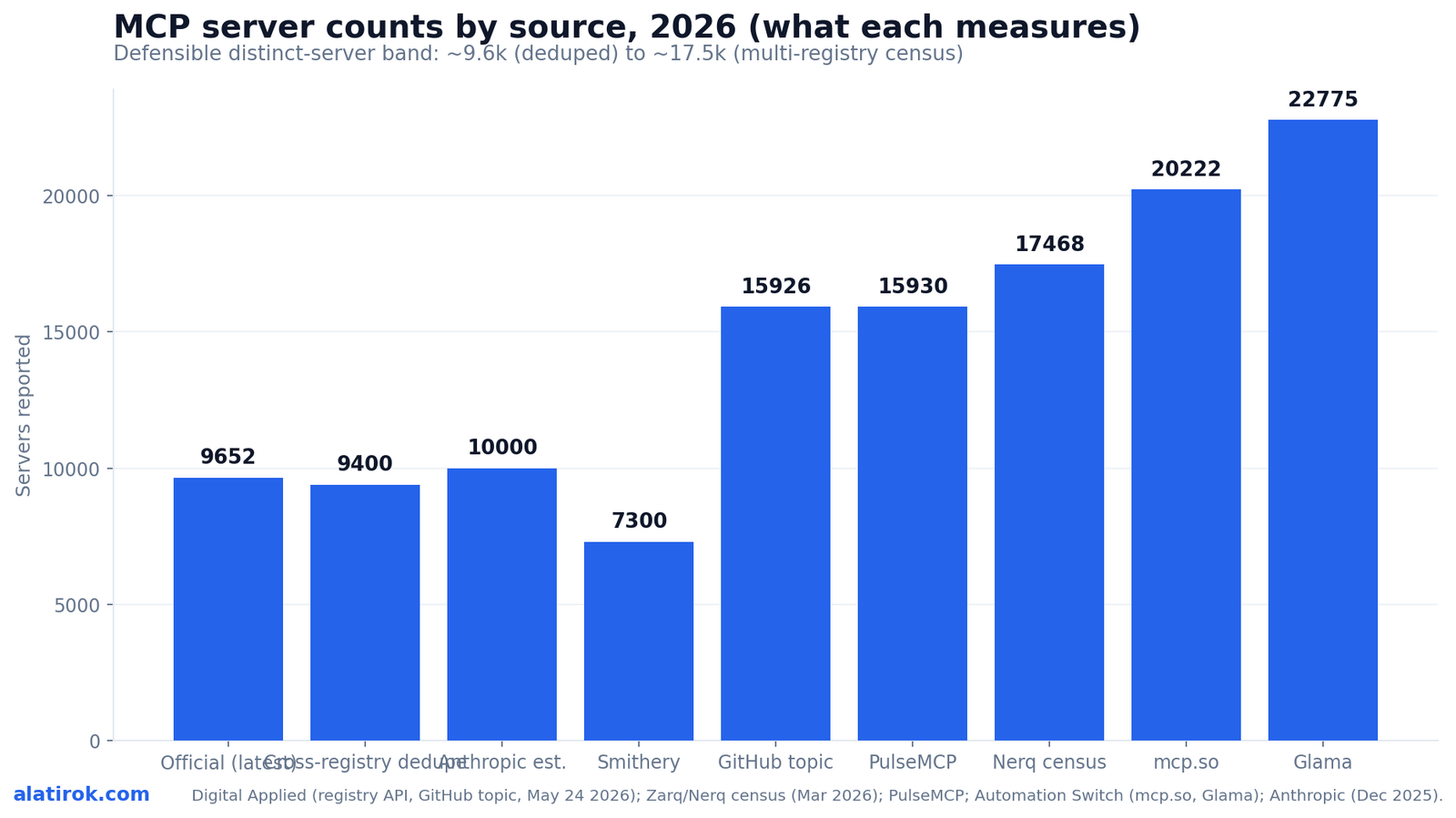
The honest answer to the MCP server statistics 2026 question is a range, not a single number: roughly 9,600 to 17,500 servers depending entirely on what you count and whether you de-duplicate. The official Model Context Protocol registry API reported 9,652 latest server records on May 24, 2026; the most aggressive third-party census indexed 17,468. Both are ‘correct.’ They are answering different questions.
Almost every ranking page you will find quotes one of these figures, attaches a confident headline, and moves on. That is the gap this article closes. We pulled the seven most-cited counts published in the first half of 2026, lined them up next to what each one actually measures, and normalized them to a defensible real number with an explicit de-duplication note. If you need a citable figure for a deck, a pitch, or a security review, this is the table to screenshot.
The short version: the official registry is the floor (deduped, protocol-native, one record per server name), the GitHub topic and big directories are the ceiling (they include forks, wrappers, abandoned repos, and re-publishes), and the truth sits in the band between them. Anyone who hands you a single number without telling you which question they answered is quoting a directory’s marketing, not measuring the ecosystem.
Why do MCP server counts disagree so wildly (9.6k vs 15.9k vs 17.5k)?
The counts diverge because each source measures a different unit: deduped server names, every published version, GitHub repositories with a topic tag, or a multi-registry union without cross-source dedupe. A single popular server can legitimately show up as one record in the official registry, twelve records in a version-counting view, and three or four entries across PulseMCP, Smithery and mcp.so simultaneously. Read carefully, the MCP server statistics 2026 vary by an order of magnitude depending on which unit you count.
Walk it through with one real example from the data. The official registry holds 9,652 latest server records but 28,959 server-and-version records. That 3x gap is not 28,959 servers, it is the same ~9,652 servers times their published version history. A page that quotes 28,959 is counting changelog entries and calling them servers.
GitHub’s topic search returned 15,926 repositories tagged mcp-server on the same day the registry showed 9,652. That delta is real software, but it is heavy with forks, half-finished experiments, template clones, and repos that were never published to any registry. It measures developer activity, not connectable, distinct servers. The independent Q1 2026 census from Zarq/Nerq pushed even higher to 17,468 by crawling six sources at once (GitHub, npm, PyPI, HuggingFace, Docker Hub and MCP registries) and union-ing the results, with HuggingFace alone contributing 35.5% of entries.
So the reconciliation rule is simple. To compare counts honestly you have to ask three questions of every number: (1) Is it deduped to one record per server, or does it count versions? (2) Does it include unpublished GitHub repos and forks? (3) Is it a single registry or a multi-source union with no cross-dedupe? Once you tag each figure with those answers, the ‘contradiction’ disappears.
Before quoting any MCP server statistic, tag it: deduped-by-name (official registry), version-counted (28,959), GitHub-topic repos (forks + experiments included), or multi-registry union (cross-source duplicates included). Counts only contradict each other when this tag is stripped off. It almost always is.
MCP server statistics 2026: the reconciliation table
Here is every major MCP server count published in H1 2026, with the exact figure, the measurement date, and what is actually being counted. This is the auditable core of the article. Each row links a number to its unit so you can pick the one that fits your question instead of grabbing whichever is largest.
Read it top to bottom and the spread stops looking like chaos. The official deduped count (9,652) and Anthropic’s own December 2025 figure (“more than 10,000 active public servers”) agree almost exactly. The GitHub topic count and PulseMCP land together near 16,000 because both sweep in unpublished and forked repos. The multi-source censuses (Nerq 17,468, mcp.so 20,222, Glama 22,775) climb highest because union-without-dedupe is the most inclusive possible method.
Digital Applied’s H1 retrospective did the cross-registry dedupe work explicitly and landed at roughly 9,400 distinct servers by mid-April 2026 across four canonical registries plus npm. That number is the most methodologically careful figure in the set, and it sits right next to the official registry’s 9,652. When the two most rigorous methods independently converge near 9.5k, that is your defensible center of gravity.
| Source | Reported count | As of | What it actually counts |
|---|---|---|---|
| Official MCP Registry (latest records) | 9,652 | May 24, 2026 | Deduped, one record per server name — protocol-native floor |
| Digital Applied cross-registry dedupe | ~9,400 distinct | Mid-Apr 2026 | 4 registries + npm, de-duplicated — most rigorous method |
| Anthropic ecosystem update | >10,000 active public | Dec 9, 2025 | Vendor estimate of active public servers |
| PulseMCP directory | 15,930+ (16,500+ daily) | May 2026 | Single largest curated directory; includes forks/wrappers |
| GitHub ‘mcp-server’ topic | 15,926 repos | May 24, 2026 | Tagged repositories — includes unpublished, forks, experiments |
| Nerq / Zarq census | 17,468 | Q1 2026 (Mar 9) | Union of 6 registries, no cross-source dedupe — ceiling |
| mcp.so directory | 20,222 | Apr 2026 | Marketplace index, submission + curated |
| Glama directory | 22,775 | May 2026 | Largest raw directory index |
| Smithery | ~7,300 | May 2026 | Curated app-store style registry (quality-filtered) |
| Official registry (server+version) | 28,959 | May 24, 2026 | Every published version — NOT a server count |
What is the defensible ‘real’ number of MCP servers?
If you need one defensible figure, use ~9,600 distinct, connectable MCP servers as of late May 2026, and cite the ~9.6k–17.5k band whenever you want to show the full ecosystem including forks and unpublished repos. That floor is anchored on two independent rigorous methods — the official registry’s deduped 9,652 and Digital Applied’s cross-registry dedupe of ~9,400 — that agree to within 3% despite being computed differently.
The upper bound of the band, ~17,500, is the Nerq six-registry census. We stop there rather than at mcp.so’s 20,222 or Glama’s 22,775 because those two raw directory indexes lean hardest on un-deduplicated submissions and re-published wrappers, which inflate the count without adding distinct, usable servers. They are useful for discovery, not for census.
This is the chart below. We plot each source’s reported count side by side, annotate what each bar measures, and shade the defensible band from the deduped floor (~9.6k) to the census ceiling (~17.5k). When someone asks ‘how many MCP servers are there in 2026,’ point at the band, not a single bar.
MCP SDK downloads vs server count: don’t conflate them
9,652
Official registry latest records
Deduped, one per server name — May 24, 2026
97M
Monthly MCP SDK downloads
Up ~970x from ~100k at Nov 2024 launch
17,468
Nerq six-registry census
Union of 6 sources, no cross-dedupe — Q1 2026
+38%
Distinct servers, 4 months
~6,800 (YE 2025) to ~9,400 (mid-Apr 2026)
97 million monthly MCP SDK downloads is an adoption signal, not a server count — it measures developers pulling the Python and TypeScript libraries to build with, up from roughly 100,000 monthly at the November 2024 launch. That is close to a 970x increase in about 16–18 months, one of the steepest adoption curves any developer protocol has posted. But it tells you how many people are building, not how many distinct servers exist.
This conflation is the second-biggest error in MCP adoption statistics 2026 coverage, right behind quoting a single registry. A page that puts “97M” next to “how many MCP servers” is mixing a download counter with a server census. One developer running CI can generate thousands of SDK downloads a month while shipping zero new servers. The two metrics move for completely different reasons.
Keep them in separate columns. SDK downloads (97M/month, Mar 2026) measure builder momentum. Server counts (~9.6k–17.5k) measure shipped surface area. Search demand is a third axis entirely: the top 50 most-searched MCP servers drew 170,000+ US and 622,000+ worldwide monthly searches, with Playwright (82k), Figma (74k) and GitHub (69k) leading — and 42 of the top 50 are developer tools, which is why the category split skews the way it does.
MCP server categories breakdown: connectors dominate
Connectors and SaaS integrations are the single largest MCP server category at roughly 38%, followed by developer tooling at ~27%, data and search at ~18%, system and browser at ~11%, and creative and content at ~6%. These are directional ranges from Digital Applied’s April 2026 ecosystem snapshot against their tracked subset — no public registry publishes an official five-bucket split, so treat them as proportions, not precise counts.
The shape tells the strategic story better than the headline number. Connectors lead because the commercial value of MCP is wiring an agent into the SaaS tools a business already runs — CRM, ticketing, docs, payments. That is where vendors are publishing first-party servers and where enterprise budgets land. Developer tooling is second because the earliest adopters were engineers building for themselves, which also explains why 42 of the 50 most-searched servers are dev tools.
For anyone deciding where to build, the gap between categories is the opportunity map. Creative and content at ~6% is underbuilt relative to demand; system and browser at ~11% is crowded but high-traffic (Playwright alone pulls 82k monthly searches). If you are picking a wedge, the count tells you where the competition is, and the category split tells you where it isn’t.
Pros
Cons
“When the two most rigorous methods independently land near 9.5k, that is your defensible center of gravity — not whichever directory’s marketing number is largest.”
Alatirok analysis of H1 2026 MCP registry data
How fast is the MCP ecosystem growing in 2026?
Cite ~9.6k distinct servers (band 9.6k–17.5k) — and always name the unit
The distinct-server count grew about 38% in four months — from ~6,800 at year-end 2025 to ~9,400 by mid-April 2026 — while curated directories added roughly 1,000+ new indexed servers per month through Q1–Q2 2026. PulseMCP projected crossing 16,500 daily-updated entries by its June snapshot at that pace, and Smithery climbed from ~6,000 in March to ~7,300 in May.
MCP registry growth is decelerating from the explosive 2025 launch curve into something more durable. The H1 retrospective projects 10,000–12,000 distinct servers by end of 2026, with new growth concentrating in vendor-published connectors and enterprise-internal servers rather than the community novelty servers that drove the first wave. That is a healthier, stickier kind of growth — fewer toy GitHub repos, more production connectors that someone is paid to maintain.
The practical takeaway for 2026: the headline count is flattening but the quality mix is improving. If you are tracking the ecosystem, watch the deduped distinct-server line and the connector share, not the biggest directory’s vanity total. The directories will keep racing each other past 20,000; the number that matters is how many distinct, maintained servers you could actually connect an agent to today, and that number is comfortably in five figures and climbing.
Builder’s take
I run two products on top of MCP, so I care about this number for a practical reason: when I tell a partner ‘the ecosystem has X servers,’ I need to be able to defend X. Here is how I read the 2026 data after building against it.
- Stop quoting a single registry. Anyone citing one headline number (especially the biggest one) is selling you a directory, not measuring an ecosystem. The honest answer is a range with a methodology note attached.
- The official registry’s 9,652 latest records is the closest thing to a ‘protocol-native’ census because it dedupes to one record per server name. It is the floor I anchor on.
- Server count and SDK downloads are two different stories and most posts conflate them. 97M monthly SDK downloads measures developers pulling the libraries to BUILD; it tells you almost nothing about how many distinct servers ship.
- For my own roadmap I treat ~9.6k as ‘real distinct servers you could plausibly connect today’ and ~17.5k as ‘the upper bound including forks, wrappers and stale GitHub repos.’ The truth lives in that band.
- The category split matters more than the headline. Connectors dominate at ~38% because the money is in wiring agents to SaaS, which is exactly where Cyntr and Loomfeed live.
Frequently asked questions
Roughly 9,600 distinct, connectable servers as of late May 2026, based on the official MCP registry’s 9,652 deduped latest records and an independent cross-registry dedupe of ~9,400. Counting more loosely — including GitHub forks, wrappers and un-deduplicated directory submissions — pushes the figure to ~15,900 (PulseMCP, GitHub topic) and up to ~17,468 in the broadest multi-registry census. The defensible band is ~9.6k to ~17.5k; which number is ‘right’ depends on whether you count distinct servers or every tagged repo.
Because they count different units. The official registry deduplicates to one record per server name (9,652 as of May 24, 2026), while PulseMCP is a broad curated directory (15,930+, projecting 16,500+) that includes forks, wrappers, re-published packages and servers never submitted to the official registry. PulseMCP is optimized for discovery; the official registry is optimized for a clean, protocol-native census. Neither is wrong — they answer different questions.
No. The 28,959 figure is the official registry’s server-and-version record count — it counts every published version of every server, not distinct servers. The same ~9,652 servers times their version histories produces that number. Quoting 28,959 as a server count is one of the most common errors in MCP server statistics coverage. The distinct-server figure from the same registry on the same date is 9,652.
MCP SDK downloads measure developers pulling the Python and TypeScript client/server libraries to build with — 97 million per month as of March 2026, up from roughly 100,000 monthly at the November 2024 launch (about a 970x increase). This is an adoption and builder-momentum signal, not a server census. One developer can generate thousands of downloads while shipping zero servers, so the two metrics should never be merged into a single count.
By search demand, the leaders are Playwright (~82k monthly searches), Figma (~74k), GitHub (~69k), the Atlassian/Jira/Confluence cluster (~40k), Context7 (~32k), Supabase (~26k), Notion (~23k), Serena (~19k), Slack (~17.7k) and browser servers (~16.1k). The top 50 together draw 170,000+ US and 622,000+ worldwide monthly searches, and 42 of those 50 are developer tools — which is why dev tooling is the second-largest server category after connectors.
Using Digital Applied’s April 2026 ecosystem snapshot (directional, since no registry publishes an official split): connectors and SaaS integrations ~38%, developer tooling ~27%, data and search ~18%, system and browser ~11%, and creative and content ~6%. Connectors lead because the commercial value of MCP is wiring agents into the SaaS tools businesses already run. Treat these as proportions across a tracked subset, not exact counts of the full ecosystem.
Primary sources
- MCP Adoption Statistics 2026 (registry API counts, GitHub topic, Anthropic figures) — Digital Applied
- MCP Ecosystem H1 2026 Retrospective (cross-registry dedupe ~9,400 distinct servers) — Digital Applied
- MCP Adoption Statistics (SDK downloads, remote-server growth) — MCP Manager
- 50 Most Popular MCP Servers in 2026 (search-volume rankings) — MCP Manager
- State of AI Assets Q1 2026 — 17,468 MCP servers, six-registry crawl — Zarq / Dev.to
- MCP Server Directory (16,500+ updated daily) — PulseMCP
- Official MCP Registry — Model Context Protocol
- Where to Find MCP Servers in 2026 (mcp.so 20,222; Glama 22,775) — Automation Switch
Last updated: June 2, 2026. Related: Agent Infrastructure.