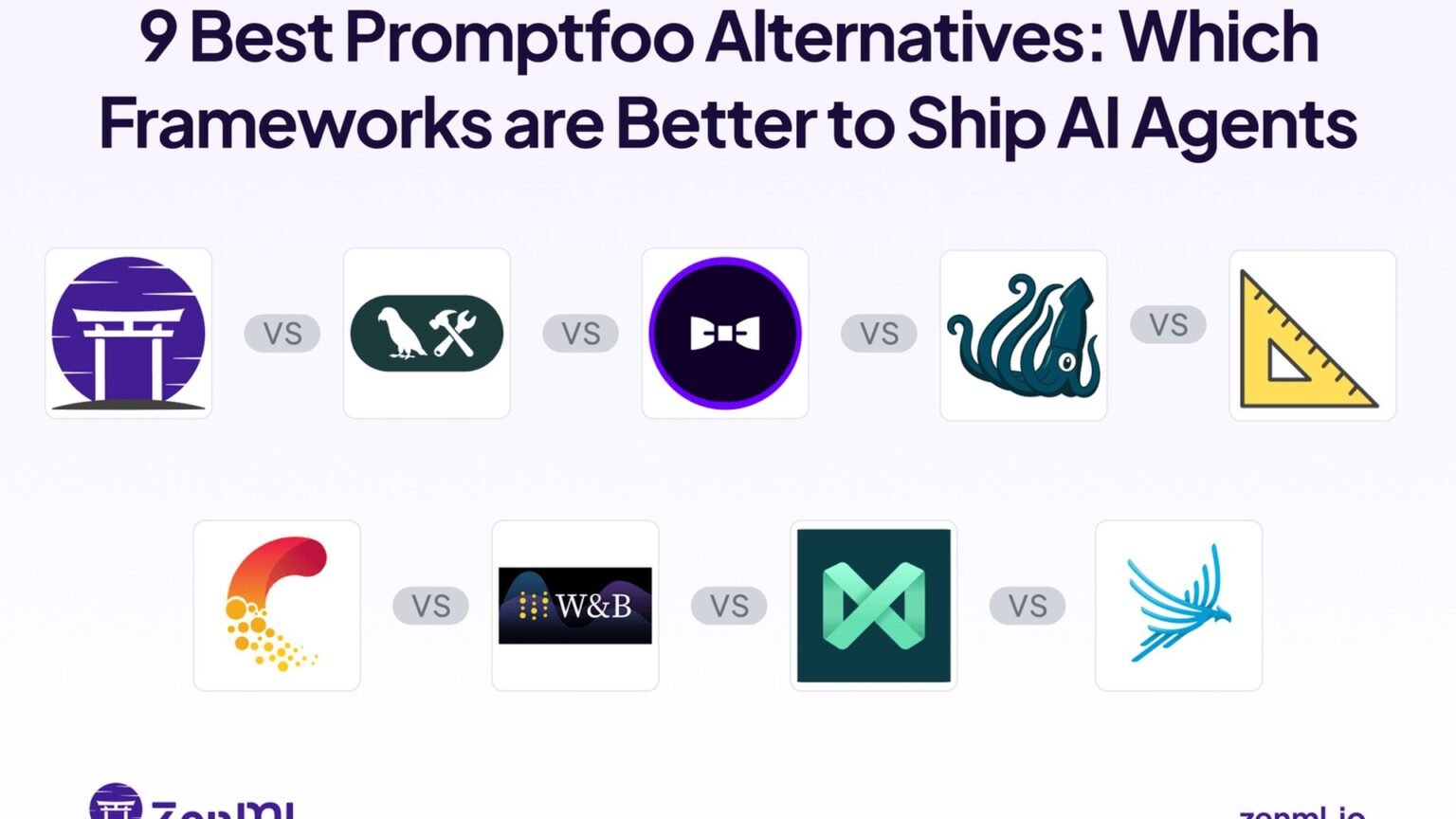

The LLM eval framework choice changed materially after OpenAI said it had acquired Promptfoo on March 9, 2026, turning the former open-source default into a vendor-owned asset and pushing teams to rethink neutrality, portability, and stack design. The practical lesson from 2026’s eval market is not to pick one winner, but to separate CI/CD gating from human review and regression tracking so your evaluation layer stays replaceable.
If you need a fast map of the market first
6
tools in the core 2026 comparison set
Promptfoo, DeepEval, DSPy, OpenAI Evals, Inspect AI, Braintrust
$86M
Promptfoo acquisition price
Per editor-provided news hook for March 9, 2026
2
tools most production teams need
A CI gate plus a dashboard/annotation layer
28K+
DSPy GitHub stars
Repository star count is visible on GitHub and may change over time
The news hook matters because it changes incentives. Promptfoo built mindshare as an open-source default for red-teaming and LLM evaluation, then OpenAI acquired it for $86 million on March 9, 2026, according to the editor-provided reporting context and the migration narrative that followed in the developer community. That is why LLM eval framework choice is no longer just a feature comparison; it is also a neutrality and control decision.
The six names that kept showing up in 2026 are not interchangeable. DeepEval is the Python-first, pytest-friendly option for metric gates and deployment blocking; Braintrust is the platform layer for annotation, regression tracking, and dashboards; Inspect AI is the offline-first path for reproducible safety work; OpenAI Evals remains a reference implementation; Promptfoo still matters for red-teaming and attack-style testing; DSPy belongs in the conversation, but as a programming framework for LM systems rather than a direct substitute for an eval harness.
That framing is the most useful starting point for an LLM eval framework choice: decide whether you are buying a gate, a dashboard, a safety lab, or a programming model. Teams that skip that decomposition usually end up comparing tools that solve different problems.
DeepEval
Best for: Engineering teams enforcing quality thresholds before deploys
What works
Watch out for
Braintrust ⭐ Editor’s Pick
Best for: Teams that need shared visibility across engineering, product, and operations
What works
Watch out for
Inspect AI
Best for: Safety teams, public-sector work, and reproducibility-heavy evaluations
What works
Watch out for
Promptfoo
Best for: Teams that value its attack and vulnerability-testing heritage
What works
Watch out for
OpenAI Evals
Best for: Teams wanting a baseline open-source reference from OpenAI
What works
Watch out for
DSPy
Best for: Teams optimizing LM program composition and systematic prompting strategies
What works
Watch out for
Promptfoo’s ownership changed the risk profile of the category. The technical question is now tied to portability and vendor dependence.
“DSPy is the framework for programming—not prompting—language models.”
DSPy GitHub repository
If your main job is blocking bad releases in CI
Pick DeepEval first. Multiple 2026 comparisons position it as the cleanest answer when your primary need is to run tests in a Python codebase, integrate with pytest-style workflows, and fail builds when quality metrics drop below a threshold. For this branch of the LLM eval framework choice, the winning criterion is not dashboard polish; it is whether the framework fits naturally into the software delivery path you already have.
This is also where the market got clearer after Promptfoo’s ownership change. If your team wants a neutral, code-centric gate rather than a vendor-shaped control plane, DeepEval is easier to justify as the first component in a two-layer stack. You can add a platform later without rewriting the test logic that protects production.
Pros
Cons
from deepeval import assert_test
from deepeval.metrics import AnswerRelevancyMetric
from deepeval.test_case import LLMTestCase

metric = AnswerRelevancyMetric(threshold=0.7)

test_case = LLMTestCase(
    input="What does SOC 2 Type II mean?",
    actual_output="SOC 2 Type II evaluates controls over time."
)

assert_test(test_case, [metric])
If product, ops, and leadership all need to see regressions
Best default: DeepEval plus Braintrust
Choose a platform layer such as Braintrust, then pair it with a lightweight eval framework. The strongest 2026 synthesis across the comparison pieces is that production teams usually need two tools: one for CI/CD gating and one for human annotation, regression tracking, and stakeholder dashboards. That is the most important takeaway in this LLM eval framework choice because it stops teams from forcing one product to do two different jobs badly.
Braintrust’s positioning is clearest on the second job. The company’s own comparisons and third-party guides keep returning to the same split: DeepEval, RAGAS, or Promptfoo for code-level checks; Braintrust, LangSmith, or Arize-style platforms for review loops and visibility. If your issue is not just model quality but organizational memory, dashboards matter more than another local CLI.
Pros
Cons
Use one framework for CI gates and one platform for annotation, regression tracking, and dashboards.
If your team keeps putting DSPy in the same bucket as eval tools
Runner-up branch: choose DSPy only when the problem is program design
Stop and reframe the decision. DSPy describes itself as a framework for programming rather than prompting language models, which makes it adjacent to evaluation but not equivalent to Promptfoo, DeepEval, or Inspect AI. In an LLM eval framework choice, DSPy belongs on the branch where your real problem is optimizing LM program composition, not merely scoring outputs after the fact.
That distinction matters because the wrong comparison leads to the wrong architecture. If you need benchmark runs, release gates, and review dashboards, DSPy is not the whole answer. If you are redesigning how prompts, retrievers, and modules are composed and optimized, DSPy can be central, with a separate eval layer still handling regression tests and reporting.
Pros
Cons
DSPy is not best understood as a direct substitute for a production eval dashboard or a simple CI gate.
import dspy

class AnswerQuestion(dspy.Signature):
    """Answer a question with a concise factual response."""
    question = dspy.InputField()
    answer = dspy.OutputField()

predict = dspy.Predict(AnswerQuestion)
result = predict(question="What is retrieval-augmented generation?")
print(result.answer)
If you work on safety, governance, or public-sector style evaluations
Choose Inspect AI first. Its public positioning emphasizes offline-first evaluation and prioritizes correctness, transparency, and reproducibility over real-time telemetry features, which is exactly the tradeoff many governance and safety teams want. For this branch of the LLM eval framework choice, reproducibility is the product.
That makes Inspect AI a better fit than mainstream product analytics tools when the audience includes auditors, regulators, or internal safety review boards. You can still connect findings back into broader observability systems later, but the center of gravity is different: the goal is a defensible record of what was tested, how it was tested, and whether the result can be reproduced.
Pros
Cons
“Inspect prioritizes correctness, transparency, and reproducibility over real-time telemetry features.”
Inspect AI documentation
If you still want Promptfoo after the OpenAI deal
Warning: use Promptfoo for its niche, not as your only layer
Use it when its red-teaming strengths are the reason you are buying, not because it used to be the default. Promptfoo’s long-standing appeal included OWASP- and NIST-style presets, reconnaissance and attack-planning workflows, and vulnerability-oriented testing. Those capabilities do not disappear because ownership changed.
What does change is the strategic posture around neutrality. If your LLM eval framework choice is heavily influenced by avoiding single-vendor dependence, Promptfoo now deserves the same scrutiny buyers apply to any platform owned by a model provider. The safe pattern is to isolate it to the branch where its security testing is uniquely useful, while keeping your broader evaluation data and release gates portable.
Pros
Cons
Promptfoo may still be useful, but teams should now ask whether ownership could shape roadmap neutrality, integrations, or migration costs.
If you want the simplest final decision matrix
Here is the shortest useful answer. Start with the job to be done, not the brand. Most teams making an LLM eval framework choice in 2026 should begin with DeepEval for CI gates and add Braintrust for annotation and regression visibility; choose Inspect AI when reproducibility and safety review dominate; use DSPy when the real work is LM program design; keep Promptfoo for red-teaming if that niche matters; and treat OpenAI Evals as a reference point rather than the default end-state.
| Condition | Primary recommendation | Why this path fits | What to pair it with |
|---|---|---|---|
| You need release gates in a Python stack | DeepEval | Best fit for CI/CD thresholds and pytest-style workflows | Braintrust for dashboards and human review |
| You need cross-functional regression visibility | Braintrust | Built around annotation, regression tracking, and stakeholder dashboards | DeepEval or another code-level eval harness |
| You are optimizing LM program composition | DSPy | Programming framework, not just a scoring tool | A separate eval framework for regression testing |
| You need reproducible safety or governance evals | Inspect AI | Offline-first and reproducibility-oriented | Optional observability layer for broader ops |
| You need adversarial testing and red-teaming | Promptfoo | Security-oriented evaluation remains its strongest branch | Keep core eval data portable elsewhere |
| You want a baseline open-source reference | OpenAI Evals | Historically important reference implementation | Usually another tool for production operations |
Frequently asked questions
The most defensible default is a two-layer setup: a code-level eval framework for CI gates and a platform for annotation and regression tracking. That framing appears in comparison coverage from Inference.net and in vendor comparisons such as Braintrust’s DeepEval alternatives article.
Not in the same sense as DeepEval or Promptfoo. DSPy describes itself as a framework for programming language models, which makes it adjacent to evaluation but not a direct substitute for a CI gating tool or dashboard platform. See the project’s own description on GitHub.
Choose Inspect AI when reproducibility, transparency, and offline-first workflows matter more than real-time telemetry. Its documentation explicitly emphasizes those priorities, making it a strong fit for safety and governance work; see Inspect AI.
Yes, but mainly where its red-teaming and vulnerability-testing strengths are the reason you want it. The broader concern is neutrality and lock-in, which is why many 2026 comparisons now discuss alternatives and migration paths, including Braintrust’s Promptfoo alternatives article and the community post on DEV.
Primary sources
- Braintrust: DeepEval alternatives 2026 — Braintrust
- Inference.net: LLM evaluation tools comparison — Inference.net
- Confident AI: Best AI evaluation tools for prompt experimentation 2026 — Confident AI
- Braintrust: Best Promptfoo alternatives 2026 — Braintrust
- DEV: Top 5 AI agent eval tools after Promptfoo’s exit — DEV Community
- DSPy GitHub repository — GitHub
- Inspect AI documentation — UK AI Safety Institute
- OpenAI Evals GitHub repository — GitHub
Last updated: May 23, 2026. Related: Observability.