
Decagon, Sierra, Fin, Agentforce and Cognigy now resolve most tier-1 tickets autonomously. We compare resolution rates, pricing models, integration and where each one still breaks.
What changed: AI customer support went from deflection to resolution
$15.12B
2026 AI customer service market size
growing ~25.8% CAGR toward $117.87B by 2034
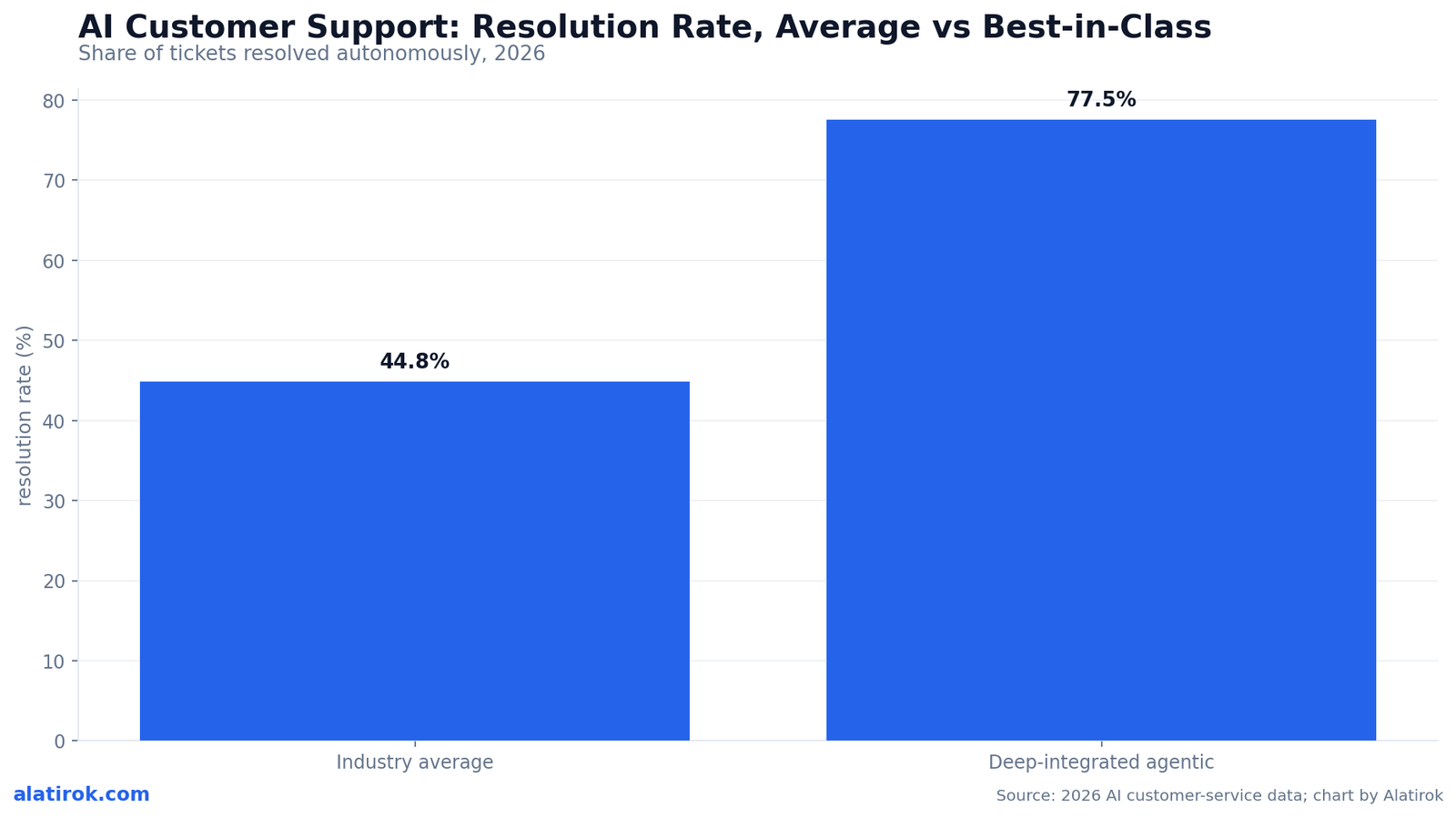
44.8%
Industry-average AI resolution rate
vs 70-85% for deep-integrated agentic platforms
$80B
Gartner-forecast labor savings in 2026
global contact-center agent cost reduction from conversational AI
66%
Service orgs running AI agents
up from 39% in 2025, per Salesforce
In 2026, the leading AI customer support platforms autonomously resolve the majority of tier-1 tickets end to end — not just deflect them — and they bill for that outcome rather than for software seats. The shift is the single most important thing to understand before you buy. “Deflection” used to mean the bot answered a question so the customer stopped contacting you; “resolution” means the agent actually completed the task — issued the refund, changed the booking, reset the account — by calling your backend systems.
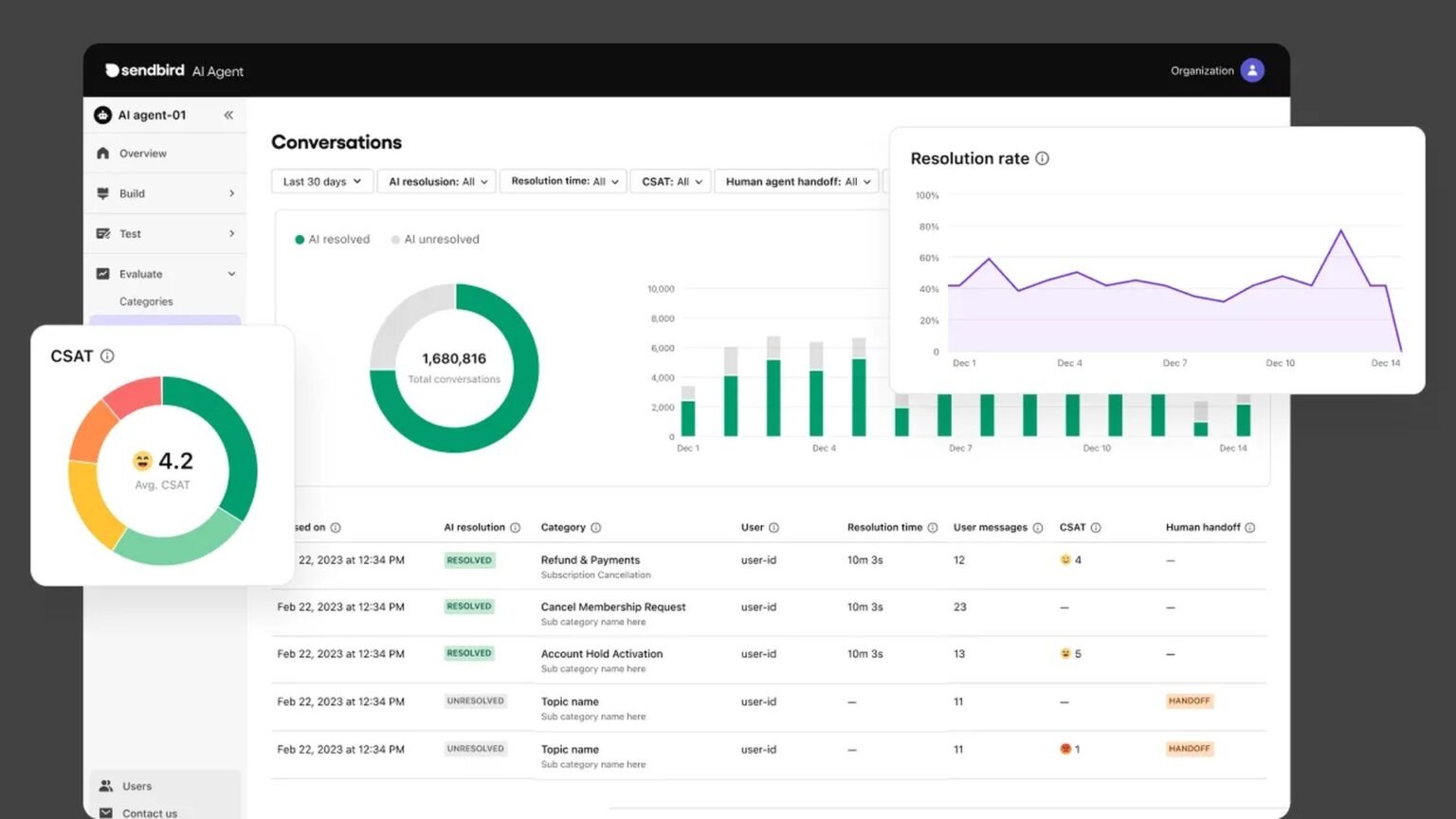
The distinction matters financially because most vendors now charge per resolution. Industry data for 2026 puts realistic AI resolution at 65-70% for standard deployments and 70-85% for purpose-built agentic platforms with deep backend integration, while the unfiltered industry average across all tools still sits around 44.8%. The gap between the best agents and the median is enormous, and it is almost entirely a function of how well the agent is wired into your stack — not which model it runs.
The money has followed. Decagon was valued at $4.5 billion in January 2026 after a $250M Series D led by Coatue and Index, and confirmed that valuation with an employee tender offer in March. Sierra, founded by former Salesforce co-CEO and OpenAI chairman Bret Taylor, raised roughly $950M at a $15.8B valuation in May 2026, reaching over $150M ARR with 40%+ of the Fortune 50 as customers. Gartner expects agentic AI to autonomously resolve 80% of common customer service issues without human intervention by 2029, with a projected 30% cut in operational costs.
This guide compares the platforms enterprises actually shortlist in 2026 — Decagon, Sierra, Intercom Fin, Salesforce Agentforce and NiCE Cognigy — plus the incumbent help desks bolting AI onto existing seats. We focus on the four decisions that determine ROI: resolution rate against your real ticket mix, pricing model, integration depth, and escalation behavior.
Gartner data shows AI deflects 45%+ of queries but only about 14% of issues are fully self-service resolved. A vendor quoting an 80% ‘deflection’ number may be resolving far less. Always ask for the resolution rate, and define what ‘resolved’ means in your contract.
Pricing models: per-resolution vs per-conversation vs seat
The pricing model you choose matters as much as the platform, because it decides who absorbs the risk when the AI fails — you or the vendor. Three models dominate in 2026, and they are not interchangeable.
Per-resolution (outcome-based) is the model the AI-native vendors champion. Intercom Fin charges $0.99 per resolution and bills at most once per conversation, no matter how many questions the customer asks. Sierra and Decagon also price on outcomes; Decagon has reported per-resolution rates as low as ~$0.50 in some contracts, alongside per-conversation options near $0.99. The appeal is incentive alignment: you only pay when the agent does the job. The catch is that you must control the definition of “resolution,” because a loose definition lets the vendor count a polite deflection as a paid win.
Per-conversation charges regardless of outcome. Salesforce Agentforce lists $2.00 per conversation, and crucially you still pay that $2.00 even when the conversation escalates to a human. Ada sits around $1.00-$3.50 per interaction. This model is simpler to forecast but punishes you for the AI’s mistakes.
Per-seat with AI add-ons is how the incumbents retrofit. Zendesk’s Resolution Platform charges $1.50 (committed) to $2.00 (pay-as-you-go) per automated resolution on top of $55-$169 per agent per month plus a $50/agent/month Advanced AI add-on. Freshworks Freddy runs roughly $100 per 1,000 sessions, charging per session whether or not the issue is solved. The hidden cost across all enterprise deals is the floor: Decagon carries a ~$50K annual platform fee before usage, Sierra a six-figure ‘Agent OS’ access fee, and Agentforce mandates a Data Cloud subscription that can start at $108K+/year plus $50K-$150K implementation.
“Per-resolution pricing aligns incentives beautifully — right up until you realize finance has to manually audit what the vendor counted as a resolution.”
On the hidden tax of outcome-based billing
| Platform | Headline price | Model | Platform / floor cost |
|---|---|---|---|
| Intercom Fin | $0.99 / resolution | Outcome (per resolution) | Optional Intercom seat from $29/mo |
| Decagon | ~$0.50-$0.99 / resolution | Outcome / per-conversation, custom | ~$50K/yr platform fee; median ~$386K |
| Sierra | Outcome-based, custom | Per resolved outcome | Six-figure Agent OS fee; $150K+/yr |
| Salesforce Agentforce | $2.00 / conversation | Per conversation (charged even on escalation) | Data Cloud $108K+/yr; impl $50K-$150K |
| Zendesk Resolution Platform | $1.50-$2.00 / resolution | Per resolution + seats | $55-$169/agent/mo + $50/agent AI add-on |
| Freshworks Freddy | ~$100 / 1,000 sessions | Per session (any outcome) | Help desk from $15-$79/agent/mo |
The AI-native leaders: Decagon vs Sierra
Decagon and Sierra are the two purpose-built enterprise platforms competing for the top of the market, and they diverge on philosophy: Decagon is the configurable CX concierge with published resolution numbers, while Sierra is the white-glove Agent OS for the Fortune 50.
Decagon, founded in 2023 by Jesse Zhang and Ashwin Sreenivas, runs across chat, email, voice and SMS and publishes hard outcomes: 80% deflection at Duolingo, 70% resolution at Chime, and $1M in attributed revenue from automated conversations at Hunter Douglas. Its customer roster includes Figma, Notion, Square, Cash App, Riot Games, Rippling, Avis Budget Group, Oura and 1-800-Flowers — more than 100 large accounts. Typical go-live is around six weeks. The trade-offs: native help-desk support is concentrated on Zendesk, Salesforce and Kustomer (no Freshdesk or HubSpot out of the box), and customers report limited transparency into why the agent reached a given decision plus underdeveloped audit logs.
Sierra, from Bret Taylor and Clay Bavor, positions itself as the orchestration and governance layer — the “Agent OS” — for the largest enterprises, handling mortgage refinancing, insurance claims and complex support across chat, voice, SMS and WhatsApp. It rarely publishes deflection percentages, leaning instead on Fortune 50 logos and go-live speed (Vivid Seats went live in four weeks). Its outcome pricing is unusually nuanced: simple Q&A and a resolution equivalent to a 20-minute L2 call can both count, and in most cases escalated cases incur no charge. Trade-offs: context loss in longer conversations, a steep initial learning curve, and limited self-service editing without Sierra’s team in the loop.
Net: if you want published benchmarks, faster self-configuration and ecommerce-style breadth, Decagon is the natural shortlist entry. If you are a Fortune-100 enterprise with regulated, multi-step workflows and budget for a white-glove build, Sierra’s governance depth is the draw.
Decagon
Best for: Mid-market to enterprise on Zendesk/Salesforce/Kustomer wanting measurable resolution fast
What works
Watch out for
Sierra
Best for: Large regulated enterprises with complex, multi-system support journeys
What works
Watch out for
Help-desk incumbents: Fin, Agentforce and NiCE Cognigy
If your team already lives in a help desk or contact center, the incumbent AI agents bolt directly onto your existing data and workflows — a real advantage that often outweighs a few points of raw resolution rate.
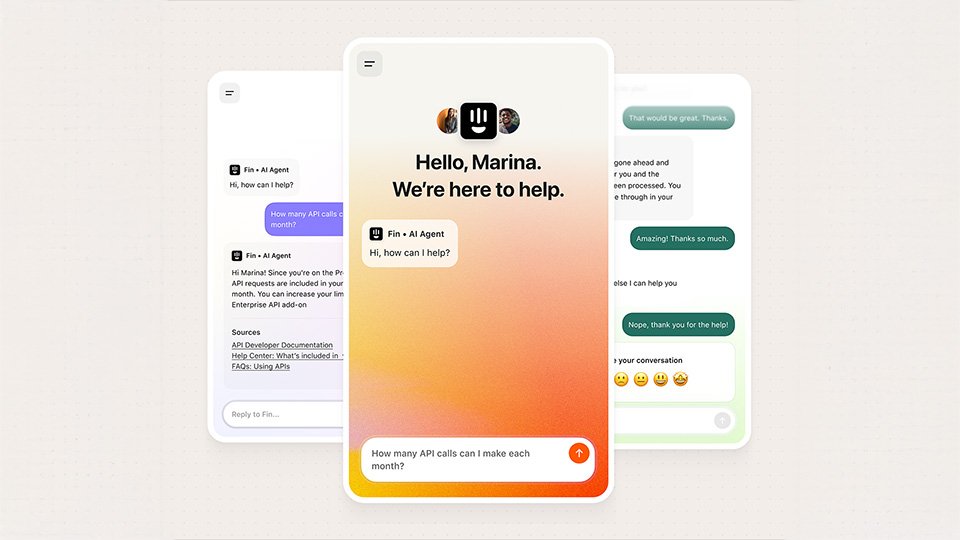
Intercom Fin is the most-deployed AI agent in 2026, with a 67% average resolution rate across 7,000+ customers, improving roughly 1% per month. At $0.99 per resolution with no mandatory platform fee, it is the easiest entry point — but Intercom’s own published case studies show real-world resolution running 42-50% in many accounts, a reminder that the headline average hides a wide spread driven by knowledge-base quality.
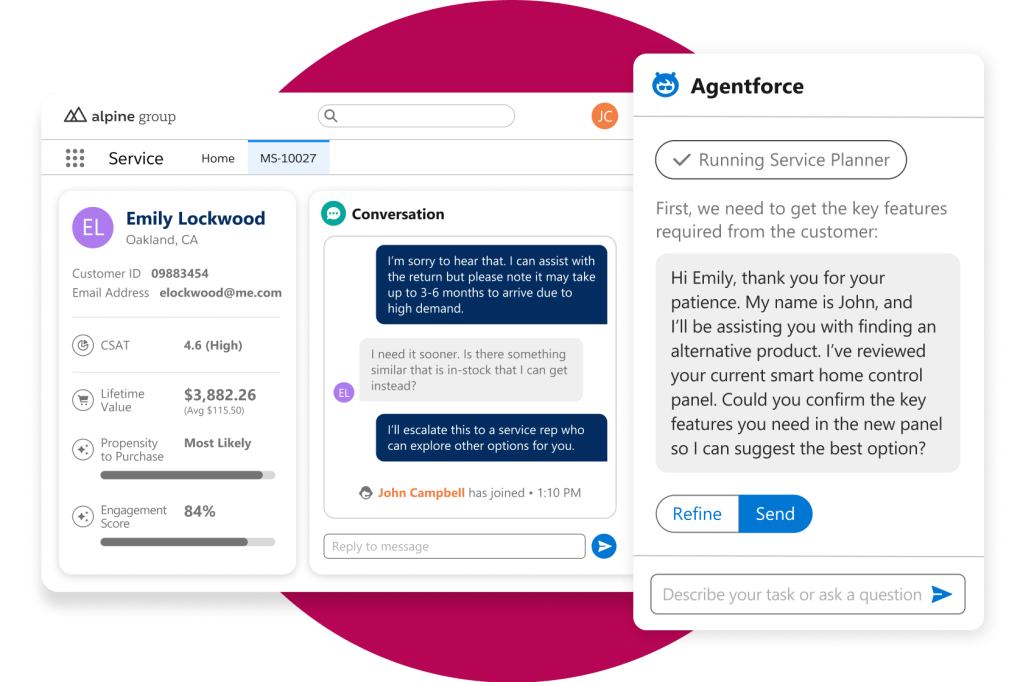
Salesforce Agentforce 360 reached general availability in February 2026 and is the default choice if your service org already runs Service Cloud and Data Cloud. Salesforce reports strong outcomes: OpenTable resolves 70% of diner and restaurant inquiries autonomously, 1-800Accountant hit 90% case deflection during peak tax season, and Reddit deflected 46% of cases while cutting resolution times 84%. The friction is cost and prerequisites — $2 per conversation (billed even on escalation), a mandatory Data Cloud subscription, and heavy implementation services.
NiCE Cognigy is the voice-and-contact-center play. NiCE acquired Cognigy for roughly $955M, closing in September 2025, and the platform is now the conversational and agentic layer of NiCE’s CXone. Cognigy was named a Leader in the Forrester Wave 2026 for Conversational AI Platforms, speaks 100+ languages with real-time translation, and is built for first-call resolution in high-volume voice operations. If your center is voice-heavy and already on NiCE, this is the path of least resistance.
Intercom Fin
Best for: SMB to mid-market teams wanting fast time-to-value without a six-figure floor
What works
Watch out for
Salesforce Agentforce 360
Best for: Enterprises already standardized on Salesforce Service Cloud + Data Cloud
What works
Watch out for
NiCE Cognigy
Best for: Voice-heavy, multilingual contact centers on or moving to NiCE CXone
What works
Watch out for
Integration and escalation: where resolution rate is actually won
An AI customer support agent’s resolution rate is set less by its model and more by two things: how deeply it can take actions in your backend, and how gracefully it hands off to a human when it should. This is the part demos hide and procurement teams underweight.
Integration depth is the dividing line between deflection and resolution. An agent that can read your knowledge base can answer questions; an agent that can call your order-management, billing and identity systems can actually issue the refund or change the booking. Gartner’s data underlines this: 62% of underperforming AI projects fail because of insufficient data preparation, versus under 15% from model limitations. The model is rarely the bottleneck — the plumbing is. Before signing, list your top 20 ticket reasons and ask the vendor to prove the agent can complete each one via API, not just describe the answer.
Escalation is the other half. The best 2026 deployments treat handoff as a designed action with a confidence threshold: when the agent’s trust score drops below a set bar, it routes to a human with full context attached. Introducing trust scores with automatic fallback reduces agent failure rates by up to 50%. Sierra’s pricing reflects this maturity — escalated cases usually aren’t billed. Agentforce’s per-conversation model does not give you that relief, so escalation-heavy queues get expensive fast.
Watch for context handoff quality specifically. A clean handoff passes the full transcript, the customer’s verified identity, and what the agent already tried, so the human doesn’t make the customer repeat themselves. A bad handoff dumps the customer into a generic queue — the fastest way to torch CSAT and erase any savings the AI generated.
A practical integration checklist before you sign
1) List your top 20 ticket intents by volume. 2) For each, ask the vendor to demo a full resolution (the action taken in your backend), not just an answer. 3) Confirm native connectors for your help desk (Zendesk/Salesforce/Kustomer/Freshdesk/HubSpot) — Decagon, for example, does not natively support Freshdesk or HubSpot. 4) Verify identity/auth handling for account-specific actions. 5) Pin the contractual definition of ‘resolution’ to an action completed, not a message sent.What a good escalation policy looks like
Set a confidence/trust threshold below which the agent always hands off. On handoff, pass the full transcript, verified customer identity, attempted actions, and a one-line summary. Route to a skill-matched human, not a generic queue. Log every escalation reason so you can close knowledge gaps. Re-train on escalated transcripts monthly — escalations are your highest-value training data.Where AI customer support still fails in 2026
AI customer support fails in three recurring ways in 2026: confident hallucination, brittle escalation, and the legal liability companies inherit when their agent gets it wrong. Every buyer should plan for these, not assume them away.
Hallucination is real but bounded by grounding. Ungrounded chatbots hallucinate 15-27% of the time; properly grounded, retrieval-backed LLMs drop to 0.7-1.5%. Even so, enterprise deployments average roughly 18% hallucination in live interactions when grounding is sloppy. Hallucination-related complaints are only about 0.34% of AI-handled tickets, yet 71% of CX leaders rank them a top-three governance risk — because the downside is asymmetric.
The cautionary tale is Moffatt v. Air Canada. The airline’s chatbot invented a bereavement-fare refund policy; a tribunal ruled Air Canada liable for negligent misrepresentation and ordered it to pay the customer, rejecting the argument that the bot was a separate entity. The lesson, now baked into 2026 procurement: you own what your agent says. Pair that with the Chevrolet dealership whose ChatGPT-powered bot was prompt-injected into ‘agreeing’ to sell a $76,000 Tahoe for $1, and you have the two failure archetypes — bad information and adversarial manipulation.
The structural fix is a hybrid operating model. 76% of contact-center leaders have formally adopted human-in-the-loop designs, combining AI for tier-1 volume with humans for complex, high-stakes, or emotionally charged cases. The goal in 2026 is not 100% automation; it is maximizing safe automation while keeping a fast, well-briefed human path for everything the agent shouldn’t touch.
Pros
Cons
Moffatt v. Air Canada established that a company is liable for what its support chatbot tells customers. Treat your agent’s promises as your company’s promises — and red-team it against prompt injection before it ever touches a real customer.
Verdict: which AI customer support platform to buy
Buy on resolution rate and integration depth, not demo deflection
There is no single best AI customer support platform — the right choice is determined by your company size, your existing stack, and how much of your ticket volume requires real backend actions versus simple answers.
For SMB and mid-market teams that want fast time-to-value without a six-figure commitment, Intercom Fin is the pragmatic starting point: transparent $0.99-per-resolution pricing, a 67% average resolution rate, and no platform floor. If you already run Salesforce Service Cloud, Agentforce 360 is the path of least resistance despite its per-conversation billing and Data Cloud prerequisite, because it is grounded directly in your CRM. Voice-heavy contact centers on NiCE should default to Cognigy.
For large enterprises buying a strategic CX platform, the decision narrows to Decagon versus Sierra. Choose Decagon for published outcomes, multi-channel breadth and faster self-configuration; choose Sierra for the deepest governance and orchestration on complex, regulated, multi-step workflows — if you can fund the white-glove build. Whichever you pick, the work that determines success is the same: integrate the agent into your backend actions, define ‘resolution’ precisely in the contract, and design escalation as a first-class path.
Builder’s take
I build agent orchestration runtimes at Cyntr, so I read every one of these support platforms as a constrained version of the same problem: route intent, call tools safely, and know when to stop. The vendors that win in 2026 are the ones that treat escalation as a first-class action, not a failure state.
- Buy on resolution rate against your real ticket mix, not the vendor’s demo deflection number — the gap is routinely 20-30 points.
- Per-resolution pricing aligns incentives but you must own the definition of ‘resolved’; audit a month of transcripts before you trust the invoice.
- Integration depth, not model quality, is the moat in 2026 — an agent that cannot take an action in your backend can only deflect, never resolve.
- Always wire a confidence threshold with automatic human handoff; trust scores with fallback cut agent failure rates by up to half.
Frequently asked questions
Deflection means the AI answered or contained a query so the customer didn’t reach a human; resolution means the agent actually completed the task end to end, such as issuing a refund or changing a booking. Gartner data shows AI deflects 45%+ of queries but fully resolves only about 14% via self-service, so a high deflection figure can hide a much lower resolution rate. Always ask vendors for the resolution rate.
Per-resolution pricing is common: Intercom Fin charges $0.99 per resolution, Zendesk $1.50-$2.00, and Decagon roughly $0.50-$0.99. Salesforce Agentforce charges $2.00 per conversation even on escalation. Enterprise platforms add floors: Decagon ~$50K/year, Sierra a six-figure Agent OS fee, and Agentforce a mandatory Data Cloud subscription starting around $108K/year plus $50K-$150K implementation.
Per-resolution (outcome-based) pricing aligns vendor incentives with results because you mostly pay only when the agent does the job, and platforms like Sierra often don’t bill escalated cases. The trade-off is that you must control and audit the contractual definition of ‘resolution.’ Per-seat or per-conversation models are easier to forecast but can charge you even when the AI fails or escalates.
For 2026, expect 65-70% for standard deployments and 70-85% for purpose-built agentic platforms with deep backend integration. The all-tools industry average is far lower at around 44.8%. Real-world results vary widely with knowledge-base quality and integration depth — Intercom’s own case studies show Fin resolving 42-50% in many accounts despite a 67% headline average.
For large enterprises the shortlist is usually Decagon or Sierra. Decagon offers published outcomes (70-80% at named customers), multi-channel coverage and faster self-configuration, but native help-desk support is limited to Zendesk, Salesforce and Kustomer. Sierra offers the deepest governance and orchestration for complex regulated workflows, used by 40%+ of the Fortune 50, but carries a six-figure floor and a steeper build.
The company deploying the agent is liable. In Moffatt v. Air Canada, a tribunal ruled the airline responsible for its chatbot inventing a refund policy and rejected the argument that the bot was a separate entity. Treat your agent’s statements as your company’s statements, ground it in verified data to limit hallucination, and red-team it against prompt injection before launch.
Primary sources
- Decagon valued at $4.5 billion — Bloomberg
- Sierra reaches $100M ARR in under two years — TechCrunch
- Sierra raises nearly $1B at $15.8B valuation — CNBC
- Decagon completes first tender offer at $4.5B — TechCrunch
- AI customer service agent pricing comparison — Fin (Intercom)
- Decagon vs Sierra 2026 buyer guide — eesel AI
- NiCE to acquire Cognigy for ~$955M — NiCE
- Outcome-based pricing for AI agents — Sierra
- Gartner: agentic AI to resolve 80% of common issues by 2029 — Gartner
- Moffatt v. Air Canada chatbot ruling — McCarthy Tétrault
- OpenTable Agentforce implementation — Salesforce
- Resolve, don’t deflect — the metric that decides ROI — Lorikeet
Last updated: May 31, 2026. Related: Products.