
Fortune says Microsoft’s own data shows AI agents can cost more than humans. We rebuilt the per-task token math to find out when that’s actually true.
Is AI agent cost vs employees actually a fair fight?
Sometimes the AI agent cost vs employees comparison favors the human, but only on a narrow slice of multi-step, long-context tasks where token consumption explodes. That nuance got flattened in late May 2026, when Fortune reported that Microsoft’s own internal data showed using AI agents can be more expensive than paying human employees for certain work. The line that traveled was simpler and scarier: AI is now more expensive than humans.
The strongest single quote in that reporting did not come from Microsoft at all. Bryan Catanzaro, Nvidia’s VP of Applied Deep Learning, told Fortune that for his team, “the cost of compute is far beyond the costs of the employees.” Coming from the company selling the compute, that is a remarkable admission, and it is what turned a niche FinOps gripe into a board-level question.
But a quote is not a cost model. The honest version of the AI agent cost vs employees question is not “which is cheaper” in the abstract. It is: on this specific task, at this loop depth, at this success rate, which one wins? The news coverage never did that arithmetic. So we did, with real per-token prices and a real worked example you can reproduce.

Agentic models do not just answer a prompt. They plan, call tools, read results, and re-read the entire accumulated context on every step. That loop is where the money goes, and it is why the same task can cost 3x or 100x depending on how many steps it takes.
Why do AI agents cost so much more per task than a chatbot?
AI agents cost far more per task than chatbots because every step in an agent loop re-sends the entire accumulated context, so a 5-step task can cost 3x a single chat and a 200-step task can cost over 100x. Stanford’s Digital Economy Lab calls this the “context snowball”: the agent reads a task, gets a response, then must re-read the original prompt plus that response before the next action, and the input grows on every iteration.
The dominant line item is input tokens, not the clever output you actually wanted. In a 30-team production audit by LeanOps, re-sent context accounted for 62% of the total bill, tool definitions another 14%, and the actual reasoning output just 11%. You are mostly paying the model to re-read things it already saw.
This is why Tom’s Hardware could report, citing industry analysis, that agentic AI consumes up to 1,000x more tokens than a standard query in the worst cases. It is also why the same agent on identical tasks can vary in cost by up to 30x, per Stanford. Agents, the researchers note, cannot even predict their own token cost, which makes them genuinely hard to budget.
| Loop type | Steps | Approx. tokens | Cost per run | Multiple of one chat |
|---|---|---|---|---|
| Single chatbot call | 1 | ~3,000 | $0.05 | 1x |
| Light agent loop | 5 | ~47,000 | $0.16 | 3.2x |
| Moderate loop | 50 | ~480,000 | ~$1.60 | ~30x |
| Autonomous debugging loop | 200 | ~2,000,000+ | ~$5.00+ | ~100x |
What does one agentic task actually cost in dollars?
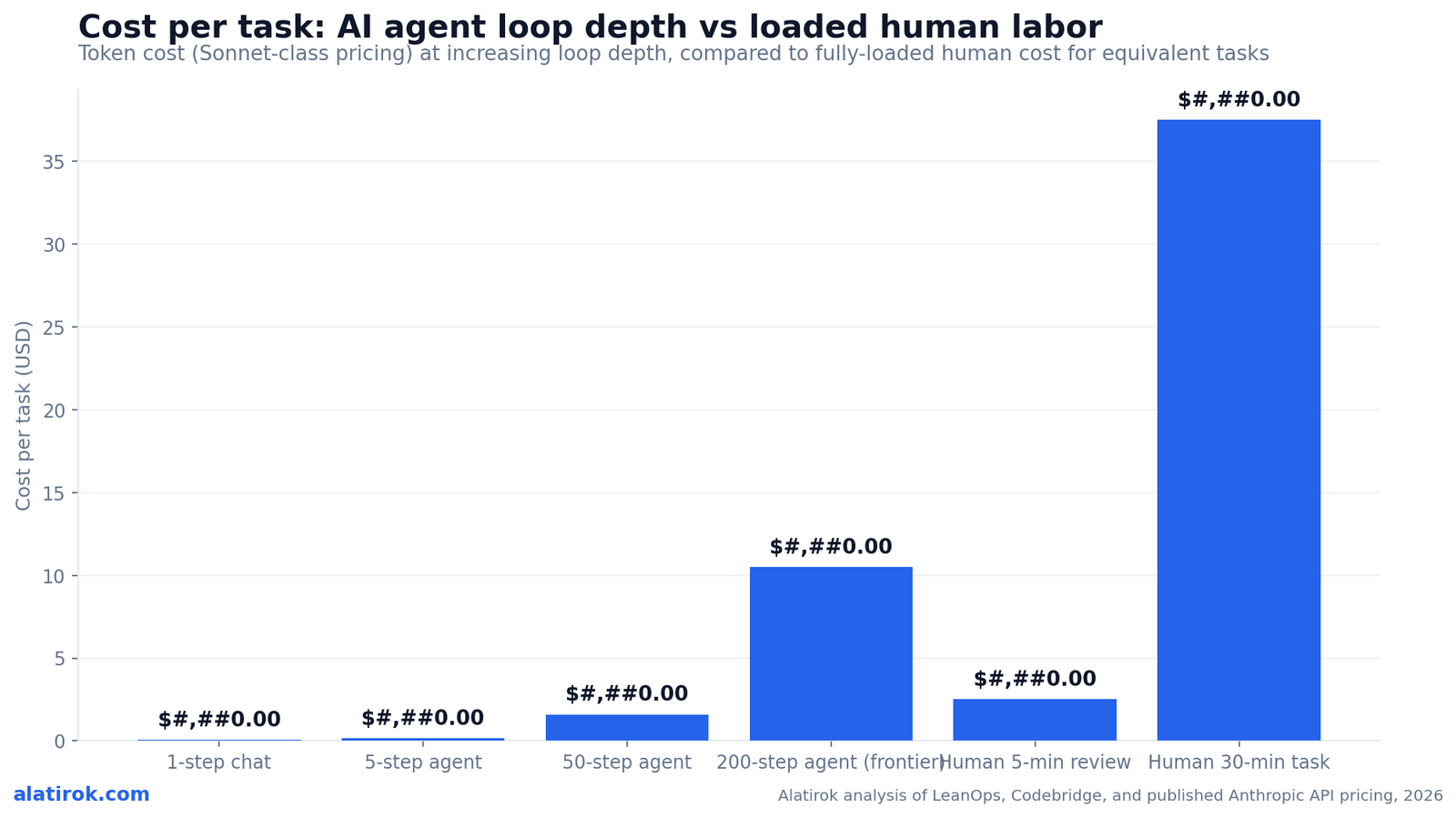
A single 5-step coding agent task on a 2,000-line file costs about $0.16 in tokens, versus roughly $0.05 for the same request as a one-shot chat, a 3.2x premium documented step by step by LeanOps. That gap is small in isolation. The problem is that production agents do not run five steps once; they run dozens of steps thousands of times a day.
Scale it up and the numbers get loud. Codebridge’s 2026 analysis pegs a mature support-agent deployment at roughly $0.76 per successful task once you divide annual spend by task volume, and individual developer audits found median spend of $480/month, with the 90th percentile at $1,650/month and weekend outliers north of $4,200 from a single engineer. One growth-stage SaaS with 35 engineers reported an $87,000 monthly baseline.
Now anchor that against a human. A fully loaded knowledge worker at $75/hour costs about $37.50 for a 30-minute task. A $30/hour reviewer doing a 5-minute spot check costs about $2.50. So an agent at $0.16 to $0.76 per task crushes the human on cost, until the agent needs 200 steps, retries three times, and runs on a frontier model, at which point a single autonomous run can pass $10 and the math inverts.
Why is Microsoft cancelling Claude Code if agents are cheap?
Microsoft is cancelling most direct Claude Code licenses and moving engineers to GitHub Copilot CLI precisely because the per-seat economics broke once usage ran unconstrained, not because agents are useless. Per Fortune, the move came after roughly six months of Claude Code availability inside Microsoft, with engineers directed to migrate. Notably, the strategic relationship is untouched: Microsoft’s Foundry-era commitments to Anthropic, including a multi-billion-dollar investment and a large Azure compute deal, remain in place.
This is a usage problem dressed up as a vendor problem. The same week the cancellation reporting circulated, GitHub flipped Copilot itself to usage-based billing on June 1, 2026, replacing flat premium-request counting with metered “AI Credits” priced by token consumption, including input, output, and cached tokens. One credit equals one cent of value. Day-one users reported surprise bills, and Visual Studio Magazine documented a developer facing a $180 June bill.
The pattern across the industry is the same. Meta reportedly ran a “Claudeonomics” leaderboard, Amazon promoted “tokenmaxxing,” and Uber’s CTO said in April that the company burned its entire 2026 AI coding budget in four months after gamifying adoption with internal leaderboards. When you incentivize consumption of a metered resource and then meter it, the bill is not a surprise; it is a forecast.
“For my team, the cost of compute is far beyond the costs of the employees.”
Bryan Catanzaro, VP of Applied Deep Learning, Nvidia, to Fortune
Will token prices fall fast enough to fix the AI agent cost problem?
1,000x
Peak token multiplier
Agentic AI vs a standard query, worst case (Tom’s Hardware)
62%
Bill from re-sent context
Largest line item in a 30-team audit (LeanOps)
24x
Token demand growth by 2030
Goldman Sachs forecast
4 months
Uber’s 2026 AI budget burn
Entire annual budget, per its CTO (Fortune)
Per-token prices are falling, but token consumption is rising faster, so the AI agent cost vs employees gap may widen before it closes. This is the central paradox in the Fortune reporting. Gartner forecasts roughly a 90% reduction in cost per token by 2030. In the same breath, Goldman Sachs projects agentic AI could lift token consumption 24-fold by 2030, reaching about 120 quadrillion tokens per month.
Run that as simple arithmetic. If price per token drops 90% (you pay 10 cents on the dollar) but volume rises 24x, your spend does not fall, it roughly 2.4x’s. Deflation in unit cost is real and it is not enough, because agentic loops convert every price cut into permission to run more steps. The snowball eats the discount.
There is a second trap the coverage flagged: providers may not pass through the full unit-cost decline to customers, keeping margin as inference gets cheaper. So the enterprise sees prices fall slower than the underlying compute, while its own usage climbs. That is the worst quadrant: your bill goes up while the press tells you AI is getting cheaper.
When do AI agents actually beat employees on cost?
AI agents beat employees on cost whenever the task is short-loop, tolerant of a sub-perfect success rate, and cheap to verify, and they lose whenever the task needs deep multi-step autonomy, one-shot correctness, or frontier-model reasoning on every step. The dividing line is not the model; it is the shape of the work.
The decisive variable people forget is success rate. Codebridge notes early agent deployments resolve roughly 50% of tasks autonomously, rising to 70-80% in mature systems. A task that costs $0.16 but succeeds only 60% of the time really costs about $0.27 per successful outcome once you account for retries and escalation. Price agents in dollars-per-success, never dollars-per-call, or you will underestimate the bill by exactly the failure rate.
The winning architecture is not agent-versus-human; it is agent-plus-human with model routing underneath. Route the 70% of cheap sub-tasks to a budget model at $0.25 to $1 per million tokens and reserve frontier models for the 30% that need them, a split that published routing analyses say cuts total token spend 60-80%. Cap context per step to kill the snowball, set a hard token budget per task, and put a human on the 8% of cases the agent escalates. That is how the AI agent cost vs employees question stops being a headline and becomes a line item you control.
Pros
Cons
How should you budget for agents after the Microsoft cost report?
Agents are not more expensive than humans. Ungoverned loops are.
Treat agent spend like cloud egress, not like a software seat: meter it per task, cap context per step, route by difficulty, and review the bill in dollars-per-successful-outcome. The Microsoft AI cost report is less a verdict on agents than a warning about ungoverned usage, and the fix is operational discipline, not abstinence.
Start with instrumentation. You cannot manage a per-task cost you cannot see, and since agents cannot predict their own token cost, you have to measure it after the fact and feed it back into budgets. Set a hard token ceiling per task that aborts runaway loops, the single most effective control against the $4,200-weekend failure mode. Then route aggressively: cheap models for the easy 70%, frontier models for the hard 30%.
Finally, redo the agent-vs-employee math per workflow, not per company. For a five-minute review task, an agent at $0.20 beats a $2.50 human spot check handily. For a half-hour of genuine judgment, a $37.50 human still beats a frontier agent that might burn $10+ and still escalate. The companies that win in 2026 are not the ones that pick a side in the AI agent cost vs employees debate. They are the ones that put each task on the cheaper side of the line.
Builder’s take
I run agent loops in production every day at Cyntr and Loomfeed, so the ‘AI is more expensive than humans’ headline landed differently for me than it did for most readers. The headline is half-true in a way that matters. Here is what I actually watch:
- The killer cost is not the model price, it is the context snowball. In our own runs, re-sent input tokens are the single largest line item, exactly like the third-party audits show. If you are not capping context per step, your bill is mostly paying to re-read the same prompt fifty times.
- Cost per task only means something next to a success rate. A $0.16 task that fails 40% of the time is really a $0.27 task, and a frontier-model task that succeeds first try can be cheaper than a budget model that loops. I price every agent in dollars-per-successful-outcome, never dollars-per-call.
- Microsoft cancelling Claude Code seats and GitHub flipping Copilot to token metering on the same week is not a coincidence. The whole industry is moving the agent cost from a fixed seat to a variable meter, and that is a FinOps problem, not an AI problem. Budget for it like cloud egress.
- Agents win decisively on tasks humans are overqualified for: triage, first-draft, retrieval, classification. They lose on anything that needs one shot at high stakes. The right question is never ‘agent or employee’, it is ‘which 70% of this task is cheap enough to give the agent’.
Frequently asked questions
Only for a specific slice of work. The May 2026 Fortune report, citing Microsoft data and an Nvidia executive, showed agents can cost more than humans on deep, multi-step tasks where token consumption explodes. But on short-loop, high-volume tasks, agents at $0.05 to $0.76 per task still beat human labor costing $2.50 to $37.50 per task by a wide margin. It is a per-workflow answer, not a blanket one.
Because of the context snowball. An agent re-sends the entire accumulated context on every step of its loop, so a 5-step task can cost about 3.2x a single chat and a 200-step task can exceed 100x. Stanford’s Digital Economy Lab found re-sent input tokens dominate the bill, and one production audit attributed 62% of total spend to re-sent context alone.
A documented 5-step coding agent task on a 2,000-line file costs about $0.16 in tokens versus about $0.05 as a one-shot chat. Mature support-agent deployments average roughly $0.76 per successful task. But long autonomous loops on frontier models can exceed $10 per run, and individual developers have hit $4,200 in a single weekend.
Per Fortune, Microsoft is cancelling most direct Claude Code seats after about six months and moving engineers to GitHub Copilot CLI, because flat per-seat economics broke under unconstrained usage. The broader Anthropic relationship, including Microsoft’s investment and Azure compute commitments, remains intact. The same week, GitHub moved Copilot itself to usage-based, token-metered billing.
Not on their own. Gartner forecasts a roughly 90% drop in cost per token by 2030, but Goldman Sachs projects token consumption rising 24-fold over the same period. A 90% price cut against 24x more volume still roughly 2.4x’s your spend. Agentic loops convert every price cut into permission to run more steps, so usage discipline matters more than unit price.
Treat agent spend like a metered utility. Cap context per step to kill the snowball, set a hard token budget per task to abort runaway loops, route easy sub-tasks (about 70%) to cheap models and reserve frontier models for the hard 30%, which published analyses say cuts spend 60-80%. Always measure cost in dollars-per-successful-outcome, not per call, since success rates of 50-80% inflate the real price.
Primary sources
- Microsoft reports are exposing AI’s real cost problem — Fortune
- AI cost crisis hits tech giants as agentic AI eats up to 1000x more tokens — Tom’s Hardware
- How are AI agents spending your tokens? — Stanford Digital Economy Lab
- AI Agents Burn 50x More Tokens Than Chats — LeanOps
- AI Agent Development Cost: Real Cost per Successful Task for 2026 — Codebridge
- GitHub Copilot is moving to usage-based billing — The GitHub Blog
- AI costs begin to bite as agents may increase token demand by 24 times, says Goldman Sachs — Tom’s Hardware
Last updated: June 2, 2026. Related: Capital.