
Per-resolution, per-conversation, and per-seat models can bill the same support ticket at wildly different rates. Here is what each actually costs a CX buyer once you normalize the math.
What outcome-based pricing for AI agents actually means
Outcome-based pricing for AI agents means you pay only when the agent produces a defined result, usually a resolved customer conversation, and pay nothing when it escalates or fails. That is the clean version. In practice, the CX market in 2026 runs at least three competing models under the same banner, and they bill the identical support ticket at prices that differ by more than 3x once you do the math.
The three models you will actually be quoted are per-resolution (you pay a fixed fee each time the agent closes a ticket end-to-end), per-conversation (you pay for every interaction the agent touches, resolved or not), and per-seat (a flat monthly license per human or agent, with AI capacity bundled in). Vendors mix and match these, and most stack a base platform or seat fee underneath whatever per-outcome charge they advertise.
The reason outcome-based pricing for AI agents took over the support category so fast is incentive alignment. Bessemer Venture Partners’ AI pricing playbook frames the shift bluntly: when the software does the work a human used to do, charging per seat undercharges for value, and charging per token overcharges for waste. Pricing on the outcome puts the vendor’s revenue at risk alongside the buyer’s, which is exactly why Sierra’s Bret Taylor has argued so publicly for it.
But the alignment story hides a trap that this article exists to expose: the billable unit is defined by the vendor, not by you. The same ticket can be one resolution at Intercom, one automated resolution at Zendesk, or one conversation that triggered eight backend actions at Salesforce. Until you normalize those definitions to a single metric, cost per resolved ticket, the pricing pages are not comparable at all.
Ignore the headline unit price. Model effective cost per resolved ticket at your real resolution rate. A cheap per-conversation price can be the most expensive option once you account for everything you pay on tickets the agent never actually solved.
Per-resolution: Intercom Fin, Zendesk, and HubSpot Breeze
Per-resolution pricing charges a fixed fee only when the AI agent closes a ticket end-to-end with no human involvement, so unresolved conversations and escalations cost you nothing. This is the purest form of outcome-based pricing for AI agents, and three major vendors now anchor it at very different price points.
Intercom set the reference price. Fin is $0.99 per resolution, with no charge when Fin fails to resolve, and the company has built itself almost entirely around the model on its way past $100M in Fin ARR. A resolution at Intercom means Fin answered the question and the customer confirmed or left without asking for more help, billed once per conversation even if several questions were answered. There is a monthly minimum (commonly cited at 50 resolutions), and seat costs apply if you also run Intercom’s helpdesk rather than bolting Fin onto an existing one.
Zendesk became the first major incumbent suite to switch its AI agents to outcomes, announcing the move at its Relate conference. Its price is $1.50 per automated resolution on committed volume, or $2.00 pay-as-you-go, and notably Zendesk validates each billable resolution with a separate AI evaluation model before it counts. That second-model check is a genuine buyer protection, but the Zendesk number sits on top of a Suite plan plus a $50 per-agent-per-month Advanced AI add-on, so the per-resolution figure is not your whole bill.
HubSpot moved last and went cheapest. In April 2026 HubSpot switched its Customer Agent (part of Breeze) from $1.00 per conversation to $0.50 per resolved conversation, announcing on April 2 and rolling out by April 14. At fifty cents a resolution it undercut every major rival on the headline number, though SaaStr’s coverage noted the change was “more expected than bold” given how far the rest of the market had already moved.
| Vendor / agent | Billable unit | Headline price | Charged on failure? | Notable condition |
|---|---|---|---|---|
| Intercom Fin | Resolution | $0.99 | No | Min. ~50 resolutions/mo; seat fees if using Intercom helpdesk |
| Zendesk AI agents (committed) | Automated resolution | $1.50 | No | Second AI model validates each resolution; + Suite plan + $50/agent AI add-on |
| Zendesk AI agents (PAYG) | Automated resolution | $2.00 | No | Pay-as-you-go, no volume commitment |
| HubSpot Breeze Customer Agent | Resolved conversation | $0.50 | No | Switched from $1.00 per-use in April 2026 |
Per-conversation: why Agentforce bills differently
Per-conversation pricing charges for every interaction the agent handles regardless of whether it resolved anything, which is why Salesforce Agentforce is not pure outcome-based pricing despite often being grouped with it. Agentforce’s customer-facing conversational rate is $2.00 per conversation, and you pay it whether the agent solved the problem or dumped the customer to a human after three failed turns.
That single design choice changes the economics completely. With a per-resolution vendor, a 0% resolution month costs you nothing. With a per-conversation vendor, you pay full freight on every dead end. Fin’s own comparison material makes the point sharply: at a 60% resolution rate, conversation-based pricing means roughly 40% of your spend goes to interactions that were never resolved.
Salesforce has effectively conceded that per-conversation is hard to buy. SaaStr documents that Agentforce now runs three pricing models simultaneously: the original $2.00 per conversation (October 2024), Flex Credits at $0.10 per action / $500 per 100,000 credits (May 2025), and per-user AELA licensing starting at $125/user/month (late 2025). The reason cited is definitional ambiguity, the exact buyer trap below: as SaaStr puts it, “what even counts as a conversation when a single customer query triggers 8 backend processes?”
Sierra sits at the opposite pole. It prices tiered by resolution complexity, an FAQ answer costs less than a return-processing or subscription-change flow, and typically does not charge when the agent escalates to a human. Sierra does not publish list prices; third-party estimates put annual contracts in the low-to-mid six figures plus setup fees, which makes it an enterprise play rather than a self-serve per-ticket SKU.
“What even counts as a conversation when a single customer query triggers 8 backend processes?”
SaaStr, on why Salesforce abandoned pure per-conversation Agentforce pricing
The real comparison: cost per resolved ticket
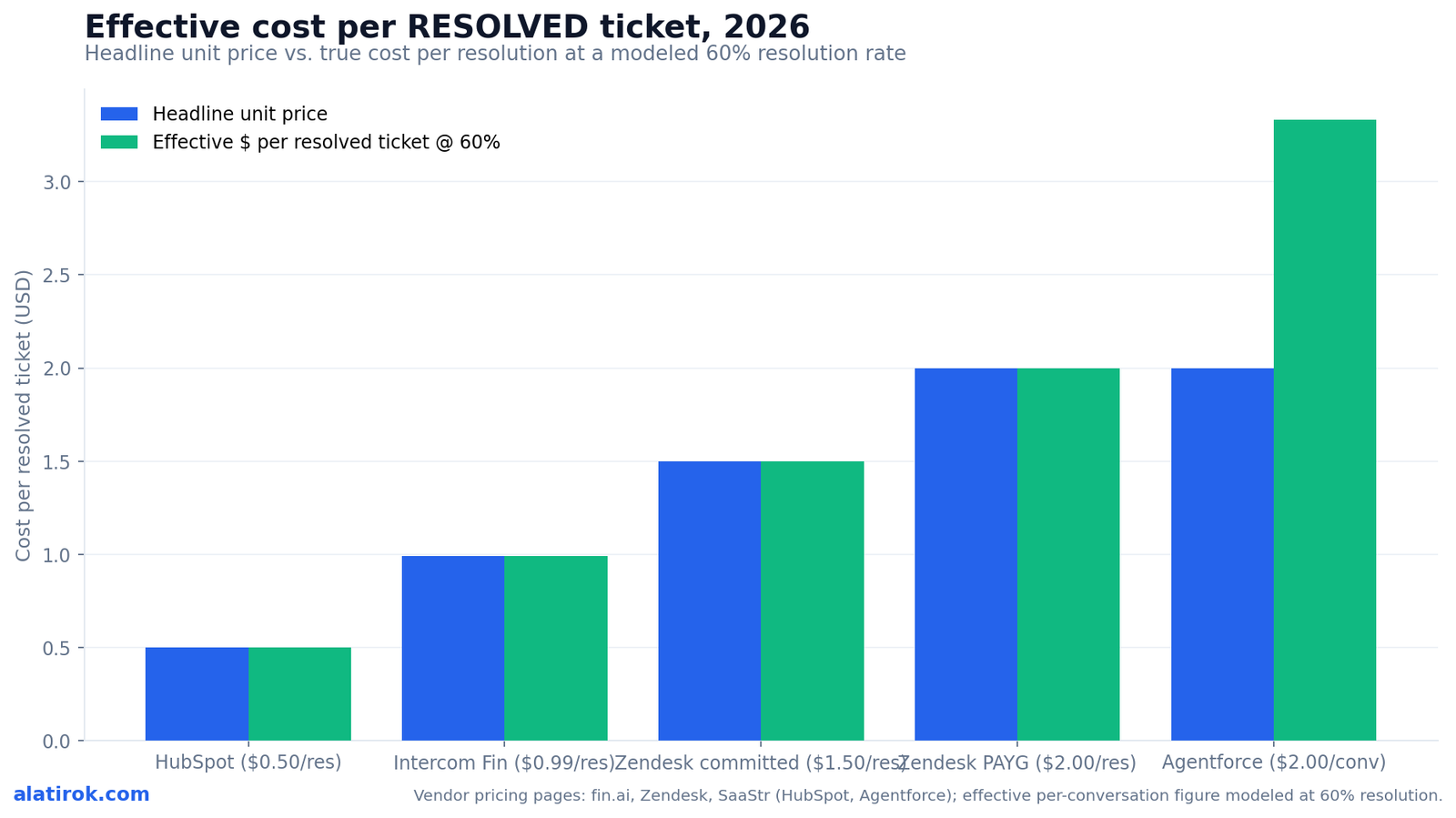
Once you normalize every model to effective cost per resolved ticket at a realistic 60% resolution rate, the per-conversation option becomes the most expensive by a wide margin. This is the chart no vendor pricing page wants you to build, because it is the only apples-to-apples view of what you actually pay for the outcome you actually want.
The math is straightforward. Under a per-resolution model, the effective cost per resolved ticket equals the headline price, because you only pay on resolution: Fin is $0.99, HubSpot $0.50, Zendesk $1.50 committed. Under a per-conversation model, you pay on every interaction, so to get 60 resolutions you pay for roughly 100 conversations. Agentforce at $2.00 per conversation therefore costs about $3.33 per resolved ticket at a 60% resolution rate, not $2.00.
Change the resolution rate and the gap moves with it. At an 80% resolution rate, the same $2.00 per-conversation agent drops to $2.50 effective per resolution; at 40%, it balloons to $5.00. Per-resolution pricing is flat against your resolution rate by construction, which is precisely the predictability CX buyers say they want and the risk transfer vendors say they are offering. The modeled chart below assumes a 60% resolution rate explicitly, the number Fin uses in its own comparisons and a defensible mid-point for a reasonably tuned 2026 support agent.
The buyer trap: who defines ‘resolved’
The single biggest hidden cost in outcome-based pricing for AI agents is that the vendor defines the billable unit, so the same support ticket can be billed very differently across two vendors quoting the same price. A resolution is not a resolution is not a resolution. Read each definition as if it were a contract clause, because it is.
Watch three definitional levers in particular. First, the resolution window: if a customer goes quiet after the agent answers, does that count as resolved automatically, and after how long? A short auto-resolve window inflates billable resolutions in the vendor’s favor. Second, procedure handoffs: Intercom counts a configured workflow that ends in a handoff as a billable outcome, which is reasonable but means “handed off” is not always free. Third, multi-question conversations: most vendors bill once per conversation, but confirm whether a customer who returns the next day opens a new billable unit.
Per-conversation models hide a different trap. If one customer query fans out into eight backend actions, are you billed for one conversation or charged for actions under a credit model? Salesforce’s pivot to Flex Credits and then AELA seat licensing was a direct response to buyers being unable to forecast this. Zendesk’s separate-validation-model approach is the strongest protection on the market right now because it puts a check between “the agent thinks it resolved this” and “you get billed.”
The practical defense is to run a paid pilot and reconcile the vendor’s resolution count against your own definition of a solved ticket, measured in your helpdesk, for at least one full month before signing committed volume. If the vendor’s billed count is materially higher than your reconciled count, the headline price is fiction and you should renegotiate the definition, not the dollar figure.
Before signing, get written answers to: (1) exact definition of a billable resolution/conversation; (2) the auto-resolve window in minutes/hours; (3) whether escalations and handoffs are billable; (4) whether a returning customer starts a new unit; (5) any monthly minimum; (6) every fee stacked underneath the per-outcome price (seats, platform, AI add-on).
Where per-seat and hybrid still win
Per-seat and hybrid pricing still beat pure outcome-based pricing for AI agents when your volume is low, highly variable, or when the agent does internal work that has no clean customer-facing resolution to bill against. Outcome pricing is not universally cheaper; it is cheaper at high, predictable resolution volumes with a well-tuned agent.
The market reflects this hedging. Per Chargebee’s 2025 subscriptions data cited alongside the Bessemer playbook, 43% of SaaS firms used hybrid pricing in 2026, with adoption projected toward roughly 61% by year-end. Hybrid, a base subscription plus usage or outcome tiers on top, gives buyers predictability and vendors upside, which is why Bessemer reports hybrid adopters posting materially higher revenue growth and net revenue retention than pure-subscription peers.
For a CX buyer, the decision rule is volume and variance. If you resolve tens of thousands of tickets a month at a stable rate, pure per-resolution almost always wins on cost and aligns incentives. If your volume is spiky or low, the monthly minimums on per-resolution plans can make a flat seat license cheaper, and Salesforce’s AELA per-user model exists precisely for procurement teams who need a fixed, budgetable line item. The worst position is paying per conversation on a low-resolution agent, where you fund failure at full price.
Pros
Cons
How to model your own number before you sign
$0.50
HubSpot Breeze per resolved conversation
Cut from $1.00 per-use in April 2026
$3.33
Agentforce effective cost per resolution
At $2.00/conversation and a modeled 60% resolution rate
~61%
SaaS firms on hybrid pricing by end of 2026
Up from 43% in 2026 (Chargebee / Bessemer)
Per-resolution wins for most CX buyers, but only after you audit the definition
To find your true cost, multiply your monthly resolved-ticket volume by the effective cost per resolved ticket for each model at your measured resolution rate, then add every stacked seat and platform fee. Do not compare headline unit prices; they are not the same product.
Take a team resolving 5,000 tickets a month with a 60% agent resolution rate (3,000 resolutions). Under Fin at $0.99 you pay roughly $2,970 in resolution fees. Under HubSpot at $0.50 you pay about $1,500. Under Zendesk committed at $1.50 you pay about $4,500 in resolution fees plus your Suite plan and the $50/agent AI add-on. Under Agentforce at $2.00 per conversation you pay for all 5,000 conversations, roughly $10,000, to get the same 3,000 resolutions, before any Service Cloud seat costs.
That single example is the entire argument: same workload, same outcome, a more than 6x spread between the cheapest per-resolution option and the per-conversation option, driven almost entirely by who pays for the agent’s failures. Build this table for your real numbers, pull your actual resolution rate from a pilot rather than trusting the vendor’s, and treat the definition of the billable unit as the most important line in the contract.
Builder’s take
I price two products that touch agentic workflows, so I read these vendor pricing pages the way a buyer should: assume every word in the definition was negotiated to favor the seller. A few things I tell anyone evaluating this in 2026.
- The number on the pricing page is the least important number. The definition of the billable unit is the whole game. “Resolution” at Intercom, “automated resolution” at Zendesk, and “conversation” at Agentforce are three different products wearing the same word.
- Per-conversation pricing is a tax on your own deflection rate. The worse your knowledge base, the more you pay per actually-resolved ticket, because you are funding every dead-end interaction. Outcome models invert that incentive and put the vendor’s revenue at risk alongside yours.
- Always model effective cost per resolved ticket at your real resolution rate, not the headline unit price. At a 60% resolution rate, a $2.00 per-conversation agent costs you ~$3.33 per actual resolution, which is more than 3x the cheapest per-resolution option.
- Watch for the hybrid floor. Most of these still stack a seat or platform fee underneath the per-outcome charge, so “only pay for results” is rarely the whole bill. Read the minimums.
- I would still take a slightly higher per-resolution price over a cheaper per-conversation one in almost every case, because it aligns the vendor with the only metric that matters to my P&L: tickets that actually went away.
Frequently asked questions
Outcome-based pricing for AI agents charges you only when the agent produces a defined result, typically a resolved customer conversation, and charges nothing when it escalates to a human or fails. The most common version in 2026 is per-resolution pricing, used by Intercom Fin, Zendesk, and HubSpot Breeze. It contrasts with per-conversation pricing, which bills every interaction regardless of outcome, and per-seat pricing, a flat monthly license.
Intercom Fin costs $0.99 per resolution, and you are not charged when Fin fails to resolve a conversation. A resolution is counted once per conversation when Fin answers the question and the customer confirms or leaves without asking for more help. There is typically a monthly minimum of about 50 resolutions, and additional seat costs apply if you run Intercom’s own helpdesk rather than connecting Fin to an existing one.
Salesforce Agentforce’s conversational rate is $2.00 per conversation, charged whether or not the agent actually resolves the issue, which makes it per-conversation rather than per-resolution. Because you pay on failed interactions too, the effective cost per resolved ticket is higher than the headline figure, roughly $3.33 at a 60% resolution rate. Salesforce also offers Flex Credits ($0.10 per action) and per-user AELA licensing from $125/user/month, running three models at once.
On headline per-resolution price, HubSpot Breeze Customer Agent is cheapest at $0.50 per resolved conversation, having cut from $1.00 in April 2026, followed by Intercom Fin at $0.99 and Zendesk at $1.50 committed. Per-conversation models like Agentforce at $2.00 are the most expensive per actual resolution because you also pay for every unresolved interaction. The true ranking depends on your measured resolution rate and any stacked seat or platform fees.
The biggest hidden cost is that the vendor defines the billable unit, so the same ticket can be billed very differently across vendors quoting identical prices. Key levers are the auto-resolve window (how quickly a quiet customer counts as resolved), whether escalations and handoffs are billable, and whether a returning customer opens a new unit. Run a one-month paid pilot and reconcile the vendor’s billed count against your own definition of a solved ticket before signing committed volume.
Per-seat or hybrid pricing wins when your ticket volume is low or highly variable, or when the agent does internal work with no clean customer-facing resolution to bill against. Monthly minimums on per-resolution plans can make a flat license cheaper at low volume. Hybrid pricing (a base subscription plus usage or outcome tiers) was used by 43% of SaaS firms in 2026 and is projected toward roughly 61% by year-end precisely because it balances buyer predictability with vendor upside.
Primary sources
- Fin AI Agent Pricing — Intercom (fin.ai)
- AI Customer Service Agent Pricing Comparison — Intercom (fin.ai)
- Zendesk First in CX Industry to Offer Outcome-Based Pricing for AI Agents — Zendesk
- HubSpot Switching AI Pricing From Per Use to Per Resolution — SaaStr
- Salesforce Now Has 3+ Pricing Models for Agentforce — SaaStr
- Bret Taylor of Sierra on AI Agents and Outcome-Based Pricing — A Cheeky Pint (Substack)
- The AI Pricing and Monetization Playbook — Bessemer Venture Partners
- HubSpot Moves to Outcome-Based Pricing for Some Breeze AI Agents — MarTech
Last updated: June 1, 2026. Related: Commerce.