
A neutral, third-party scorecard of 8 outbound AI SDR tools graded on the autonomy spectrum, data quality, and the inbox-placement tax every vendor ranker hides.
What are the best AI SDR agents in 2026?
The best AI SDR agents in 2026 are Amplemarket Duo for human-in-the-loop quality, Clay for research and enrichment, and Reply.io’s Jason AI for budget-conscious teams, while the fully-autonomous “set-and-forget” agents like 11x Alice and Artisan Ava remain the riskiest picks because of weaker data, thin deliverability tooling, and high churn. That ranking will not match the one you read on any vendor’s blog, and that is the point.
Search “best AI SDR agents 2026” and every result is a vendor crowning itself number one. Amplemarket scores its own Duo at 219 out of 231 in an eval Amplemarket designed. 11x ranks Alice at the top of a comparison 11x wrote. Neither neutral, and neither prices in the single number that decides whether outbound lands at all: inbox placement.
This is a third-party scorecard. We grade all eight tools on three axes the vendors hide: where each sits on the autonomy spectrum (full-autonomous agent vs. human-in-the-loop copilot), the quality of its underlying data source, and the deliverability reality of AI outreach in 2026, where AI-sent cold email is spam-flagged at roughly 8% versus 3% for human-written email. If you are buying an outbound agent this year, that 5-point gap is the tax you are quietly signing up for.
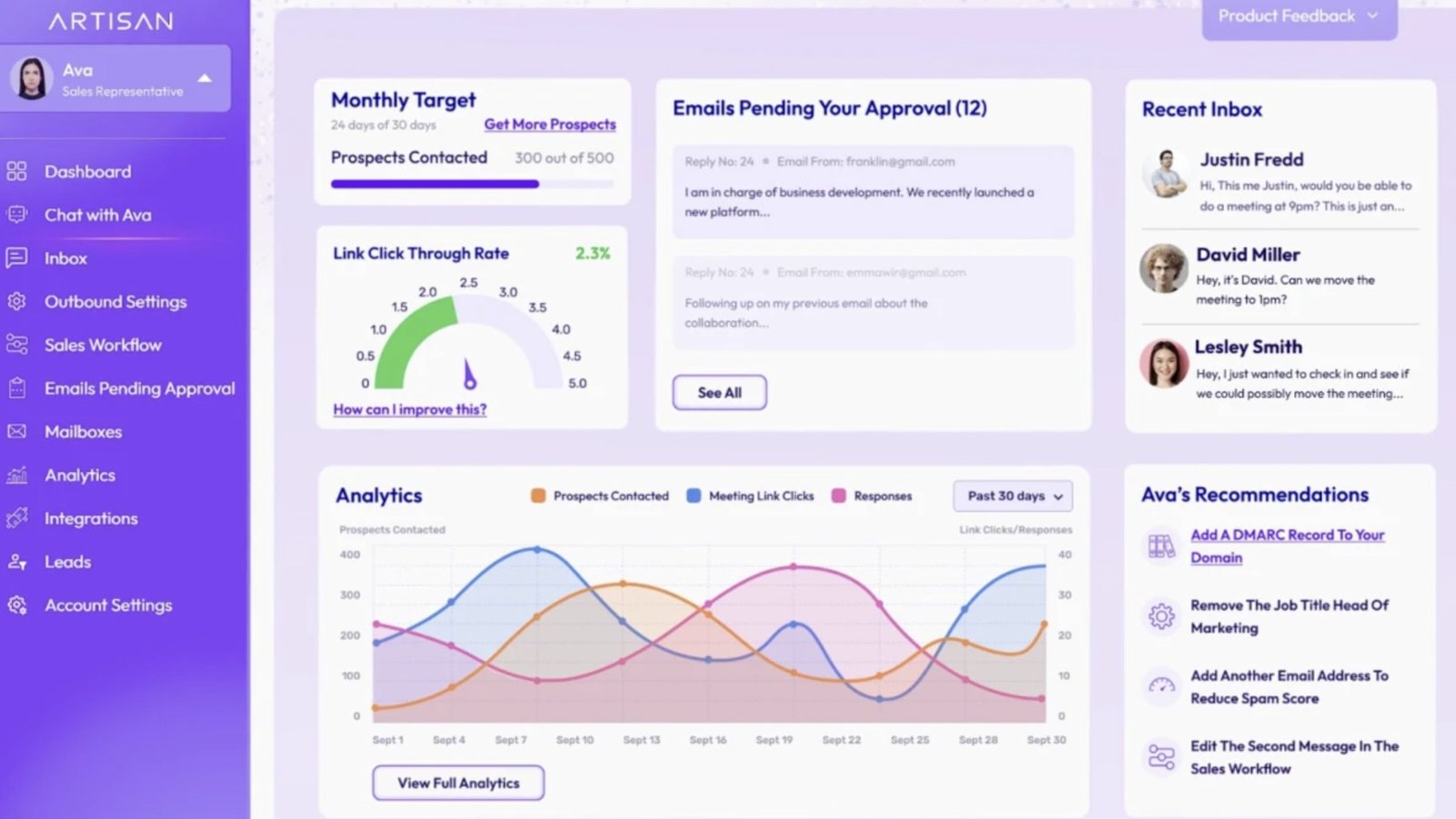
AI SDR tools compared: the 2026 scorecard
Here are all eight AI SDR tools compared on autonomy model, pricing, data source, and G2 rating, so you can see the full field in one view before the individual breakdowns. Scores in the rightmost column come from Amplemarket’s published 231-point evaluation; treat them as directional given the source, but the autonomy and data columns are the buying lens that matters most.
A note on reading the table: “Copilot” means a human reviews and approves before anything sends. “Autonomous” means the agent can research, write, and send end-to-end with minimal human gating. In 2026 that distinction is the difference between a tool that makes your reps faster and a tool that can burn your sending domain unattended.
| Tool | Autonomy model | Pricing (2026) | Data source | G2 rating | Eval score |
|---|---|---|---|---|---|
| Amplemarket Duo | Human-in-the-loop copilot | ~$3,200/user/yr | Native B2B data + signals | 4.6/5 (571+) | 219/231 |
| Clay | Copilot (research/enrich) | From ~$149/mo, usage-based | Waterfall enrichment | 4.8/5 (207) | 58/231 |
| Regie.ai | Copilot (content) | $35,000+/yr | No native data | 4.2/5 (128) | 41/231 |
| Artisan (Ava) | Full-autonomous | $2,000–$5,000/mo | Built-in contact DB | 3.8/5 (89) | 35/231 |
| Reply.io (Jason AI) | Copilot + AI layer | $89–99/user + $500–1,500/mo | Multi-source | 4.5/5 (1,340) | 34/231 |
| Nooks | Copilot (dialer-first) | $4,000–5,000/user/yr | Call-focused | 4.8/5 (915) | 26/231 |
| AiSDR | Full-autonomous (budget) | $750–$2,500/mo | Limited | 4.1/5 (42) | 24/231 |
| 11x (Alice) | Full-autonomous | ~$60,000/yr | No proprietary data | N/A | 21/231 |
11x vs Artisan vs Amplemarket: which autonomous SDR wins?
In the 11x vs Artisan vs Amplemarket matchup, Amplemarket wins on quality and ROI because its human-in-the-loop model and native data outscore both fully-autonomous agents, while 11x Alice and Artisan Ava trade quality for autonomy you mostly do not want. This is the head-to-head everyone searches, so here is the honest version.
11x’s Alice is the purest expression of the full-autonomous thesis: it identifies prospects, runs custom deep research, personalizes, sends, handles replies, and books meetings with minimal human involvement, drawing on 21+ data providers and a 400M+ contact pool. The pitch is a digital worker that replaces SDR headcount at roughly $60,000/year. The catch is that Alice carries no proprietary data and thin deliverability infrastructure, and third-party evals report steep churn at the three-month mark when the autonomous output meets real inboxes.
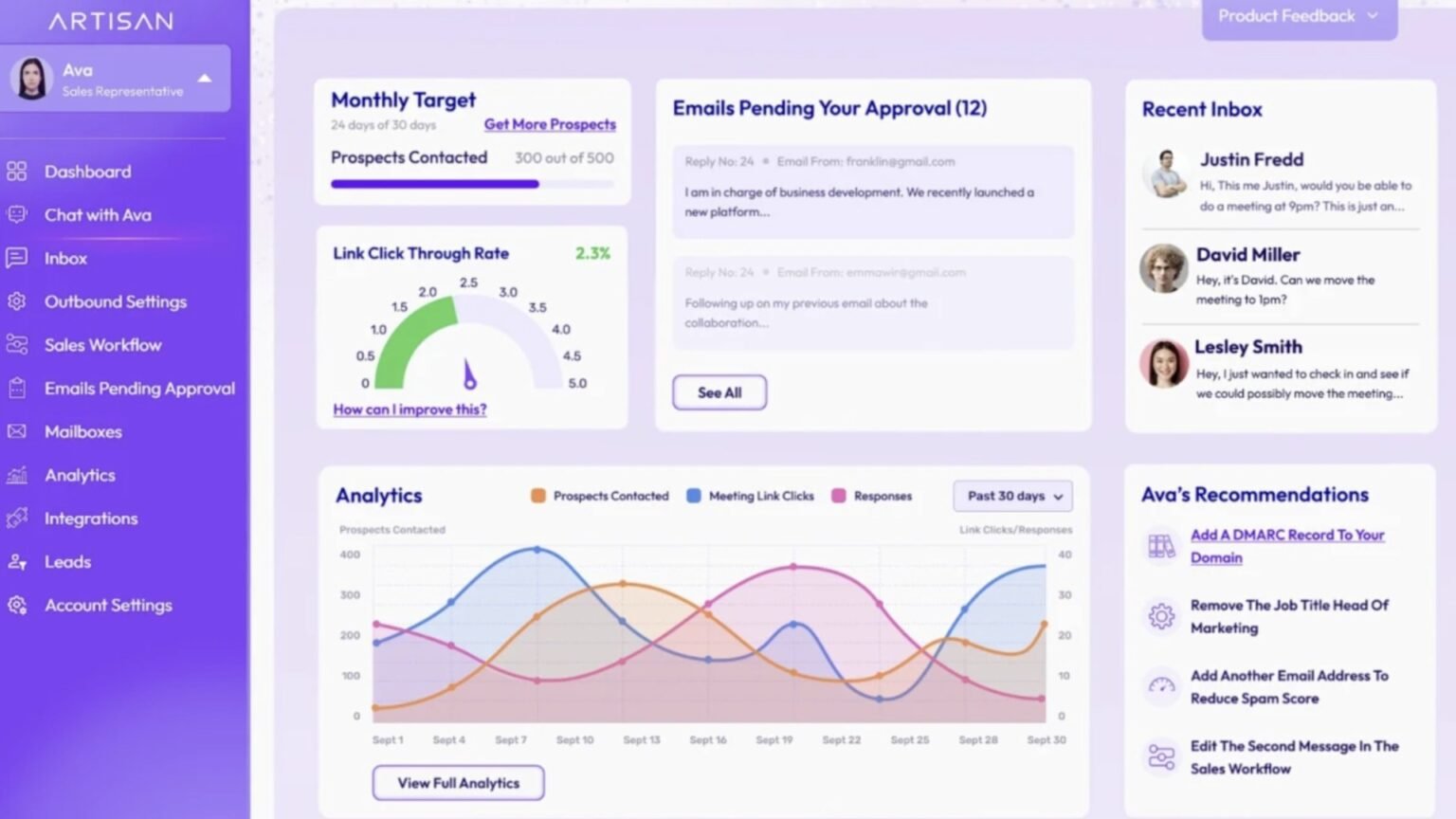
Artisan’s Ava sits in the same full-autonomous camp, focused on email and LinkedIn with a personalization waterfall, warmup, and mailbox-health monitoring, priced at $2,000–$5,000/month. It is more affordable than 11x, but G2 sentiment (3.8/5) flags generic messaging and targeting accuracy as the recurring complaints, the predictable failure mode of autonomy without a human gate.
Amplemarket’s Duo is the human-in-the-loop counterpoint: three agents (Signal, Research, Sequence) prepare the work, but a human guides strategy, reviews messaging, and approves before sends go out. It is the only one of the three with native data plus its own deliverability layer, and it carries the strongest review profile at 4.6/5 across 571+ reviews. For most teams in 2026, that is the safer and higher-ROI bet.
“The faster and more autonomous the agent operates, the lower the average quality of what lands in the inbox. Autonomy is a liability dial, not a productivity dial.”
The autonomy paradox of 2026 AI SDRs
Autonomous AI SDR vs copilot: which model should you buy?
Buy a human-in-the-loop copilot, not a fully-autonomous AI SDR, unless you have the deliverability infrastructure and review discipline to contain a bad send at scale. The autonomous-vs-copilot choice is the single most consequential decision in this category, and the vendors selling autonomy frame it backwards.
A copilot (Amplemarket Duo, Clay, Regie.ai, Reply.io’s Jason AI) puts AI on research, enrichment, and draft generation while a human approves before anything sends. The cost is a human in the loop; the benefit is that your worst-case output is a draft nobody approved, not 3,000 spam-flagged emails on your primary domain.
A fully-autonomous agent (11x Alice, Artisan Ava, AiSDR) compresses the whole funnel into one unattended loop. When it works, it scales headcount-free. When it drifts, by hallucinating a prospect’s role, misreading a signal, or hammering the same domain on a tight cadence, it does so at machine speed and on your sender reputation. In 2026, the augment-don’t-replace teams consistently report better pipeline-per-dollar than the full-replacement teams.
The pragmatic move is graduated autonomy: start every play human-gated, measure reply and spam-flag rates against a human control, and only hand a specific play to the agent once it clears your bar. No vendor ships this as the default because “replace your SDRs” sells better than “approve drafts faster.”
Pros
Cons
Do AI SDRs hurt email deliverability?
Yes, AI SDRs measurably hurt deliverability today: AI-sent cold email is spam-flagged at roughly 8% versus 3% for human-written email, a 5-point gap, even though bounce rates are identical at about 6% for both. This is the number every vendor ranking omits, and it is the one that decides whether your outbound is seen at all.
In a 100,000-email paired analysis (50K AI, 50K human, October 2025–April 2026), AI email did not lose on bounces, it lost on spam placement: filter heuristics still penalize the statistical fingerprint of generated text. The good news is that the gap is mostly an infrastructure-and-cadence problem, not a fundamental ceiling on AI copy.
Cadence is the dominant inbox lever, and it dwarfs any subject-line trick. Sending at 1-day intervals produced 71% inbox placement; stretching to 3-day intervals produced 93%, a 31% relative lift. Domain warmup compounds it: domains under 30 days old landed at 51% inbox placement versus 91% for domains aged 90+ days. An autonomous agent left to send aggressively on a fresh domain is the worst-case combination of both variables.
Since February 2024, Google and Yahoo have enforced SPF, DKIM, and DMARC for bulk senders, spam-complaint rates below 0.3%, and one-click unsubscribe, while Gmail flags domains exceeding a 2% bounce rate. None of that is optional in 2026. The right buying question is not “does this tool write good email” but “does this tool ship the authentication, warmup, and cadence controls that keep the 8% spam-flag rate from becoming your number.”
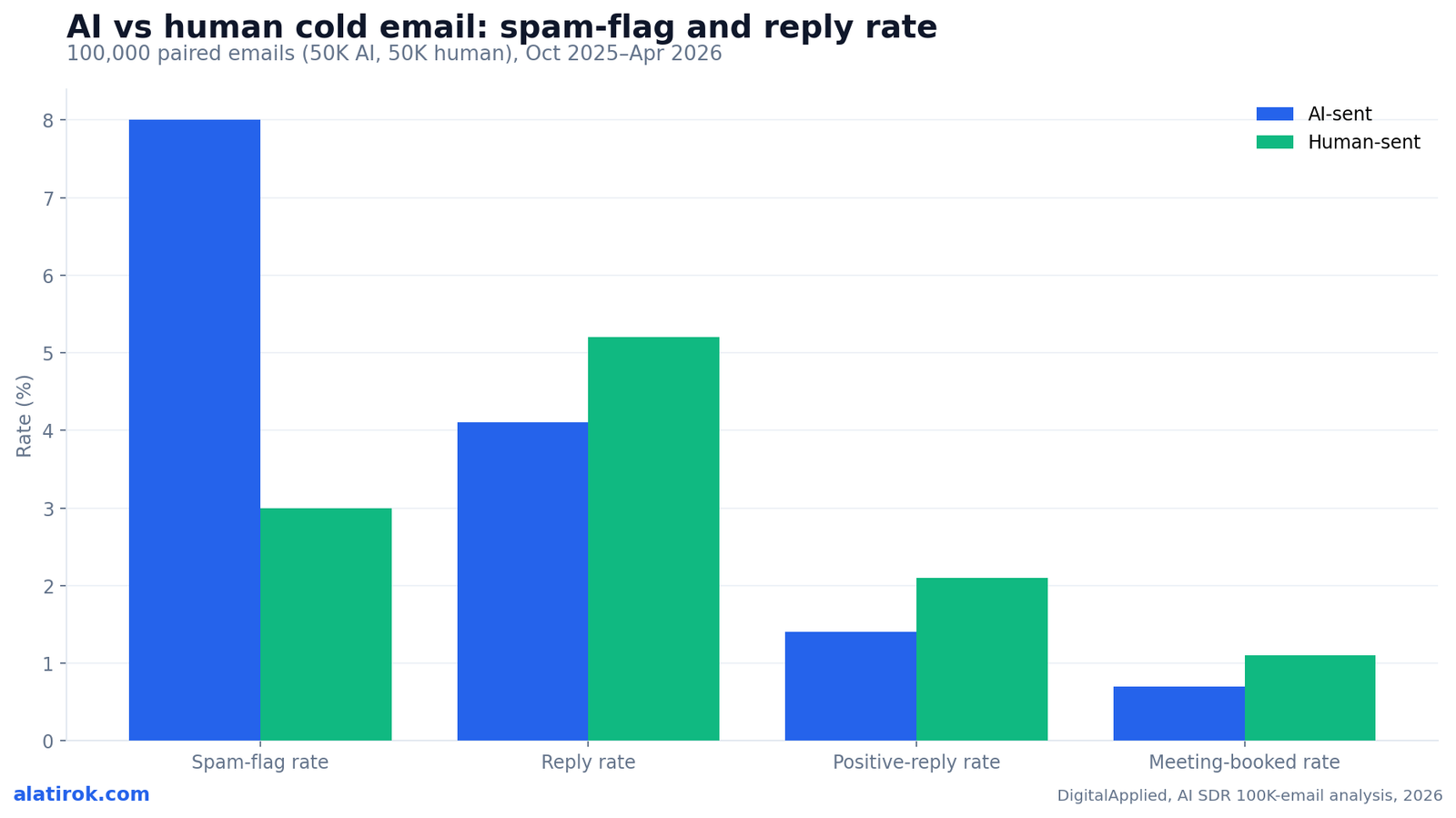
AI outreach is spam-flagged at ~8% vs ~3% for human email. At scale, that 5-point gap silently removes a chunk of your best prospects from the inbox before anyone reads a word. Price it into any autonomous-SDR business case.
AI cold email reply rate vs human: is the copy good enough?
8% vs 3%
Spam-flag rate, AI vs human cold email
5-point deliverability gap
4.1% vs 5.2%
Reply rate, AI vs human
Gap down from 2.0pt in 2024
71% → 93%
Inbox placement, 1-day vs 3-day cadence
Cadence is the dominant lever
+28%
Reply lift from named-event personalization
Data beats model
AI cold email now lands a 4.1% reply rate versus 5.2% for human-written email, a 1.1-point gap that has narrowed from 2.0 points in 2024, meaning AI copy is closing on humans fast even as the deliverability gap stays wide. The copy is nearly good enough; the inbox placement is what still costs you.
Break it down and the story holds: AI hit 1.4% positive replies vs 2.1% for humans, and 0.7% meetings booked vs 1.1%. Those are real gaps, but they are shrinking, and in some verticals AI already wins, SaaS outbound saw AI reply at 6.1% versus 5.7% for humans. The vertical spread is enormous, from 6.1% in SaaS down to 1.9% in financial services, so your category matters more than your model.
The data also exposes which AI “tells” filters and prospects punish. “I hope this email finds you well” cost 22% in reply rate. Leverage/delve/synergize vocabulary cost 14%. More than two em-dashes cost 8%. A missing full signature cost 9%. Short wins: bodies under 60 words replied at 5.1% versus 2.4% for 200+ words, and question-format subject lines added 18% across the board.
The takeaway for tool selection: the agent’s writing model is no longer the differentiator. Named-event personalization (+28%) and company-name tokens (+14%) outperform any base-model upgrade, and those depend on the data and signal layer, not the LLM. Buy the tool with the best data, then constrain it to short, specific, well-signed copy.
The verdict: best AI SDR agents 2026 by use case
Buy the data and deliverability layer, not the autonomy
The best AI SDR agents in 2026 split by use case: Amplemarket Duo for teams that want quality and ROI, Clay for research-heavy GTM engineers, Reply.io’s Jason AI for budget teams, and Nooks if your motion is phone-first; treat 11x and Artisan as high-risk bets that demand strong deliverability discipline. No single tool wins for everyone, which is exactly why a self-crowning vendor ranking is useless.
Whatever you pick, run a 200-email paired test against a human control before you sign anything north of $24K/year, measure spam-flag and reply rate, not just “emails sent.” The category’s real differentiator is data and deliverability, not the writing model, and the only way to know is to test on your own domain and your own ICP.
Amplemarket Duo
Best for: Mid-market and enterprise teams augmenting human SDRs
What works
Watch out for
Clay
Best for: GTM engineers building custom waterfall workflows
What works
Watch out for
Reply.io (Jason AI)
Best for: SMBs wanting an AI layer on proven sequencing
What works
Watch out for
11x (Alice)
Best for: Teams betting on full SDR replacement with infra to back it
What works
Watch out for
Builder’s take
I build agents for a living at Cyntr and Loomfeed, and the AI SDR category is where the gap between demo and production is widest. Here is what I tell founders evaluating these tools:
- The autonomy dial is a liability dial. Full-autonomous agents that send without a human gate move the failure mode from “slow rep” to “3,000 bad emails before lunch, on your sending domain.” Start human-in-the-loop and earn autonomy per-play.
- Buy the data and deliverability layer, not the agent. The copy gap between AI and humans is down to 1.1 points and closing. The 5-point spam-flag gap is the moat that actually costs you pipeline, and almost no vendor will quote it to you.
- Cadence beats cleverness. Spacing sends to 3-day intervals lifts inbox placement from 71% to 93%. That single lever swamps any subject-line model the vendor is selling you on.
- Score the tool on your stack, not the vendor’s leaderboard. Every ranker is a vendor crowning its own product. Run a 200-email paired test against a human control before you sign anything north of $24K/year.
Frequently asked questions
For most teams, Amplemarket Duo is the best overall AI SDR agent in 2026 because its human-in-the-loop model, native B2B data, and built-in deliverability layer produce higher-quality outreach and better ROI than fully-autonomous agents. Clay is best for research and enrichment, Reply.io’s Jason AI for budget teams, and Nooks for phone-first motions. The autonomous “replace your SDRs” tools like 11x Alice and Artisan Ava carry the most risk because of weaker data and thin deliverability tooling.
Yes. In a 100,000-email paired analysis, AI-sent cold email was spam-flagged at roughly 8% versus 3% for human-written email, a 5-point gap, even though bounce rates were identical at about 6%. The problem is largely fixable through infrastructure: domains aged 90+ days landed at 91% inbox placement versus 51% for fresh domains, and a 3-day send cadence placed 93% versus 71% for a 1-day cadence.
AI cold email achieves about a 4.1% reply rate versus 5.2% for human-written email, a 1.1-point gap that has narrowed from 2.0 points in 2024. Positive replies run 1.4% (AI) versus 2.1% (human), and meetings booked run 0.7% versus 1.1%. In some verticals AI already wins, SaaS outbound saw AI reply at 6.1% versus 5.7% for humans.
Buy a human-in-the-loop copilot unless you have strong deliverability infrastructure and review discipline. A copilot puts AI on research and draft generation while a human approves before sending, so your worst case is an unsent draft. A fully-autonomous agent compresses the whole funnel into an unattended loop, and when it drifts it ships bad sends at machine speed on your sending domain. In 2026, augment-don’t-replace teams report better pipeline-per-dollar.
Pricing spans a wide range: Amplemarket Duo runs about $3,200/user/year, Clay starts around $149/month (usage-based), Reply.io’s Jason AI adds $500–$1,500/month on top of an $89–$99/user base, Artisan Ava costs $2,000–$5,000/month, Regie.ai starts at $35,000+/year, and 11x Alice runs about $60,000/year. AiSDR is the budget autonomous option at $750–$2,500/month.
Since February 2024, Google and Yahoo require bulk senders to authenticate with SPF, DKIM, and DMARC, keep spam-complaint rates below 0.3%, and offer one-click unsubscribe, while Gmail flags domains exceeding a 2% bounce rate. AI SDRs that send aggressively on unwarmed domains violate these thresholds fastest, which is why cadence control, domain warmup, and authentication matter more than the writing model when choosing a tool.
Primary sources
- 8 best AI sales agents and AI SDR tools in 2026, compared — Amplemarket
- Artisan vs Amplemarket vs 11x: Best AI SDR Platform (2026) — 11x
- AI SDR Real Performance: 100K Email Analysis 2026 — DigitalApplied
- AI SDR Pricing in 2026: What Every Platform Actually Costs — Babuger
- AI SDR Platforms 2026: Apollo, Outreach, Clay, Lemlist — DigitalApplied
Last updated: June 2, 2026. Related: Products.