
Gartner says agentic procurement software jumps from $2B to $53B by 2030. Here is what Zip, Tropic and Keelvar have actually delivered.
What are autonomous procurement agents 2026, and why now?
Autonomous procurement agents 2026 are AI systems that run sourcing and buying workflows end to end — intake, supplier outreach, bid analysis, negotiation prompts, contract review and invoice matching — escalating to humans only on exceptions. They are the difference between a copilot that drafts an email and an agent that runs a reverse auction, scores the bids, and recommends an award without a buyer touching each step.
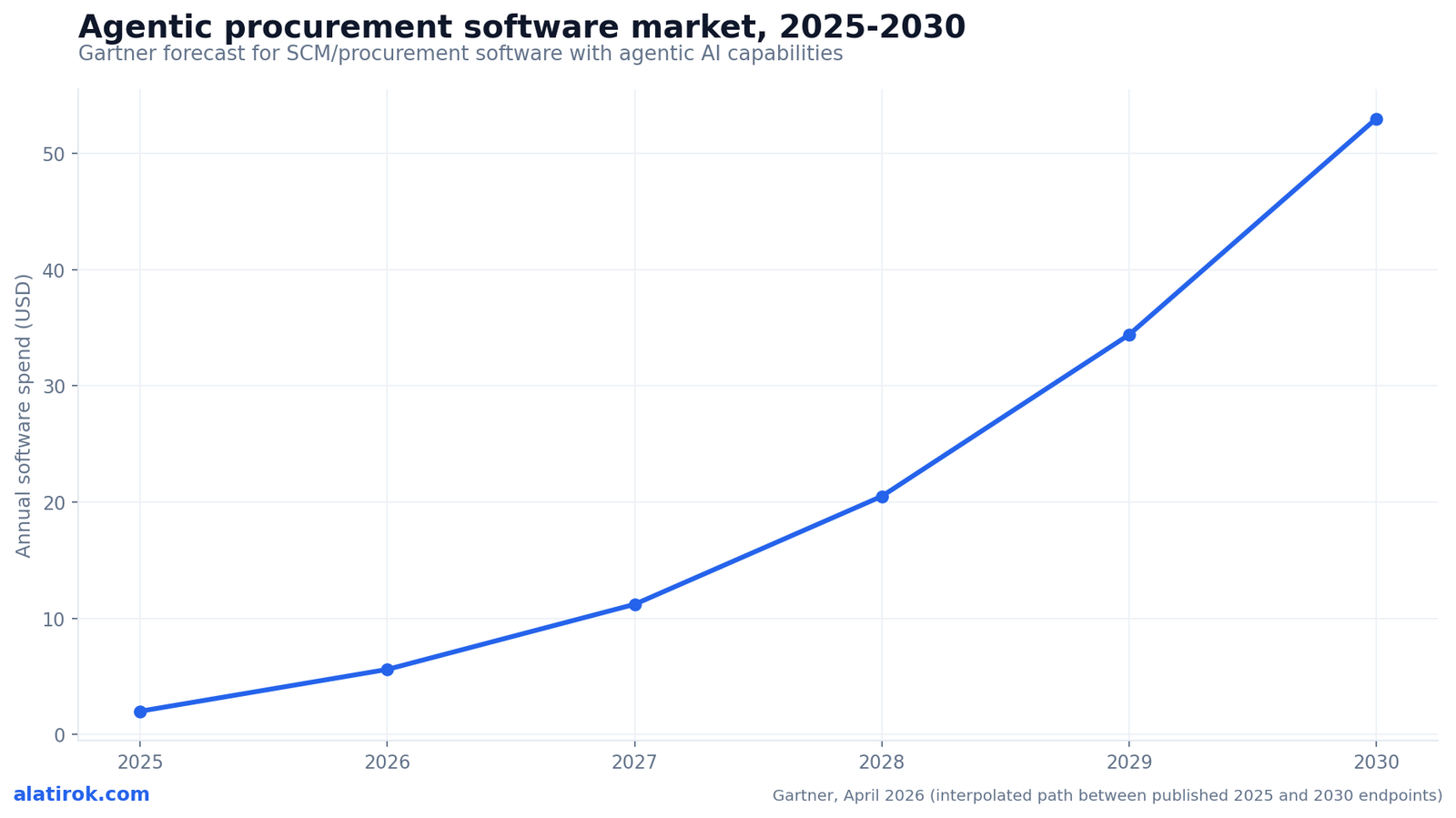
The reason the category crystallized in 2026 is timing on three curves at once. Gartner now forecasts supply-chain and procurement software with agentic AI growing from less than $2 billion in 2025 to $53 billion by 2030 — a 93.5% compound annual growth rate. On the demand side, 94% of surveyed procurement leaders report using generative AI at least weekly, and roughly 80% of CPOs name AI a top priority. And on the supply side, the three vendors profiled here — Zip, Tropic and Keelvar — crossed the line from demos into audited, dollar-denominated outcomes.
The structural insight is that procurement is unusually well-suited to agents. Most spend is not strategic. Tail spend, repeatable sourcing events, supplier-performance monitoring and early risk flagging are rules-heavy, high-volume and low-stakes per transaction. That is precisely the envelope where a constrained agent outperforms a human on cost and cycle time — and where the 2026 vendors are concentrating their automation.
The $53B forecast, decomposed
Gartner’s $53B-by-2030 figure is not one market — it splits into simple AI agents growing to $37.6 billion and advanced autonomous agents growing to $15.9 billion, with the autonomous tier compounding faster (100.3% CAGR) but remaining the minority of spend. Reading the forecast as a single number obscures the most important governance fact in it: even by 2030, fully autonomous agents are projected to be about 20% of total SCM software spend, not the whole thing.
Software with simple AI agents — assistants and narrow task-runners — grows from roughly $1.5 billion in 2025 to $37.6 billion in 2030, a 91% CAGR. Software with advanced autonomous agents grows from about $492 million to $15.9 billion, a 100.3% CAGR. Enterprise adoption of agentic features moves from 5% of SCM-software users in 2025 to 60% by 2030, while legacy SCM software without generative AI shrinks from $28.3 billion to $17.4 billion as budget migrates.
The takeaway for buyers is that the market is bifurcating, not converging. The cheap, fast wins are in the simple-agent tier you can deploy this year. The advanced-autonomous tier — where an agent commits spend or awards business on its own — is real but smaller, slower to trust, and the part that demands payments-grade governance.
This is the single most data-rich slice of the story, so it gets the chart below: the market trajectory plus a vendor-outcome panel.
Zip: orchestration at $6B in cumulative savings
Zip is the scale story — it has surpassed $6 billion in cumulative customer savings, processes hundreds of billions in spend across more than 7 million suppliers, and at its 2026 AI Summit launched 50+ purpose-built procurement AI agents under the banner of “agentic procurement orchestration.” Zip’s bet is that procurement is an orchestration problem across procurement, finance, legal, IT and security — and that agents win by coordinating those handoffs, not by replacing any single tool.
The operating numbers Zip discloses are the more credible signal than the valuation. The platform reports delivering 10 million AI insights across 26 million approvals and saving customers 10 million days of cycle time. Its named roster — OpenAI, Anthropic, Mars, LinkedIn, Block, Snowflake, Reddit, Coinbase, AMD, T-Mobile, Dollar Tree and others — is unusually concentrated in companies that themselves build AI, which is a useful tell about who trusts agents with their own spend.
The cleanest case study is Dollar Tree, which increased procurement’s influence from 13% to over 40% of its $5 billion in non-product spend, cut cycle times 70%, and identified $100 million in savings. That is the pattern to copy: agents do not just run existing events faster, they pull more spend under management, and the savings come from coverage as much as from negotiation.
On the corporate side, Zip has raised $371 million and most recently carried a $2.2 billion valuation. Treat that as context, not proof — the $6B verified-savings figure is the number a CFO should underwrite against.
Tropic: verified savings and the 15.5% rate
$362M
Spend negotiated by Tropic in H1 2025
Customer spend run through the platform
$56M
Verified savings delivered
15.5% average savings rate
~$14B
Spend-intelligence corpus
Benchmark data behind the agents
80,000
Manual hours saved in H1 2025
Across intake, compliance, contract, invoicing
Tropic is the verified-savings story — in the first half of 2025 it negotiated $362 million in customer spend and delivered $56 million in verified savings, a 15.5% average savings rate, on top of a spend-intelligence corpus approaching $14 billion. Where Zip leads with orchestration breadth, Tropic leads with a defensible benchmark dataset and a hard, audited savings rate against a stated denominator.
Tropic ships five named agents that each attack a high-friction step: a Smart Request Assistant for intake, a Compliance Copilot that flags policy violations in real time, a Contract Intelligence Engine that extracts terms and renewal dates, a Negotiation Navigator that supplies pricing benchmarks, and an AI Invoice Match that validates invoices against contracts and POs. In H1 2025 those agents reportedly saved roughly 80,000 hours of manual work, ran 51,655+ instant price checks, and analyzed nearly 17,650 agreements.
The momentum metrics matter because they show the data flywheel turning: Q2 2025 saw deal closures up 43%, ARR bookings up 84%, and supplier-intelligence usage up 73% quarter over quarter. The more spend that flows through the corpus, the sharper the benchmarks, the better the negotiation prompts — and the harder the dataset is to replicate.
The lesson for evaluators is to anchor on the savings rate and its denominator. “$56M saved” is marketing; “$56M saved on $362M negotiated, audited as verified” is something you can put in a business case.
Keelvar: the only vendor in both Gartner sourcing categories
Keelvar is the autonomy story — it is the only vendor named in both the Advanced Sourcing Optimization and Autonomous Sourcing categories of the 2026 Gartner Market Guide for Sourcing Applications, letting one platform handle complex high-value awards and high-volume repeatable events. That dual listing is the cleanest third-party validation in this space: it says the same vendor can model a thousand-line-item award scenario and also run a tactical event without a human at each step.
The proof is in Keelvar’s own throughput. The company reports that 71% of sourcing events on its platform are now managed by AI agents, that 85% of sourcing activity across its customer base is automated, and that some events complete in under 15 minutes. Its Sourcing Optimizer handles the defensible, high-stakes decisions; its Autonomous Sourcing engine runs event creation, supplier communication, bid analysis and award recommendations as a hands-off workflow.
Keelvar also frames the macro forecast that buyers should internalize: AI-driven sourcing events already account for more than 70% of tactical and tail spend, and agents are projected to manage 60–70% of end-to-end transactional procurement. The boundary is explicit — humans keep strategic sourcing, complex negotiations, supplier relationships, new-category strategy and high-value financial commitments. Agents take the transactional majority.
If Zip is breadth and Tropic is benchmark data, Keelvar is depth of automation on the sourcing event itself. The three are not strictly competitors so much as three different bets on where the autonomy frontier sits.
Vendor scorecard: who fits which spend
Match the vendor to the spend profile: Zip for orchestration breadth across functions, Tropic for verified software/SaaS savings backed by benchmark data, and Keelvar for autonomous and optimized sourcing events. None of these is a drop-in replacement for the others; the scorecard below maps each to the job it is built for.
The honest caveat: all three publish their own numbers, and savings methodologies differ. Tropic’s 15.5% is the only figure here expressed as a clean rate against a disclosed denominator; Zip’s $6B is cumulative across years and customers; Keelvar’s automation percentages describe activity, not dollars. Read them as directional proof of category traction, not as apples-to-apples benchmarks.
Zip
Best for: Enterprises consolidating intake-to-pay under one orchestration layer
What works
Watch out for
Tropic
Best for: SaaS and software spend where benchmarks drive negotiation leverage
What works
Watch out for
Keelvar
Best for: High-volume tactical/tail sourcing plus complex optimized awards
What works
Watch out for
The case for and against handing procurement to agents
Autonomous procurement agents 2026 deliver real, audited savings and cycle-time cuts on transactional spend — but the autonomy should be earned tier by tier, with policy, escalation and audit logging on every path that commits money. The data supports aggressive automation of the tactical majority and deliberate caution on the strategic minority.
The pros-and-cons below are the framework I would hand a CPO before signing. The wins are concrete; the risks are the same ones every production agent system faces — bad data, over-broad autonomy, and decisions no one can later explain.
Pros
Cons
How to evaluate an autonomous procurement vendor
The savings are real; govern the autonomy
Evaluate autonomous procurement agents 2026 the way you would a payments system: demand a verified savings rate with a disclosed denominator, map exactly which decisions the agent can take unsupervised, and require an audit log on every spend-committing action. The vendors that win the next two years will be the ones whose numbers survive that scrutiny.
Start with the savings claim. Ask for the rate, the denominator, and who verified it — Tropic’s “$56M on $362M” framing is the standard to hold others to. Then map the autonomy ceiling: which events run end to end, which require approval, and how exceptions escalate. Keelvar’s explicit line — agents take transactional spend, humans keep strategic — is a healthy default to negotiate around.
Probe the data asset, because it is the real moat. A vendor’s benchmark corpus (Tropic’s ~$14B) and supplier graph (Zip’s 7M+) determine negotiation quality far more than the agent’s prompt engineering. Finally, insist on governance you can audit: policy on every path, opt-in autonomy, and immutable logs of what each agent decided and why. That is the difference between a procurement agent you can defend to a board and one you cannot.
Ask every vendor four questions: (1) What is your verified savings rate and its denominator? (2) Which decisions can the agent take without a human? (3) What benchmark and supplier data trains it? (4) Can I audit every spend-committing action after the fact?
“The agent is the interface; the spend-intelligence corpus is the product. A startup with great agents and no data will lose.”
Surya Koritala, founder of Cyntr and Loomfeed
Builder’s take
As someone who runs intent-routed AI agents in production at Cyntr and Loomfeed, I read these procurement numbers as an engineer, not a buyer. The headline market figure is the least interesting part. The interesting part is where the agents are actually allowed to act without a human in the loop.
- Tail spend and standardized sourcing events are the wedge. They are high-volume, low-stakes, and rules-heavy — exactly where a constrained agent beats a human on cost and latency. Zip’s 26M approvals and Keelvar’s sub-15-minute events are the same pattern: automate the boring 70%, escalate the rest.
- Verified savings is the only metric I trust here. Tropic’s 15.5% rate is reported against $362M of negotiated spend, not a slide. When you evaluate a vendor, ask what their denominator is and who audited the numerator.
- The ‘savings’ framing hides the real moat: data. Tropic’s ~$14B spend-intelligence corpus and Zip’s 7M+ supplier graph are the assets. The agent is the interface; the benchmark data is the product. A startup with great agents and no spend corpus will lose.
- Watch the autonomy ceiling. Gartner splits the forecast into simple agents ($37.6B) and advanced autonomous agents ($15.9B) for a reason — full autonomy is still the minority of spend. Govern the advanced tier like you would a payments system: policy on every path, opt-in escalation, full audit logs.
Frequently asked questions
Autonomous procurement agents are AI systems that run sourcing and buying workflows end to end — intake, supplier outreach, bid analysis, negotiation, contract review and invoice matching — and escalate to humans only on exceptions. Unlike copilots that merely draft, they can run a sourcing event and recommend an award without a buyer touching each step.
Gartner forecasts supply-chain and procurement software with agentic AI growing from less than $2 billion in 2025 to $53 billion by 2030, a 93.5% CAGR. Within that, simple AI agents grow to $37.6 billion and advanced autonomous agents to $15.9 billion, while enterprise adoption of agentic features rises from 5% to 60% of SCM-software users.
Verified results vary by vendor. Tropic negotiated $362 million in spend in H1 2025 and delivered $56 million in verified savings, a 15.5% average rate. Zip reports surpassing $6 billion in cumulative customer savings across its base. Keelvar reports 71% of sourcing events managed by AI and 85% of sourcing activity automated, with some events completing in under 15 minutes.
It depends on the spend. Zip leads on orchestration breadth across procurement, finance, legal, IT and security. Tropic leads on verified software/SaaS savings backed by a ~$14 billion spend-intelligence corpus. Keelvar leads on sourcing autonomy and is the only vendor named in both the Advanced Sourcing Optimization and Autonomous Sourcing categories of the 2026 Gartner Market Guide for Sourcing Applications.
AI-driven sourcing events already account for more than 70% of tactical and tail spend, and agents are projected to manage 60–70% of end-to-end transactional procurement. Humans are expected to retain strategic sourcing, complex negotiations, supplier-relationship management, new-category strategy and high-value financial commitments.
Ask four things: what is the verified savings rate and its denominator; which decisions the agent can take without a human; what benchmark and supplier data trains it; and whether you can audit every spend-committing action after the fact. Treat the deployment like a payments system — policy on every path, opt-in autonomy, and immutable logs.
Primary sources
- Gartner Forecasts Supply Chain Management Software with Agentic AI Will Grow to $53 Billion by 2030 — Gartner
- Zip Surpasses $6 Billion in Customer Savings as Agentic Procurement Orchestration Transforms Enterprise Purchasing — Business Wire / Zip
- Tropic’s Procurement Platform Gains Ground, Driving $56M in Savings and 73% Growth in Intelligence Use — GlobeNewswire / Tropic
- Keelvar named in the 2026 Gartner Market Guide for Sourcing Applications for Advanced Sourcing Optimization and Autonomous Sourcing — Keelvar
- Why 2026 Is the Year of AI Agents for Autonomous Procurement — SupplyChainBrain
- New Survey: 86% of Finance Leaders Plan Major AI Investment by 2026 as Tropic Unveils Five Procurement Agents — GlobeNewswire / Tropic
Last updated: June 1, 2026. Related: Products.