
A vendor-neutral, three-way breakdown of pricing models, CRM lock-in, and real implementation timelines, with a clear “when each one loses” verdict for 2026 buyers.
Sierra vs Decagon vs Agentforce: which CX agent wins in 2026?
For a vendor-neutral pick: choose Sierra if you are a high-volume consumer brand that needs voice-first, multichannel coverage; choose Decagon if you are a technical SaaS company that wants natural-language agent logic over a knowledge base; and choose Agentforce only if your customer records already live in Salesforce and you have Data Cloud. That is the short answer in the Sierra vs Decagon vs Agentforce decision, and the rest of this guide proves it with real 2026 pricing, CRM lock-in math, and implementation timelines.
Almost every page-one result for this comparison is published by a competing CX vendor, which is why so many of them quietly drop Agentforce and deliver a tidy two-way fight, or steer you toward their own product at the end. Alatirok has no agent to sell. We ran this as a buyer would: three columns, one scorecard, and an explicit “when each one loses” section so you know the failure modes before the contract, not after.
The stakes are high because these are not cheap experiments. Sierra closed a $950M Series C at a $15.8B valuation in May 2026, and Decagon tripled to a $4.5B valuation in January 2026 on a $250M Series D. Agentforce sits inside Salesforce, the default system of record for a huge slice of enterprise CX. Picking among them is less about model quality, which is converging, and more about pricing structure, data gravity, and how long it takes to go live.
| Sierra | Decagon | Agentforce | |
|---|---|---|---|
| Pricing model | Outcome / per-resolution + platform fee | Outcome / per-resolution + platform fee | Per-action Flex Credits ($0.10/action) or $2/conversation |
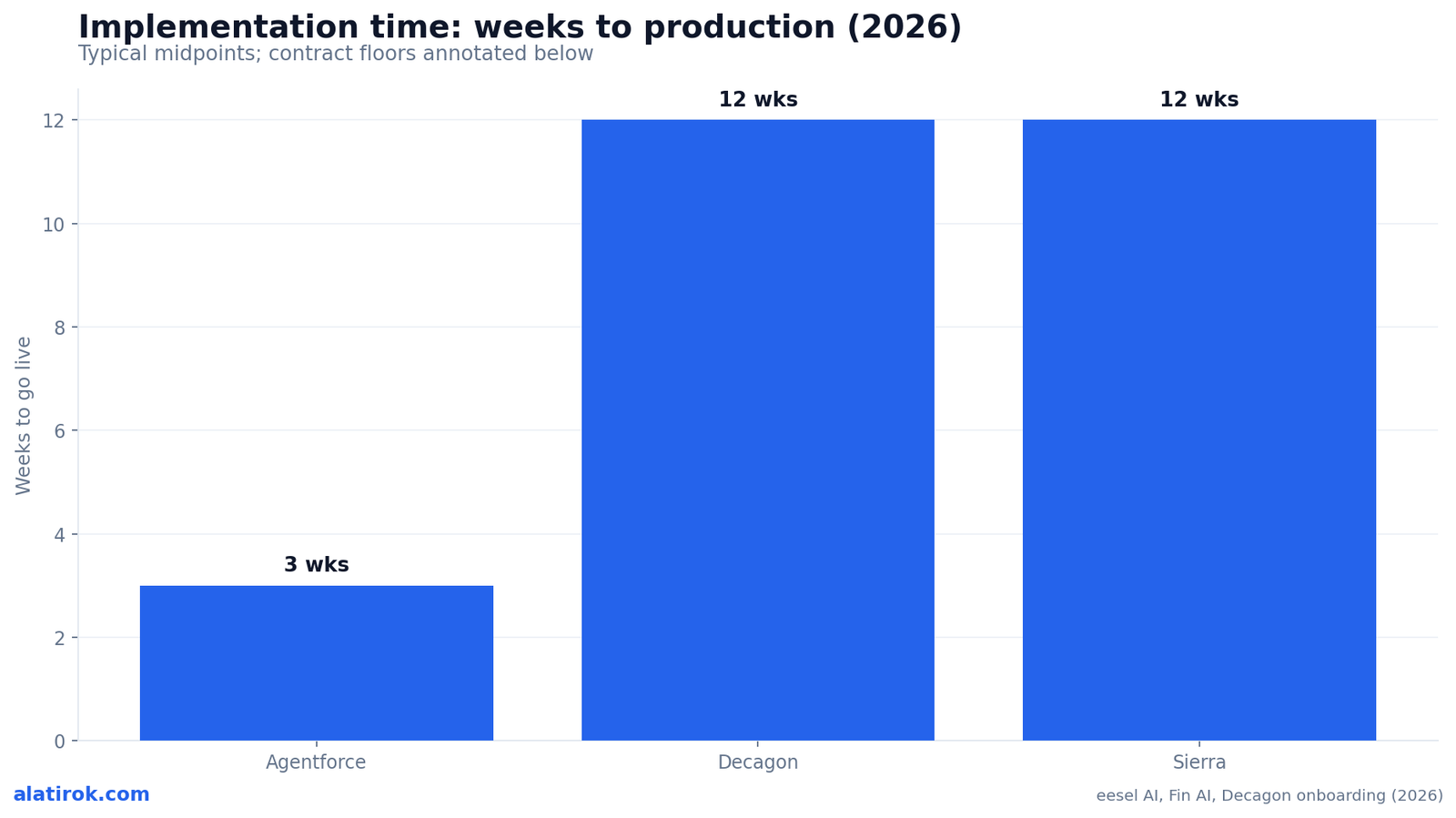
| Implementation (typical) | 8-16 weeks (custom workflows) | ~6-16 weeks (historical-ticket training) | 2-4 weeks (once connectors set) |
| Best-fit buyer | High-volume consumer brands, voice-first | Technical SaaS, KB-driven ticket resolution | Existing Salesforce Service Cloud shops |
| CRM lock-in | Low (CRM-neutral) | Low (CRM-neutral) | High (Salesforce + Data Cloud effectively required) |
| Entry contract floor | ~$150K+/yr | ~$95K-$150K+/yr | ~$50K-$150K+ setup; Data Cloud ~$108K+/yr |
| Helpdesk included | No (needs separate platform) | No (needs separate platform) | Yes (native to Service Cloud) |
How do Sierra, Decagon, and Agentforce actually differ?
Sierra is an “Agent OS” for multichannel consumer CX, Decagon is an AI concierge built around natural-language Agent Operating Procedures for technical SaaS, and Agentforce is the AI layer bolted onto Salesforce Service Cloud. They look similar on a feature grid, but their centers of gravity are completely different.
Sierra, founded by Bret Taylor, positions itself as an operating system for building and running CX agents across chat, voice, SMS, WhatsApp, and email simultaneously. Its March 2026 “Ghostwriter” capability builds production-ready agents from standard operating procedures, call transcripts, or plain-English descriptions. Sierra claims more than 40% of the Fortune 50 as customers and crossed $150M ARR by February 2026. The wedge is voice-first, omnichannel scale for big consumer brands.
Decagon’s signature is the Agent Operating Procedure (AOP): a framework that lets CX teams write agent logic in plain English while technical teams keep code-level guardrails underneath. It targets technical SaaS and KB-heavy support, with documented deflection above 80% at customers like Duolingo and resolution near 70% at Chime. If your support volume is knowledge-base ticket resolution and you want engineers and CX to share one editable source of truth, Decagon is purpose-built for that.
Agentforce is fundamentally different in kind. It is not a standalone CX company; it is the agent layer inside Salesforce. It reads and writes CRM data natively, executes Flow-based workflows, and lives where your Service Cloud cases already live. That native data access is its single biggest advantage and, as we will see, the root of its biggest hidden cost.
Sierra and Decagon are CRM-neutral: they sit on top of whatever helpdesk you run. Agentforce is CRM-native: it only pays off if your records already live in Salesforce, and Data Cloud is effectively mandatory for it to function well. That single distinction reshapes total cost of ownership more than any per-unit price.
Sierra vs Decagon vs Agentforce pricing: outcome vs per-action
The real pricing fork is this: Decagon and Sierra charge for outcomes (per resolution), while Agentforce charges per action via Flex Credits regardless of whether the customer’s issue was solved. That structural difference matters more than any headline rate, because it determines who carries the risk when an agent works hard but fails to resolve.
Decagon typically pairs a platform fee around $50,000/year with per-conversation or per-resolution charges, with one reported rate near $0.50 per resolution; third-party estimates put real annual spend between roughly $95,000 and $590,000 depending on volume. Sierra also uses outcome-based resolution pricing on custom enterprise contracts, with estimates commonly cited at $150K+ per year and professional-services fees that can rival first-year licensing. Both are sales-gated with no public price list and no free trial.
Agentforce’s Flex Credits work out to about $0.10 per standard action, sold in packs of 100,000 credits for $500, where one action covers up to 10,000 tokens. Cross that token threshold and a single action bills as two: a 15,000-token action costs $0.20, not $0.10. There is also a flat $2.00-per-conversation option. The catch is that per-action billing accrues whether or not the conversation resolves, so a chatty, multi-step interaction that ends in an escalation still runs up credits.
Here is the part the vendor-published comparisons bury: Agentforce requires a Data Cloud subscription that starts around $108,000/year to function effectively, on top of Service Cloud licensing that runs $175/user/month at the Enterprise tier. So the “cheap” $0.10-per-action option sits on a six-figure platform floor. For a shop already standardized on Salesforce, that floor is largely sunk cost. For everyone else, choosing Agentforce means buying a data platform in order to buy an agent.
“Outcome pricing aligns the vendor to resolutions. Per-action pricing bills you for effort. In CX, you are buying resolutions, not effort.”
Alatirok analysis, 2026
Outcome-based pricing for CX agents: who carries the risk?
Outcome-based pricing for CX agents shifts risk to the vendor: if the agent does not resolve the issue, you do not pay the resolution fee. Per-action pricing shifts that risk back to you. This is the philosophical heart of the Sierra vs Decagon vs Agentforce choice.
Decagon and Sierra both lean into resolution-based billing, which sounds buyer-friendly and largely is, but read the definition of “resolution” carefully. Vendors define resolution differently: some count any conversation the AI handled without escalation, others require a confirmed customer-satisfaction signal. A loose definition inflates your invoice; a strict one protects your budget. Negotiate the definition, not just the rate.
Agentforce’s per-action model is more predictable to forecast if your volume is stable, because you can estimate actions per conversation and multiply. But it does not reward the vendor for solving problems, only for performing steps. Salesforce’s bet is that native CRM access makes its agent resolve faster anyway, so action counts stay low. That bet holds up best when the data it needs is already clean and unified in Data Cloud, which loops back to the lock-in cost.
For most buyers, the practical rule is simple. If your support volume is spiky and you want the vendor incentivized to actually close tickets, outcome pricing from Decagon or Sierra is the safer structure. If your volume is steady, your data is already in Salesforce, and you value forecasting predictability, Agentforce’s per-action math can come out cheaper on a fully loaded basis.
Implementation time: 2-4 weeks vs 8-16 weeks
Agentforce can go live in roughly 2-4 weeks once Salesforce connectors are configured, while Sierra and Decagon typically take 8-16 weeks because they train on historical tickets and build custom workflows from scratch. That gap is not a quality knock; it reflects how much bespoke logic each platform builds for you.
Agentforce is fast precisely because it inherits your Salesforce data model. If your cases, contacts, and knowledge articles are already structured in Service Cloud, the agent has a running start and the main work is wiring Flows and Data Cloud. The flip side: that speed assumes your Salesforce house is already in order. Messy data or heavy Data Cloud unification work can stretch the timeline well past the headline.
Decagon’s standard onboarding runs about six weeks from signature to production for straightforward deployments, with the early weeks spent engineering API connections to your CRM and helpdesk. Sierra ranges from roughly four to ten weeks for simpler builds and longer for complex, voice-heavy, multichannel rollouts. Both invest weeks in ingesting historical tickets and tuning agent behavior, which is why deflection rates can be high but the ramp is slower.
One under-discussed cost: the eesel and Fin analyses note that both Sierra and Decagon customers often depend on the vendor’s team to push production changes, especially early on. That dependency is fine if you want white-glove service and bad if you need to iterate hourly. Agentforce, living in your own Salesforce org, gives your admins more direct control once it is live.
When does each one lose? The CRM lock-in reality
Agentforce loses the moment your records are not already in Salesforce, because Data Cloud becomes a mandatory six-figure prerequisite; Sierra loses on price and change-velocity for smaller teams; and Decagon loses when your stack is Freshdesk or HubSpot or you need deep audit transparency. Knowing the failure modes is how you avoid a mis-buy.
Agentforce loses when there is no Salesforce gravity. Its biggest strength, native CRM access, becomes its biggest liability if your customer data lives elsewhere, because you would have to stand up and pay for Data Cloud (roughly $108K+/year) just to feed the agent. For a non-Salesforce shop, that converts a $0.10-per-action tool into a six-figure platform commitment. It also loses for buyers who want true vendor neutrality, since it deepens Salesforce lock-in by design.
Sierra loses for smaller or mid-market teams on two fronts: price and change-velocity. With estimates starting around $150K+/year plus heavy professional services, and a documented tendency for customers to depend on Sierra’s team for production changes, it is built for Fortune 500 scale, not lean iteration. Reviewers also flag context loss in longer conversations and a steep initial setup curve.
Decagon loses when your helpdesk is unsupported or your governance bar is high. It integrates cleanly with Zendesk, Salesforce, and Kustomer but is reported incompatible with Freshdesk and HubSpot, and reviewers cite underdeveloped audit logs and limited transparency into agent decisions. If you are in a regulated environment that needs deep explainability, that is a real gap. It also, like Sierra, requires a separate helpdesk platform for human-agent workflows, adding $55-$175+ per agent per month.
Pros
Cons
Best AI agent for customer service 2026: the verdict
Pick by data gravity first, channel mix second
There is no single best AI agent for customer service in 2026; there is a best fit per buyer profile. Sierra wins for high-volume consumer brands, Decagon wins for technical SaaS with KB-driven tickets, and Agentforce wins for Salesforce-native shops with clean Data Cloud already in place.
Map your situation to the axis that actually decides cost. If your data already lives in Salesforce and Data Cloud is funded, Agentforce’s speed and native access make it the lowest-friction, often lowest-TCO option. If your data lives anywhere else, treat Agentforce’s sticker price as a starting point and add the Data Cloud floor before comparing.
If you are not in the Salesforce orbit, the contest is Sierra vs Decagon, and it comes down to channel mix and team profile. Voice-first, multichannel, Fortune 500 scale points to Sierra. Knowledge-base ticket deflection, natural-language agent logic, and a technical-SaaS support motion points to Decagon. Both bill on outcomes, both take 8-16 weeks, and both will want a six-figure annual commitment.
Sierra
Best for: Large consumer brands, voice-first omnichannel CX
What works
Watch out for
Decagon
Best for: Technical SaaS, KB-driven ticket resolution
What works
Watch out for
Agentforce
Best for: Existing Salesforce Service Cloud shops
What works
Watch out for
Builder’s take
I build agent orchestration at Cyntr and a discussion platform at Loomfeed, so I evaluate these tools the way an operator does, not the way a vendor’s landing page does. Three things I tell every founder weighing Sierra vs Decagon vs Agentforce:
- The pricing-model fight matters more than the per-unit rate. Outcome pricing (Decagon, Sierra) aligns the vendor to resolutions; Agentforce’s per-action Flex Credits bill you whether or not the customer’s problem got solved. Model the worst case, not the demo.
- Agentforce’s true price is Data Cloud. The $0.10-per-action headline hides a roughly $108K/year Data Cloud floor that’s effectively mandatory. If your records already live in Salesforce, that cost is sunk and Agentforce wins on TCO. If they don’t, you’re buying a data platform to buy an agent.
- Implementation time is a buying signal, not a footnote. A 2-4 week Agentforce stand-up versus 8-16 weeks for a custom Sierra or Decagon build tells you exactly how much bespoke logic each one is really doing. Fast is not always better, but it is always cheaper.
Frequently asked questions
It depends on your support profile. Sierra is better for high-volume consumer brands that need voice-first, multichannel coverage at Fortune 500 scale. Decagon is better for technical SaaS companies that want knowledge-base ticket resolution and natural-language Agent Operating Procedures shared between CX and engineering. Both are CRM-neutral, outcome-priced, and take 8-16 weeks to deploy.
Both use opaque, sales-gated pricing. Decagon typically pairs a platform fee around $50,000/year with per-resolution charges (one reported rate near $0.50/resolution), with real annual spend estimated between roughly $95,000 and $590,000. Sierra estimates commonly start at $150K+/year plus professional-services fees that can rival first-year licensing. Neither offers a free trial.
Effectively yes. Agentforce runs on Data Cloud for unified customer data, and that subscription, which starts around $108,000/year, is required for the agent to function well. That is why Agentforce only makes financial sense if your records already live in Salesforce; otherwise you are buying a six-figure data platform just to run the agent.
Outcome pricing (used by Decagon and Sierra) charges per resolution, so the vendor is paid only when the customer’s issue is solved. Agentforce Flex Credits charge per action, about $0.10 per standard action, regardless of whether the conversation resolves. Outcome pricing puts resolution risk on the vendor; per-action pricing puts it on you.
Agentforce can go live in about 2-4 weeks once Salesforce connectors are configured. Sierra and Decagon typically take 8-16 weeks because they train on historical tickets and build custom workflows. Decagon’s standard onboarding is around six weeks for straightforward deployments; complex, voice-heavy Sierra rollouts run longer.
Sierra and Decagon have the least CRM lock-in because they are CRM-neutral and sit on top of whatever helpdesk you run (Zendesk, Salesforce, Kustomer). Agentforce has the most lock-in by design, since it is native to Salesforce and depends on Data Cloud, deepening your commitment to the Salesforce ecosystem.
Primary sources
- Sierra raises $950M at $15.8B valuation — TechCrunch
- Sierra locks up $950M at a $15.8B valuation — Axios
- Decagon completes first tender offer at $4.5B valuation — TechCrunch
- Decagon’s Valuation Triples to $4.5 Billion — Business Wire
- Decagon vs Sierra: 2026 guide — eesel AI
- AI Agent Pricing Comparison 2026 — Fin AI
- Agentforce Pricing Explained: Flex Credits, Real Costs & Hidden Fees — Clientell
- Salesforce Agentforce setup cost: 2026 pricing breakdown — eesel AI
Last updated: June 6, 2026. Related: Products.