
Gartner pegs the agent-software segment at $206.5B in 2026, jumping to $376.3B in 2027. Here is how that money is priced, where it sits inside the $2.59T total, and why Gartner warns it may not pay off.
How much is AI agent software spending in 2026?
$206.5B
AI agent software spending, 2026
Gartner forecast
$376.3B
AI agent software spending, 2027
82% YoY jump
$2.59T
Total worldwide AI spend, 2026
up 47% YoY
+47%
Total AI spend growth, 2026
Gartner, May 2026
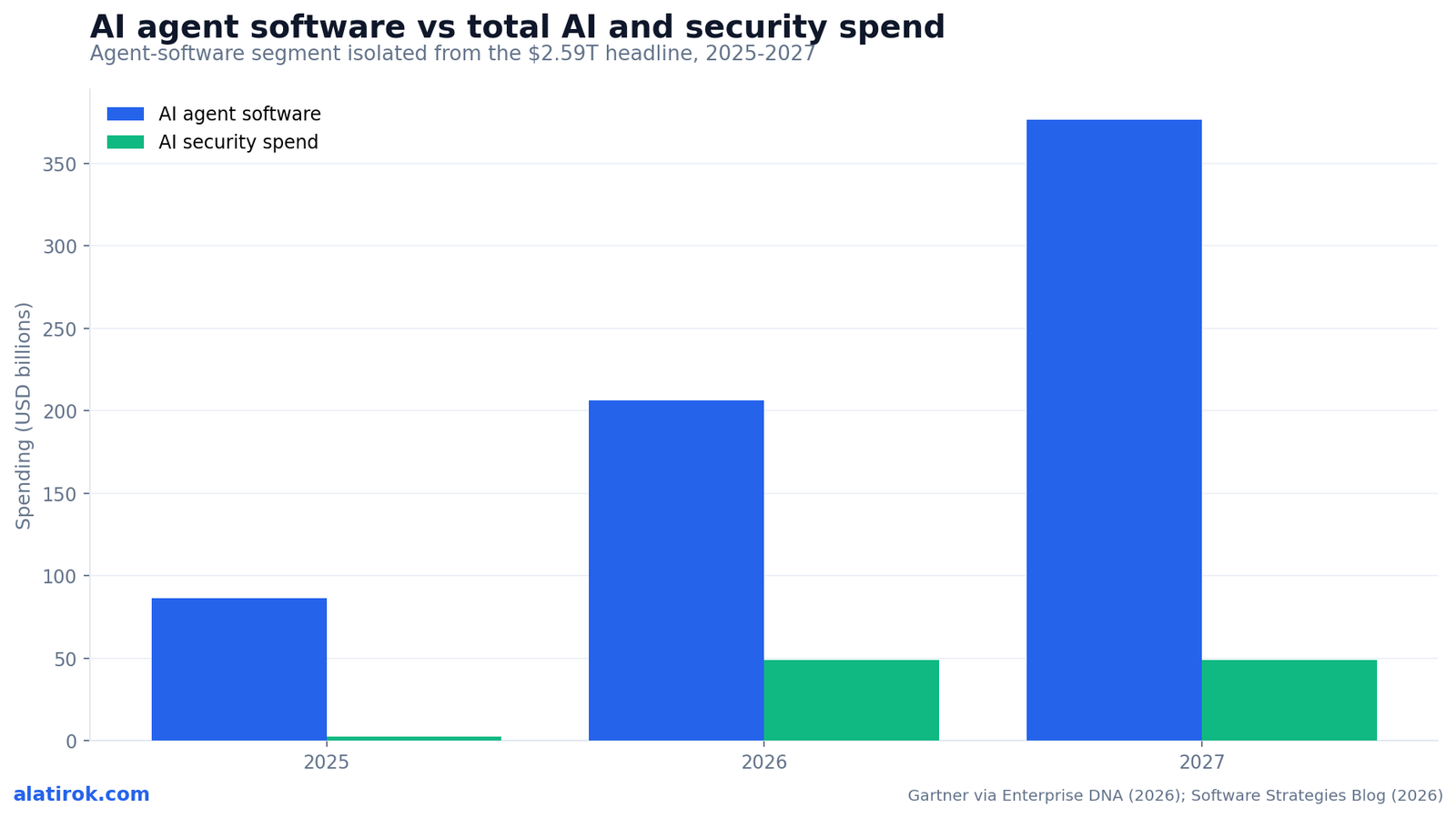
AI agent software spending in 2026 is forecast at $206.5 billion, rising to $376.3 billion in 2027 — an 82% single-year jump, per Gartner. That figure sits up from roughly $86.4 billion in 2025, meaning the agent-software segment is on track to nearly 4.4x in just two years. This is the number a CFO sizing the agent opportunity should actually anchor on — not the headline $2.59 trillion total-AI figure that gets reprinted everywhere.
The distinction matters because most coverage of AI agent software spending 2026 collapses into one of two unhelpful buckets. The first reprints Gartner’s top-line $2.59T worldwide AI number, which is dominated by infrastructure capex you will never directly purchase. The second is a link farm of adoption statistics that buries the one line that maps to a budget decision. The agent-software segment is the part you license, deploy, govern, and have to justify on a return.
Here is the cleanest way to frame it. Total AI spend is the whole iceberg. AI software (all of it) is roughly $453 billion in 2026. Agent software — the autonomous, task-completing layer specifically — is the $206.5 billion slice inside that. It is the fastest-growing, most strategically loaded, and least understood line in the entire AI budget conversation.
What is the AI agent market size in 2026 versus total AI spend?
The AI agent market size in 2026 is about $206.5 billion, which is roughly 8% of the $2.59 trillion total AI spend and roughly 46% of the $453 billion all-AI-software figure. In other words, agents are a small slice of the headline number but already nearly half of every AI dollar that goes toward software rather than chips and cloud.
That ratio is the single most important context that press-release reprints leave out. Gartner notes more than 45% of all AI spending in 2026 goes to infrastructure — AI-optimized servers, semiconductors, network fabric, and IaaS. That is hyperscaler and chip-vendor money, not enterprise software-license money. When you strip infrastructure out and look at what enterprises actually buy as software, agents are the dominant growth engine.
The chart below isolates the three numbers that matter for budgeting and shows the agent-software trajectory against the security spend it is racing ahead of. The 2027 agent figure ($376.3B) is the strongest signal in the data set: it is the year Gartner expects agentic spending to overtake conversational/chatbot spending outright.
How is AI agent software priced — per-seat or per-action?
AI agent software pricing is collapsing away from per-seat toward per-action and per-resolution models, which directly changes how the 2026 spend lands on your bill. Per-seat fell from about 21% to 15% of SaaS pricing in roughly twelve months, while hybrid models surged from 27% to 41% adoption — now the de facto standard. The reason is simple: when one agent does the work of three humans, per-seat pricing leaves most of the value on the table, so vendors are repricing around outcomes.
For a buyer, this is the most actionable part of the entire forecast. The same agent can cost wildly different amounts depending on the model. Per-seat agent pricing runs roughly $30 to $80 per agent per month. Per-ticket runs $0.30 to $1.00 per inbound conversation. Per-resolution — the model where the vendor only charges when the agent closes the work without a human — runs $0.50 to $2.00. Salesforce Agentforce has published around $2.00 per conversation; Intercom Fin around $0.99; some challengers undercut at $0.50 to $0.60.
The practical risk: a fleet of agents priced per-action has no natural ceiling. A per-seat budget is predictable; a per-resolution budget scales with usage, which is exactly what makes the $206.5 billion 2026 number plausible and exactly what makes it dangerous to forecast naively. If your agents succeed, your bill grows with your success.
| Model | Typical price | Bills on | Best when | Budget risk |
|---|---|---|---|---|
| Per-seat | $30-$80 / agent / mo | Provisioned agents | Stable, attended use | Underprices high-volume agents |
| Per-ticket | $0.30-$1.00 / inbound | Every conversation | Predictable inbound volume | Pays for unresolved work |
| Per-resolution | $0.50-$2.00 / resolved | Successful outcomes only | Outcome-aligned deployments | Scales with success, no ceiling |
| Per-user SKU (Agent 365) | $15 / user / mo | Licensed human users | Governed fleets in M365 | Decoupled from agent workload |
Microsoft Agent 365: the SKU that anchors the spending math
Microsoft Agent 365 reached general availability on May 1, 2026 at $15 per user per month, and is bundled into the new Microsoft 365 E7 suite — making it the first mass-market per-agent SKU that anchors the agent-software-spend math. Before Agent 365, the $206.5 billion forecast was an aggregation of fragmented startup billing. Now there is a list-price line item from the world’s largest enterprise software vendor that millions of seats can attach to overnight.
Agent 365 is available both standalone and inside Microsoft 365 E7, the new Frontier-tier bundle at roughly $99 per user per month. E7 stacks M365 E5 (around $60 from July 2026), Microsoft 365 Copilot ($30), Entra Suite ($12), and Agent 365 ($15). Bought separately those components run about $117, so E7 represents a roughly 15% bundle discount — and a deliberate funnel that pulls agent spend into the core enterprise contract.
This is why the segment number is no longer speculative. When a per-agent SKU ships inside the default productivity bundle of most large enterprises, agent software stops being a discretionary experiment and becomes a line on the enterprise agreement. That is the mechanism by which a $86.4B-to-$206.5B leap actually happens in a single year.
A per-user SKU like Agent 365 ($15/user/mo) decouples your bill from actual agent workload — you pay per licensed human, not per task. That makes spend predictable but can mask whether the agents are doing anything. Pair the SKU with usage telemetry or you will renew a fleet you can’t prove is working.
Does AI agent spending actually pay off? Gartner’s contrarian warning
No — Gartner explicitly warns that AI and autonomous-business layoffs may free up budget but do not deliver returns, and predicts over 40% of agentic AI projects will be canceled by the end of 2027. This is the caveat the press-release reprints systematically omit, and it is the single most important thing a CFO should internalize before signing a multi-year agent contract.
The logic is uncomfortable. Many enterprises are funding agent deployments by cutting headcount, then booking the avoided salary as the ROI. Gartner’s position is that this is a budget-shuffling exercise, not value creation: the layoff frees cash, but the agent does not automatically generate the productivity that justifies the spend. You can have rising spend, falling headcount, and flat output simultaneously — which looks like efficiency on a spreadsheet and feels like decline in the business.
Layer this against the security gap and the picture sharpens. Enterprises are forecast to spend about $244.2 billion on information security in 2026, yet the asymmetry between AI-amplified security tooling and securing AI itself ran roughly 17 to 1 in 2025 ($49B versus $2.8B). Agents are entering production at 7-8x the rate organizations are building governance around them. So the honest read of AI agent software spending 2026 is: the spend is certain, the returns are conditional, and the controls are lagging.
“The spend is certain. The returns are conditional. The controls are lagging.”
The honest read of the 2026 agent-software forecast
What is the AI agent software market growth rate through 2027?
The AI agent software market growth rate is roughly 139% from 2025 to 2026 ($86.4B to $206.5B) and 82% from 2026 to 2027 ($206.5B to $376.3B) — a decelerating but still extraordinary curve. By comparison, all-AI-software grows about 60% in 2026 and 41% in 2027, and total AI spend grows 47% in 2026. Agents are outrunning every adjacent category, which is precisely why isolating the line matters.
The deceleration from 139% to 82% is not weakness; it is the math of a base effect on a segment that is becoming genuinely large. A category adding more than $169 billion of net-new spend across two years is, as SaaStr put it, on track to be bigger than entire established B2B software categories were just a few years ago. The growth rate also tells you something about timing: 2026 is the inflection year, 2027 is the year agentic overtakes chatbots.
For planning, translate the rate into a posture. If your sector tracks the segment, your agent-software line should roughly double in 2026 and grow another ~82% in 2027. If it isn’t, you are either deliberately abstaining or quietly falling behind the category — and given the 40% cancellation rate, deliberate abstention from the hype while running tightly-scoped pilots is a defensible strategy, not a laggard one.
Pros
Cons
How should a CFO budget for AI agents in 2026?
The agent-software line is real money — treat it like a portfolio, not a purchase
Budget AI agent software in 2026 as a managed portfolio: fund small, instrument everything, prefer per-action pricing for variable workloads, and reserve a parallel line for security and observability from day one. The $206.5 billion segment is real, but the 40% cancellation forecast means undifferentiated funding is how budget evaporates. The enterprises that win are not the ones that spend the most — they are the ones that can prove which agents earned their cost.
Three concrete moves. First, separate the SKU line from the consumption line: a per-user license like Agent 365 covers the platform, but per-resolution or per-action vendors are where runaway cost hides — cap and monitor them. Second, refuse to book avoided headcount as ROI; require an output metric (resolutions, cycle time, revenue touched) that survives the layoff. Third, fund governance concurrently — the 17x security gap is the most reliable predictor of which deployments become the next breach headline.
The macro backdrop supports aggression with discipline. With 65% of enterprises increasing AI budgets in 2026 at a median 22% rise, and a third of senior leaders expecting to spend $10M+ on AI this year, the capital is flowing. The differentiated bet is not whether to spend on agents — it is building the measurement layer that tells you when to double down and when to kill, before Gartner’s cancellation statistic finds you.
Builder’s take
I build the agent infrastructure these forecasts are quietly describing, so I read the $206.5B number differently than most. Here is what I’d tell a CFO sizing this line for next year’s budget.
- The agent-software line is the only AI sub-number that maps to a SKU you can actually buy and govern. Total-AI and infrastructure figures are someone else’s capex; agent software is your P&L.
- Per-seat is a trap the second your agents start working unattended. Model your 2026 budget on per-action or per-resolution, because that is where every serious vendor is migrating and where your bill will actually land.
- Budget the security and observability layer at the same time as the agents, not a year later. The 17x tooling-vs-securing gap is not a Gartner abstraction; it is the exact hole I watch teams fall into when they ship agents to prod with no audit trail.
- Treat Gartner’s 40%-cancellation prediction as a planning assumption, not a warning. Fund agents the way you fund a portfolio: small bets, real metrics, fast kills. The spend is real; the returns are not automatic.
Frequently asked questions
Gartner forecasts AI agent software spending at $206.5 billion in 2026, rising to $376.3 billion in 2027 — an 82% single-year jump. That is up from roughly $86.4 billion in 2025, making it the fastest-growing line inside the broader AI budget.
The AI agent market size in 2026 (~$206.5B) is roughly 8% of the $2.59 trillion total worldwide AI spend and about 46% of the $453 billion all-AI-software figure. More than 45% of total AI spend goes to infrastructure, which is hyperscaler capex rather than enterprise software you license.
Pricing is shifting from per-seat toward per-action and per-resolution. Per-seat runs about $30-$80 per agent per month, per-ticket $0.30-$1.00 per conversation, and per-resolution $0.50-$2.00 per resolved case. Per-seat fell from ~21% to ~15% of SaaS while hybrid models rose from 27% to 41% adoption.
Microsoft Agent 365 reached general availability on May 1, 2026 at $15 per user per month. It is available standalone and bundled into Microsoft 365 E7 (~$99/user/mo), alongside M365 E5, Copilot, and Entra Suite. It is the first mass-market per-agent SKU anchoring the agent-software-spend math.
Gartner warns that AI and autonomous-business layoffs may free up budget but do not deliver returns, and predicts over 40% of agentic AI projects will be canceled by the end of 2027. Booking avoided headcount as ROI is budget-shuffling, not value creation. Require an output metric that survives the layoff.
Roughly 139% from 2025 to 2026 ($86.4B to $206.5B) and 82% from 2026 to 2027 ($206.5B to $376.3B). That outpaces all-AI-software (60% then 41%) and total AI spend (47% in 2026). 2026 is the inflection year; 2027 is when agentic spending overtakes chatbots.
Primary sources
- Gartner Forecasts Worldwide AI Spending to Grow 47% in 2026 — Gartner
- Gartner: AI Spending Hits $2.59 Trillion in 2026, Up 47% — Enterprise DNA
- Gartner Says Autonomous Business and AI Layoffs May Create Budget Room, but Do Not Deliver Returns — Gartner
- Gartner’s $244.2B security forecast shows enterprises spend 17x more on AI tools than securing AI — Software Strategies Blog
- Gartner: AI Software Spending to Grow 60% to $453B in 2026 — SaaStr
- Agent 365 Licensing: What It Covers and Costs — SAMexpert
- SaaS Pricing Is Breaking: Why Per-Seat Models Don’t Survive the AI Agent Era — MindStudio
- Gartner Predicts Over 40% of Agentic AI Projects Will Be Canceled by End of 2027 — Gartner
Last updated: June 6, 2026. Related: Capital.