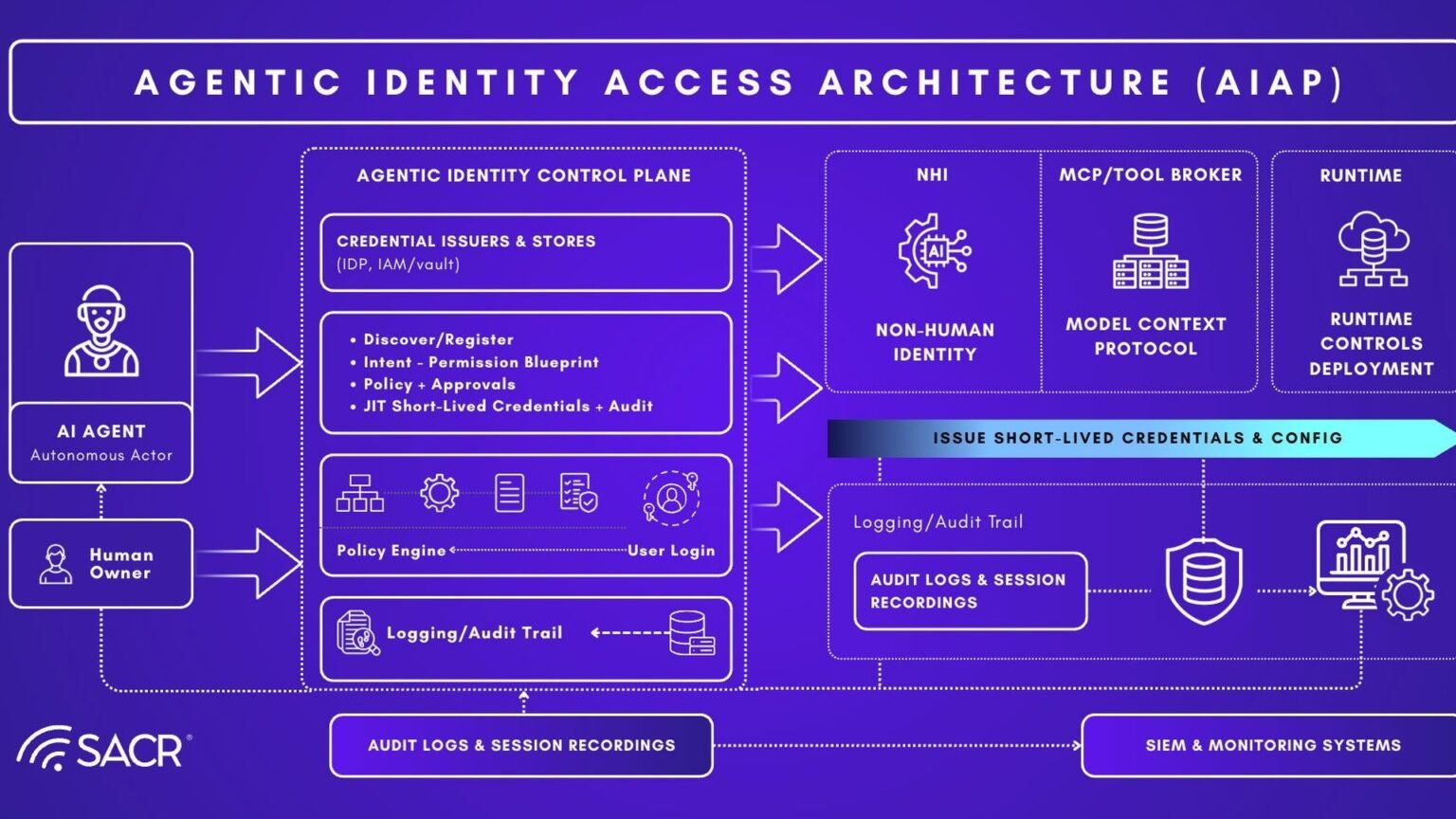

The first buyer matrix scoped to agent-specific identity primitives — what each platform issues an agent, how it handles cross-app delegation, and whether you pick one or stack all three.
AI agent identity governance, Entra vs Okta vs SailPoint: the short answer
For AI agent identity governance, Entra vs Okta vs SailPoint is not a three-way bake-off — it’s a three-layer stack. Microsoft Entra Agent ID and Okta for AI Agents both issue and authenticate agent identities and broker cross-app delegation; SailPoint governs those identities with discovery, ownership mapping, and entitlement review. Most mature enterprises in 2026 run an authentication provider (Entra or Okta) underneath SailPoint as the authoritative governance engine, rather than picking one and dropping the others.
That framing matters because almost every comparison you’ll find online lines these three up as legacy IAM suites and grades them on SSO, MFA, and joiner-mover-leaver lifecycle. Those features are table stakes and they tell you nothing about the new problem: an autonomous AI agent is a non-human identity that acts on behalf of a human, reaches across multiple apps in a single task, and can be spun up by the hundreds. The 2025-era IDaaS scorecard doesn’t measure any of that.
This article is the buyer matrix scoped to the agent-specific products that shipped in 2026 — Entra Agent ID (registered through Microsoft Graph), Okta for AI Agents plus Cross App Access (XAA), and SailPoint’s Agent Identity Security inside its Agentic Fabric. We compare what each one actually issues to an agent, how it handles cross-app delegation, how it deals with static credentials, the depth of its audit trail, and crucially where each one sits in your architecture.
Gartner’s projection that 40% of enterprise applications will include task-specific AI agents by 2026 (cited by Okta) is why this stopped being theoretical. Once agents are embedded in the apps your employees already use, every one of them needs an identity, a scope, an owner, and a paper trail.
What does each platform actually issue to an AI agent?
Entra Agent ID issues a first-class agent identity registered in Microsoft Entra (created programmatically through Microsoft Graph via an Agent Instance and an Agent Card), built on a reusable Agent Identity Blueprint template. Okta for AI Agents registers each agent as a first-class identity in Universal Directory and issues it credentials it can vault and rotate. SailPoint does not primarily issue the identity — it discovers, governs, and maps every agent (a non-human identity) to a human owner with lifecycle controls.
This is the cleanest way to see the division of labor. Entra and Okta are in the business of minting and authenticating the agent. SailPoint is in the business of making sure that whatever got minted is owned, justified, and reviewed.
Microsoft’s model reached general availability in 2026 and is structured around a three-construct hierarchy: an Agent Identity Blueprint (a reusable template that standardizes how an agent identity should look and operate), the Agent Identity itself assigned to a specific agent instance, and an Agent User Account that backs on-behalf-of scenarios. The Graph registration path lets platform teams onboard agents programmatically — though note the registry is moving toward Microsoft Agent 365, and the current Graph API is expected to be deprecated in favor of an Agent 365 API.
Okta’s GA release (Okta for AI Agents, generally available April 30, 2026) bundles discovery of sanctioned and shadow agents, registration of agents as first-class identities, an Agent Gateway control plane with a virtual MCP server, and credential vaulting with automatic rotation so agent secrets never appear in plaintext or logs.
SailPoint’s contribution, delivered through Agentic Fabric (launched May 11, 2026), is governance breadth: connectors that discover agents across Microsoft 365 Copilot, Microsoft Foundry, Amazon Bedrock, Google Vertex AI, Salesforce Agentforce, Databricks, and ServiceNow, then map each agent to an owner and enforce least-privilege and lifecycle policy.
Entra Agent ID vs Okta Cross App Access: how cross-app delegation works
For Microsoft Entra Agent ID vs Okta Cross App Access, the key difference is the delegation primitive. Okta’s Cross App Access (XAA) is an open protocol that extends OAuth and OpenID Connect — using the Identity Assertion Authorization Grant adopted by the IETF OAuth Working Group — so your identity provider mediates each agent-to-app connection instead of every app brokering its own OAuth grant. Entra Agent ID uses Microsoft’s on-behalf-of flows and Agent User Accounts to carry a human’s authorization context into the apps an agent touches, anchored in the Microsoft ecosystem.
Cross-app delegation is the single most important and most under-discussed capability in this category. When an agent reads a document in one app and writes a summary into another, something has to decide whether that agent — acting for that specific human — is allowed to do both. Do it wrong and you’ve built a lateral-movement engine with a service account.
XAA’s design goal is to kill token sprawl. Instead of each agent accumulating its own pile of API tokens, refresh tokens, and service-account credentials across every app it integrates with, the identity provider becomes the central broker and translates identity and authorization context across domains. XAA already has stated support from Automation Anywhere, AWS, Boomi, Box, Glean, Google Cloud, Grammarly, Miro, Salesforce, and WRITER — meaningful because a delegation protocol is only as good as the apps that honor it.
Entra’s strength in delegation is gravitational: if your agents live inside Microsoft 365, Copilot, and Foundry, the on-behalf-of model and Conditional Access apply to agent identities with the same machinery your admins already know. The trade-off is that the deepest delegation guarantees are strongest inside Microsoft’s own surface area.
Where does SailPoint fit here? It largely doesn’t broker the live delegation — it governs the entitlements that delegation draws on. SailPoint answers ‘should this agent have had access to that scope at all, and who signed off,’ which is the review layer underneath whatever runtime protocol grants the token.
The agent identity feature matrix: Entra vs Okta vs SailPoint
Here is the side-by-side scoped to agent identity primitives — not the legacy SSO/MFA scorecard. Read it as a layer map: Entra and Okta own the left columns (issuing, authenticating, delegating), SailPoint owns the right columns (discovery, lifecycle governance, entitlement review).
The pattern that emerges is that no single product is strong across every row, which is exactly why the ‘stack, don’t pick’ conclusion holds for most buyers. Entra is deepest for Microsoft-native estates, Okta is deepest for heterogeneous multi-app delegation via an open protocol, and SailPoint is deepest for cross-platform governance and audit.
| Capability | Entra Agent ID | Okta for AI Agents | SailPoint Agentic Fabric |
|---|---|---|---|
| What it issues an agent | First-class agent identity registered via Microsoft Graph (Agent Instance + Agent Card) from a reusable Blueprint | First-class identity in Universal Directory with vaulted, auto-rotated credentials | Does not mint — discovers and governs existing agents as non-human identities |
| Cross-app delegation | On-behalf-of flows + Agent User Account; strongest inside Microsoft 365/Copilot/Foundry | Cross App Access (XAA): open OAuth/OIDC extension brokering each agent-to-app connection | Governs the entitlements delegation draws on; not the live broker |
| Static credential / service-account handling | Conditional Access applies to agent identities; managed-identity patterns | Okta Privileged Access vaults and rotates static credentials/API keys | Discovers and owner-maps machine identities; flags risky standing credentials |
| Discovery + lifecycle governance | Entra ID Governance lifecycle workflows for agent identities | Discovery of sanctioned + shadow agents; registration | Purpose-built: cross-cloud discovery, owner mapping, zero-standing-privilege/JIT |
| Audit-trail depth | Agent sign-in/audit logs in Entra | Agent Gateway logs all interactions for audit/observability | Continuous entitlement review + threat detection across all agent platforms |
| Where it sits | Authentication + Microsoft-native governance | Authentication + delegation (open protocol) | Governance / authoritative entitlement engine |
Static credentials, service accounts, and the non-human identity blast radius
The fastest way to fail at agent identity is to hand each agent a long-lived service account or API key and call it done. Okta Privileged Access directly targets this by vaulting and rotating static credentials so they never appear in plaintext or logs; SailPoint targets it by discovering machine identities and mapping every one to a human owner with lifecycle controls; Entra applies Conditional Access and managed-identity patterns to agent identities.
Non-human identities already outnumber human ones in most enterprises, and agents multiply the problem because a single agent platform can spawn many short-lived workers. Every one that holds a static secret expands the blast radius of a single leaked key.
This is the row where ‘authn vs governance’ becomes concrete. Okta gives you the runtime control — vault the key, rotate it, enforce policy when an agent uses it. SailPoint gives you the governance control — find every key, attach an accountable human, and force a review when it goes stale or over-privileged. Running both is not redundant; it’s defense in depth.
SailPoint’s packaging reflects this: its Agentic Business tier establishes foundational least-privilege governance across identity types, while Agentic Business Plus pushes to zero-standing-privilege with just-in-time access — a direct answer to the standing-credential problem that static service accounts create.
Both Okta and SailPoint lead with discovery of unsanctioned ‘shadow’ agents for a reason: in 2026, business users spin up agents inside SaaS apps faster than security teams can register them. An identity strategy that only covers the agents you deliberately built will miss the ones your org is already running.
Mindshare and market position: who’s leading agent identity in 2026?
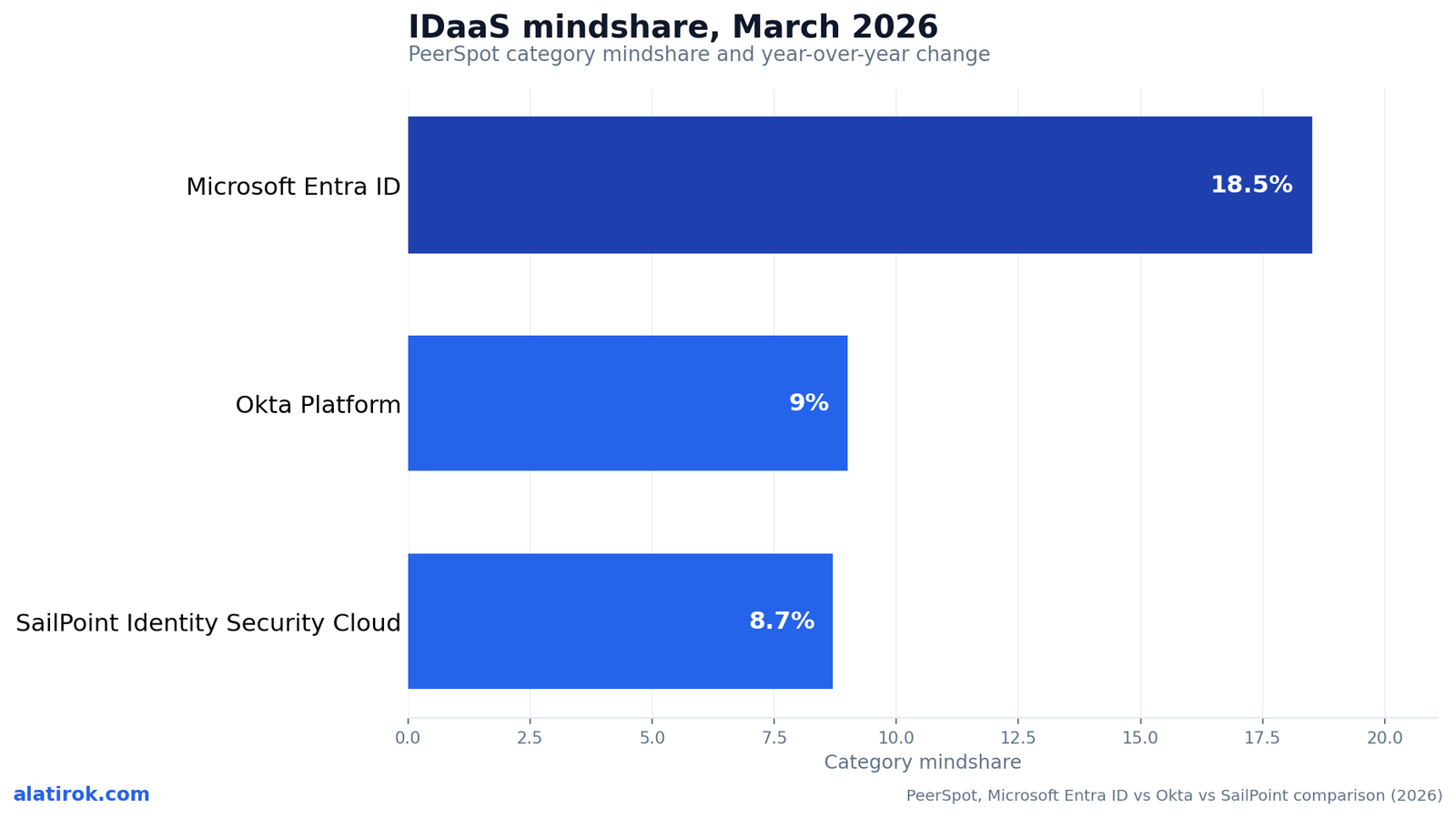
In PeerSpot’s March 2026 IDaaS mindshare data, Microsoft Entra ID leads at 18.5% (down from 29.0% year-over-year), with Okta Platform at 9.0% (down from 14.0%) and SailPoint Identity Security Cloud at 8.7% (down from 11.0%). All three declined as the broader IDaaS category fragmented — but mindshare in the legacy category is a weak proxy for who wins the new agent-identity race.
Read these numbers carefully. They measure the old IDaaS category, where Entra’s bundling-with-Microsoft-365 advantage is decisive. They do not measure agent-specific traction, where the field is genuinely open and where SailPoint’s governance focus and Okta’s open-protocol bet are differentiators that don’t show up in an IDaaS mindshare chart.
The more useful signal is product cadence in the first half of 2026: Entra Agent ID hitting GA, Okta for AI Agents reaching GA on April 30 with XAA as an open standard, and SailPoint shipping Agentic Fabric on May 11. Three established identity vendors all shipped purpose-built agent products within weeks of each other — that’s the real market signal.
Best agent identity governance platform 2026: which should you choose?
The best agent identity governance platform in 2026 depends on your existing stack and which layer you’re solving. Choose Entra Agent ID if your agents live inside Microsoft 365, Copilot, and Foundry and you want identity to ride your existing Conditional Access. Choose Okta for AI Agents if you run a heterogeneous, multi-vendor app estate and want open-protocol cross-app delegation (XAA) plus privileged-credential vaulting. Choose SailPoint when you need authoritative, cross-cloud governance, owner mapping, and entitlement review — and pair it with whichever of the first two you authenticate with.
The honest verdict is that the strongest deployments stack authentication and governance rather than forcing a single winner. Okta or Entra mints and delegates; SailPoint governs. That’s the pattern enterprises are converging on, and it’s the pattern the seed data from PeerSpot reflects: Okta/Entra for authentication plus SailPoint as the authoritative governance engine — complementary, not either/or.
Pros
Cons
“The real question isn’t which vendor governs AI agent identity — it’s which layer. Authentication and governance are different jobs, and the vendors that pretend otherwise are selling you a false choice.”
Surya Koritala, founder of Cyntr and Loomfeed
Cross App Access (XAA) vs Entra Agent ID: do they overlap or stack?
Cross App Access (XAA) and Entra Agent ID overlap on the authentication-and-delegation layer — both broker an agent’s access to apps on behalf of a human — so in practice you pick one as your primary authentication provider rather than running both. Where they genuinely stack is with a governance engine like SailPoint layered on top, which is complementary to either.
If you’re choosing your authn-and-delegation provider, the deciding factor is ecosystem gravity versus protocol openness. Entra wins when your world is Microsoft and you value Conditional Access continuity. XAA wins when your world is heterogeneous and you value an open, IETF-track standard that any participating app can honor rather than a vendor-specific flow.
The ‘stack, don’t pick’ rule applies cleanly to the governance layer, not the authn layer. You generally won’t run Entra Agent ID and Okta XAA side by side as competing brokers — but you will very plausibly run either one underneath SailPoint, because discovery, owner mapping, and entitlement review are jobs neither Entra nor Okta is primarily built to be the authoritative system of record for.
Bottom line: pick ONE authentication/delegation provider (Entra Agent ID OR Okta with XAA based on your app ecosystem), then add a governance engine (SailPoint) as the authoritative system of record fBuilder’s take
I run agents in production at Cyntr, and the moment you move past one agent calling one API, identity stops being a checkbox and becomes the hardest part of the stack. Here is what the vendor decks won’t tell you.
- The real question is not ‘which vendor’ but ‘which layer.’ Entra and Okta answer authentication and delegation; SailPoint answers governance and entitlement review. Most serious deployments need both layers, and the slides that frame this as a three-way cage match are selling you a false choice.
- Cross-app delegation is where the actual risk lives. An agent that can read your inbox AND write to your CRM is a lateral-movement engine. Okta’s XAA and Entra’s on-behalf-of flows are the only primitives that scope that delegation per-connection instead of handing the agent a god-mode service account.
- Audit-trail depth is the line-item nobody tests in a POC and everybody regrets in an incident. Ask each vendor to show you the log line for ‘agent X used delegated token Y to touch resource Z on behalf of human W’ — if it takes three systems to reconstruct that, you have a forensics problem, not an identity solution.
- Static credentials are the silent killer. Service accounts and API keys handed to agents are the single biggest non-human identity attack surface in 2026. If your plan doesn’t include vaulting and rotation (Okta Privileged Access) or owner-mapped lifecycle (SailPoint), you’ve just scaled your secrets sprawl by the number of agents you deploy.
- Watch the platform gravity. Microsoft is folding the agent registry into Agent 365; the Graph API path you build on today may need re-registration tomorrow. Bet on the standards (OAuth, OIDC, the Identity Assertion Authorization Grant) more than the proprietary registry, because the standards will outlive the SKU names.
Frequently asked questions
Neither is universally better — they win in different environments. Entra Agent ID is better when your agents live inside Microsoft 365, Copilot, and Foundry, because it reuses your existing Conditional Access and Graph tooling. Okta for AI Agents (GA April 30, 2026) is better for heterogeneous, multi-vendor app estates because its Cross App Access (XAA) protocol is an open OAuth/OIDC extension that any participating app can honor for cross-app delegation.
Cross App Access is an open industry-standard protocol that extends OAuth and OpenID Connect — using the Identity Assertion Authorization Grant adopted by the IETF OAuth Working Group — so your identity provider centrally brokers each AI agent-to-app and app-to-app connection. It reduces token sprawl, gives security teams visibility into which agent accessed which resource, and produces a complete audit trail across apps.
Mostly they’re complementary, not competitive. Entra Agent ID and Okta for AI Agents mint and authenticate agent identities and broker delegation; SailPoint’s Agent Identity Security (in its Agentic Fabric, launched May 11, 2026) discovers agents across clouds, maps each to a human owner, and runs entitlement governance. The common 2026 pattern is Okta or Entra for authentication plus SailPoint as the authoritative governance engine.
Ownership splits across two layers. The authentication and delegation layer (Entra Agent ID or Okta for AI Agents) issues the agent an identity and controls how it accesses apps on behalf of a human. The governance layer (SailPoint, or Entra ID Governance) decides whether that access is justified, who the accountable human owner is, and forces periodic entitlement review. Mature enterprises run both layers.
Long-lived service accounts and API keys are the biggest non-human identity risk for agents. Okta Privileged Access vaults and automatically rotates static credentials so they never appear in plaintext or logs. SailPoint discovers machine identities, maps each to an owner, and pushes toward zero-standing-privilege with just-in-time access. Entra applies Conditional Access and managed-identity patterns to agent identities.
Plan for change. Entra Agent ID currently supports programmatic onboarding through Microsoft Graph by creating an Agent Instance and Agent Card, but the agent registry is moving to Microsoft Agent 365, and the existing registry Graph API is expected to be deprecated and replaced by an Agent 365 API. Agents registered through the current API may need to be re-registered, so build against the standards where you can.
Primary sources
- Okta introduces Cross App Access to secure AI agents — Okta
- Cross App Access: Securing AI agent and app-to-app connections — Okta
- New Okta innovations secure the AI-driven enterprise — Okta
- Overview of agent identities in Microsoft Entra — Microsoft Learn
- Governing Agent Identities — Entra ID Governance — Microsoft Learn
- Agent Registry is moving from Microsoft Entra to Agent 365 — Topedia
- SailPoint Agentic Fabric expands governance to autonomous AI agents — Help Net Security
- SailPoint redefines identity security with adaptive identity innovations — SailPoint
- Microsoft Entra ID vs Okta Platform vs SailPoint (2026) — PeerSpot
Last updated: June 6, 2026. Related: Identity Provenance.