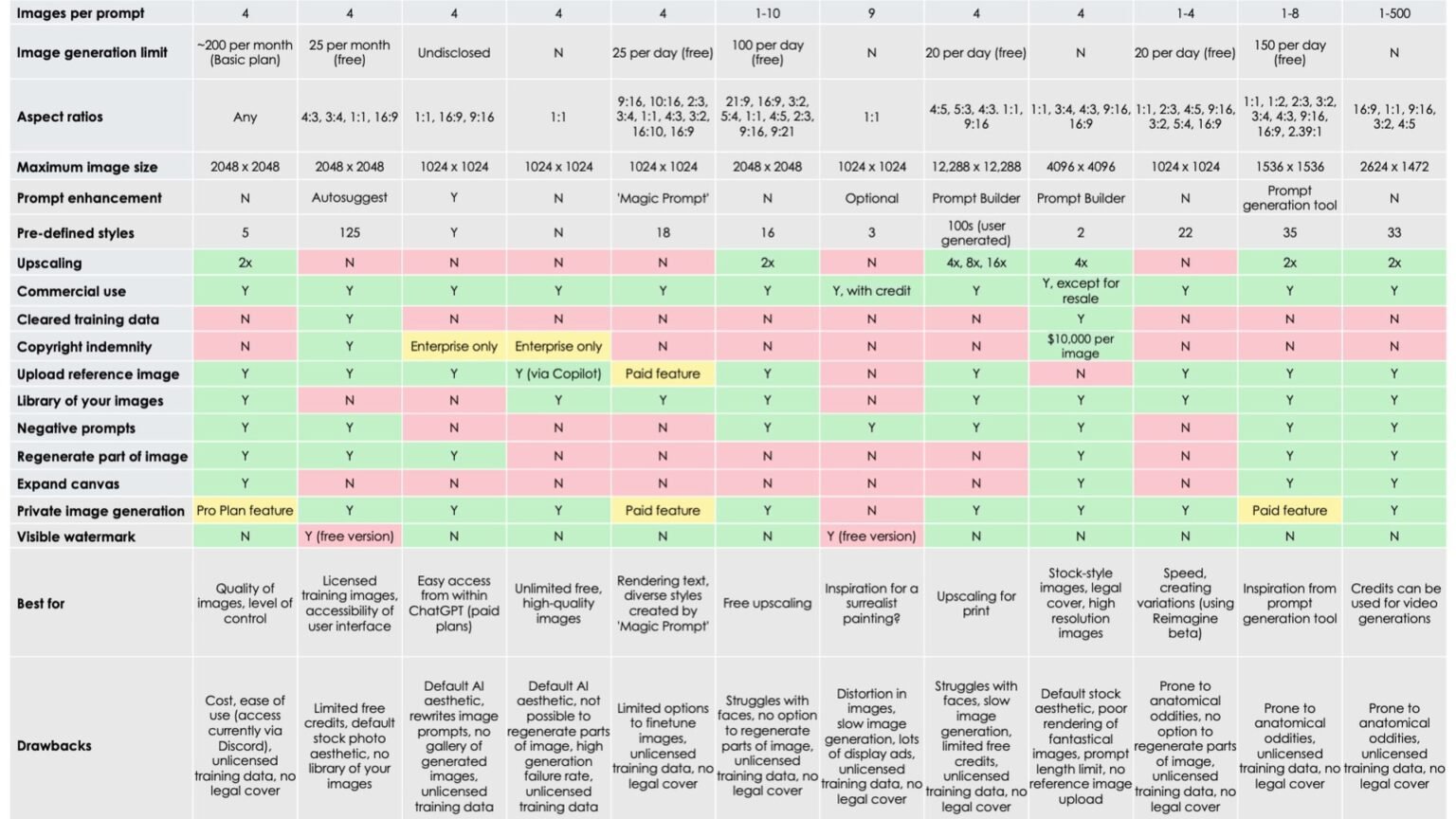

The 2026 image-model market has split into three camps: API-first systems for product teams, creator-first tools for visual experimentation, and more open model families for teams that want deployment flexibility. This comparison examines gpt-image-2, Imagen 3, Flux 1.1, Midjourney v7, and DALL·E 4 across the criteria that actually shape buying decisions: prompt adherence, photorealism, artistic range, access model, API availability, and content policy posture. Where official documentation is thin or unavailable, this article avoids unsupported claims rather than filling gaps with guesswork.
The market has matured, but the buying criteria got tougher
1024×1024
Imagen 3 sample resolution on Google Cloud docs
Shown in Vertex AI image generation examples
API + Azure
OpenAI deployment paths for image generation
OpenAI API and Azure OpenAI Service both document image generation access
Discord + Web
Midjourney’s primary product surfaces
Official site emphasizes both interfaces
An AI image generation comparison in 2026 is not just a beauty contest. Teams now care about whether a model follows long prompts reliably, whether it can render text and layout cleanly, whether it is available through an API, and whether its policy stack fits a commercial workflow. Those factors often matter more than isolated social-media examples.
The five names in this comparison do not all sit on equal footing. OpenAI offers image generation through its API and through Azure OpenAI Service, Google positions Imagen 3 through Vertex AI and consumer products, Black Forest Labs offers the Flux family with commercial pathways and open-weight options in the broader Flux ecosystem, and Midjourney remains a creator-first product with Discord and web workflows. DALL·E 4 is included because it is part of the topic, but OpenAI’s current official image-generation documentation centers on gpt-image-1 rather than a separately documented DALL·E 4 product page, so any comparison has to be careful about what is actually verifiable.
That leaves a practical editorial split. If you are a developer or product team, API availability and documentation carry heavy weight. If you are a designer or solo creator, Midjourney’s aesthetic output and community workflow may matter more. If you want deployment flexibility, Flux deserves attention even when its user experience depends on the platform you choose.

⚠️ Method note. This article uses official product pages and documentation where available. For DALL·E 4, OpenAI does not currently provide a clearly separate official product page comparable to the others, so the assessment is necessarily more limited.
gpt-image-2: best overall for product teams
OpenAI’s strongest documented position in image generation is its current API stack. The company’s Image Generation API emphasizes high-quality image generation, editing, inpainting, and text rendering, and Microsoft documents image generation support through Azure OpenAI Service. For teams building apps, that combination matters more than leaderboard chatter because it translates into procurement, deployment, and support pathways that enterprises can actually use.
On prompt adherence, OpenAI’s newer multimodal image stack has a clear advantage in how it is positioned: the official materials stress instruction following, editing, and generation from text prompts within a broader model platform. That usually makes it a better fit for productized workflows such as marketing asset generation, ecommerce imagery, and iterative editing than tools built primarily for one-shot artistic exploration.
Photorealism is strong, but the bigger story is controllability. OpenAI’s docs and examples focus on practical generation tasks rather than only stylized showcase images. That makes gpt-image-2 the safest recommendation for teams that need dependable output across many prompt types. Content policy is also comparatively legible because OpenAI publishes policy and safety material alongside its API platform. The tradeoff is that teams looking for maximal openness or a highly distinctive house aesthetic may find it less exciting than Flux or Midjourney.
gpt-image-2 ⭐ Editor’s Pick
Best for: Apps, enterprise workflows, editing-heavy pipelines, and teams that need API access
What works
Watch out for
Pros
Cons
📌 Verdict. If you need one image model that balances quality, prompt following, editing workflows, and enterprise-ready access, gpt-image-2 is the most practical pick.
“For commercial teams, the winner is often the model that is easiest to operationalize, not the one with the most viral outputs.”
Alatirok editorial assessment based on official product documentation
Imagen 3: best if you are already in Google Cloud
Google’s Vertex AI image generation documentation makes Imagen 3 easy to place in the market: it is a serious enterprise and developer option with Google Cloud integration, safety controls, and a documented path for generation and editing. For organizations already standardized on Vertex AI, that lowers adoption friction considerably.
Imagen 3 has been positioned by Google around high-quality image generation and strong text rendering. In practice, that makes it competitive in prompt adherence and useful for commercial design tasks where models often fail on signage, labels, or layout-sensitive prompts. Google also documents responsible AI controls and usage guidance in a way enterprise buyers expect.
The limitation is not image quality so much as ecosystem gravity. If your stack already runs on Google Cloud, Imagen 3 is a natural shortlist candidate. If not, OpenAI’s image stack currently feels more central in the broader AI application ecosystem, while Midjourney remains more culturally prominent among creators. Imagen 3 is the disciplined choice, not always the most talked-about one.
Imagen 3
Best for: Google Cloud customers, enterprise teams, and apps that need policy controls
What works
Watch out for
📌 Best fit. Imagen 3 makes the most sense for teams already using Vertex AI, Google Cloud IAM, and Google’s broader enterprise tooling.
Flux 1.1: best for flexibility and open-model workflows
Black Forest Labs quickly became one of the most important names in image generation because the Flux family offered a credible alternative to closed platforms. The company’s official site at Black Forest Labs and model references across partner ecosystems made Flux especially relevant for teams that care about portability, self-hosting pathways, or commercial flexibility.
In this comparison, Flux 1.1 stands out less for a single polished first-party app and more for what it enables. Open or more accessible model distribution changes procurement math, experimentation speed, and deployment architecture. That matters for startups building proprietary creative tools, for infrastructure teams that want control over inference, and for organizations uncomfortable with a fully closed vendor stack.
The tradeoff is consistency of experience. With OpenAI, Google, or Midjourney, the product surface is more unified. Flux often depends on which platform, host, or implementation you use. That can be a strength for advanced users and a weakness for teams that want a single vendor accountable for UX, moderation, and support. On pure strategic flexibility, though, Flux remains the most interesting option in the field.
Flux 1.1
Best for: Model builders, infrastructure teams, and startups that want deployment choice
What works
Watch out for
📌 Open-model angle. Flux is the standout choice for teams that value model portability and deployment flexibility over a tightly managed single-vendor experience.
Midjourney v7: best for distinctive aesthetics and creator workflows
Midjourney remains the most recognizable creator-first brand in AI image generation. Its official site, Midjourney, centers on image creation through its own product environment rather than an enterprise API narrative. That distinction matters. Midjourney is still where many artists, designers, and visual experimenters go when they want striking images fast and are comfortable working inside a community-shaped workflow.
On artistic style range, Midjourney is still unusually strong because its product identity has always leaned into visual taste, not just compliance with prompts. That can produce more compelling outputs for concept art, moodboards, and stylized campaigns. It can also make Midjourney feel less deterministic for teams that need exact prompt adherence or highly structured commercial outputs.
The biggest limitation in a head-to-head buying guide is access model. Midjourney is easier to recommend to creators than to software teams building image generation into a product. Its Discord and web interfaces are real strengths for exploration, but they are not substitutes for the kind of API-first integration path that OpenAI and Google document. If your goal is inspiration and aesthetics, Midjourney is still elite. If your goal is product infrastructure, it is harder to make the lead recommendation.
Midjourney v7
Best for: Designers, artists, marketers, and solo creators exploring visual directions
What works
Watch out for
📌 Creative verdict. Midjourney v7 is the best pick in this group for users who prioritize visual style and exploratory creation over API-centric deployment.
DALL·E 4: too unclear to recommend over OpenAI’s newer image stack
DALL·E remains one of the most influential brands in AI image generation, but a 2026 buyer needs to separate brand recognition from current product clarity. OpenAI’s official public documentation for image generation points readers to the Image Generation API and model families used there, rather than to a clearly separate, fully documented DALL·E 4 product page with the same level of detail as the other contenders in this comparison.
That creates a practical problem for evaluation. If a buyer is choosing an OpenAI image model today, the official path is to assess OpenAI’s current image-generation offering, not to anchor on the older DALL·E naming convention. Without a dedicated official DALL·E 4 page covering access, capabilities, and pricing in a way readers can verify directly, it would be misleading to score it as if it were a fully separate, transparently documented product.
So the verdict here is simple: treat DALL·E 4 as a legacy brand reference unless and until OpenAI publishes a clearer standalone product position. If you want OpenAI for image generation, choose the current documented image stack instead.
DALL·E 4
Best for: Readers researching OpenAI’s image lineage rather than selecting a current standalone product
What works
Watch out for
⚠️ Editorial caution. There is not enough clearly separated official product documentation to recommend DALL·E 4 over OpenAI’s current documented image-generation API offering.
Which should you pick?
Best overall: gpt-image-2
The short answer is that there is no single winner for every buyer. gpt-image-2 is the best overall recommendation because it combines strong prompt adherence, editing workflows, API availability, and credible enterprise deployment paths. Imagen 3 is the best alternative for organizations already committed to Google Cloud. Flux 1.1 is the most strategically flexible choice for teams that care about openness and deployment control. Midjourney v7 remains the best creator-first option when distinctive aesthetics matter more than API integration.
Pricing and access are where buyers should do the last-mile diligence. Official pricing pages and plan structures change frequently, and some vendors separate consumer subscriptions from API billing. The more durable decision criteria are access model, governance fit, and whether your team needs a polished managed product or a model you can shape around your own stack.
| Use case | Best choice | Why | Runner-up |
|---|---|---|---|
| Build image generation into an app | gpt-image-2 | Best documented API-first path with OpenAI and Azure support | Imagen 3 |
| Enterprise team already on Google Cloud | Imagen 3 | Strong fit with Vertex AI and Google Cloud governance | gpt-image-2 |
| Need deployment flexibility or open-model workflows | Flux 1.1 | Best strategic option for portability and custom infrastructure | gpt-image-2 |
| Concept art and stylized creative exploration | Midjourney v7 | Most creator-centric workflow and strong aesthetic reputation | Flux 1.1 |
| Need the safest all-around recommendation | gpt-image-2 | Best balance of quality, control, access, and operational readiness | Imagen 3 |
Frequently asked questions
For most product teams, gpt-image-2 is the safest choice because OpenAI provides a documented Image Generation API, and Microsoft documents image generation support in Azure OpenAI Service. If your organization is already standardized on Google Cloud, Imagen 3 on Vertex AI is the clearest alternative.
It depends on the job. Midjourney is easier to recommend for creators who want visually distinctive outputs and an exploratory workflow. For teams that need app integration, governance, or enterprise deployment, official docs from OpenAI and Google Cloud make those platforms more practical.
Flux 1.1 stands out for flexibility and the broader appeal of open-model workflows. Black Forest Labs positions itself as a model company rather than only a closed end-user app, which makes it attractive for teams that want more control over deployment and experimentation. Start with the official Black Forest Labs site when evaluating the Flux family.
Only cautiously. OpenAI’s current official public materials for image generation point to the Image Generation API rather than a clearly separate standalone DALL·E 4 product page. For a current buying decision, it is more reliable to assess OpenAI’s documented image-generation offering directly.
Primary sources
- OpenAI Image Generation API — OpenAI
- Azure OpenAI Service image generation documentation — Microsoft Learn
- Google Cloud Vertex AI image generation overview — Google Cloud
- Black Forest Labs official site — Black Forest Labs
- Midjourney official site — Midjourney
Last updated: May 20, 2026. Related: Agent Infrastructure.