
We graded eight named products on a four-level autonomy ladder across AP, reconciliation, month-end close, and historical catch-up, with an honest column for where a human still signs off.
Which are the best AI accounting agents 2026 buyers should actually trust to run unattended?
The best AI accounting agents 2026 has produced fall into two very different buckets, and the software directories ranking them refuse to draw the line: a handful of products genuinely run unattended through month-end close, while most of the field still needs a human to sign off on nearly every judgment call. Our top pick for true unattended operation is Pilot’s AI Accountant, which on February 4, 2026 became the first to claim onboarding-through-close with zero human intervention. For embedded, ledger-native autonomy the winner is Digits; for accounts payable specifically it’s Vic.ai.
The problem with every roundup from aimultiple, Slashdot, FitGap, DesignRush, and ClickUp is that they lump a $20 invoicing app in with a system that closes your books, then score them on the same star scale. That tells a finance or SMB buyer nothing about the only question that matters: what happens when nobody is watching the agent at 2am?
So we built an autonomy ladder and graded each named product per workflow. Below you’ll find the ranked eight, a full L1-to-L4 matrix across AP, reconciliation, month-end close, and historical catch-up, and — the column the directories never publish — exactly where a human still has to sign off.
The autonomy ladder: L1 categorize to L4 full close
An accounting agent is only as ‘autonomous’ as the workflow it can finish without a human touching it, so we grade on four levels rather than a single star rating. L1 means the agent suggests or categorizes and a human confirms. L2 means it executes routine work but pauses on anything ambiguous. L3 means it runs the workflow end-to-end and only escalates material or low-confidence items. L4 means it completes the entire workflow unattended, including edge cases, with logging instead of pre-approval.
This is the wedge the evergreen directories miss. ‘AI-powered’ can mean L1 or L4, and the gap between them is the gap between a tool that saves you ten minutes and one that replaces a workflow. As one 2026 industry guide put it, the spectrum runs from single-task ‘taskers’ up to multi-agent ‘orchestrators’ — and almost everyone marketing ‘autonomous’ lives in the middle.
Keep one rule in mind as you read the scores: even the L4 systems keep a hard approval gate on material-impact decisions. Pilot‘s own framing is that ‘only humans can make accountable decisions.’ L4 is about who does the work, not who is legally accountable for it.
L1 = suggest, human confirms. L2 = executes routine, pauses on ambiguity. L3 = end-to-end, escalates material/low-confidence items. L4 = completes the workflow unattended, logs everything, no pre-approval. ‘Human sign-off’ in our table flags where the ladder still tops out below L4.
The autonomy-ladder matrix: 8 products scored per workflow
Across the four core workflows, only Pilot and Digits reach L4 on month-end close, while AP is the most-solved workflow industry-wide — Vic.ai, Booke, and Digits all hit L4 there. Historical catch-up (closing prior-period books) remains the hardest, and is where most products drop a level. Scores below reflect each vendor’s documented capability as of mid-2026, not marketing claims.
Read the ‘human sign-off’ column as the honest answer to ‘can AI do bookkeeping without a human?’ The answer in 2026 is: for AP and reconciliation, increasingly yes; for the full close and for catch-up, only Pilot and Digits credibly say yes, and even they escalate material items.
| Product | AP | Reconciliation | Month-end close | Historical catch-up | Human sign-off still required? |
|---|---|---|---|---|---|
| Pilot AI Accountant | L4 | L4 | L4 | L4 | Material-impact items only (escalated) |
| Digits AGL | L4 | L4 | L4 | L3 | Low-confidence GL entries |
| Vic.ai | L4 | L3 | L2 | L1 | Approvals routing, non-AP work |
| Zeni | L3 | L4 | L3 | L2 | Tricky items flagged for review |
| Booke AI | L3 | L4 | L2 | L2 | ~5% of transactions + reconciliation review |
| Puzzle | L3 | L4 | L3 | L2 | Founder confirms close; complex entries |
| Docyt | L3 | L3 | L2 | L2 | Location-level review, accruals |
| Botkeeper | L2 | L2 | L1 | L2 | CPA reviews categorization & journal entries |
Best AI accounting agents 2026, ranked 1-8
Here is the ranked list, weighted toward how high each product climbs the autonomy ladder on the workflows that cost finance teams the most time. The verdict and pros/cons for each pick tell you who it’s actually for.
1. Pilot AI Accountant
Best for: SMBs and startups wanting a fully managed, unattended close
What works
Watch out for
2. Digits Autonomous General Ledger
Best for: Firms and SMBs wanting ledger-native, real-time financials
What works
Watch out for
3. Vic.ai
Best for: Mid-market AP teams drowning in invoices
What works
Watch out for
4. Zeni
Best for: Venture-backed startups wanting software plus a human safety net
What works
Watch out for
5. Booke AI
Best for: Bookkeeping firms scaling many small clients cheaply
What works
Watch out for
6. Puzzle
Best for: Startups wanting to own the software at half the managed-service cost
What works
Watch out for
7. Docyt
Best for: Restaurants, retail, and hospitality with many locations
What works
Watch out for
8. Botkeeper
Best for: CPA firms scaling without sacrificing review control
What works
Watch out for
AI accountant Pilot vs Digits: which autonomous general ledger agent wins?
Pilot vs Digits comes down to architecture: Pilot is a fully managed AI Accountant that runs the close for you as a service, while Digits is an autonomous general ledger you operate, with autonomy embedded in the ledger itself. If you want to hand over the entire function and get financial statements back, Pilot is the cleaner answer. If you want to own a real-time, AI-native ledger and keep your own light-touch oversight, Digits is the better fit.
Pilot’s February 2026 launch is the more aggressive autonomy claim — CEO Jessica McKellar described telling the agent to ‘go onboard this customer,’ after which it completes the monthly close within an hour, escalating only material-impact decisions. Digits’ edge is provenance and scale: dozens of in-house models trained on $825B+ in small-business transactions, already powering 2,000+ month-end closes, with dedicated agents for bank reconciliation.
For most SMBs the deciding factor is operating model, not feature lists. Pilot abstracts the ledger away; Digits puts a better ledger in your hands. Both keep a human gate on material judgments, which is why neither is a magic black box — and why both belong above the assist-only tools the directories rank alongside them.
“The honest test of an autonomous accounting agent isn’t whether it uses AI. It’s what happens to your close at 2am when nobody is watching.”
Alatirok editorial
How much faster is the AI agent month-end close, really?
-75%
High-end close compression
12-day close cut to 3 days after agent reconciliation
~55%
Average close-time reduction
Across industries, ERPs, and entity structures
$825B+
Transactions training Digits’ AGL
Across 2,000+ powered month-end closes
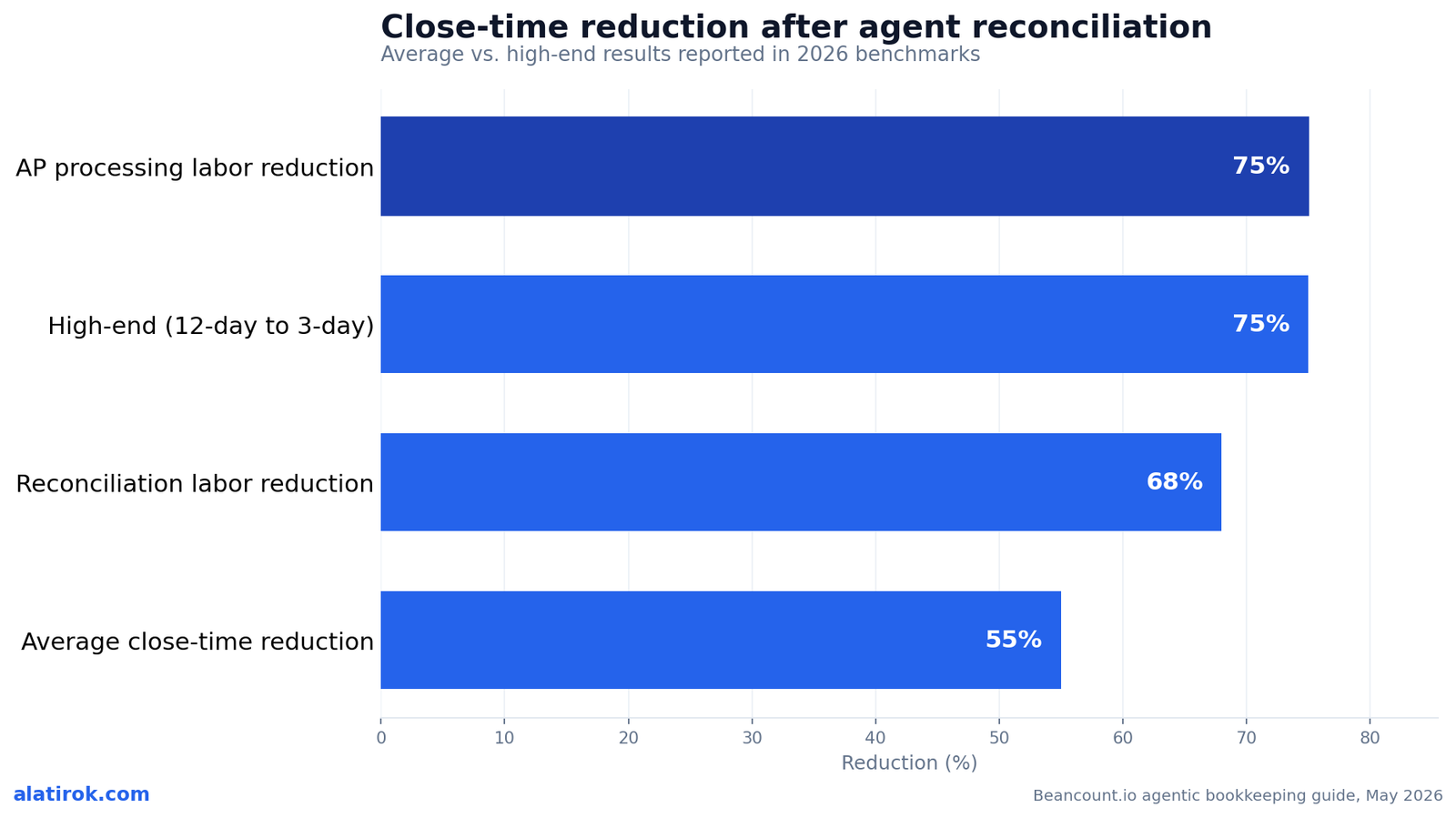
Finance teams deploying agent-driven reconciliation report roughly a 55% faster monthly close on average, with high-end cases compressing a 12-day close to 3 days — a 75% reduction. Those figures are consistent across 2026 benchmarks: AI deployment cuts close time 40-55% regardless of industry, ERP, or entity structure, with labor reduction of 60-75% on reconciliation specifically.
The mechanism is unglamorous and that’s the point. Agents match GL balances against bank statements, subledger data, and third-party confirmations automatically, saving 1.5-2.5 days per close cycle on reconciliation alone. On accounts payable, mature implementations report 70-80% reductions in processing labor. The close gets faster because the work that used to pile up at month-end is now done continuously.
Can AI do bookkeeping without a human in 2026 — and where does a human still sign off?
The autonomy boundary, not the brand, is what you’re buying
In 2026, AI can do most bookkeeping without a human for AP and reconciliation, and — with Pilot and Digits — can run a full month-end close unattended, but every credible system still escalates material-impact and low-confidence decisions to a person. The line isn’t ‘AI vs. human,’ it’s ‘routine execution vs. accountable judgment.’
Concretely, here’s where the human sign-off still lives across the field: material journal entries and accruals, revenue-recognition edge cases, anything flagged low-confidence by the model, and final accountability for filed financials. Pilot escalates material items; Zeni and Puzzle route ‘tricky’ entries; Botkeeper keeps a CPA on categorization by design. The 2026 best-practice consensus is hard approval gates at judgment-critical steps and complete audit trails — not blind trust.
So the buyer’s real decision is how high to set the autonomy boundary. Start by letting an agent run L4 on AP, where the field is most mature. Keep a human on the close until you trust the escalation policy. Then expand. The agents on this list are good enough that the constraint is now governance and trust, not capability.
Pros
Cons
Builder’s take
I build agent orchestration for a living at Cyntr, so I read every accounting vendor’s word choice with suspicion. ‘Autonomous’ is the most abused word in this category right now.
- The honest test isn’t ‘does it use AI’ — it’s ‘what happens at 2am when nobody is watching.’ An agent that pauses on every ambiguous transaction is a fancy suggestion engine, not an autonomous one.
- Watch the escalation policy, not the marketing. Pilot, Digits, and Zeni all auto-approve only what they’re confident in and route the rest to a human. That gate is a feature, not a failure — but it’s the difference between L3 and L4.
- Training data is the real moat here. Digits’ $825B in transactions and Vic.ai’s 1B+ invoices are why their categorization holds up; a thin GPT wrapper over your bank feed will not.
- For SMBs, the smart move in 2026 is to deploy an agent on the one workflow it’s genuinely L4-ready for (usually AP), keep a human on the close, and expand the autonomy boundary quarter by quarter.
Frequently asked questions
Pilot’s AI Accountant (launched Feb 4, 2026) is the only product claiming onboarding-through-close with zero human intervention. Digits’ Autonomous General Ledger reaches L4 autonomy with autonomy embedded in the ledger itself, and Vic.ai leads accounts payable with 90%+ straight-through processing. These three are the only picks that credibly run a core workflow unattended; most other tools still need a human to confirm.
Pilot is a fully managed AI Accountant that runs your close as a service and hands back financial statements. Digits is an autonomous general ledger you operate yourself, trained on $825B+ in transactions across 2,000+ closes. Choose Pilot to outsource the whole function; choose Digits to own a real-time, AI-native ledger with light-touch oversight. Both escalate material decisions to a human.
Mostly yes for accounts payable and reconciliation, and — with Pilot and Digits — for the full month-end close. But every credible system still escalates material journal entries, accruals, revenue-recognition edge cases, and low-confidence items to a person. Final accountability for filed financials remains human. The line is routine execution (AI) versus accountable judgment (human).
Finance teams report roughly a 55% faster monthly close on average after deploying agent-driven reconciliation, with high-end cases cutting a 12-day close to 3 days (a 75% reduction). Reconciliation labor drops 60-75% and AP processing labor 70-80%, mainly because work that used to pile up at month-end is now handled continuously.
Booke AI starts at $20/client/month and claims ~95% autonomous categorization, logging into QuickBooks Online and Xero each morning to process the bank feed — though G2 reviews are mixed (4.3/5). Puzzle, around $200/month for its Plus tier, runs Autopilot by default and is software you own rather than a managed service, making it strong value for venture-backed startups.
Vic.ai is the category leader for autonomous accounts payable. Trained on over 1 billion invoices with 97-99% AI accuracy, it handles extraction, GL coding, and approvals touch-free, reaching 90%+ straight-through processing at maturity and ~78% touch-free posting after a four-week learning period. Digits and Booke also reach high AP autonomy, but Vic.ai is the most proven AP-specific agent.
Primary sources
- Pilot Unveils AI Accountant — Pilot
- Pilot launches fully autonomous AI bookkeeper — Accounting Today
- Pilot Rolls Out Fully Autonomous AI Accountant — CPA Practice Advisor
- Digits Launches First AI Agents for Accounting Workflows — GlobeNewswire
- Digits announces Autonomous General Ledger — Accounting Today
- How Vic.ai AP Autonomy Works — Vic.ai
- Zeni Launches AI Accounting Agent — PR Newswire
- Agentic AI in Bookkeeping 2026 — Beancount.io
- Booke.ai Review (2026) — AccountingAITools
Last updated: June 6, 2026. Related: Products.