
A buyer’s decision matrix for runtime agent governance — keyed to the OWASP Agentic Top 10 — that separates real policy enforcement from model-risk dashboards before the EU AI Act high-risk gate.
What are the best AI agent governance platforms in 2026?
The best AI agent governance platforms 2026 are the ones that enforce policy in the live request path — Microsoft’s open-source Agent Governance Toolkit, AWS Bedrock AgentCore Policy, ServiceNow AI Control Tower, and Salesforce Agent Fabric lead because they can block an agent action before it executes, not just describe it afterward. Everything else on most roundups — watsonx.governance, Credo AI, and the model-card crowd — is excellent at model risk but does not sit between your agent and the tool it is about to call.
That distinction is the whole reason this article exists. Incumbent “best AI governance” lists blur two layers that buyers must keep separate. Model governance (also called ML governance) answers “is this model fair, documented, and approved?” Agent governance answers “can this autonomous agent take this action, right now, with this identity, against this resource?” The first is a binder. The second is a bouncer.
We compare eight platforms on the axes that actually decide a procurement: runtime enforcement (yes/no), enforcement latency, policy language, agent-identity model, self-host versus SaaS, OWASP Agentic Top 10 coverage, and EU AI Act mapping. The spine of the comparison is the OWASP Top 10 for Agentic Applications, published December 2025 — the first vendor-neutral rubric that names the risks (goal hijacking, tool misuse, identity abuse, rogue agents) these platforms claim to cover.
Timing matters. The EU AI Act’s high-risk obligations create a hard 2026 procurement gate, and most enterprises cannot yet answer real-time governance questions for every agent they run. If you are scoping the buy, read this as a decision matrix, not a popularity contest.
We only ranked platforms that target the agent layer specifically. We scored each on whether it does runtime policy enforcement (decision in the request path), its policy language, its agent-identity model, self-host availability, the count of OWASP Agentic Top 10 risks it addresses, and whether it ships an explicit EU AI Act mapping. Pure model-risk and pure observability tools are discussed as a boundary, not ranked as agent governance.
AI agent governance vs observability vs model risk: the boundary buyers miss
Agent governance enforces — it sits in the request path and can permit, deny, or require approval for an action before it happens. Observability records — it ingests traces and tells you what an agent did. Model risk assesses — it documents and scores a model’s fairness, robustness, and approval status. Confusing the three is the single most expensive mistake in this procurement.
Picture the three as concentric rings around a running agent. The model-risk ring (watsonx.governance, Credo AI’s policy packs, model cards) wraps the model artifact: bias testing, documentation, sign-off, regulatory mapping. The observability ring (Traceloop, OpenTelemetry traces, eval harnesses) wraps execution: latency, hallucination rate, reasoning traces, cost. The governance ring sits inside both, on the wire between the agent’s decision and the world — and it is the only ring that can stop a prompt-injected agent from wiring funds.
This is exactly the line our agent control plane explainer draws between a control plane (the orchestration brain that routes and coordinates agents) and a governance platform (the enforcement layer that constrains them). A control plane decides which agent runs; a governance platform decides what that agent is allowed to do. ServiceNow and Salesforce bundle both; AWS and Microsoft’s toolkit specialize in the enforcement layer; IBM and Credo AI lean to the assessment side.
Why this matters for compliance: EU AI Act Article 26 deployer obligations demand human oversight, automated logs retained for at least six months, and the ability to intervene. An observability dashboard satisfies the logging half. Only a governance layer with a kill switch and approval workflows satisfies the oversight-and-intervention half. Buy for the half you are missing.
“A control plane decides which agent runs. A governance platform decides what that agent is allowed to do. Most ‘AI governance’ roundups never draw that line.”
Alatirok analysis
| Layer | Acts when | Can it stop an action? | Representative tools |
|---|---|---|---|
| Model risk / ML governance | Before deployment, periodically | No — assesses the model artifact | watsonx.governance, Credo AI policy packs, model cards |
| Observability / tracing | After the action (or in parallel) | No — records and alerts | Traceloop, OpenTelemetry, eval harnesses |
| Agent governance (this article) | In the request path, before the action | Yes — permit / deny / require approval | MS Agent Governance Toolkit, AgentCore Policy, AI Control Tower, Agent Fabric |
AI agent governance tools compared: the 8-platform decision matrix
Across the eight, only four do true runtime enforcement with a per-agent identity: Microsoft’s Agent Governance Toolkit, AWS Bedrock AgentCore Policy, ServiceNow AI Control Tower, and Salesforce Agent Fabric. IBM watsonx.governance and Credo AI are assessment-and-monitoring layers; Bifrost is an enforcement-capable gateway with guardrails; Okta’s agent identity covers the identity axis only. The table below is the matrix to take into a vendor call.
Read the table by column, not by row. If your hard requirement is self-host plus a policy language your team already runs, the open-source toolkit and AgentCore Policy (Cedar) jump out. If your requirement is a single pane that discovers shadow agents across SaaS and can kill them, ServiceNow leads. If you live in the Salesforce estate, Agent Fabric’s Trusted Agent Identity and on-prem Runtime Fabric are the path of least resistance.
One honest caveat on the latency column: the figures measure different things. Microsoft’s <0.1ms p99 is the in-process policy-engine decision; Bifrost's ~11µs at 5,000 req/s is gateway transport overhead, not a policy verdict; ServiceNow and Salesforce do not publish a comparable per-decision number because their enforcement is workflow- and gateway-mediated. Treat the column as a directional signal of architecture (inline library vs. network hop), not a benchmark you can rank on alone.
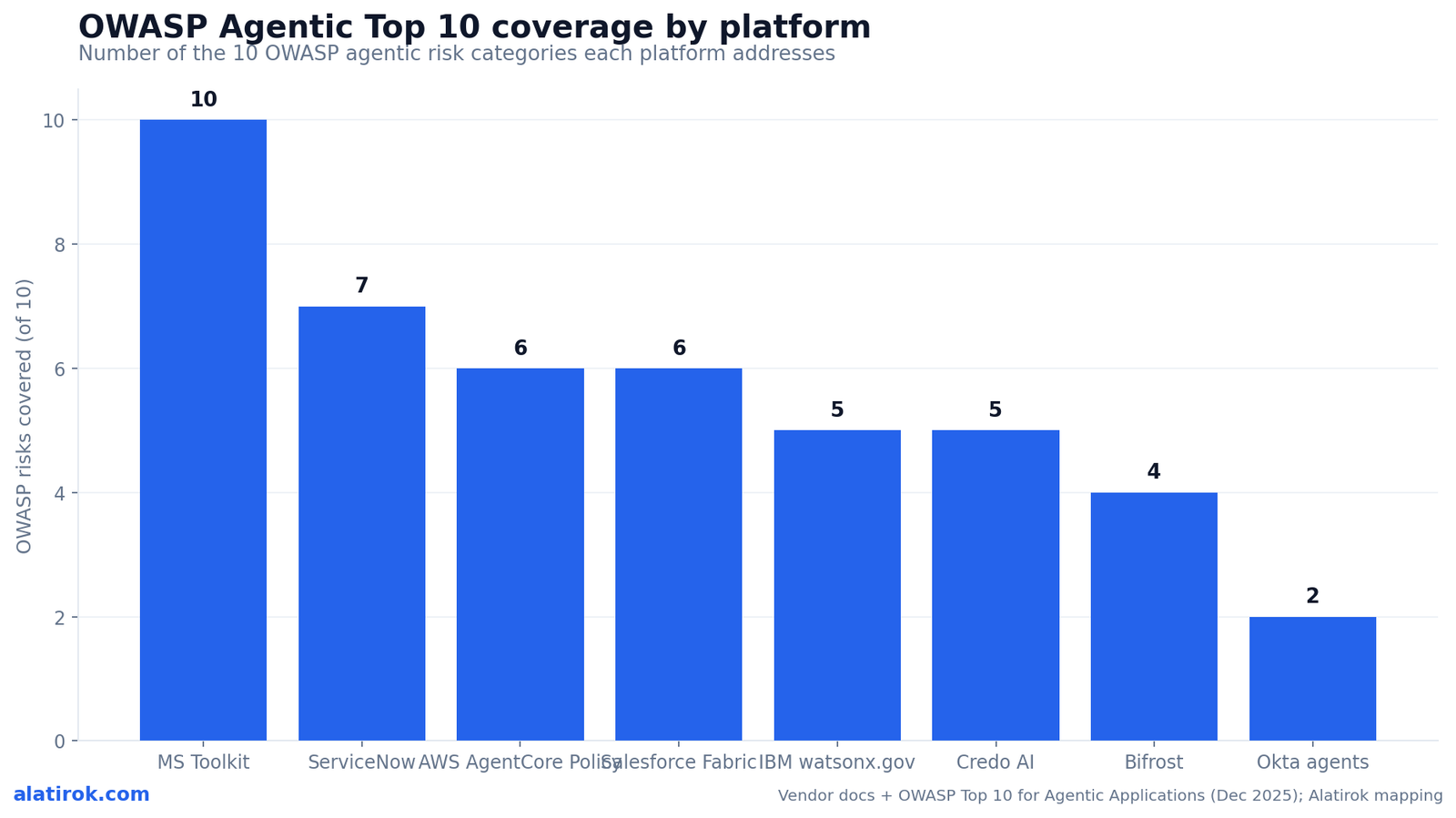
| Platform | Runtime enforcement | Enforcement latency | Policy language | Agent identity | Self-host | OWASP Agentic /10 | EU AI Act mapping |
|---|---|---|---|---|---|---|---|
| MS Agent Governance Toolkit | Yes | <0.1ms p99 (in-proc) | YAML / Rego / Cedar | Ed25519 DID | Yes (MIT) | 10/10 | Yes |
| AWS Bedrock AgentCore Policy | Yes | Inline at gateway | Cedar (+ NL prompts) | IAM / OAuth principal | No (VPC) | ~6/10 | Partial |
| ServiceNow AI Control Tower | Yes (kill switch + workflows) | Workflow-mediated | Vendor rules + risk frameworks | ServiceNow agent ID | No (SaaS) | ~7/10 | Yes (NIST + EU AI Act packs) |
| Salesforce Agent Fabric | Yes (guardrails + approvals) | Gateway / Runtime Fabric | Vendor guardrails | Trusted Agent Identity | Partial (Runtime Fabric) | ~6/10 | Partial |
| IBM watsonx.governance | No (assess + route/block) | N/A (eval-time) | Policy rules + benchmarks | Governed-asset registry | Hybrid | ~5/10 (assessment) | Yes |
| Credo AI | No (monitor + escalate) | N/A (trace eval) | Policy packs (no enforce DSL) | Agent registry / cards | SaaS / VPC | ~5/10 (assessment) | Yes (EU AI Act, NIST, ISO 42001) |
| Bifrost (Maxim AI) | Partial (guardrails at gateway) | ~11µs/req @ 5k RPS | Config + guardrail rules | Virtual keys / SSO | Yes (Apache 2.0) | ~4/10 | No |
| Okta for AI Agents | Identity only | Auth-time | Auth policies | Non-human identity | No (SaaS) | ~2/10 (identity) | Partial |
The open-source entrant nobody benchmarked: Microsoft Agent Governance Toolkit
The Microsoft Agent Governance Toolkit, released April 2, 2026 under an MIT license, is the first open-source framework to claim coverage of all 10 OWASP Agentic risks with deterministic policy enforcement at sub-0.1ms p99 — and it is the one most incumbent roundups left out entirely. It is not a Microsoft-cloud lock-in play: it ships SDKs for Python, TypeScript, .NET, Rust, and Go, and hooks into LangChain/LangGraph, CrewAI, Google ADK, OpenAI Agents SDK, AutoGen, and the Microsoft Agent Framework via their native extension points.
The toolkit is seven components, but the load-bearing three are Agent OS (a stateless policy engine that intercepts every action before execution and speaks YAML, OPA Rego, and Cedar), Agent Mesh (Ed25519 decentralized identifiers plus an Inter-Agent Trust Protocol and a 0-1000 behavioral trust score across five tiers), and Agent Runtime (CPU-style privilege rings, saga orchestration for multi-step transactions, and an emergency kill switch). Agent Compliance closes the loop with EU AI Act, HIPAA, and SOC 2 mappings and OWASP evidence collection.
The architectural claim worth underlining is that blocked actions are made “structurally impossible” rather than probabilistic — policy is evaluated at the middleware layer before output reaches an external system. That is the opposite of a guardrail that asks a model nicely. As of the v4.0.0 release on June 1, 2026, the project sits at roughly 3.9k GitHub stars and remains in public preview with Microsoft-signed releases, with a stated aspiration to move into a neutral foundation home.
For buyers, the toolkit reframes the build-versus-buy question. You can self-host a 10/10-coverage enforcement layer for free and reuse Rego or Cedar policies your platform team already trusts — the same Rego patterns we used in our OPA/Rego tool-call authorization tutorial. The trade is operational: you run it, you patch it, you wire the dashboards. SaaS incumbents sell you the operations.
If you already run OPA or Cedar in your platform, the Microsoft Agent Governance Toolkit lets you extend those exact policies to agent actions — self-hosted, MIT-licensed, 10/10 OWASP coverage, sub-0.Runtime agent governance: how enforcement actually works (and where AgentCore, ServiceNow, and Salesforce sit)
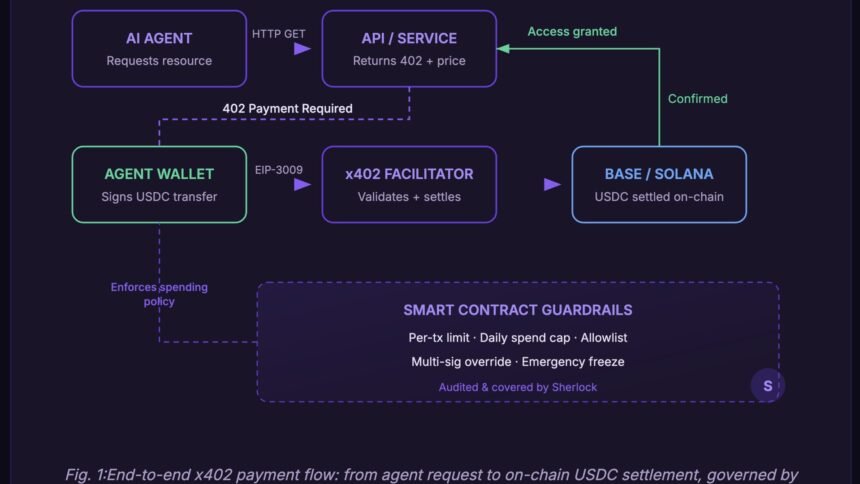
Runtime agent governance means a policy decision point intercepts each agent action — a tool call, an MCP request, an egress — evaluates it against policy and identity, and returns permit, deny, or require-approval before the action runs. The enforcement point is a gateway, a middleware hook, or a sidecar; the decision is made in microseconds to single-digit milliseconds. This is the mechanism that survives a prompt injection, because the verdict does not depend on the agent behaving.
AWS Bedrock AgentCore Policy, which reached general availability in March 2026, is the cleanest cloud example. Every tool call routes through an AgentCore Gateway; Policy evaluates a Cedar rule against the principal (an OAuth user or IAM entity) and the tool’s input parameters before invocation. AWS’s own framing is precise: Guardrails control what the model says, IAM controls which tools exist, and Policy controls what you can ask a tool to do — “regardless of how the agent is prompted or manipulated, and regardless of what bugs exist in the agent code itself.” You can author rules in Cedar or via natural-language prompts.
ServiceNow AI Control Tower governs from a different angle: discovery first. It inventories every agent, model, dataset, and prompt across the enterprise — including shadow agents — then layers observe (built on the Traceloop acquisition for runtime reasoning traces), govern (risk frameworks aligned to NIST and the EU AI Act), secure, and measure. Its enforcement teeth are agent kill switches and approval workflows; its Action Fabric lets any MCP-connected agent (Claude, Copilot, homegrown) execute governed enterprise actions headlessly. GA is expected August 2026.
Salesforce Agent Fabric stakes out the multi-vendor control-plane position. Its Trusted Agent Identity requires mobile approval for high-stakes actions (financial transactions, legal review) and writes an auditable trail for every privileged operation; its Runtime Fabric option runs guardrails on your own infrastructure for private-cloud and on-prem workloads. Agent Broker for deterministic orchestration reached GA in June 2026. The open question analysts keep raising is whether the enforcement is as deterministic in practice as the determinism branding promises.
Pros
Cons
Where model-risk tools fit: IBM watsonx.governance, Credo AI, and the assessment layer
IBM watsonx.governance and Credo AI are best-in-class at model and assessment governance, and both have added agent monitoring — but neither is primarily a runtime enforcement layer, and buying them expecting a kill switch is the category error this article is built to prevent. They belong in your stack; they belong in the outer ring.
IBM’s 2026 updates added agent monitoring and insights that track decisions, behaviors, and performance in production and trigger alerts when thresholds break, plus decision assurance that can block, route, or fall back when output quality drops, and Guardium AI Security posture surfaced directly in the governance console. watsonx Orchestrate is evolving into an agentic control plane in private preview. The strength is GRC depth across hybrid, multi-vendor estates and a genuine EU AI Act mapping; the limit is that enforcement is eval-time and routing-based, not in-the-request-path for arbitrary external tool calls.
Credo AI — ranked No. 6 in Applied AI on Fast Company’s 2026 Most Innovative Companies list — is purpose-built for governance workflow: an agent registry with agent cards (purpose, tools, data sources, guardrails), discovery, risk assessment, deployment gates, runtime monitoring of traces, and pre-built policy packs for the EU AI Act, NIST AI RMF, ISO 42001, and SOC 2. It detects policy violations and drift and escalates to a human. What it does not do is sit on the wire and deny the action itself; it is the system of record for whether the action should have been allowed.
The pattern is consistent: assessment tools cluster at 4-5 on OWASP coverage because they can document risks like memory poisoning or rogue agents that they cannot structurally prevent. Pair one of these with a runtime enforcement layer and you have both the binder and the bouncer. Buy only one and you have a compliance gap that the EU AI Act deadline will expose.
watsonx.governance and Credo AI are not ‘losing’ to Microsoft or AWS — they answer a different question. If your gap is documentation, fairness testing, deployment sign-off, and regulator-ready evidence, they are the right buy. If your gap is stopping a live agent from misusing a tool, they are not. Most enterprises in 2026 need both layers, bought deliberately, not one tool mislabeled as the other.
Agent governance and the EU AI Act: why this is a 2026 procurement gate
10/10
OWASP Agentic risks
covered by the Microsoft toolkit — the only entrant claiming full coverage
<0.1ms
p99 enforcement
in-process policy decision in Agent OS
6 months
log retention
minimum automated-log retention under EU AI Act Article 26 for deployers
Dec 2025
OWASP Agentic Top 10
first vendor-neutral agentic security benchmark, the rubric for this comparison
The EU AI Act makes agent governance a 2026 budget line because high-risk obligations are arriving, deployers must prove human oversight and keep automated logs for at least six months, and you cannot demonstrate oversight over an autonomous agent you cannot identify, log, or stop. A governance layer is how you turn a regulatory clause into operational reality.
Get the dates right, because the omnibus muddied them. Article 26 deployer duties — informing affected people, human oversight, log retention, and Fundamental Rights Impact Assessments where required — attach to high-risk systems. Following the political agreement of 7 May 2026, the application of several Annex III high-risk areas (biometrics, critical infrastructure, education, employment, migration, border control) was pushed to 2 December 2027, while other high-risk timelines around 2 August 2026 and 2 August 2027 remain in play depending on the system. The practical takeaway is unchanged: the readiness work — identity, logging, oversight, kill switches — has to be procured and deployed in 2026 to be operational before any of these dates.
This is where the OWASP Agentic Top 10 and the EU AI Act converge into one checklist. Identity & Privilege Abuse (ASI03) maps to your deployer duty to attribute actions; Rogue Agents (ASI10) maps to your duty to intervene; the logging obligation maps to the audit-trail requirements we detailed in our agent audit-log requirements guide. A platform that gives every agent a verifiable identity, an immutable action log, and a kill switch is, not coincidentally, a platform that helps you pass an EU AI Act audit.
So the buying sequence writes itself. Inventory your agents (ServiceNow and Credo AI both start here). Give each one a real identity (Entra Agent ID, an Ed25519 DID, a SPIFFE credential, or a Trusted Agent Identity — see our non-human identity tooling roundup). Put an enforcement point in the request path with policy you can defend in Rego or Cedar. Wire the logs and the kill switch to a human. Map the whole thing to Article 26. That is the gate, and 2026 is when you walk through it.
Verdict: which AI agent governance platform should you buy in 2026?
Best overall: Microsoft Agent Governance Toolkit (paired with a model-risk system of record)
For most enterprises in 2026, the answer is a pair: an enforcement layer plus an assessment layer. If you want one runtime engine that covers all 10 OWASP risks, can self-host, and reuses your Rego/Cedar policies, the Microsoft Agent Governance Toolkit is the strongest single pick — and it is free. Bolt a governance system of record (Credo AI or watsonx.governance) on top for the EU AI Act paperwork.
The cloud-native picks sort cleanly by where your agents already live. All-in on AWS: Bedrock AgentCore Policy with Cedar is the native, GA, in-the-gateway answer. Running a sprawling multi-SaaS estate with shadow agents you cannot even see: ServiceNow AI Control Tower’s discover-observe-govern-secure loop plus kill switches is the control room. Deep in the Salesforce estate with high-stakes human-approval needs: Agent Fabric’s Trusted Agent Identity and on-prem Runtime Fabric. Need a fast, open gateway as the chokepoint and you will write guardrails yourself: Bifrost.
What none of these is: a substitute for the others. The mistake we keep watching buyers make is purchasing a model-risk dashboard, checking the “AI governance” box, and discovering at audit time that nothing was ever in the request path. Separate the rings, buy for the ring you are missing, and map every choice back to the OWASP Agentic Top 10 and EU AI Act Article 26.
Builder’s take
I build agent systems for a living — Cyntr orchestrates autonomous personas end to end, and Loomfeed runs agent-authored content into production. So I evaluate this category the way a buyer should: can it actually stop a bad action, or does it just describe one after the fact? Here is what I tell people scoping a governance purchase in 2026.
- Ask one question first: ‘Does this sit in the request path?’ If a tool only ingests traces or scores a model after the run, it is observability or model-risk tooling, not agent governance. Both are useful. Only one stops a rogue tool call before money moves.
- Pick your policy language before your vendor. If your platform team already runs OPA/Rego or Cedar, buy a governance layer that speaks it natively — you will reuse policies you already trust instead of learning a vendor DSL that locks you in.
- Agent identity is the load-bearing wall. Without a per-agent credential (an Entra Agent ID, an Ed25519 DID, or a SPIFFE identity), your audit log says ‘the service account did it’ and your EU AI Act human-oversight story collapses. Make identity a hard requirement, not a roadmap item.
- The OWASP Agentic Top 10 is the only rubric I trust to compare these tools apples-to-apples. Map each platform to all ten risks; the gaps tell you what you are still buying separately (a sandbox, a prompt-injection filter, a kill switch).
- Self-host is not paranoia in this category — it is latency and data residency. Inline enforcement on a hot path means every millisecond is tax on every agent action; an on-prem or VPC deployment also keeps prompts and tool arguments out of a third party’s logs.
Frequently asked questions
AI model governance assesses the model artifact — fairness, robustness, documentation, and approval — before and periodically after deployment; tools like IBM watsonx.governance and Credo AI lead here. AI agent governance enforces policy on a running agent’s actions in the request path, deciding permit, deny, or require-approval for each tool call or egress before it executes. Model governance is a binder; agent governance is a bouncer. Most enterprises need both.
The Microsoft Agent Governance Toolkit, released April 2, 2026 under an MIT license, is the leading open source agent governance option. It claims coverage of all 10 OWASP Agentic Top 10 risks with deterministic policy enforcement at sub-0.1ms p99, supports YAML, OPA Rego, and Cedar policy languages, ships SDKs for Python, TypeScript, .NET, Rust, and Go, and uses Ed25519 decentralized identifiers for agent identity. Bifrost (Apache 2.0) is a strong open-source gateway alternative if you mainly need an enforcement chokepoint with guardrails.
No. Observability (Traceloop, OpenTelemetry, eval harnesses) records what an agent did and surfaces traces, latency, and hallucination rates — after or alongside execution. Agent governance sits in the request path and can stop an action before it happens. They are complementary rings: observability tells you what occurred, governance controls what is allowed. The EU AI Act’s logging duty maps to observability; its human-oversight and intervention duty maps to governance.
ServiceNow AI Control Tower ships risk frameworks aligned to the EU AI Act and NIST; Credo AI offers pre-built policy packs for the EU AI Act, NIST AI RMF, ISO 42001, and SOC 2; IBM watsonx.governance and the Microsoft Agent Governance Toolkit both include explicit EU AI Act mappings (the toolkit also maps HIPAA and SOC 2). AWS Bedrock AgentCore Policy and Salesforce Agent Fabric provide the enforcement and audit primitives but partial out-of-the-box EU AI Act packaging. Map any choice to Article 26 deployer obligations: identity, six-month log retention, human oversight, and intervention.
A control plane is the orchestration layer that decides which agents run and how they are coordinated and routed; a governance platform is the enforcement layer that constrains what those agents are allowed to do. ServiceNow AI Control Tower and Salesforce Agent Fabric bundle both control-plane and governance functions, while the Microsoft Agent Governance Toolkit and AWS Bedrock AgentCore Policy specialize in the governance/enforcement layer. You can run a control plane without enforcement, but you cannot pass an agent governance audit that way.
The in-process policy decision is the fast part: Microsoft’s Agent OS reports under 0.1ms p99, and Bifrost reports roughly 11 microseconds of gateway overhead per request at 5,000 requests per second. Gateway- and workflow-mediated enforcement (AWS AgentCore Policy, ServiceNow, Salesforce) adds a network hop rather than a published per-decision figure. In practice the policy verdict is negligible against LLM inference time; the real cost to manage is the availability and operational burden of putting an enforcement point on the hot path, which favors self-hosted, low-latency deployments for high-throughput agents.
Primary sources
- Introducing the Agent Governance Toolkit: open-source runtime security for AI agents — Microsoft Open Source Blog
- microsoft/agent-governance-toolkit (GitHub) — GitHub / Microsoft
- Secure AI agents with Policy in Amazon Bedrock AgentCore — AWS Machine Learning Blog
- Policy in Amazon Bedrock AgentCore (developer guide) — AWS Documentation
- ServiceNow expands AI Control Tower to discover, observe, govern, secure, and measure AI — ServiceNow Newsroom
- ServiceNow adds agent kill switches to AI control tower — The Register
- Salesforce Advances Agent Fabric: Guided Determinism and Governance Controls — Salesforce News
- New security metrics, agent monitoring and insights in watsonx.governance — IBM
- Credo AI named No. 6 in Applied AI on Fast Company’s Most Innovative Companies 2026 — Credo AI
- Bifrost: the fastest open source LLM gateway — GitHub / Maxim AI
- OWASP Top 10 for Agentic Applications — the benchmark for agentic security — OWASP GenAI Security Project
- Article 26: Obligations of Deployers of High-Risk AI Systems — EU Artificial Intelligence Act
- EU agrees to delay key AI Act compliance deadlines — Travers Smith
Last updated: June 3, 2026. Related: Governance.