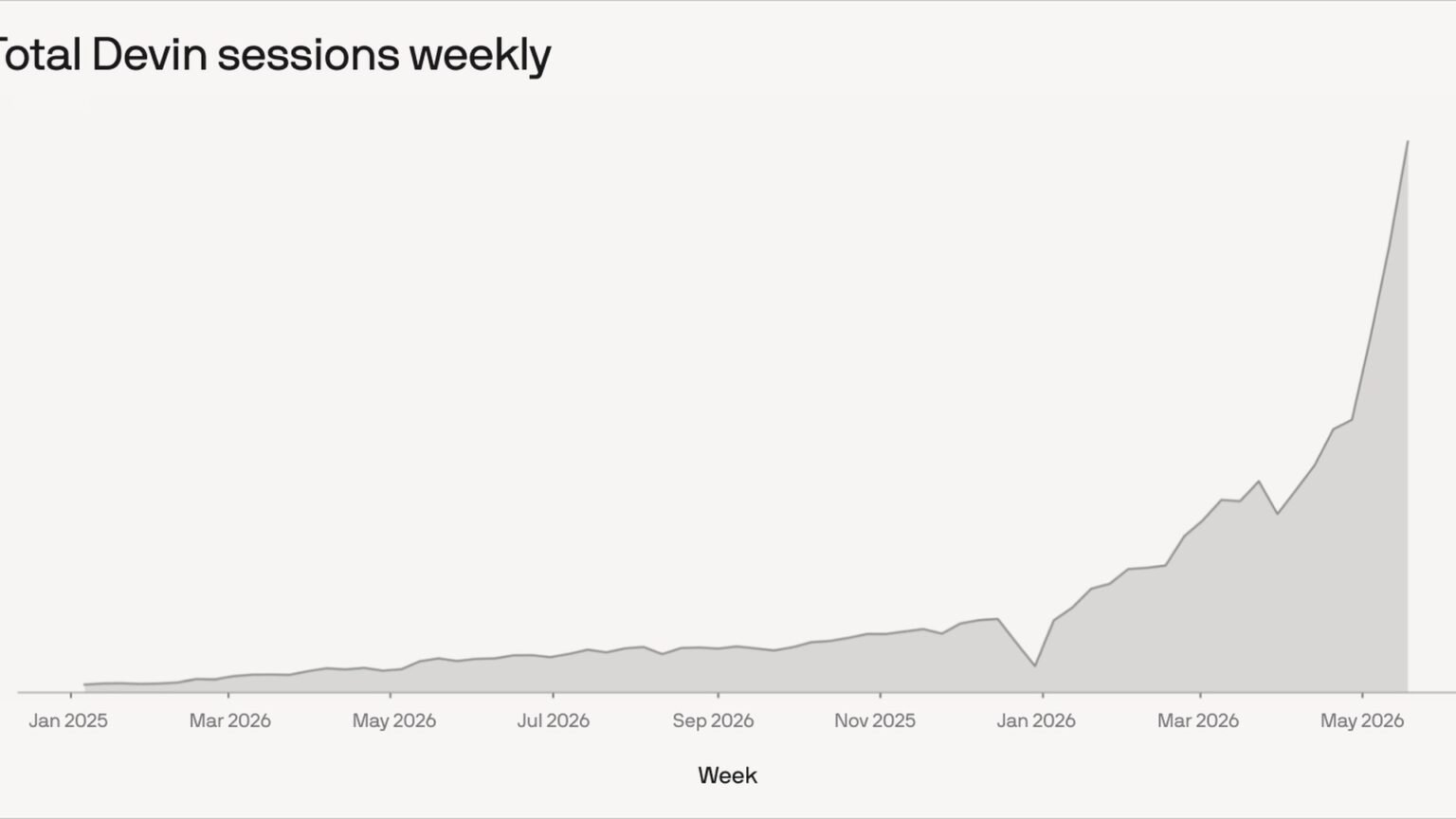

The Devin timeline from the March 2024 viral demo to enterprise standard is one of the defining arcs in AI agents. Devin’s story is one of the defining AI agent arcs of the past two years. What began with a viral March 2024 launch from Cognition quickly became a debate over benchmark theater, product readiness, and whether autonomous software engineering was truly here. Since then, Cognition has added commercial packaging, enterprise integrations, reference customers, and the Windsurf editor to turn a headline-grabbing demo into a broader platform play. This chronology tracks the milestones from launch through early 2026, and pairs them with the market context that made Devin one of the most watched products in agent infrastructure. For deeper product context, see our related coverage: what Cognition Devin is in 2026, Devin vs. Codex, and Cursor vs. Windsurf vs. Claude Code.
At a glance: the milestones that defined Devin
$4B
Cognition valuation in 2024 financing reports
Reported by Bloomberg after the company’s 2024 funding round
9 ACUs
Included monthly usage on Devin Team
Shown on Cognition pricing materials
3
Named enterprise references in public materials
Goldman Sachs, MongoDB, and Nubank
The fastest way to understand the Devin timeline is to separate three phases. First came the launch phase in early 2024, when Cognition introduced Devin as an AI software engineer and published a demo that spread rapidly across developer and investor circles. Then came the commercialization phase, when Cognition added pricing, integrations, and team workflows that made Devin something companies could actually buy. The third phase is the enterprise phase, where named customers and the Windsurf acquisition pushed the product from a standalone agent into a broader developer platform story.
📌 Context. This article focuses on verifiable milestones from Cognition’s own materials and widely documented company announcements. It omits rumors and uncited claims.
| Date | Milestone | Why it mattered |
|---|---|---|
| March 12, 2024 | Cognition launches Devin publicly | Introduced Devin as an autonomous AI software engineer and ignited broad industry attention |
| 2024 | Cognition adds ACU pricing, GitHub and Slack integrations, and team plans | Marked the shift from demo to commercial product |
| 2024–2025 | Enterprise customer references include Goldman Sachs, MongoDB, and Nubank | Provided proof points that large companies were willing to deploy Devin |
| Mid-2025 | Cognition acquires Windsurf | Added a major IDE/editor footprint and brought Devin closer to day-to-day developer workflows |
| Late 2025–early 2026 | Devin is positioned as an autonomous engineering teammate inside enterprise organizations | Showed the market’s move from curiosity to operational adoption |
Q1 2024: Devin launches and the demo goes viral
On March 12, 2024 — the inflection point in the Devin timeline —, Cognition unveiled Devin on its official site and described it as the first AI software engineer. The launch page showed Devin planning tasks, writing code, debugging, and using developer tools in a browser-based environment. The company’s announcement framed Devin not as a coding autocomplete product but as an agent that could take a software task, reason through steps, and execute work with limited supervision.
The launch spread quickly because Cognition paired the announcement with a polished demo that showed Devin completing what the company described as a real freelance engineering task from Upwork. That framing mattered. The product was not presented as a chatbot helping a developer write snippets. It was presented as a system that could own a ticket-like assignment from start to finish. In a market already primed by copilots and code assistants, that was a much bigger claim.
Media coverage followed almost immediately. Outlets including Bloomberg and TechCrunch covered the launch and the company behind it. Cognition also published benchmark-style claims around SWE-bench performance on its launch materials, helping position Devin as a leap beyond code completion and into autonomous software engineering.
“The launch worked because it gave the market a vivid picture of what an AI agent for software engineering might look like in practice.”
Alatirok analysis of the March 2024 launch
Q1–Q2 2024: Excitement meets scrutiny
The same qualities that made the launch viral also made it controversial. Independent developers and researchers began dissecting the public materials and asking how much of the demo reflected repeatable product behavior versus a carefully curated showcase. Some criticism centered on edited test cases and whether the Upwork example relied on conditions that would not generalize. Other commentary questioned benchmark framing and the gap between a recorded success path and production reliability.
One recurring point of debate involved whether parts of the showcased workflow depended on interfaces or assumptions that ordinary users would not have. Those critiques did not erase the significance of the launch, but they did shape the next year of discourse around Devin. From that point on, Cognition had to prove not only that the agent could impress in a demo, but that it could operate inside real software teams with auditable outputs and predictable economics.
That scrutiny ended up being healthy for the category. Devin became a forcing function for a broader industry question: what counts as evidence that an AI agent can truly do engineering work? The answer shifted away from benchmark screenshots and toward deployment details, integration depth, pricing transparency, and named customer references.
⚠️ Why this phase mattered. The contested launch narrative stayed attached to Devin for months. Cognition’s later product and enterprise moves mattered in part because they answered doubts created in spring 2024.
Q2–Q4 2024: Cognition turns Devin into a product
After the launch cycle, Cognition’s public messaging became more operational. The company expanded Devin from a headline demo into a product with packaging, usage controls, and integrations. On Cognition’s product and pricing pages, Devin was sold using ACUs, or Agent Compute Units, a usage abstraction that gave customers a way to reason about cost and throughput. That was an important shift because autonomous agents are expensive to run, and enterprise buyers needed a billing model that tied usage to work rather than to vague seat-based promises.
Cognition also added integrations with tools that matter in real engineering organizations, including GitHub and Slack. GitHub integration connected Devin to the source-of-truth system where code review, branches, and pull requests live. Slack integration mattered for workflow and visibility, giving teams a way to interact with Devin in the communication layer where engineering work is often coordinated. Those additions made Devin less of a standalone curiosity and more of a participant in the existing software delivery stack.
Commercial packaging broadened as well. Cognition introduced multiple plans, including team-oriented options and enterprise pathways. The company’s pricing materials made clear that Devin was not being positioned as a mass-market free tool. It was being sold as a premium, high-compute engineering system aimed at organizations willing to pay for autonomous execution. That pricing posture aligned with the product’s ambition and with the economics of running long-horizon agentic tasks.
| 2024 product move | Public signal | Strategic implication |
|---|---|---|
| ACU pricing | Usage-based commercial model on Cognition pricing pages | Made autonomous work legible to finance and engineering leaders |
| GitHub integration | Connection to code hosting and review workflows | Moved Devin closer to production software delivery |
| Slack integration | Messaging-layer workflow support | Improved team coordination and visibility around agent work |
| Multi-tier plans | Team and enterprise packaging | Signaled that Cognition was building for organizations, not only individual experimentation |
2024 funding context: capital follows the agent thesis
Cognition’s rise also unfolded against a period of intense investor interest in AI coding and agent infrastructure. In 2024, Bloomberg reported that Cognition had raised funding at a $4 billion valuation. That figure mattered beyond headline value. It showed that investors were willing to price Devin not as a niche developer tool but as a potential platform company in one of the most commercially attractive AI categories.
The financing environment around Devin reflected a broader market belief that software engineering would be one of the first knowledge-work domains where AI agents could produce measurable ROI. Code is testable, versioned, and tied to business outcomes. That made the category easier to underwrite than more ambiguous forms of enterprise automation. Cognition benefited from that logic, but it also inherited the burden of proving that autonomous engineering could scale beyond demos and pilot projects.
📌 Capital signal. A multibillion-dollar valuation in 2024 put Cognition in the top tier of agent startups and raised expectations for product maturity and enterprise traction.
2025: Enterprise references start to define the story
By 2025, the center of gravity in the Devin narrative had shifted. The question was no longer whether the launch had been flashy. The question was which companies were willing to put Devin into real engineering workflows. Cognition’s public materials began highlighting enterprise references including Goldman Sachs, MongoDB, and Nubank, along with claims of broader Fortune 500 adoption.
Those names mattered for different reasons. Goldman Sachs signaled credibility with highly regulated, security-conscious enterprise buyers. MongoDB carried weight with infrastructure-minded developers and engineering leaders who would be skeptical of superficial automation claims. Nubank pointed to modern digital product organizations operating at large scale. Together, the references suggested that Devin was finding a place across different kinds of software teams rather than in a single narrow niche.
This was also the period when the market’s language around Devin changed. Instead of describing it only as an AI software engineer, Cognition increasingly framed the product as a teammate that could take on scoped work, collaborate through existing tools, and operate inside organizational controls. That subtle repositioning was important. Enterprises do not buy magic. They buy systems that fit process, governance, and accountability.
“Named enterprise customers did more to validate Devin than any benchmark chart could.”
Alatirok analysis of 2025 enterprise adoption signals
Mid-2025: Cognition acquires Windsurf
The biggest strategic event in Devin’s 2025 timeline was Cognition’s acquisition of Windsurf, the coding environment previously known as Codeium. The deal gave Cognition more than a product extension. It brought a widely used editor surface, a large installed base of developers, and a stronger answer to a question that had lingered since Devin’s launch: where does the agent actually live in the daily workflow of software teams?
Windsurf mattered because the coding market was increasingly converging around integrated environments rather than isolated assistants. Developers wanted chat, code editing, context retrieval, terminal access, and agentic execution in one place. Devin had been powerful as an autonomous system, but Windsurf gave Cognition a more natural front end for iterative work and broader developer adoption. It also strengthened the company’s position against rivals that were blending IDE experiences with agent workflows.
The acquisition had another effect. It reframed Cognition from a single-product company into a broader developer platform contender. With Devin as the autonomous execution layer and Windsurf as the interactive environment, Cognition could tell a more complete story about how AI supports software engineering from prompt to pull request. For enterprise buyers, that combination also simplified vendor evaluation by reducing the number of tools needed to cover assisted and autonomous coding.
📌 Why Windsurf mattered. The acquisition connected Devin’s autonomous workflow to a mature editor experience and a large developer user base, strengthening Cognition’s distribution and product surface.
| Before acquisition | After acquisition | Strategic effect |
|---|---|---|
| Devin as a standalone autonomous agent experience | Devin paired with Windsurf editor workflow | Broader coverage of both assisted and autonomous coding |
| Cognition known mainly for a viral agent demo | Cognition with a larger developer distribution footprint | Improved go-to-market leverage |
| Workflow centered on delegated tasks | Workflow spanning editing, context, and execution | Better fit for enterprise engineering teams |
Late 2025 to early 2026: Devin becomes an enterprise teammate
By late 2025 and into early 2026, the public framing around Devin had become much more concrete. Cognition’s materials and customer references positioned Devin as a system that could operate inside enterprise development organizations as an autonomous engineering teammate. That language reflects a meaningful shift in market maturity. The product was no longer being judged only on whether it could solve a benchmark issue or complete a staged task. It was being judged on whether it could fit into backlog management, code review, internal tooling, and team communication at scale.
This phase of the Devin timeline is also where the broader AI coding market started to look more like infrastructure than novelty. Enterprises evaluating Devin were also comparing it with coding agents, editor-native assistants, and model-provider tools. What distinguished Cognition’s pitch was the emphasis on delegated execution rather than just interactive assistance. Devin’s value proposition remained that a developer or manager could assign work, monitor progress, and receive artifacts back through familiar systems.
That does not mean the debate is over. Autonomous engineering still raises questions about reliability, review burden, security boundaries, and cost efficiency. Yet by early 2026, the evidence threshold had changed. Devin had moved from a product people argued about on social media to one that large organizations were willing to test and, in some cases, standardize around for specific classes of work.
Where does this go next?
The next chapter in the Devin timeline will likely be decided less by launch theatrics and more by enterprise operating data. Buyers now want to know how often Devin completes work without intervention, what categories of tasks it handles best, how much human review remains necessary, and whether ACU-based economics hold up under broad deployment. Those are the metrics that determine whether an agent becomes a standard tool or remains a premium experiment.
Cognition also has a platform integration challenge and opportunity. With Windsurf in the portfolio, the company can unify interactive coding, delegated execution, and team coordination into a single workflow. If it succeeds, Devin could become part of a broader enterprise development stack rather than a point solution. If it fails, the market may fragment between editor-native assistants, model-provider agents, and specialized enterprise automation tools.
For now, the most important fact is that Devin survived the hardest transition in AI products: from viral demo to paid deployment. That does not guarantee long-term dominance. It does mean Cognition has already crossed a threshold many agent startups never reach. The next 12 months will show whether Devin becomes a durable enterprise standard or one influential step in a much larger shift toward autonomous software engineering.
📌 Related reading. For product-level analysis, see our 2026 Devin guide, Devin vs. Codex, and Cursor vs. Windsurf vs. Claude Code.
Frequently asked questions
Cognition announced Devin on March 12, 2024 on its official launch page. The company introduced it as an AI software engineer and published examples of Devin planning, coding, and debugging tasks. See Cognition’s launch post.
ACU stands for Agent Compute Unit, the usage metric Cognition uses in its commercial packaging for Devin. Cognition’s pricing page explains plan structure and included monthly ACUs for team usage. See Cognition pricing.
Cognition has publicly highlighted enterprise references including Goldman Sachs, MongoDB, and Nubank in its product and company materials. For current customer references, see Cognition’s official site.
The launch drew scrutiny because independent observers questioned how representative the public demo was of normal product behavior, including concerns about edited demonstrations and benchmark framing. Cognition’s official launch materials remain the primary source for what the company claimed at the time: Introducing Devin.
Windsurf gave Cognition a stronger editor and IDE surface around Devin’s autonomous workflow, helping the company serve both interactive coding and delegated execution. You can learn more about the editor product at Windsurf’s official site.
Primary sources
- Cognition official site — Cognition
- Introducing Devin — Cognition
- Cognition pricing — Cognition
- Windsurf official site — Windsurf
- Bloomberg coverage of Cognition financing — Bloomberg
- TechCrunch coverage of Cognition and Devin — TechCrunch
Last updated: May 20, 2026. Related: Agent Infrastructure.