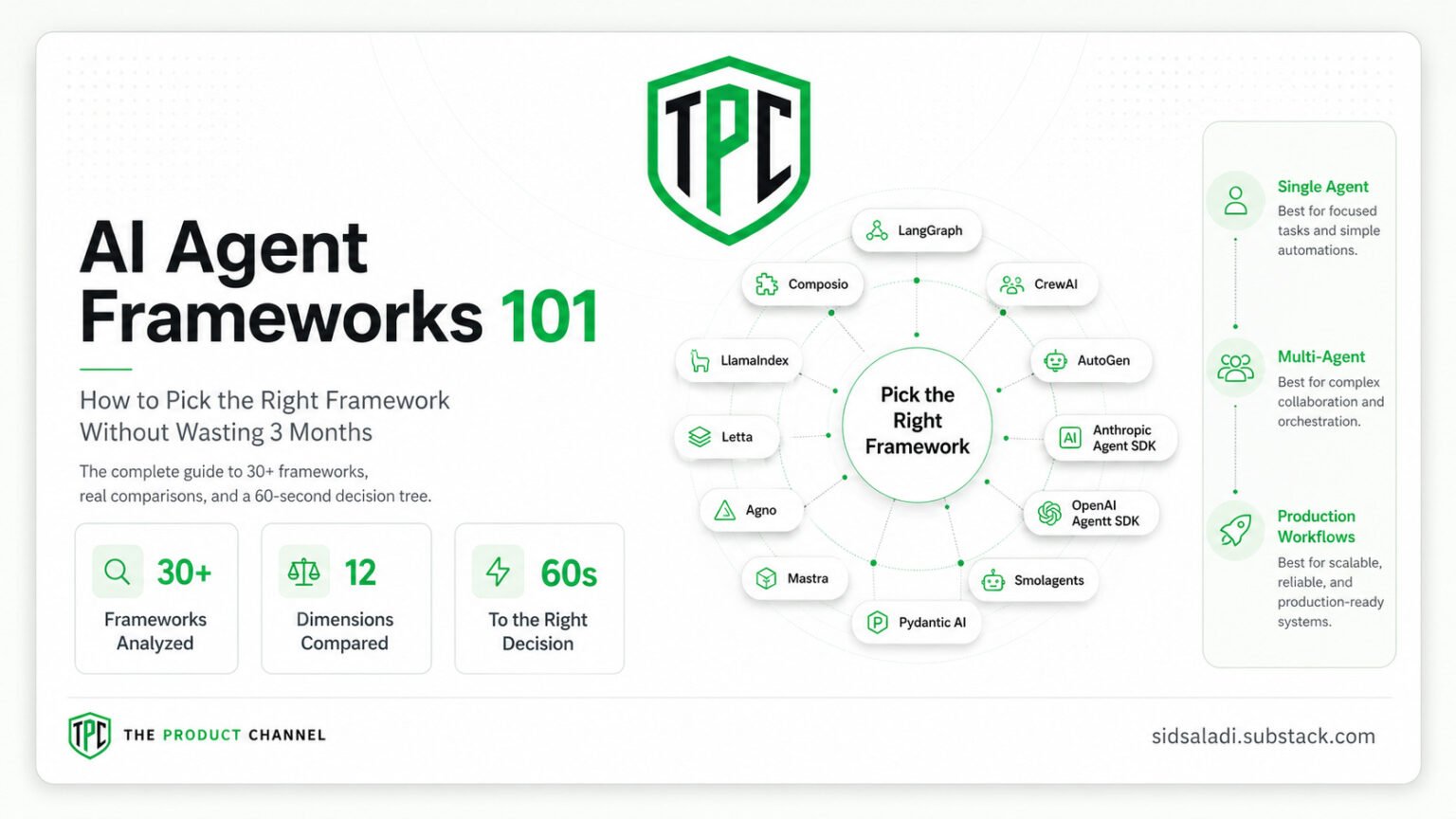

AI agent SDKs now sit at the center of application architecture for teams building copilots, internal automation, and tool-using workflows. The market has split between lightweight SDKs that stay close to model APIs and broader frameworks that add memory, orchestration, and deployment primitives. This list ranks 10 real options by adoption and developer experience, with an eye toward what builders actually need in 2026: fast iteration, typed interfaces, reliable tool use, and a path from demo to production. If you want more workflow-heavy context, see our guides to LangGraph and CrewAI.
Why this ranking matters now
10
SDKs ranked
All are real, publicly documented products or OSS projects
2
Primary ranking factors
Adoption and developer experience
2026
Selection lens
Built for current agent workflows, not just chat wrappers
Agent tooling has matured quickly. In 2024 and 2025, many teams were still stitching together model APIs, homegrown tool routers, and ad hoc state management. By 2026, the center of gravity has shifted toward SDKs that package those concerns into a developer-friendly abstraction. The practical question is no longer whether to use an agent SDK, but which one best matches your language stack, deployment model, and tolerance for framework opinionation.
This ranking emphasizes two factors above all else: adoption and developer experience. Adoption matters because community examples, integrations, and maintenance depth reduce implementation risk. DX matters because agent systems are already complex; the SDK should remove friction rather than add it. The result is a list that favors tools with strong documentation, active ecosystems, and clear primitives for tools, memory, workflows, and structured outputs.
📌 Methodology. Rankings are editorial and weighted toward public adoption signals, documentation quality, ecosystem maturity, and day-to-day developer ergonomics. Feature breadth alone did not determine placement.
1. Vercel AI SDK — the best overall SDK for shipping agentic apps in TypeScript
Best overall: Vercel AI SDK
Vercel AI SDK takes the top spot because it combines broad model-provider support, polished TypeScript ergonomics, and a pragmatic path from UI generation to agentic backends. Vercel positions the project as an open-source AI toolkit for TypeScript, with support for generating text and structured objects, tool calling, and framework integrations across modern JavaScript stacks. For teams already building on Next.js or adjacent frontend infrastructure, it is one of the shortest paths from prototype to production.
The strongest part of the experience is how little ceremony it adds. The SDK stays close to common application patterns rather than forcing a heavyweight orchestration model up front. That makes it especially attractive for product teams that want to add agent behavior inside existing apps instead of standing up a separate agent platform. It is not the most opinionated workflow engine on this list, but that restraint is part of its appeal.
Vercel AI SDK ⭐ Editor’s Pick
Best for: Product teams building agentic features into web apps with TypeScript
What works
Watch out for
import { generateText } from 'ai';
import { openai } from '@ai-sdk/openai';

const result = await generateText({
  model: openai('gpt-4.1'),
  prompt: 'Summarize the last 5 support tickets and suggest next actions.'
});

console.log(result.text);
2. Mastra — the most compelling full-stack TypeScript agent framework for ambitious teams
Runner-up for TypeScript-heavy teams
Mastra has quickly become one of the most interesting TypeScript-native agent frameworks, combining workflows, agents, integrations, and local development tooling in a more opinionated package than Vercel AI SDK. The company presents Mastra as an open-source TypeScript AI framework for building agents and workflows, and that framing is accurate: it is not just an SDK wrapper but a broader application layer for agent systems.
That extra structure is why it ranks so highly. Teams that want batteries included often find Mastra easier to reason about than assembling multiple libraries themselves. The tradeoff is that it asks developers to buy into a framework worldview. For greenfield builds, that can be a strength. For teams that want a thinner abstraction, it can feel heavier than necessary.
Mastra
Best for: Startups and product teams standardizing on TypeScript for agent apps
What works
Watch out for
“Mastra is one of the clearest signals that the TypeScript agent stack is maturing beyond wrappers into full application frameworks.”
Alatirok editorial assessment
3. PydanticAI — the cleanest Python answer to type-safe agent development
PydanticAI stands out because it brings the design instincts of the Pydantic ecosystem into agent development. The project describes itself as a Python agent framework designed to make it less painful to build production-grade applications with generative AI, and its emphasis on type safety, validation, and structured outputs gives it a very different feel from more free-form agent libraries.
For Python teams that care about correctness and explicit schemas, PydanticAI is unusually compelling. It is not trying to be everything at once. Instead, it focuses on making core agent interactions more reliable and inspectable. That narrower focus is a feature, not a bug, especially in enterprise settings where typed contracts matter.
PydanticAI
Best for: Backend and platform teams building Python services with strict schemas
What works
Watch out for
📌 Best Python DX. If your team already relies on Pydantic models and typed Python services, PydanticAI is one of the easiest agent SDKs to justify.
from pydantic import BaseModel
from pydantic_ai import Agent

class TicketSummary(BaseModel):
    issue: str
    priority: str

agent = Agent('openai:gpt-4.1', result_type=TicketSummary)
result = agent.run_sync('Summarize this support ticket and assign a priority.')
print(result.output)
4. OpenAI Agents SDK — the most direct route to OpenAI-native agent patterns
OpenAI Agents SDK earns a high rank because many developers want the shortest path to agent workflows built around OpenAI’s own abstractions. The open-source Python SDK is designed around agents, handoffs, guardrails, and tracing, giving developers a vendor-native way to build systems that align closely with OpenAI’s platform direction.
The main advantage is coherence. The primitives are designed to work together, and teams that are already committed to OpenAI models may prefer this over a more neutral framework. The downside is equally clear: if portability across providers is a top priority, a vendor-specific SDK may feel constraining compared with broader orchestration layers.
OpenAI Agents SDK
Best for: Developers standardizing on OpenAI models and platform workflows
What works
Watch out for
5. LangChain — still the default ecosystem bet, even if the DX can be uneven
LangChain remains one of the most widely recognized names in the agent tooling market, and that ecosystem gravity still matters. The project spans integrations, abstractions, and adjacent products, making it a common starting point for teams that need breadth more than elegance. Its staying power comes from community scale and the sheer number of examples and connectors available.
The reason it does not rank higher is that developer experience has long been a mixed story. LangChain can feel sprawling, and many teams now use only selected pieces rather than embracing the entire stack. Even so, its ecosystem footprint is too large to ignore. Builders who need maximum compatibility often still end up here, or at least nearby. Readers evaluating workflow-centric options should also compare it with our LangGraph guide.
LangChain
Best for: Teams that want broad integrations and a large community footprint
What works
Watch out for
⚠️ Ecosystem vs simplicity. LangChain’s biggest strength is breadth. Its biggest weakness is that breadth can also increase conceptual overhead.
6. LlamaIndex agents — strong for retrieval-heavy agent systems
LlamaIndex built its reputation around data frameworks for LLM applications, and its agent tooling benefits from that heritage. Teams building retrieval-heavy assistants, knowledge workflows, or enterprise search-adjacent agents often find LlamaIndex a natural fit because the data layer and agent layer are closely related in practice.
It ranks in the middle because its strengths are real but somewhat use-case specific. If your application depends on connecting agents to private data and retrieval pipelines, LlamaIndex can be a very strong choice. If you want the simplest general-purpose agent SDK, other tools on this list may feel lighter.
LlamaIndex
Best for: Teams building knowledge agents and retrieval-centric applications
What works
Watch out for
7. smolagents — a refreshingly small and practical open-source agent framework
Hugging Face’s smolagents has won attention by doing less, more clearly. The project is intentionally lightweight, and that design choice makes it attractive to developers who want to understand the control flow of their agents instead of disappearing into framework magic. In a market full of abstraction creep, that restraint is valuable.
smolagents ranks well because the developer experience is approachable and the Hugging Face ecosystem gives it credibility. It ranks below the top tier because it is not trying to be a full-stack production framework in the same way as some competitors. For experimentation, education, and lean builds, though, it is one of the most appealing options available.
smolagents
Best for: Developers who want a minimal, open-source Python agent framework
What works
Watch out for
“The appeal of smolagents is right in the name: smaller surface area, fewer surprises, faster understanding.”
Alatirok editorial assessment
8. Anthropic Agent SDK — promising for Claude-centric builders, but narrower in ecosystem pull
Anthropic’s Agent SDK belongs on this list because a growing number of developers want vendor-native tooling around Claude and Anthropic’s model capabilities. The official documentation positions it as an SDK for building agentic applications, giving Claude-focused teams a first-party route rather than relying entirely on third-party frameworks.
Its placement reflects a familiar tradeoff. If your roadmap is tightly aligned with Anthropic, the SDK can offer a cleaner path to vendor-specific patterns. If you want broad ecosystem gravity, examples, and provider neutrality, the field is stronger elsewhere. This is a credible option, just not the default recommendation for most teams.
Anthropic Agent SDK
Best for: Developers committed to Anthropic models and workflows
What works
Watch out for
9. Phidata — useful for memory-centric agent apps, though less central than the leaders
Phidata has carved out a place in the market with an emphasis on agents, memory, and knowledge-oriented application patterns. That makes it relevant for teams that want more than a thin model wrapper and are looking for a framework that treats persistent context as a first-class concern.
It lands near the bottom of this top 10 not because it lacks utility, but because the adoption and ecosystem pull appear smaller than the leaders above it. Teams with a strong match to its design philosophy may still find it productive. For the average buyer choosing a default stack, though, the top half of this list is easier to recommend.
Phidata
Best for: Teams exploring knowledge and memory-centric agent patterns
What works
Watch out for
10. Composio — best understood as the tool-integration layer you may pair with another SDK
Use as a layer, not a default framework
Composio makes this list because tool integration is one of the hardest parts of agent development, and Composio focuses directly on that problem. The company provides infrastructure for connecting agents and LLM applications to external tools and services. In practice, many teams will use it alongside another SDK rather than as the sole center of their architecture.
That is also why it ranks tenth in a list of agent SDKs. Composio is valuable, but it is somewhat orthogonal to the full-stack framework question. If your biggest bottleneck is reliable access to third-party tools, it can be a force multiplier. If you are choosing a primary agent programming model, start with one of the higher-ranked SDKs and evaluate Composio as an integration layer.
Composio
Best for: Teams that need many external tool integrations for agent workflows
What works
Watch out for
📌 How to use it. Composio often makes the most sense as a complement to an agent SDK, not a replacement for one.
Summary table: the top AI agent SDKs at a glance
If you want the shortest possible takeaway, the market splits into a few clear buckets. Vercel AI SDK and Mastra lead the TypeScript side, with Vercel winning on flexibility and Mastra on framework completeness. PydanticAI is the cleanest Python choice for typed, production-minded teams. OpenAI Agents SDK and Anthropic Agent SDK are strongest when you want first-party alignment with a model vendor. LangChain and LlamaIndex remain major ecosystem bets, while smolagents, Phidata, and Composio serve more specific preferences and use cases.
For teams exploring multi-agent architecture beyond SDK selection, our CrewAI walkthrough is a useful companion read.
| Rank | Product | Best for | Language focus | Editorial take |
|---|---|---|---|---|
| 1 | Vercel AI SDK | Shipping agentic product features fast | TypeScript | Best overall balance of adoption and DX |
| 2 | Mastra | Opinionated TypeScript agent apps | TypeScript | Framework-first choice for ambitious builds |
| 3 | PydanticAI | Typed Python agent systems | Python | Best Python DX for structured outputs |
| 4 | OpenAI Agents SDK | OpenAI-native agent workflows | Python | Strong first-party path for OpenAI users |
| 5 | LangChain | Breadth and integrations | Python/JavaScript | Still huge, though not always elegant |
| 6 | LlamaIndex | Retrieval-heavy agent systems | Python | Best when data pipelines are central |
| 7 | smolagents | Minimal open-source agent builds | Python | Lightweight and easy to understand |
| 8 | Anthropic Agent SDK | Claude-centric development | Official SDK | Useful if Anthropic is your center of gravity |
| 9 | Phidata | Memory-aware assistants | Python | Niche but relevant for context-rich apps |
| 10 | Composio | Tool integrations | Integration layer | Best paired with another primary SDK |
Frequently asked questions
AI agent SDKs are developer tools for building software that can reason over context, call tools, and return structured outputs. Examples include Vercel AI SDK, PydanticAI, and the OpenAI Agents SDK.
For most TypeScript teams, Vercel AI SDK is the best default because of its strong TypeScript ergonomics and broad provider support. Teams that want a more opinionated framework should also evaluate Mastra.
For Python teams that care about typed interfaces and structured outputs, PydanticAI is one of the strongest choices. Teams that want vendor-native workflows can also look at the OpenAI Agents SDK.
Not always, but it can help when your agent needs reliable access to many external services. Composio is best evaluated as an integration layer that complements a primary SDK such as Vercel AI SDK or Mastra.
Primary sources
- Vercel AI SDK — Vercel
- Vercel AI GitHub repository — GitHub
- Mastra — Mastra
- PydanticAI GitHub repository — GitHub
- smolagents GitHub repository — GitHub
- Phidata — Phidata
- Composio — Composio
- OpenAI Agents SDK GitHub repository — GitHub
- LlamaIndex — LlamaIndex
- Anthropic Agent SDK — Anthropic
- LangChain — LangChain
Last updated: May 20, 2026. Related: Agent Infrastructure.