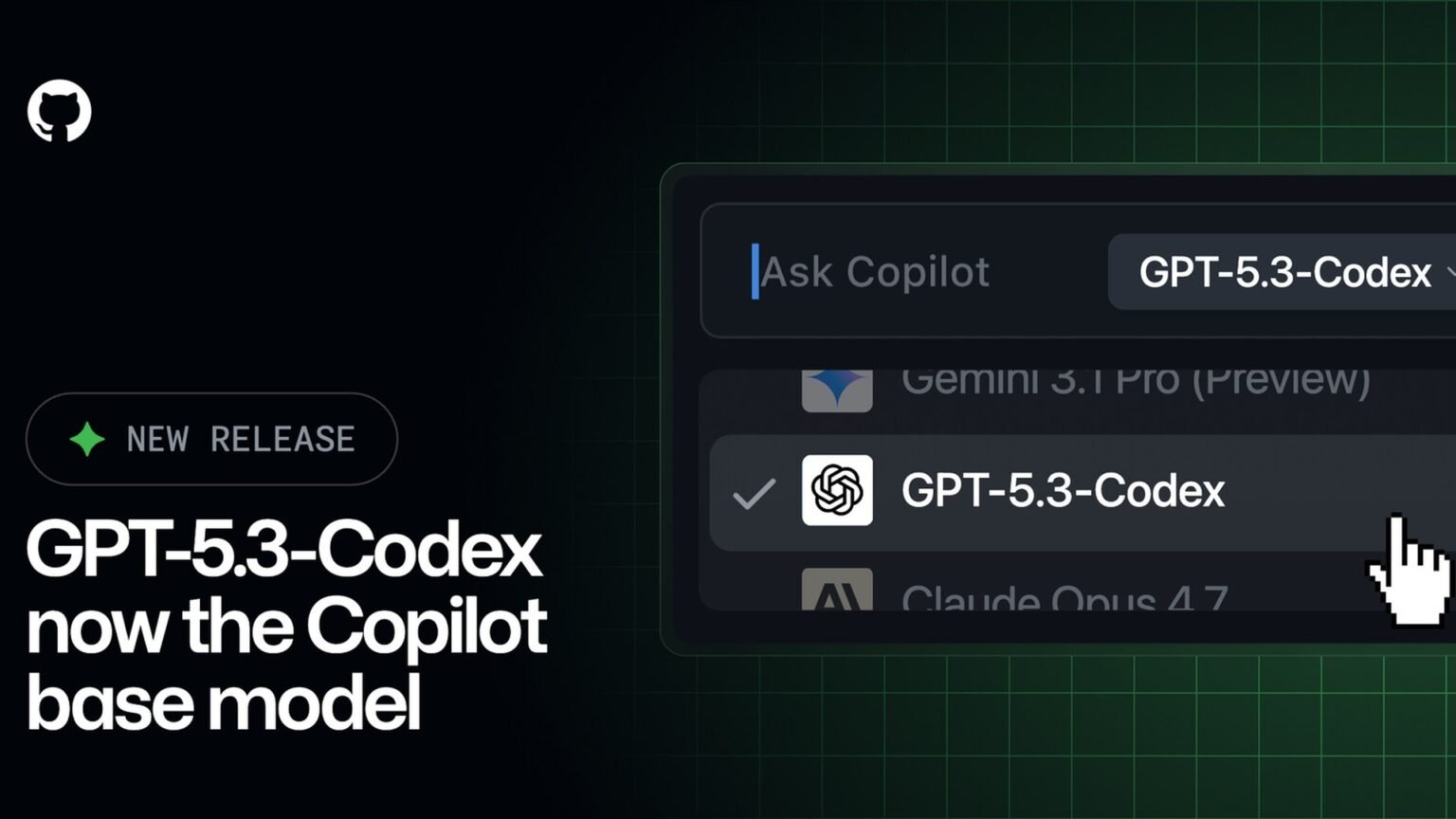

GitHub has made GPT-5.3-Codex Copilot the default base model for Copilot Business and Copilot Enterprise, effective May 17, 2026, replacing GPT-4.1 after a rollout first announced on March 18. The switch is narrow but meaningful: it does not automatically change Copilot Pro or Free, it introduces a 1x premium-request multiplier where GPT-4.1 had been force-enabled at 0x, and it puts a new enterprise KPI at the center of the pitch — code survival rate rather than a public benchmark score.
GitHub flipped the default for Business and Enterprise
May 17
effective date
Default changed for Business and Enterprise
Feb 4, 2027
LTS end date
For GPT-5.3-Codex
1x
premium request multiplier
GPT-5.3-Codex counts as one premium request
High
code survival rate
GitHub’s stated reason for the switch
GitHub’s May 17 changelog says GPT-5.3-Codex is now the base model for Copilot Business and Copilot Enterprise. It supersedes GPT-4.1, which had previously been the default, and the company notes that the change follows an announcement made on March 18. The practical reading is simple: if an organization is on those paid team tiers and its admin has not explicitly approved another model, the default experience now shifts to the newer Codex model.
That scope matters. GPT-5.3-Codex Copilot is not an all-SKU switch. GitHub’s own changelog limits the default change to Business and Enterprise, while individual Copilot Pro pricing and plan pages continue to sit on their standard deprecation path rather than an immediate forced swap. Free-tier users are not part of this change either.
GitHub also attached a long-term support window to the model: February 5, 2026 through February 4, 2027. For teams that care about model stability, that is one of the most concrete details in the announcement. It gives platform owners a date range for internal testing, policy approval, and budget planning instead of a vague promise that the model will remain available.
Effective May 17, 2026, GPT-5.3-Codex became the default base model for Copilot Business and Copilot Enterprise, replacing GPT-4.1.
GitHub is selling a production metric, not a leaderboard score
The most interesting line in the announcement is not the model name. It is GitHub’s rationale: “GitHub Copilot data has shown that GPT-5.3-Codex has a significantly high code survival rate among enterprise customers.” That is a different framing from the one most coding-model launches use, where the headline usually centers on public benchmark performance.
In plain terms, code survival rate points to code that gets accepted, shipped, and remains in place rather than being quickly reverted. That makes it a workflow metric tied to production outcomes, not just a lab score. GPT-5.3-Codex Copilot is therefore being positioned less as a benchmark winner and more as a model that produces code enterprises keep.
GitHub did not publish public benchmark numbers in this changelog. There is no SWE-Bench table, no HumanEval chart, and no attempt to anchor the decision to a familiar leaderboard. That omission looks deliberate. It suggests GitHub wants enterprise buyers to judge the default model on downstream usefulness inside real repositories, where review friction, revert rates, and maintainability matter more than one-shot task completion.
That is a notable divergence in the coding-assistant market. Public evals still shape developer mindshare, but enterprise platform teams often care more about whether generated code survives code review and production hardening. The strongest takeaway from the May 17 move is that GitHub is now willing to make that internal KPI the public headline.
“GitHub Copilot data has shown that GPT-5.3-Codex has a significantly high code survival rate among enterprise customers.”
GitHub changelog, May 17, 2026
The pricing signal is small on paper and meaningful in practice
The second material change is economic. GitHub’s changelog says GPT-5.3-Codex carries a 1x premium-request multiplier. The outgoing default, GPT-4.1, had been 0x during its temporary force-enable window, which ends June 1, 2026. For enterprise admins, that means the default model is no longer the free bridge option it had been during the transition period.
That does not mean every customer suddenly faces a dramatic bill shock. It does mean the default path now has an explicit usage cost attached to it. Teams that let the platform ride on defaults will move from a no-multiplier temporary state to a metered one. GPT-5.3-Codex Copilot is therefore both a quality upgrade and a pricing-tier message.
This is the pattern enterprise buyers have been seeing across AI tooling: a vendor uses a temporary free or discounted window to smooth migration, then restores a priced default once the new model is established. GitHub is not unusual in doing that. What stands out is how tightly the cost change is paired with the quality claim. The company is effectively saying the model that costs more is the one whose code survives better in production.
For procurement and platform teams, the right question is not whether 1x is expensive in the abstract. It is whether the higher request cost is offset by lower review churn, fewer reverts, and less developer time spent repairing generated code. GitHub’s announcement gives the thesis, but each enterprise will need to validate it against its own acceptance and retention metrics.
GPT-4.1 was temporarily force-enabled at 0x. GPT-5.3-Codex is 1x, so default usage economics change on the new model.
| Model | Default status | Multiplier | Timing |
|---|---|---|---|
| GPT-5.3-Codex | Default for Business and Enterprise | 1x | Effective May 17, 2026 |
| GPT-4.1 | Previous default | 0x | Force-enabled temporarily; deprecates June 1, 2026 |
Why the rollout stops at Business and Enterprise
GitHub could have framed this as a universal Copilot upgrade. It did not. The company limited the default-model switch to Business and Enterprise, and that choice says a lot about how it wants the market to read the release. This is being sold as an enterprise-quality move, backed by enterprise usage data, not as a broad consumer perk.
That leaves an awkward but important contrast in the lineup. Copilot Pro users still pay for an individual premium plan, yet they do not get this default change automatically. GitHub’s pricing page lays out the plan structure, and the changelog is explicit that the May 17 swap applies to Business and Enterprise. For individual developers, the message is that access and default behavior are no longer the same thing across SKUs.
There is also an admin-control angle. The new default applies where no other model has been explicitly approved by the org admin. That means the model picker and approval workflow remain central to how larger customers govern Copilot. GPT-5.3-Codex Copilot becomes the baseline only in the absence of another approved choice, which preserves GitHub’s enterprise governance story even while it nudges customers toward the OpenAI-backed default.
Seen through a packaging lens, GitHub is using the default model as a feature of the enterprise tier itself. The company is not just selling seats and policy controls; it is selling a curated default that it claims performs better on the metric enterprises should care about.
Pros
Cons
What this means for Claude inside Copilot
The real story is default power
The May 17 change does not mean Anthropic models are disappearing from Copilot. There is no source for that claim, and GitHub has been expanding model choice in Copilot rather than collapsing it. Still, the default matters. Defaults shape usage, internal standards, and eventually spend.
That is why this move deserves attention beyond a routine changelog note. GitHub has spent the past year broadening Copilot’s model story, while this update tightens the company’s preference for an OpenAI model at the default layer. GPT-5.3-Codex Copilot now sits in the position most enterprise users will encounter first unless an admin has approved and selected something else.
The strategic question is not whether Claude remains available in some Copilot workflows. It is whether alternative models become secondary choices inside organizations that tend to standardize on defaults for supportability and cost tracking. In many enterprises, the model that ships as default becomes the model that wins internal mindshare, even when the picker remains open.
That makes the next few months worth watching. If GitHub continues to emphasize code survival rate as the key buying metric, then every model inside Copilot will increasingly be judged against that production KPI rather than against public evals alone.
GitHub’s default-model change does not, on its own, mean Claude is being deprecated in Copilot.
What enterprise teams should do next
First, check which models are approved at the organization level and whether any internal documentation still assumes GPT-4.1 as the default. GitHub’s changelog is clear that GPT-4.1 was only force-enabled temporarily and deprecates on June 1, 2026. Teams that built workflows around that temporary state should update them now.
Second, start measuring the same thing GitHub is using to justify the switch. If your organization has review tooling, CI metadata, or internal analytics around generated code, track acceptance, revert frequency, and post-merge edits. The promise behind GPT-5.3-Codex Copilot is not just faster completions; it is code that survives. That claim is testable in-house.
Third, watch premium-request consumption after the default flips. A 1x multiplier is easy to miss when a model change arrives through the default path rather than a deliberate opt-in. Finance, platform engineering, and developer-experience teams should all be looking at the same dashboard.
Finally, keep an eye on the broader Codex product arc. OpenAI’s current Codex page and recent coverage of the Codex mobile app rollout show the company continuing to push Codex as a branded coding product, not just a hidden model family. GitHub’s default switch reinforces that branding inside one of the largest enterprise coding surfaces in the market.
Review approved models, update internal docs, monitor premium-request usage, and measure acceptance-plus-revert rates after the default switch.
# Internal checklist for Copilot admins
# 1. Confirm approved models in org settings
# 2. Update docs that reference GPT-4.1 as default
# 3. Track premium-request usage after May 17
# 4. Compare acceptance and revert rates before/after switch

echo "Review Copilot org model approvals"
echo "Audit GPT-4.1 dependencies before June 1 deprecation"
echo "Monitor 1x premium-request consumption for GPT-5.3-Codex"
Frequently asked questions
GitHub says the default swap applies to Copilot Business and Copilot Enterprise. It does not automatically change Free, and individual users on other plans follow the standard deprecation timeline described by GitHub.
The new default base model is GPT-5.3-Codex, which GitHub says supersedes GPT-4.1 for Business and Enterprise. OpenAI’s broader Codex product is described on the official Codex page.
In the May 17 changelog, GitHub says its Copilot data shows GPT-5.3-Codex has a “significantly high code survival rate among enterprise customers”. GitHub did not publish public benchmark numbers in that post, so the claim is framed around production retention of generated code rather than a public eval leaderboard.
Yes. GitHub says GPT-5.3-Codex counts as 1x premium requests, while GPT-4.1 had been force-enabled temporarily at 0x until its June 1, 2026 deprecation. Teams should also review the broader GitHub pricing page for plan context.
Primary sources
- GitHub changelog: GPT-5.3-Codex is now the base model for Copilot Business and Enterprise — GitHub
- GitHub Copilot homepage — GitHub
- GitHub pricing — GitHub
- OpenAI Codex mobile app now available on iOS and Android — Memeburn
Last updated: May 23, 2026. Related: Products.