
Claude Opus 4.8, Gemini 3.1 Pro, and GPT-5.5 each win a different job. Here is how to route agentic coding, long context, DevOps, reasoning, and cost-sensitive work to the right model.
What is the best frontier AI model 2026 for your task?
There is no single best frontier AI model 2026 — the right choice depends entirely on the task, and the three leaders split the field cleanly: Claude Opus 4.8 for agentic coding, Google Gemini 3.1 Pro for long context and cost-sensitive work, and OpenAI GPT-5.5 for terminal and DevOps automation. Treating model selection as a per-task routing decision rather than a single vendor commitment is the difference between paying for capability you use and paying for a logo.
All three of these models are recent. Gemini 3.1 Pro arrived in February 2026, GPT-5.5 in April 2026, and Anthropic shipped Claude Opus 4.8 on 28 May 2026, just days before this guide. They cluster tightly on most general benchmarks but separate sharply on the dimensions that matter for production agents: agentic coding accuracy, context length, terminal reliability, and price per solved task.
This buyer’s guide routes five common workloads — agentic coding, long-context retrieval, cost-sensitive batch work, DevOps and terminal automation, and hard reasoning — to the model that wins each one. Throughout, remember that benchmarks and prices move fast: the figures below were accurate at the end of May 2026, and you should re-confirm them against vendor docs before committing budget.
Every score and price here is attributed to a dated 2026 source. Frontier vendors ship point releases every few weeks and re-price aggressively. Pin your model versions, run your own evals, and treat these numbers as a snapshot, not a contract.
The three frontier contenders at a glance
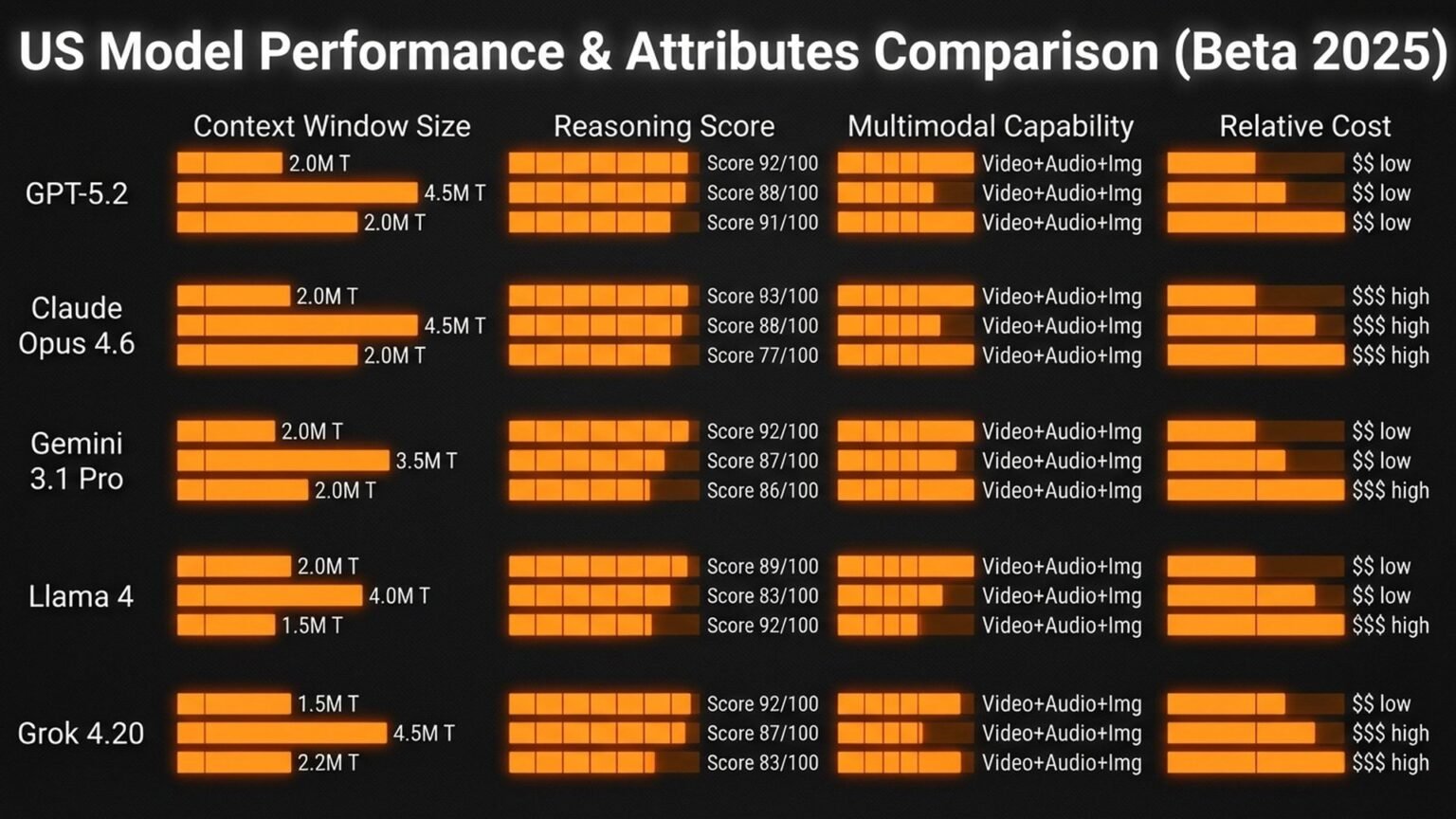
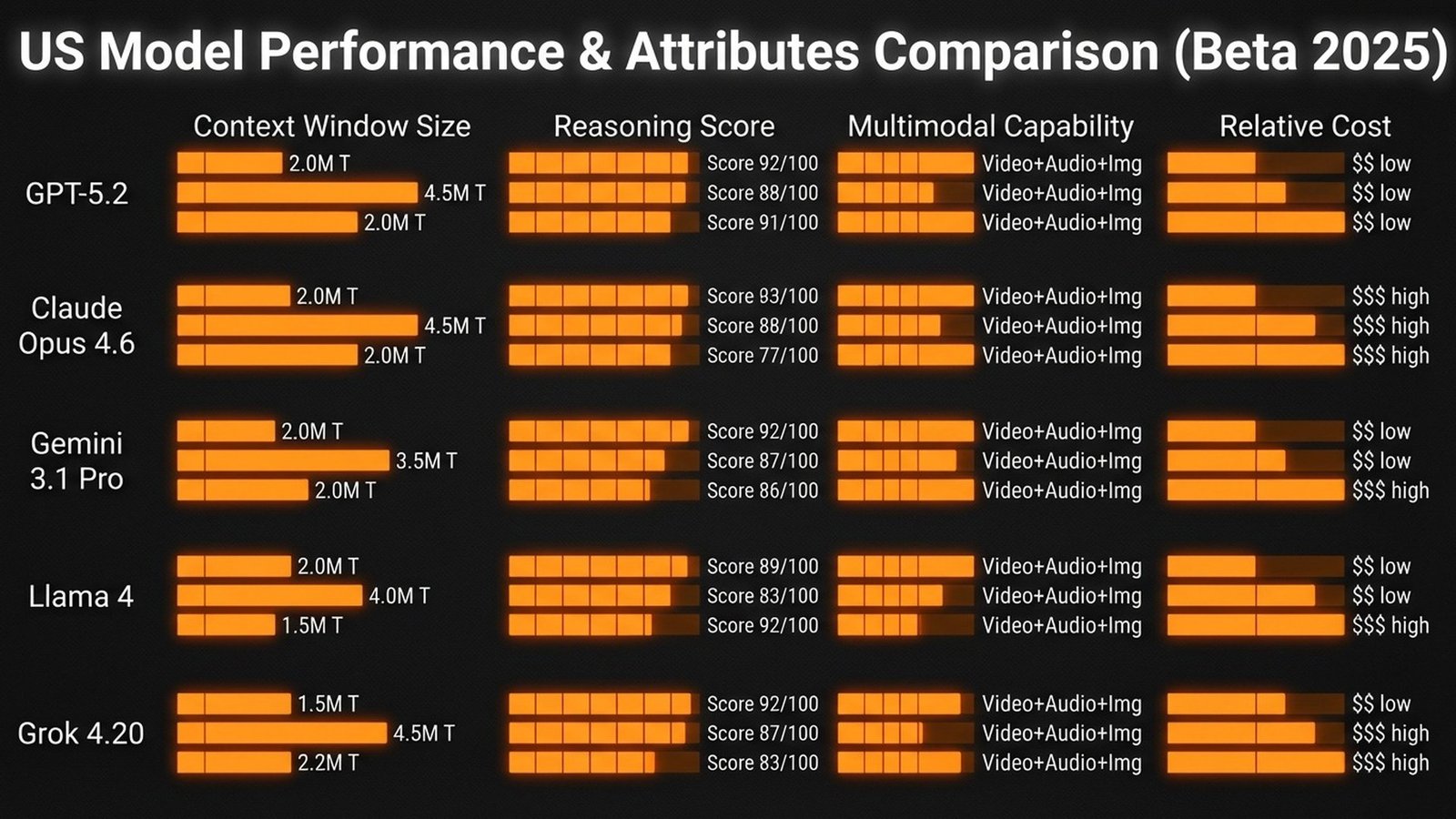
As of late May 2026, the frontier is a three-horse race: Claude Opus 4.8 leads agentic coding, GPT-5.5 leads terminal and DevOps benchmarks, and Gemini 3.1 Pro leads on price and context length. The table below puts their headline specs side by side so you can see why no single model wins every column.
The pricing spread is the story most teams miss. Gemini 3.1 Pro’s $2 input / $12 output per million tokens undercuts Opus 4.8’s $5 / $25 and GPT-5.5’s $5 / $30 by a wide margin — but raw token price is not the same as cost per finished task, which is where Opus 4.8’s higher single-pass success rate claws value back on hard agentic jobs.
| Model | Released | Context | Price (in / out per 1M) | Headline strength |
|---|---|---|---|---|
| Claude Opus 4.8 | 28 May 2026 | 200K tokens | $5 / $25 (fast mode $10 / $50) | Agentic coding leader |
| Gemini 3.1 Pro | 19 Feb 2026 | 1M tokens | $2 / $12 (over 200K: $4 / $18) | Long context and cost |
| GPT-5.5 | Apr 2026 | ~1M tokens | $5 / $30 (Pro: $30 / $180) | Terminal and DevOps |
Best frontier AI model 2026 for agentic coding
Claude Opus 4.8 is the best frontier AI model 2026 for agentic coding, scoring roughly 88.6% on SWE-Bench Verified and about 69.2% on the harder SWE-Bench Pro — ahead of GPT-5.5’s 58.6% on SWE-Bench Pro. If your workload is multi-file patch generation, large-scale migrations, or autonomous bug-fixing where the agent must plan, edit, and verify over many turns, Opus 4.8 is the default pick.
The reason is reliability over long horizons, not just raw accuracy. Anthropic reports that with Opus 4.8 “bugs slip through without comment about four times less often than Opus 4.7,” and the model ships a new dynamic workflows feature aimed specifically at large code migrations. For agent builders, fewer silent failures means fewer wasted turns and lower effective cost per merged change, even at premium token rates.
GPT-5.5 is a close second here and Gemini 3.1 Pro is genuinely competitive on coding — it posts around 80.6% on SWE-Bench Verified and an LiveCodeBench Elo near 2887 — but on the hardest end-to-end agentic tasks, Opus 4.8’s single-pass success rate is the one to beat. The premium price is justified only when the task is hard enough that a cheaper model would loop or quietly ship a broken patch.
“On hard agentic coding, the metric that matters is tokens-per-solved-task, not the sticker price per million tokens.”
Alatirok analysis
Best models for long context, cost, DevOps, and reasoning
For long-context and cost-sensitive work, Gemini 3.1 Pro wins outright; for terminal and DevOps automation, GPT-5.5 leads; and for the hardest reasoning, Opus 4.8 edges ahead. Each of these is a distinct routing target, and the gap between them is large enough to matter on a real bill.
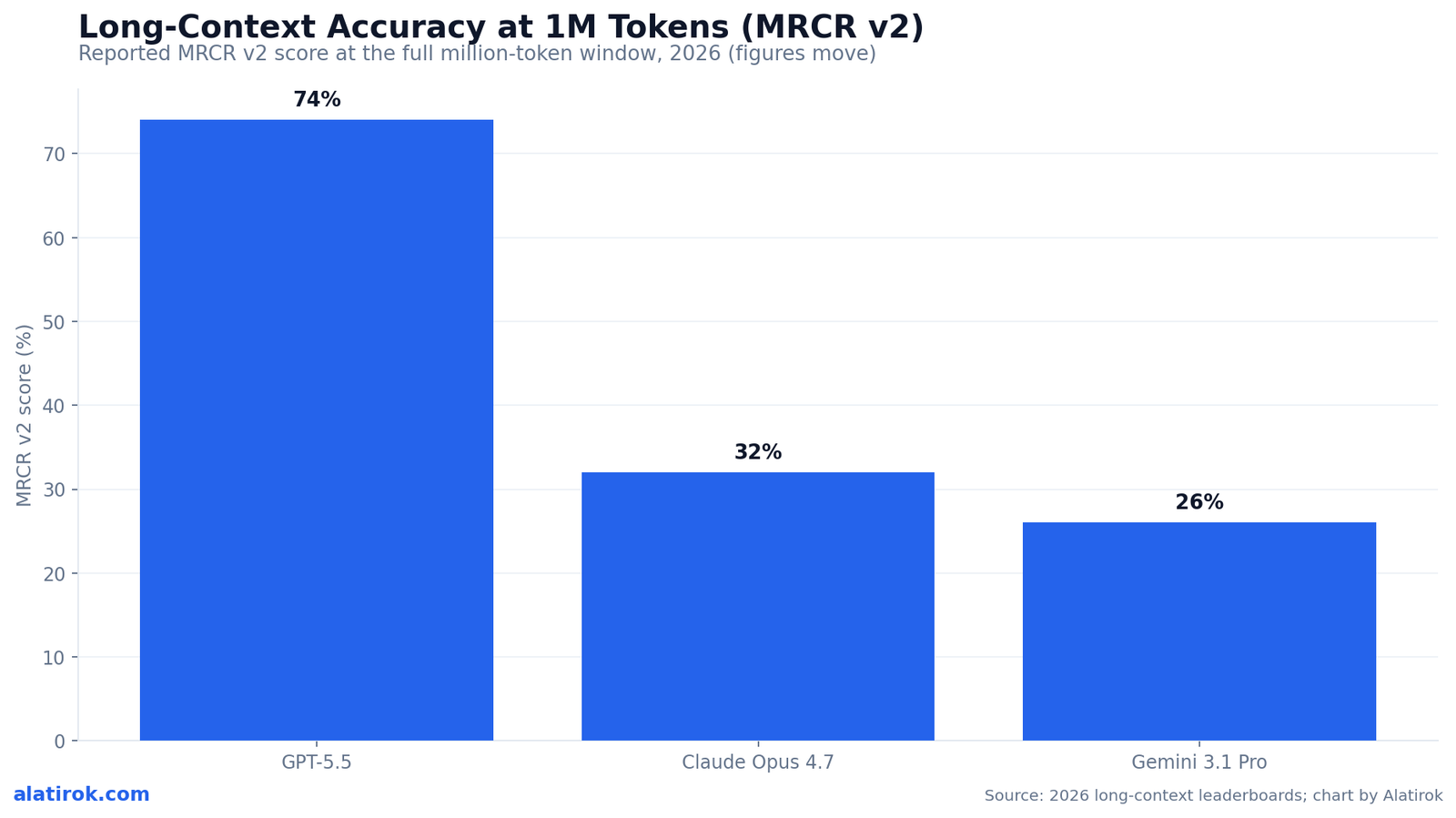
Gemini 3.1 Pro’s 1M-token context window lets it read an entire codebase or document corpus before it writes a line, which removes a whole class of chunking and retrieval glue code. Combined with $2 / $12 pricing and context caching that can cut costs by up to 75%, it is the obvious choice for whole-repo triage, large-document analysis, and high-volume batch jobs — just watch the price step-up to $4 / $18 for prompts over 200K tokens.
GPT-5.5 is the DevOps and terminal specialist. It posts a state-of-the-art 82.7% on Terminal-Bench 2.0, which tests multi-step command-line workflows requiring planning, iteration, and tool coordination — exactly the shape of CI/CD automation, infrastructure scripting, and Codex-style terminal agents. For reasoning, Opus 4.8 leads multidisciplinary tests like Humanity’s Last Exam (49.8% without tools, 57.9% with tools) and the GDPval-AA knowledge-work benchmark, though all three are strong enough that task fit usually matters more than the reasoning gap.
Route here for: long context and cost
Gemini 3.1 Pro. Whole-codebase reads, large document analysis, high-volume batch jobs. 1M-token window, $2 / $12 per 1M, caching up to 75% off. Watch the over-200K-token tier at $4 / $18.Route here for: DevOps and terminal
GPT-5.5. CI/CD automation, shell-driven agents, Codex-style workflows. 82.7% on Terminal-Bench 2.0. Priced at $5 / $30; the deliberative GPT-5.5 Pro variant runs $30 / $180 for long-horizon refactors.Route here for: hard reasoning
Claude Opus 4.8. Multidisciplinary problem-solving and knowledge work; leads Humanity’s Last Exam and GDPval-AA. All three models are close here, so weigh price and latency too.Scorecards: how each frontier model ranks
Scored on a 10-point scale weighted for production agent workloads, Claude Opus 4.8 takes the top overall slot for capability, Gemini 3.1 Pro wins on value, and GPT-5.5 anchors DevOps and terminal use cases. These scores reflect task fit and price-to-performance as of late May 2026, not a single universal ranking.
Claude Opus 4.8
Best for: Agentic coding, migrations, hard reasoning
What works
Watch out for
Gemini 3.1 Pro
Best for: Long context, cost-sensitive and batch work
What works
Watch out for
GPT-5.5
Best for: Terminal, DevOps, agentic tool use
What works
Watch out for
The verdict: pick by task, re-test every release
No single winner — route agentic coding to Opus 4.8, long context and cost to Gemini 3.1 Pro, DevOps to GPT-5.5
If you can only run one frontier model, Claude Opus 4.8 is the safest default for agent-heavy engineering teams; if cost and context dominate your workload, Gemini 3.1 Pro is the smarter buy; and GPT-5.5 is the call for terminal-first DevOps automation. But the real winning move in 2026 is to route per task rather than standardise on one model.
The economics reward routing. Sending whole-repo reads to Gemini 3.1 Pro, hard patch generation to Opus 4.8, and terminal loops to GPT-5.5 — within a single agent run — captures each model’s strength while paying premium rates only where they earn their keep. That is the model-selection discipline that separates teams who control their inference bill from those who are surprised by it.
Builder’s take
I run model selection as an infrastructure decision, not a brand loyalty one. At Cyntr, our orchestration runtime routes every step of an agent run to whichever model is cheapest for the required quality bar, and the gap between picking right and picking lazily shows up directly in our compute bill and our eval pass rates.
- Route by task, not by vendor. We send agentic patch generation to Opus 4.8, whole-repo reads and triage to Gemini 3.1 Pro, and terminal-heavy DevOps loops to GPT-5.5 — inside a single run.
- The headline output price is a trap. Opus 4.8 at $25 per 1M output looks expensive until you measure tokens-per-solved-task; on hard agentic work it often finishes in fewer turns than a cheaper model that loops.
- Long context is a cost lever, not just a capability. Gemini 3.1 Pro plus context caching cut our retrieval-heavy passes meaningfully versus chunk-and-stuff RAG, but watch the over-200K-token price tier.
- Pin your model versions and re-run your evals on every point release. Opus 4.7 to 4.8 and the GPT-5.4 to 5.5 jump both moved our routing thresholds; numbers from launch week are not gospel.
Frequently asked questions
There is no single best frontier AI model 2026; the leaders specialise. Claude Opus 4.8 leads agentic coding and hard reasoning, Gemini 3.1 Pro wins long context and cost, and GPT-5.5 leads terminal and DevOps automation. Pick by task rather than committing to one vendor.
Claude Opus 4.8 is the strongest agentic coding model as of May 2026, scoring around 88.6% on SWE-Bench Verified and about 69.2% on SWE-Bench Pro. It also has the lowest rate of silent bugs slipping through, which lowers effective cost per merged change on hard tasks.
Gemini 3.1 Pro is the cheapest of the three leaders at roughly $2 per 1M input tokens and $12 per 1M output tokens, with context caching that can cut costs by up to 75%. Pricing steps up to about $4 / $18 for prompts over 200K tokens, so confirm current rates before high-volume use.
Gemini 3.1 Pro offers the longest context window of the three at 1 million tokens, which lets it read an entire codebase or large document corpus in one pass. GPT-5.5 is close at around 1 million tokens, while Claude Opus 4.8 has a 200K-token window.
GPT-5.5 leads terminal and DevOps work, posting a state-of-the-art 82.7% on Terminal-Bench 2.0, which tests multi-step command-line workflows. That makes it well suited to CI/CD automation, infrastructure scripting, and Codex-style terminal agents.
Treat them as a late-May-2026 snapshot, not a permanent ranking. Frontier vendors ship point releases every few weeks and re-price often; GPT-5.5 doubled its API rates versus GPT-5.4, for example. Pin your model versions, re-confirm prices against vendor docs, and re-run your own evals on every release.
Primary sources
- Anthropic ships Claude Opus 4.8, tops GPT-5.5 in most benchmarks — The Decoder
- OpenAI unveils GPT-5.5 at double the API price — The Decoder
- Gemini 3.1 Pro benchmarks, pricing and context window — LLM-Stats
- Claude Opus 4.8 launch, benchmarks and more — LLM-Stats
- Introducing GPT-5.5 — OpenAI
- Gemini 3.1 Pro complete guide 2026 — NxCode
Last updated: May 31, 2026. Related: Products.