
An independent, vendor-neutral matrix of autonomous SOC analysts ranked on the one number buyers budget against: cost per investigation, plus autonomy, integrations, and decision-trail transparency.
What are the best AI SOC agents 2026, ranked by cost per investigation?
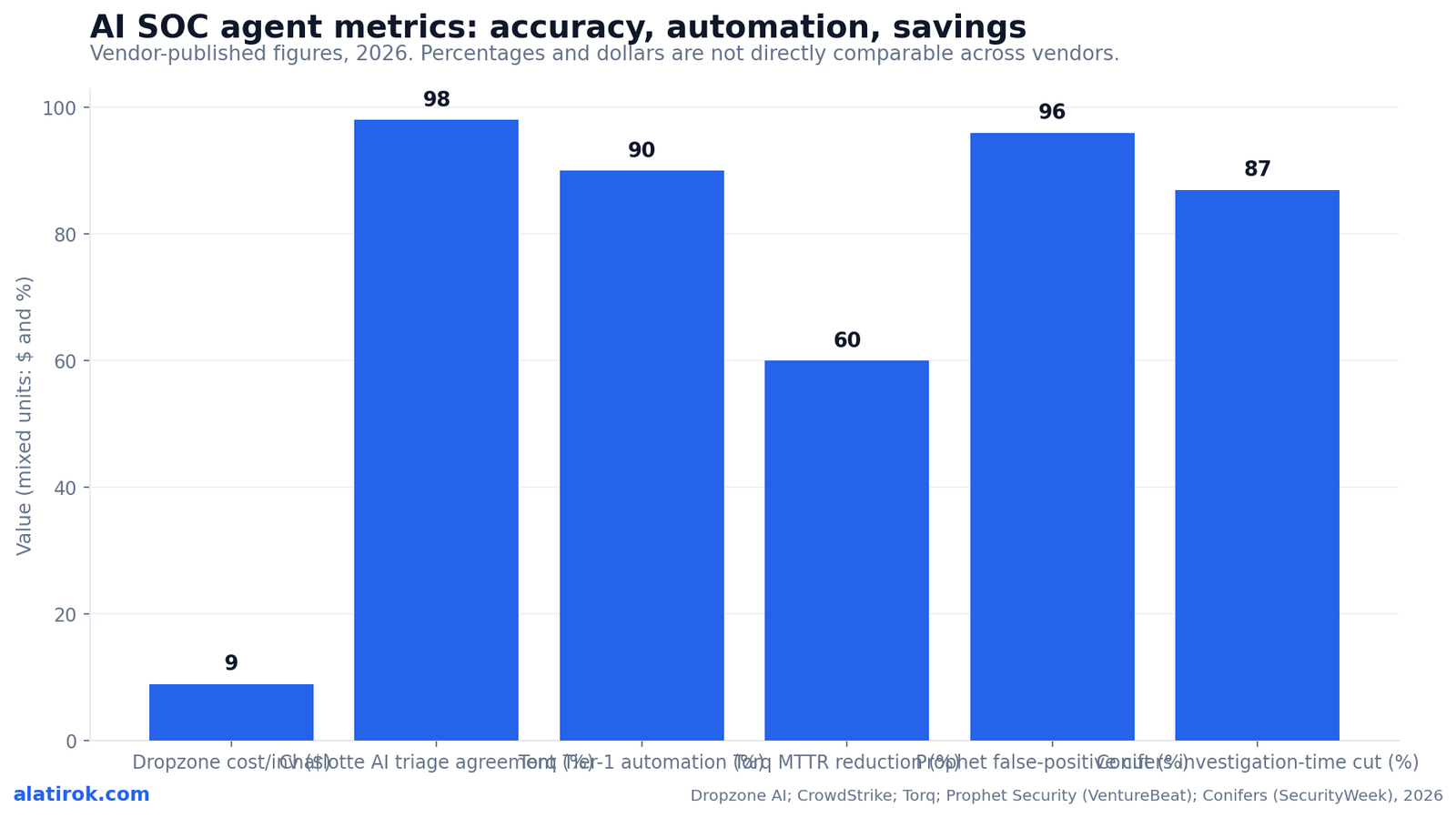
The best AI SOC agents 2026 for transparent economics is Dropzone AI at roughly $9 per investigation ($36,000/year for 4,000 investigations), and for raw triage accuracy it is CrowdStrike Charlotte AI at a verified 98%+ agreement rate with human Falcon Complete analysts. But the honest answer for most buyers is that the ‘best’ agent is the one whose pricing model matches your actual alert volume and whose decision trail your analysts can audit. That is the lens this independent ranking uses, because almost every other ranking you will find is published by an AI SOC vendor that quietly ranks itself first.
We are an independent publication. We sell no SOC platform. So instead of leading with a marketing metric, we lead with the number security buyers actually budget against: cost per investigation. Then we layer in the three things that decide whether that number holds up in production: autonomy level (triage-only versus investigate-and-respond), integration breadth, and the transparency of the decision trail.
The uncomfortable truth across the agentic SOC platforms category is that only one major vendor publishes a real per-investigation price. Dropzone AI lists ~$36,000/year for up to 4,000 investigations per AI analyst, which works out to about $9 each. Almost everyone else, including Conifers, Prophet Security, Torq, and the platform-embedded agents from CrowdStrike and SentinelOne, sits behind ‘request a quote.’ That opacity is itself a buying signal, and we flag it explicitly in the matrix below.
AI SOC analyst pricing and autonomy: the vendor-neutral matrix
Here is the data-led comparison no vendor will publish about its rivals: cost per investigation where it is public, autonomy level, integration count, Tier coverage, and whether pricing is transparent or hidden behind a quote. Treat ‘request a quote’ as a yellow flag, not a dealbreaker, but model the worst case when a vendor will not commit a number to a public page.
Dropzone AI is the transparency outlier and the reason this whole category is buyable on a spreadsheet. Its flat ~$9/investigation economics are clean, but Intezer’s teardown notes a real catch: Dropzone charges per alert ingested, which has pushed some customers to cherry-pick which alerts to feed the agent, creating exactly the coverage blind spots a SOC is supposed to eliminate. Cost transparency and cost discipline are not the same thing.
An ‘investigation’ is not standardized across vendors. Dropzone counts a full autonomous investigation per ingested alert. Platform-embedded agents (CrowdStrike, SentinelOne) bundle triage into a broader license, so your real per-investigation cost depends on alert volume and which module tier you buy. Always normalize to YOUR annual alert count before comparing quotes.
| Platform | Cost / investigation | Autonomy level | Integrations | Tier coverage | Pricing transparency |
|---|---|---|---|---|---|
| Dropzone AI | ~$9 (~$36K/yr, 4,000 invs) | Investigate (software-only analyst) | 90+ | Tier 1-2 | Public |
| CrowdStrike Charlotte AI | Quote (Falcon module add-on) | Triage + Agentic SOAR response | Falcon ecosystem + AgentWorks | Tier 1-2 | Quote |
| SentinelOne Purple AI (Athena) | Quote (Singularity add-on) | Investigate + full-loop response | Singularity + 3rd-party SIEM/data lakes | Tier 1-3 | Quote |
| Torq (Socrates / HyperSOC) | Quote (enterprise contract) | Investigate + respond (multi-agent) | Custom hyperautomation | Tier 1-3 | Quote |
| Prophet Security | Quote (claims ~$400K/yr savings) | Triage + investigate + respond | Broad connector set | Tier 1-2 | Quote |
| Conifers CognitiveSOC | Quote (Series A, undisclosed) | Investigate (Tier 2 focus) | Mesh agentic connectors | Tier 2-3 | Quote |
Dropzone AI alternatives: who wins on transparent economics?
If you are shopping Dropzone AI alternatives specifically for transparent, software-only pricing, there is no like-for-like competitor publishing a per-investigation number, which is precisely why Dropzone keeps appearing at the top of buyer shortlists. The closest alternatives compete on different axes: Intezer on forensic depth and a sub-2% escalation rate across 100% of alerts, Prophet Security on autonomous response and continuous learning, and Radiant Security on adaptive triage with auto-closure of false positives.
Where Dropzone’s economics get challenged is the per-alert ingestion model. If your environment generates a high, noisy alert volume, the ~$9-per-investigation figure can balloon, or worse, push your team to ingest selectively. Hybrid models like UnderDefense (publicly priced around $11-15 per endpoint per month with 250+ bidirectional integrations) and platform-embedded agents avoid per-alert metering by bundling cost into seats or endpoints, which is more predictable for high-volume SOCs even when it is less itemized.
For an autonomous alert triage AI specifically, the practical Dropzone alternatives split into two camps: software-only analysts you bolt onto an existing stack (Dropzone, Prophet, Conifers, Intezer) and agents native to a security platform you already own (Charlotte AI inside Falcon, Purple AI inside Singularity). The native agents win on data gravity and zero integration lift; the software-only analysts win on stack-neutrality if you run a best-of-breed, multi-vendor environment.
Pros
Cons
Tier 1 SOC automation AI agent vs investigate-and-respond: autonomy levels explained
A Tier 1 SOC automation AI agent triages and closes high-volume, repetitive alerts; an investigate-and-respond agent goes further and takes containment actions like isolating a host or disabling an account. The distinction matters because every additional autonomous step multiplies error risk, so you want maximum autonomy on triage and a hard human gate on state-changing response.
Torq Socrates is the clearest Tier 1 automation story: Torq claims it closes over 90% of Tier-1 tickets autonomously, cuts manual work dramatically, and drops MTTR by more than 60% on core use cases, with human analysts retaining control of critical decisions. That human-in-control framing is the right posture. Socrates reads natural-language runbooks and derives action flows, which is powerful for repeatable Tier 1 work and fragile for novel incidents.
On the investigate-and-respond end, SentinelOne’s Purple AI Athena release shipped one-click Auto Investigation at RSAC 2026 and chains auto-triage into full-loop response workflows that it then proposes to automate for next time. CrowdStrike pushed even further on March 25, 2026, launching the Charlotte AI AgentWorks ecosystem and seven new agents plus Charlotte Agentic SOAR, an orchestration layer that coordinates a whole ‘agentic security workforce’ across vendors. Powerful, but the more the agent acts on its own, the more you are betting on chained probabilistic decisions holding up.
“Maximum autonomy on triage, a hard human gate on any action that changes state. Reverse that and you have built a faster way to mis-triage at scale.”
Alatirok independent analysis
How accurate are AI SOC agents, and where do they still need a human?
~$9
Dropzone AI cost per investigation
Only major vendor with a public per-investigation price (~$36K/yr, 4,000 invs)
98%+
Charlotte AI agreement with human analysts
Trained on millions of Falcon Complete triage decisions
1M+
Prophet Security autonomous investigations
Across customers in six months; ~96% false-positive reduction
75%
of SOC teams at skill-erosion risk by 2030
Gartner warning on overreliance on AI triage
The best AI SOC agents 2026 hit genuinely impressive triage accuracy, CrowdStrike Charlotte AI reports a 98%+ agreement rate with human Falcon Complete analysts and Prophet Security claims a 96% false-positive reduction, but they still need a human for organizational context, novel threats, ambiguous cases, and any high-stakes containment decision. Accuracy on routine triage is close to solved; judgment under ambiguity is not.
The numbers are real and worth respecting. Charlotte AI’s Detection Triage was trained on millions of real-world Falcon Complete decisions and CrowdStrike reports it eliminates 40+ hours of manual work per week. Prophet Security says its agent ran more than 1 million autonomous investigations across customers in six months, saving an estimated 360,000 analyst hours. Conifers claims an 87% reduction in investigation time and roughly 3x analyst throughput on Tier 2 work. These are step-changes in throughput, not marketing fluff.
But accuracy is per-step, and SOC investigations are multi-step. This is where our agent error-compounding analysis matters: a 97% per-step success rate degrades sharply across a long investigate-enrich-correlate-respond chain, because the failure probabilities multiply. A 98% triage verdict that feeds a 95% enrichment step that feeds a 95% response decision is no longer a 98% system. Radiant Security and others are blunt about the limits: AI struggles with ambiguity, exceptions, and understanding why something is happening, and Gartner has warned that overreliance could erode foundational analysis skills in 75% of SOC teams by 2030. The agent is a force multiplier, not a replacement, and any vendor claiming otherwise is selling you the demo, not the median day.
Decision-trail transparency: the buying criterion no vendor leads with
The single most underrated buying criterion for agentic SOC platforms is decision-trail transparency, whether an analyst can see the evidence the agent gathered, the reasoning behind its verdict, and a one-click path to overturn it. Without it, you cannot trust autonomous closure, and you cannot defend a missed alert to an auditor or regulator.
ReliaQuest and other practitioners converge on four buyer questions: does it integrate with my stack, is it autonomous or advisory, does it cover Tier 1 and Tier 2, and can I verify the decision trail. The first three get all the marketing oxygen; the fourth decides whether the platform survives an incident review. The vendors doing this well surface evidence-backed, explainable verdicts so a human can trust, or reject, the AI’s conclusion in seconds.
This is also where pricing transparency and decision transparency correlate. Dropzone delivers analyst-ready reports for every investigation, which is part of why it can publish a flat per-investigation price, the unit of work is legible. The platforms hiding behind a quote also tend to bury the decision trail inside a broader console, which makes it harder to audit a single verdict in isolation. When you run a proof of concept, do not just measure how many alerts the agent closed; pull ten closed cases at random and ask whether a junior analyst can reconstruct, and defend, exactly why each one was closed.
Proof-of-concept test that beats any demo: feed the agent 100 of YOUR real alerts, then pull 10 closed cases at random and ask whether a junior analyst can reconstruct and defend each verdict from theWhich AI SOC agent should you buy in 2026? The verdict
Best AI SOC agent depends on your stack and alert volume, not a leaderboard
Buy Dropzone AI if you run a multi-vendor stack and need transparent ~$9-per-investigation economics on a predictable alert volume. Buy CrowdStrike Charlotte AI or SentinelOne Purple AI if you already live inside Falcon or Singularity and want native agents with no integration lift. Buy Torq for runbook-heavy Tier 1 automation, and Conifers for deep Tier 2-3 investigation. In every case, gate state-changing actions behind a human and demand an auditable decision trail.
There is no universal ‘best AI SOC agent 2026,’ and any ranking that crowns one winner for everyone is either a vendor ranking itself or a list that ignored your alert volume. The right pick is a function of three things you can measure before you sign: your annual alert count (which sets your real cost per investigation), your existing security platform (which sets your integration lift), and your appetite for autonomous response (which sets your risk).
What does not vary is the discipline. Lead your evaluation with cost per investigation normalized to your own volume, not a vendor’s headline accuracy number. Insist on a human approval gate for any action that changes system state, because autonomy compounds error across multi-step investigations. And weight decision-trail transparency as heavily as raw automation percentage, because the day you have to explain a missed breach, the explainable agent is the only one that saves you. For the wider context, see our coverage of AI in cybersecurity 2026, the best AI SRE agents 2026 for ops incidents, and the data behind AI agent error-rate compounding and AI agent failure rates in 2026.
Builder’s take
I run AI orchestration in production at Cyntr, so I read SOC-agent marketing the way I read my own changelogs: with the assumption that the demo is the best case, not the median case. Three things every buyer should internalize before signing.
- Cost per investigation is the only number that survives contact with your actual alert volume. A ‘98% accuracy’ headline is meaningless if the platform charges per alert ingested and you respond by cherry-picking which alerts to feed it, which is exactly the blind spot Dropzone customers report.
- Autonomy compounds errors. An agent that triages at 98% accuracy and then takes a containment action chains two probabilistic steps; my error-compounding data shows that 95-98% per-step reliability collapses fast over multi-step investigate-and-respond loops. Demand a human approval gate on any state-changing action, not just on closure.
- Transparency is the moat, not the model. The vendors worth buying show you the evidence trail and the reasoning behind a verdict so an analyst can overturn it in seconds. If you cannot audit why the agent closed an alert, you are not buying a SOC analyst, you are buying a faster way to mis-triage at scale.
Frequently asked questions
The best AI SOC agents 2026 include Dropzone AI (best for transparent ~$9-per-investigation pricing and stack neutrality), CrowdStrike Charlotte AI (best triage accuracy at 98%+ agreement with human analysts, if you run Falcon), SentinelOne Purple AI Athena (best full-loop investigate-and-respond), Torq Socrates (best Tier 1 automation at 90%+ of tickets), and Conifers CognitiveSOC (best deep Tier 2-3 investigation). The right pick depends on your alert volume, existing platform, and autonomy appetite, not a single leaderboard.
Dropzone AI is the only major vendor publishing a per-investigation price: roughly $9 each, based on about $36,000/year for up to 4,000 investigations per AI analyst with unlimited users. Almost every other agentic SOC platform, including CrowdStrike Charlotte AI, SentinelOne Purple AI, Torq, Prophet Security, and Conifers, hides pricing behind a quote, so you must normalize their proposals to your own annual alert volume to get a comparable per-investigation cost.
The closest Dropzone AI alternatives are Prophet Security (autonomous triage, investigate, and respond with ~96% false-positive reduction), Intezer (forensic-grade investigation across 100% of alerts with a sub-2% escalation rate), Conifers CognitiveSOC (deep Tier 2-3 focus), Radiant Security (adaptive triage with auto-closure), and platform-native agents like CrowdStrike Charlotte AI and SentinelOne Purple AI. None publishes a per-investigation price the way Dropzone does, which is why Dropzone remains the transparency leader.
No. AI SOC agents in 2026 handle high-volume, repetitive triage extremely well, CrowdStrike reports 98%+ agreement with human analysts and Torq claims 90%+ Tier-1 automation, but they still need humans for organizational context, novel threats, ambiguous cases, and high-stakes containment. Accuracy is per-step, and errors compound across multi-step investigations, so the consensus is that agents are force multipliers, not replacements. Gartner has even warned that overreliance could erode foundational analysis skills in 75% of SOC teams by 2030.
A triage-only (Tier 1 automation) agent assesses and closes or escalates alerts but does not take containment actions. An investigate-and-respond agent goes further, gathering evidence and then executing actions like isolating a host or disabling an account, sometimes in a full automated loop (SentinelOne Purple AI, CrowdStrike Charlotte Agentic SOAR, Torq HyperSOC). Because each autonomous step multiplies error risk, the recommended posture is maximum autonomy on triage with a hard human approval gate on any state-changing response action.
Most agentic SOC vendors, including Conifers, Prophet Security, Torq, and the embedded agents from CrowdStrike and SentinelOne, sell through enterprise contracts or platform module add-ons priced on alert volume, endpoints, or seats, and they prefer ‘request a quote’ to avoid anchoring buyers to a number. Dropzone AI is the exception with a public ~$36,000/year price. Treat hidden pricing as a yellow flag and always normalize any quote to your own annual alert count before comparing vendors.
Primary sources
- AI SOC Analyst Pricing & Investigation Capacity — Dropzone AI
- Dropzone AI: Pros/Cons, Pricing & Top 5 Alternatives — Intezer
- CrowdStrike Delivers the Next Breakthrough in AI-Powered Agentic Cybersecurity with Charlotte AI Detection Triage — CrowdStrike
- CrowdStrike Launches the Charlotte AI AgentWorks Ecosystem — CrowdStrike
- Torq Socrates: The AI SOC Analyst That Offloads 90%+ of Tier-1 Cases — Torq
- Purple AI | AI Security Analyst for Autonomous SecOps — SentinelOne
- AI vs. AI: Prophet Security raises $30M to replace human analysts with autonomous defenders — VentureBeat
- Conifers.ai Scores $25M Investment for Agentic AI SOC Technology — SecurityWeek
- 8 Best Agentic SOC Platforms for 2026: Independent Comparison — UnderDefense
- Top 15 AI SOC Tools for 2026: SOC Automation Compared — Intezer
- 8 Best AI SOC Tools Ranked for Enterprise Security Teams — ReliaQuest
- Why AI Can’t Replace a SOC Analyst — Radiant Security
Last updated: June 3, 2026. Related: Observability.