
We graded eight close-automation platforms on the four numbers a controller actually buys on: verified auto-match rate, days-to-close delta, SOX human-approval gate, and where each draws the auto-post-to-GL line.
What are the best AI agents for month-end close in 2026?
The best AI agents for month-end close 2026 are HighRadius, BlackLine, and Trintech Cadency for enterprise SOX-bound teams, and Numeric, FloQast, and Cube for mid-market finance — ranked here not by marketing reach but by verified auto-match rate, days-to-close delta, and how tightly each enforces a SOX human-approval gate before anything posts to the general ledger. If you are a controller choosing reconciliation automation, those are the only four numbers that survive a board review.
Every other ranking you will find on this topic is a vendor blog quietly placing itself at #1, or an aggregator listing logos. None of them grades on the metric you actually sign a contract on: how much of the ledger the agent can match touchlessly, how many days that shaves off the close, what your SOX 404 exposure is when an AI posts a journal entry, and exactly where on the autonomy spectrum each tool sits — continuous-matching, propose-journal-entry, or auto-post-to-GL.
We split this into two leagues because the buying decision is genuinely different. Enterprise teams with intercompany complexity and full SOX programs need a control framework first and a fast close second. Lean mid-market teams need speed and a four-to-eight-week implementation, not a six-figure deployment. We rank within each league, then confront the governance question every vendor deck skips: should you ever let an agent auto-post to the GL?
For the broader autonomy-ranked view across all finance functions, see our companion guide to the best AI accounting agents 2026; for the ROI math behind these deployments, our agentic AI ROI 2026 analysis; and for the control plane these agents demand, our piece on AI agent audit log requirements.
How we ranked agentic AI account reconciliation by close outcomes
We ranked by four controller-grade criteria, weighted toward audited outcomes rather than feature counts: verified auto-match rate across 100% of GL accounts (35%), days-to-close delta from real deployments (30%), SOX human-approval gate and audit-trail depth (25%), and segment fit (10%). A tool that auto-matches 90% of only its easy accounts scores lower than one that matches 80% across the entire ledger, because the close does not finish until the hard accounts do.
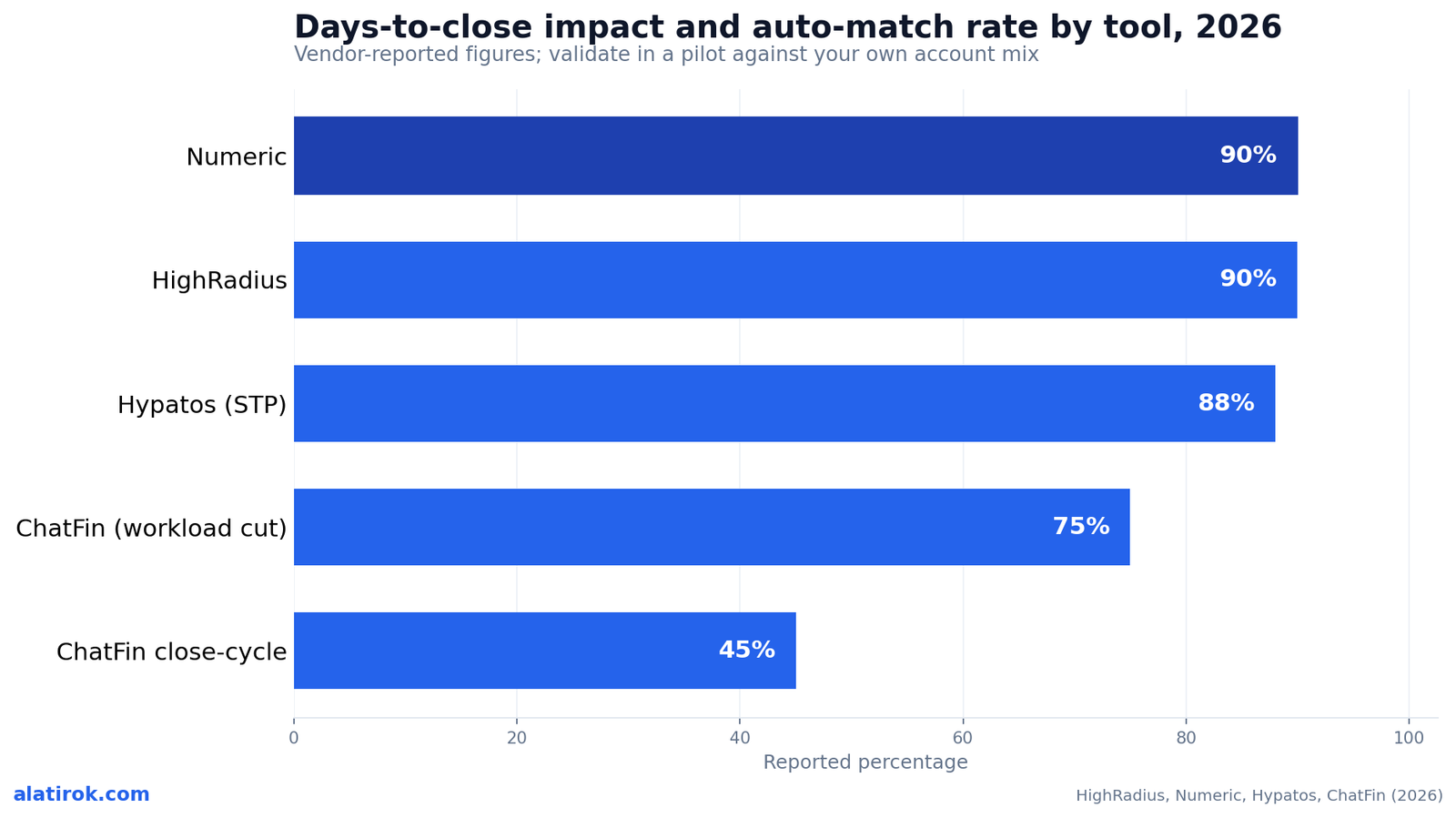
Auto-match rate is the single most-quoted and most-abused number in this category. HighRadius reports a 90% transaction auto-match rate at 99% reconciliation accuracy across 100% of GL accounts; Numeric cites 90%+ auto-match, which it frames as roughly triple the rules-only industry baseline. The figure only means something paired with the accuracy bar your auditors accept and the share of accounts it covers — so we report all three together where vendors disclose them.
Days-to-close delta is the outcome the CFO remembers. HighRadius reports cutting days-to-close by about 30%; ChatFin documents deployments moving a 10-day close to 3 days, and cites teams reaching 40-50% close-cycle reductions within six months. We treat the dramatic single-customer numbers as ceilings, not averages.
The autonomy line is the criterion no competing list grades at all. We classify each tool as continuous-matching (matches transactions as they post, never touches the GL alone), propose-journal-entry (drafts entries and accruals, holds for human approval), or auto-post-to-GL (posts directly, with approval gates configurable per account class). That distinction is where your SOX exposure lives.
Vendor blogs grade on features and logos. Controllers buy on four numbers: verified auto-match rate across all accounts, days-to-close delta, SOX approval-gate depth, and where the auto-post-to-GL line sits. Every score below is anchored to those.
The 8 best AI close automation tools 2026, ranked and compared
Across both leagues, HighRadius leads enterprise on verified auto-match rate (90% across 100% of accounts) and BlackLine leads on SOX maturity (20+ years of audited reconciliation), while Numeric leads mid-market on AI-native auto-match and Cube wins for FP&A-led lean teams. The table below is the fastest way to see where each tool draws its autonomy line and whether it enforces the human-approval gate SOX 404 expects.
Read the table by your constraint, not by rank. If your auditor is the gatekeeper, weight the SOX-gate column. If your CFO has mandated a faster close this fiscal year, weight days-to-close. If you are mid-market, ignore the enterprise rows entirely — over-buying a Trintech-class engine for 50 accounts is a classic controller mistake.
“Auto-match rate is the number vendors sell. Auto-match rate at your auditor’s accuracy bar, across 100% of your accounts, is the number you buy on.”
Alatirok close-automation review, 2026
| Rank | Tool | Segment | Verified auto-match rate | Days-to-close delta | Autonomy line | SOX human-approval gate? | Best-fit |
|---|---|---|---|---|---|---|---|
| 1 | HighRadius | Enterprise | 90% (99% accuracy, 100% of GL accounts) | ~-30% | Auto-post-to-GL (configurable) | Yes, per account class | Large O2C/treasury orgs wanting touchless close at scale |
| 2 | BlackLine | Enterprise | High, rules + Verity AI anomaly scoring | Significant (varies) | Propose-JE / auto-post (configurable) | Yes, mature SOX framework | SOX-heavy enterprises prioritizing control depth |
| 3 | Trintech Cadency | Enterprise | Strong matching + AI risk rating | Significant (varies) | Propose-JE / auto-post w/ risk routing | Yes, full prepare/review/approve/post trail | Manufacturing, distribution, complex intercompany |
| 4 | ChatFin | Enterprise / upper-mid | Continuous, 70-80% workload cut | 10 days to 3 days reported | Propose-JE (drafts, awaits approval) | Yes, no JE without explicit authorization | ERP-native teams wanting write-back without middleware |
| 5 | Hypatos | Enterprise (AP-led) | 85-92% straight-through (mixed docs) | Cuts AP/recon bottleneck | Auto-post-to-GL within configured params | Yes, parameterized exception gates | Document-heavy AP + intercompany reconciliation |
| 6 | Numeric | Mid-market | 90%+ auto-match (AI + learned rules) | Days vs weeks | Continuous-match / propose-JE | Yes, review workflows | Lean, AI-native finance teams |
| 7 | FloQast | Mid-market | Solid matching + Copilot suggestions | Faster close, fast deploy | Continuous-match / propose-JE | Yes, checklist + sign-off controls | Small-to-mid teams wanting accountant-friendly UX |
| 8 | Cube | Mid-market (FP&A-led) | ERP-synced matching | Days instead of weeks | Propose-JE / continuous | Yes, full audit trails | FP&A-led teams living in Excel/Sheets |
Enterprise league: BlackLine vs HighRadius vs Trintech
For enterprise SOX-bound close, HighRadius wins on verified touchless throughput, BlackLine wins on control maturity, and Trintech Cadency wins for complex intercompany and manufacturing — the BlackLine vs HighRadius vs FloQast question usually resolves to HighRadius or BlackLine once you cross into true enterprise complexity, with FloQast falling to the mid-market tier. All three enforce a human-approval gate; they differ in how aggressively they will post on your behalf.
HighRadius is the throughput leader. It runs 200+ AI agents that automate 60%+ of close tasks, sync GL, sub-ledger, and external systems, post journal entries and accruals, and report a 90% auto-match rate at 99% accuracy across 100% of GL accounts, cutting days-to-close roughly 30%. Its outcome-based pricing (no implementation or subscription fees until go-live) lowers the entry risk for large deployments. This is the most willing of the three to auto-post — which is exactly why its per-account-class approval configuration matters most.
BlackLine is the incumbent the auditors already trust, with 20+ years of SOX-compliant reconciliation and the deepest control framework in the category; its Verity AI layer adds anomaly detection, journal-entry risk scoring, and variance commentary on top of the established engine. You buy BlackLine when control depth and auditor familiarity outrank raw automation percentage. Note enterprise implementations are a serious commitment — six-figure deployments are common.
Trintech Cadency is the specialist for manufacturing, distribution, and heavy intercompany. Its differentiator is an AI risk-rating system that scores each journal entry, routing high-risk entries to humans while letting low-risk, high-volume ones flow — and every journal, human or AI, captures who prepared, reviewed, approved, and posted it with timestamps and supporting docs. That continuous, not reactive, audit posture is the cleanest SOX story of the three.
Two more enterprise-adjacent names earn rows: ChatFin, which matches continuously as transactions post (cutting reconciliation workload 70-80%) and writes back to the ERP natively while insisting no journal entry posts without explicit authorization; and Hypatos, the most purpose-built agentic platform for finance documents, reporting 85-92% straight-through processing in mixed-document environments with autonomous exception resolution and direct ERP posting.
Pros
Cons
Mid-market league: FloQast vs Numeric vs Cube
For mid-market teams, Numeric leads on AI-native auto-match (90%+, learning new rules from history), FloQast wins for accountant-friendly close management with fast deployment, and Cube wins for FP&A-led teams that live in Excel and Google Sheets — none requires the six-figure implementation the enterprise tier does. If you close dozens rather than hundreds of accounts, this is your league; do not let an enterprise sales motion talk you out of it.
Numeric is the most AI-native of the newer entrants. Its matching builds on rules but learns from historical patterns, parses inconsistent text fields, suggests new rules, and flags probable matches a pure rules engine misses — reaching a 90%+ auto-match rate it frames as roughly triple the rules-only baseline. Its variance commentary is among the best in class, and a recent $51M Series B is funding expansion from close management toward a broader finance platform. Buy Numeric when you want enterprise-grade matching quality without the enterprise implementation.
FloQast targets controllers who want their existing close to run better, not a re-platforming. Its strength is accountant-friendly UX, checklist-driven close management, sign-off controls, and a Copilot layer that suggests reconciliations and flags anomalies — with implementation typically measured in weeks. It leans continuous-match and propose-JE; it is not trying to auto-post your ledger for you, which many mid-market teams consider a feature, not a gap.
Cube is the FP&A-native pick. It syncs trusted data directly into Excel and Google Sheets, handles multi-entity consolidation, automated intercompany eliminations, and full audit trails, with AI agents that understand your chart of accounts — closing the books in days instead of weeks. Choose Cube when your close and your planning live in the same spreadsheets and you want one tool spanning both.
Numeric for AI-native match quality at a mid-market footprint; FloQast if accountant-friendly UX and a weeks-long implementation matter more than raw automation percentage; Cube if FP&A and close share the same spreadsheets.
The SOX risk no vendor blog confronts: should an agent auto-post to the GL?
No, you should not let an AI agent auto-post to the general ledger without a configured human-approval gate on any account material to your financial statements — SOX 404 requires segregation of duties and management’s certification of controls, and an unsupervised agent posting journal entries collapses preparer and approver into a single non-human actor. This is the control risk every vendor ranking skips, and it is the one your audit committee will ask about first.
The defensible pattern is autonomy by account class, not autonomy by product tier. Let the agent auto-post the low-risk, high-volume, well-defined accounts where the match is mechanical — bank clearing, payroll suspense, routine intercompany. Keep a propose-then-approve gate on estimates, accruals, reserves, and anything requiring judgment. HighRadius, BlackLine, and Trintech all support this per-account configuration; the mistake is flipping everything to auto-post because the demo looked clean.
Audit-trail depth is the second non-negotiable. Trintech’s model — every journal, human or AI, capturing who prepared, reviewed, approved, and posted it with timestamps and supporting documents — is the bar. The AI should appear in that trail as a distinct, named actor, never masked behind a generic service account, so an auditor can reconstruct exactly which entries an agent originated. ChatFin’s stance that no journal entry posts without explicit authorization is the right default for teams early in their agent journey.
Treat the agent like a new staff accountant on day one: scoped permissions, every action logged, a human reviewer on anything material, and a widening mandate only as it earns trust on the easy accounts. For the full control-plane requirements, see our deep dive on AI agent audit log requirements.
SOX 404 rule of thumb for 2026: auto-post the mechanical, high-volume accounts; keep a human-approval gate on every estimate, accrual, and reserve. Autonomy by account class, never by product tier.How much can you really reduce days to close with AI?
90%
HighRadius auto-match rate
at 99% accuracy across 100% of GL accounts
~30%
Typical days-to-close cut
HighRadius-reported; plan around this, not the outlier
10 to 3 days
ChatFin flagship close
single-deployment ceiling, not an average
Realistically, AI close automation cuts days-to-close by roughly 30-50% within the first six months for most teams, with standout single deployments compressing a 10-12 day close to 3 days — but the average organization should plan around the 30% figure, not the headline outlier. The variance comes almost entirely from your starting account mix and how much you let the agent automate versus gate.
The mechanism is consistent across tools: agents move reconciliation from a month-end sprint to continuous matching, so transactions match as they post rather than in a frantic close window. HighRadius reports a ~30% days-to-close reduction; ChatFin documents 40-50% close-cycle reductions within six months and a flagship 10-day-to-3-day result. Numeric and Cube both frame the shift as closing in days instead of weeks for mid-market teams.
Where teams under-deliver on these numbers, the cause is rarely the model — it is exception handling and data plumbing. If your ERP integration is CSV exports and middleware sync delays, the agent waits on stale data and your close does not compress. The tools that write back natively to the ERP (ChatFin, Hypatos, HighRadius) remove that latency; the ones that route exceptions intelligently keep humans from becoming the new bottleneck.
Which AI close agent should you choose? The verdict
HighRadius for enterprise throughput, Numeric for mid-market AI-native close — and a configured human-approval gate, always
Choose HighRadius if you are enterprise and want the highest verified touchless close; BlackLine if SOX control depth and auditor familiarity outrank automation percentage; Trintech Cadency for complex intercompany and manufacturing; and in mid-market, Numeric for AI-native match quality, FloQast for accountant-friendly speed, or Cube if FP&A and close share your spreadsheets. Match the tool to your league and your gatekeeper, then prove the auto-match rate in a pilot before you trust the deck.
Whatever you pick, the decision that matters more than the vendor is where you draw the auto-post-to-GL line. Start conservative — propose-and-approve on everything material — and widen the agent’s mandate account class by account class as it earns trust on the mechanical work. That is how you get the days-to-close win without the SOX headache.
Builder’s take
I build agent orchestration for a living at Cyntr, so I read these close-automation pitches through one lens: where exactly does the autonomy line sit, and who is liable when the agent is wrong? Here is what I tell finance friends evaluating these tools.
- The headline number vendors sell is auto-match rate; the number you should buy on is auto-match rate at your audit’s required accuracy, across 100% of accounts — a 90% match on the easy 60% of accounts is not a 90% close.
- Treat ‘auto-post-to-GL’ as a permission you grant per account class, not a product tier. The mature platforms (BlackLine, Trintech, HighRadius) let you keep a propose-then-approve gate on high-risk accounts and only fully automate the low-risk, high-volume ones.
- An agent that posts journal entries needs the same audit log discipline I demand from any autonomous system: immutable who/what/when on prepare, review, approve, post — and the AI identity recorded as a distinct actor, not hidden behind a service account.
- Days-to-close is the outcome metric, but it is downstream of exception routing quality. The agent that routes the right exception to the right human fastest beats the one with the flashiest match percentage.
- Mid-market teams should not over-buy enterprise reconciliation engines. If you close 50 accounts, Numeric or FloQast will get you to a fast close without a six-figure implementation.
Frequently asked questions
For enterprise teams, HighRadius leads on verified auto-match (90% at 99% accuracy across 100% of GL accounts) with a ~30% days-to-close cut, while BlackLine leads on SOX control depth. For mid-market, Numeric leads on AI-native auto-match (90%+), with FloQast and Cube strong for accountant-friendly and FP&A-led teams respectively. The right pick depends on your segment and which number — auto-match rate, days-to-close, or SOX gate — governs your decision.
Leading tools report 85-92%+ auto-match or straight-through rates: HighRadius cites 90% at 99% accuracy across 100% of GL accounts, Numeric cites 90%+ (roughly triple the rules-only baseline), and Hypatos reports 85-92% straight-through on mixed documents. Always validate these against your own account mix in a pilot — a high rate on easy accounts means little if the hard accounts still need manual work.
Most teams see a 30-50% reduction in days-to-close within about six months. HighRadius reports roughly 30%; ChatFin documents 40-50% close-cycle reductions and a flagship deployment going from a 10-day to a 3-day close. Plan your business case around the 30% figure rather than the dramatic single-customer outliers.
Only with a configured human-approval gate on any account material to your financial statements. SOX 404 requires segregation of duties, which an unsupervised agent posting entries undermines by collapsing preparer and approver into one non-human actor. The safe pattern is autonomy by account class: auto-post mechanical, high-volume accounts and keep a propose-then-approve gate on estimates, accruals, and reserves.
BlackLine and HighRadius are enterprise-tier: HighRadius for the highest verified touchless automation, BlackLine for the deepest SOX control framework and auditor familiarity. FloQast is mid-market — choose it when accountant-friendly UX and a weeks-long implementation matter more than raw automation percentage. If you have complex intercompany or manufacturing, also evaluate Trintech Cadency.
Every journal entry, human or AI, must capture who prepared, reviewed, approved, and posted it, with timestamps and supporting documentation — Trintech Cadency’s model is a good benchmark. Critically, the AI should appear in that trail as a distinct, named actor rather than hidden behind a generic service account, so auditors can reconstruct exactly which entries an agent originated.
Primary sources
- Agentic AI Account Reconciliation — 90% auto-match, 99% accuracy, 30% faster close — HighRadius
- Month-End Close Process 2026: the path to a 3-day close — HighRadius
- Top 10 AI Tools for Month-End Close Automation, 2026 Edition — ChatFin
- 10 Best Account Reconciliation Software Options for 2026 — Numeric
- Reconciliation Automation in 2026: Strategy, ROI, and Implementation — Numeric
- Cadency: Financial Close Software — journal approval, SOX audit trail — Trintech
- AI Journal Entry Management — risk rating and approval routing — Trintech
- Close & Consolidation Software for FP&A Teams — Cube
- Autonomous transactions with agentic AI — Hypatos Platform — Hypatos
- Numeric Raises $51M Series B, Expanding to a Comprehensive Finance Platform — PR Newswire
Last updated: June 6, 2026. Related: Products.