
Stanford’s ADP-payroll study found AI hollowed out the bottom rung of the ladder for 22-to-25-year-olds while experienced workers in the same firms held steady or grew.
What the Stanford AI entry-level job displacement 2026 finding actually says
Workers aged 22 to 25 in the most AI-exposed occupations saw a 13% relative decline in employment since ChatGPT launched, while experienced workers in the same firms and occupations held flat or grew 6-13%. That is the core result from the Stanford Digital Economy Lab’s Canaries in the Coal Mine? study by Erik Brynjolfsson, Bharat Chandar, and Ruyu Chen, drawn from ADP payroll records covering roughly 25 million U.S. workers from 2021 through 2025. That asymmetry is the heart of the AI entry-level job displacement 2026 story: the bottom rung is bearing the hit, not the whole ladder.
The headline matters because it overturns the comfortable assumption that AI’s labor effects would be diffuse and slow. They are neither. The damage is sharp, recent, and concentrated almost entirely on the youngest workers in jobs where large language models can do the work rather than merely assist it. The same study found older workers in those identical occupations untouched, and workers of every age in low-exposure jobs steady or growing.
Two numbers circulate for this finding and it is worth being precise about both. The 13% figure is a relative decline, produced by a regression that strips out firm-level shocks so it isolates the AI-exposure effect within companies. The simpler descriptive number, the raw drop in young-worker headcount in exposed jobs between late 2022 and September 2025, is about 6%. Same direction, different framing. The 13% answers ‘how much worse did young exposed workers do than they otherwise would have,’ and the 6% answers ‘how many fewer of them are on payrolls.’
This is not a survey or a forecast. It is administrative payroll microdata, the kind of evidence labor economists treat as close to ground truth, and it is the first large-scale empirical fingerprint of generative AI on the U.S. job market.

AI did not shrink the workforce. It removed the bottom rung of the ladder for one specific group: 22-to-25-year-olds in jobs where a model can replace the task instead of helping with it.
The chart: AI hit the entry rung, not the whole ladder
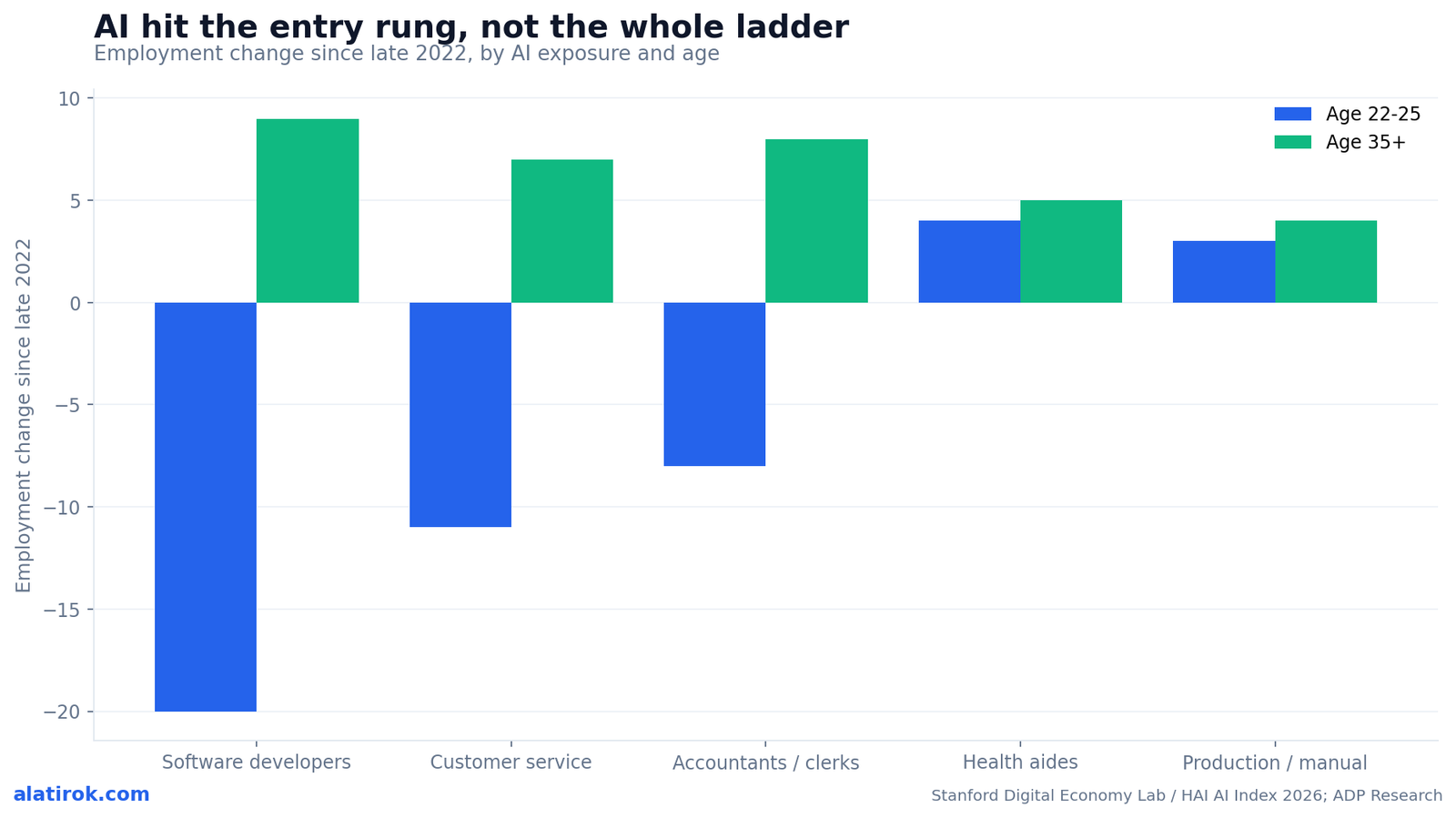
The single clearest way to see the finding is to plot employment change by occupation and split each occupation into young (22-25) versus experienced (35+) workers. When you do, an unmistakable pattern appears: in high-exposure occupations the young bar plunges while the experienced bar rises, and in low-exposure occupations both bars sit near zero or above it.
Software developers are the extreme case. Employment for 22-to-25-year-old developers fell roughly 20% from its late-2022 peak through mid-2025, the steepest drop in the dataset. Customer-service representatives show the same shape but shallower, down about 11% from a November 2022 peak. Accountants, auditors, and administrative clerks round out the high-exposure cluster. Meanwhile experienced developers and customer-service staff kept growing.
Contrast that with the control group. Home health aides, nursing assistants, production supervisors, and manual trades, all low on AI-exposure scores, posted steady or rising employment across every age band. There is no young-worker cliff in jobs a model cannot do. That asymmetry is the whole argument: if a recession or remote-work shift were driving the numbers, you would see young workers struggling everywhere, not only where AI is good at the work.
Why software developers got hit hardest
~20%
Drop in employment for developers aged 22-25
Since the late-2022 peak, the steepest in the dataset
~11%
Decline for early-career customer-service agents
From the November 2022 peak
25M
U.S. workers in the ADP payroll sample
Administrative microdata, not survey responses
+6-13%
Employment growth for experienced workers
Same occupations, older cohorts
Entry-level software development collapsed fastest because junior coding is the most cleanly automatable knowledge work in the modern economy, and 2024-25 is exactly when coding agents got good at it. The roughly 20% decline for 22-to-25-year-old developers is not a coincidence of timing; it tracks the release cadence of capable code-generation tools. Read carefully, the AI entry-level job displacement 2026 data is about the first rung, not a broad jobs collapse.
The mechanism is specific. A new graduate developer‘s value used to be the reliable implementation of well-specified work: turn a ticket into clean, tested code. That is precisely the task an LLM now performs in seconds. What a senior engineer contributes (deciding what to build, catching the subtle architectural mistake, owning the production incident at 3 a.m.) sits outside the model’s reach. Brynjolfsson summarized the intuition bluntly in an interview with The Atlantic’s Derek Thompson: what younger workers know overlaps heavily with what LLMs can replace.
Customer service follows the same logic one notch down. Scripted, knowledge-base-driven support is highly automatable, so junior agents declined about 11%, but the role still has enough genuinely human escalation and empathy work to soften the blow relative to coding.
The takeaway for anyone entering these fields is not despair, it is repositioning. The jobs are not vanishing; the version of the job that consisted of routine, codifiable output is. The version that supervises, reviews, and directs AI output is growing.
“It appears what younger workers know overlaps with what LLMs can replace.”
Erik Brynjolfsson, Stanford Digital Economy Lab
Automation versus augmentation: the line that decides who wins
The decline shows up only in occupations where AI automates the work; in occupations where AI augments the worker, employment grew for every age group including the young. This is the most policy-relevant fact in the entire paper and the one most often dropped from headlines.
The researchers separated AI-exposed jobs into two buckets using task-level data. In automation-heavy roles, where the model substitutes for what a person produces, young-worker employment fell. In augmentation-heavy roles, where the model is a tool a person wields to produce more, employment rose across the board. The exposure score itself comes from the widely cited framework by Eloundou, Manning, Mishkin, and Rock, applied to ADP’s occupational detail.
That split reframes the whole ‘will AI take my job’ question. Exposure to AI is not destiny. Two jobs can be equally AI-exposed and have opposite outcomes depending on whether the technology eats the output or amplifies the worker. The strategic move, for individuals and for companies designing roles, is to engineer work so the human stays in the augmentation column.
It also explains the apparent paradox in the wage data. In AI-exposed sectors like computer systems design, headcount of young workers fell, yet sector wages rose faster than the national average, up roughly 16.7% since fall 2022 per Dallas Fed analysis. The remaining workers, augmented by AI, became more productive and more valuable. Fewer junior seats, higher pay for the seats that remain.
Same AI exposure, opposite fate: if the model replaces your output, your entry-level seat shrinks; if the model amplifies your output, your seat (and your pay) grows. Augmentation, not exposure, is thHow the researchers ruled out the obvious alternatives
The study’s credibility rests on systematically eliminating non-AI explanations, and it did: remote work, the post-COVID tech correction, education effects, and broad macroeconomic shocks were all tested and rejected as the primary driver. Without that work, the 13% number would just be correlation.
The firm-level regression is the key control. By comparing young versus old workers within the same companies, the analysis absorbs anything happening at the firm level, including interest-rate-driven hiring freezes and the well-publicized 2023-24 tech layoffs. If a company slowed hiring across the board, that hits its control group too, so it cannot explain why only young workers in exposed roles declined.
Remote work is ruled out by the cross-occupation pattern. Remote-friendly and in-person AI-exposed jobs showed the same young-worker decline, and remote-friendly low-exposure jobs did not. Education is ruled out because the effect holds when comparing similarly credentialed workers. And the timing aligns with AI capability jumps rather than with the business cycle, which is why the authors invoke the canary metaphor: young workers are the first place the gas shows up.
Independent replication strengthens the case. The Federal Reserve Bank of Dallas reproduced the core pattern in early 2026 using the same ADP universe, finding workers aged 22-25 in the most AI-exposed occupations down about 6% from late 2022 to September 2025 while workers 35-49 in those occupations grew more than 8%, and attributed the young-worker drop to a low job-finding rate rather than layoffs.
| Alternative explanation | How it was tested | Verdict |
|---|---|---|
| Post-COVID tech layoffs / rate shock | Within-firm comparison of young vs. experienced workers | Rejected as primary driver |
| Remote-work shift | Compared remote-friendly vs. in-person exposed jobs | Rejected; pattern holds regardless |
| Education / credential gaps | Compared similarly credentialed cohorts | Rejected |
| General macroeconomic weakness | Low-exposure occupations grew across all ages | Rejected |
| AI automating codifiable tasks | Effect tracks AI-capability timeline and automation roles | Supported |
What this means for hiring managers, graduates, and policy
The honest read is that the first rung of the career ladder is being removed in exactly the jobs new graduates used to start in, but the ladder above it and the trades beside it are intact. The response is not panic; it is redesign.
For hiring managers, the temptation is to stop hiring juniors because a model now does the entry-level output. That is short-term arithmetic with a long-term hole: if no one hires juniors, the senior pipeline runs dry in a decade. The smarter move is to redefine the entry-level job as agent supervision, review, and verification rather than raw production. The junior who can direct and audit AI output is more valuable now than the junior who could only produce it.
For graduates, the data points clearly toward augmentation roles and toward skills the model does not hold: judgment, system design, stakeholder context, and the trades. Notably, low-exposure manual and care work grew for young workers throughout the period, which is reshaping the calculus around four-year degrees versus skilled trades.
For policymakers, the canary framing is a warning, not a verdict. The aggregate unemployment rate barely moved because the adjustment runs through hiring, not firing, which makes it nearly invisible in headline statistics. By the time it shows up in the official numbers, an entire cohort may have missed its on-ramp.
Pros
Cons
The bottom line on AI entry-level job displacement 2026
AI removed the bottom rung in automatable jobs, not the whole workforce
The Stanford evidence is the strongest signal yet that generative AI is already reshaping who gets hired, and it is doing so by quietly closing the door on the youngest workers in automatable jobs rather than by firing anyone. The 13% relative decline for 22-to-25-year-olds in exposed occupations, contrasted against 6-13% growth for their experienced colleagues, is a structural fingerprint, not a cyclical blip.
What makes the finding durable is the discipline behind it: 25 million workers of administrative payroll data, within-firm controls, an independent Dallas Fed replication, and a clean automation-versus-augmentation split that explains why some equally-exposed jobs grew. This is not a vibe about the future of work; it is a measurement of the present.
The actionable lesson is the one builders already feel in their daily workflow. The work that vanished is the codifiable, textbook output a new graduate used to provide. The work that grew is supervision, judgment, and augmented productivity. Whether you are a graduate choosing a path, a manager designing a role, or a policymaker watching an unemployment rate that has not yet caught up, the same instruction applies: build for the augmentation column and rebuild the bottom rung before the pipeline runs dry.
Builder’s take
I run two AI companies and write a lot of code with agents. The Stanford finding lands differently when you’ve watched the work actually move. Here is what I think builders and hiring managers should take from it, beyond the headline.
- The 13% number is a relative decline, not a layoff wave. Young people in exposed jobs are not getting fired in droves; they are not getting hired in the first place. That distinction changes the policy and the personal response entirely.
- What the model replaces is codified, textbook knowledge. The thing a 23-year-old developer brought to a team in 2021 (clean implementation of well-specified tickets) is exactly the thing I now hand to Claude or a coding agent. The thing a senior brings (judgment about what to build) is not.
- Augmentation occupations grew employment for every age. That is the actionable signal. If your role uses AI as a tool that makes you more valuable rather than a substitute for your output, the data says you are safe so far.
- I would not read this as ‘don’t hire juniors.’ I read it as ‘redesign the junior job.’ At Cyntr we still onboard early-career engineers, but their first six months look like supervising and reviewing agent output, not grinding tickets a model now closes in minutes.
- Wages are still rising in these sectors even as junior headcount falls. That tells you the adjustment is running through the hiring door, not the paycheck, which is the hardest kind of disruption to see in the official unemployment rate.
Frequently asked questions
Using ADP payroll records for roughly 25 million U.S. workers from 2021-2025, Stanford’s Digital Economy Lab found that workers aged 22-25 in the most AI-exposed occupations saw a 13% relative decline in employment after ChatGPT’s launch, while experienced workers in the same firms and occupations held flat or grew 6-13%, and low-exposure jobs grew across all ages.
Both come from the same study. The 13% is a relative decline from a regression that controls for firm-level shocks, isolating the AI-exposure effect within companies. The 6% is the simpler descriptive drop in young-worker headcount in exposed jobs between late 2022 and September 2025. They describe the same phenomenon at different levels of statistical adjustment.
Software developers aged 22-25 fell roughly 20% from their late-2022 peak, the steepest in the data. Customer-service representatives dropped about 11% from a November 2022 peak. Accountants, auditors, and administrative clerks also ranked among the most exposed. Operations and general managers scored high on exposure too.
No. In the same AI-exposed occupations, experienced workers (roughly 30 and older, with the Dallas Fed measuring ages 35-49) saw employment hold steady or grow 6-13%. The displacement was concentrated almost entirely on early-career workers whose codifiable, textbook tasks overlap most with what large language models can do.
They compared young versus experienced workers within the same firms, which absorbs company-wide hiring freezes and tech layoffs. They showed remote-friendly and in-person exposed jobs declined alike, ruling out remote work, and that low-exposure jobs grew across all ages, ruling out general weakness. The Dallas Fed independently replicated the pattern in 2026.
Employment fell only in occupations where AI automates the work, substituting for what a person produces. In augmentation occupations, where AI is a tool that amplifies a worker’s output, employment grew for every age group including the young. The same AI-exposure level can produce opposite job outcomes depending on which column the role sits in.
Primary sources
- Canaries in the Coal Mine? Six Facts about the Recent Employment Effects of AI (working paper PDF) — Stanford Digital Economy Lab
- Canaries in the Coal Mine? (publication page) — Stanford Digital Economy Lab
- Yes, AI is affecting employment. Here’s the data. — ADP Research
- Young workers’ employment drops in occupations with high AI exposure — Federal Reserve Bank of Dallas
- AI adoption linked to 13% decline in jobs for young U.S. workers, Stanford study reveals — CNBC
- These Fields Are Losing the Most Entry-Level Jobs to AI — Entrepreneur
- Stanford Confirms Quiet Erosion: First Large-Scale Evidence of AI’s Impact on Entry-Level Jobs — SalesforceDevops.net
Last updated: June 1, 2026. Related: Governance.