
No. You never license the agent. You license the human it acts for. Here is the clean decision, the $15 vs $99 math, and the double-invoice trap nobody warns you about.
Do AI agents need their own Microsoft 365 license?
Do AI agents need their own Microsoft 365 license? No — they do not need their own Microsoft 365 license. You never license the agent itself; you license the human it acts for, and a single Agent 365 license covers every agent associated with that user. Microsoft’s own licensing FAQ states it plainly: “A single Agent 365 license covers all agents associated with that user; agents themselves are not licensed.”
This is the cleanest possible answer to a question that incumbents bury under registry diagrams and SKU tables. If you remember one rule, make it this: the billable unit is a person, not a bot. Forty employees who each own six agents are forty Agent 365 seats, not 240. The agents are free to multiply; the license attaches to the licensed identity behind them.
Microsoft ties the license to “the user associated with the agent (e.g. user, owner, sponsor, or manager).” In practice that means whoever the agent runs on behalf of, or whoever owns and sponsors an unattended agent, is the seat you pay for. The agent inherits coverage through that relationship. So the honest one-line answer to “do AI agents need their own Microsoft 365 license” is: agents inherit a license from the human; they do not consume one of their own.
Agent 365 reached general availability on May 1, 2026 for commercial customers, licensed strictly on a per-user basis. That GA date matters because plenty of pre-2026 commentary treated agent licensing as theoretical. It is now a line item you can buy, and the rules below are the GA rules, not a roadmap.
Count humans, not agents. Agent 365 is licensed per user. One license covers all agents that user owns, sponsors, manages, or that act on their behalf. There is no per-agent SKU at GA.
How much does Agent 365 cost per user?
Agent 365 costs $15 per user per month as a standalone license, billed annually. It is also bundled into the new Microsoft 365 E7 suite at $99 per user per month, which combines Microsoft 365 E5, Microsoft 365 Copilot, Entra Suite, and Agent 365 in one SKU. Both options went GA on May 1, 2026.
Those are the only two ways to buy it. There is no $5 starter, no consumption-only Agent 365 tier, and no per-agent metering for the governance layer itself. You either add the $15 standalone seat to the licenses you already own, or you move up to the $99 E7 bundle and get Agent 365 as one ingredient among four.
The standalone $15 figure is the number most buyers actually need, because most organizations are not ready to re-platform their entire estate onto E7. If you already run Microsoft 365 E3 or E5, you can layer Agent 365 on top at $15 per user without touching the rest of your agreement. SAMexpert prices the bundle’s components separately at roughly $117 ($60 E5 from July 2026, $30 Copilot, $12 Entra Suite, $15 Agent 365), so E7 represents about a 15% discount, but only if you genuinely wanted all four pieces.
A note on the per-seat math: you do not need to license every employee in the tenant. Microsoft requires “at least one user” to hold a qualifying Agent 365 license to enable the service, then recommends licensing the specific users who interact with, own, manage, or sponsor governed agents. Scope the seat count to your agent operators, not your headcount.
| Option | Price (per user/mo) | What you get | Best for |
|---|---|---|---|
| Agent 365 standalone | $15 | Agent 365 governance only (registry, Entra Agent ID, Purview, Defender, observability) | E3/E5 shops adding agent governance without re-platforming |
| Microsoft 365 E7 bundle | $99 | M365 E5 + M365 Copilot + Entra Suite + Agent 365 | Greenfield Copilot + agent rollouts that wanted all four anyway |
| Components bought separately | ~$117 | Same four products, no bundle discount | Reference math only — E7 saves ~15% |
| Per-agent license | $0 / N/A | Does not exist at GA — agents are never licensed | N/A |
Does each agent need an Agent 365 license?
No. Each agent does not need its own Agent 365 license. One Agent 365 (or E7) license held by a user covers every agent that user owns, sponsors, manages, or that operates on their behalf using their delegated permissions. This is the single most important cost mechanic in the entire model, and it is the one buyers get wrong most often.
Microsoft frames this around delegated and own access. When an agent acts on behalf of a licensed user, using that user’s permissions, the user’s Agent 365 or E7 license covers it. SAMexpert summarizes the GA behavior bluntly: “All OBO agents are covered under that user’s licence,” and individual agents do not require separate licenses. So if your sales rep runs three prospecting agents under their identity, that is one license, not four.
The practical implication is that agent sprawl is not a licensing problem at GA. It is a governance and consumption problem. You can register a thousand agents in the tenant and your Agent 365 seat count does not move, as long as those agents trace back to licensed humans. That is genuinely buyer-friendly, and it is the opposite of the per-bot horror story that early-2026 think-pieces predicted.
There is one boundary worth flagging. Fully autonomous agents that hold their own identity, mailbox, and credentials, what Microsoft calls agentic users, remain in Frontier preview and are not part of GA pricing. The “you only license the human” rule is airtight for on-behalf-of agents today; the day standalone agentic identities reach GA, expect a per-identity line to appear. Budget defensively for it.
“Agent sprawl is not a licensing problem at GA. Register a thousand agents and your seat count does not move — as long as each traces back to a licensed human.”
Alatirok analysis of Microsoft Agent 365 GA licensing
One agent, two invoices: the double-billing trap nobody warns you about
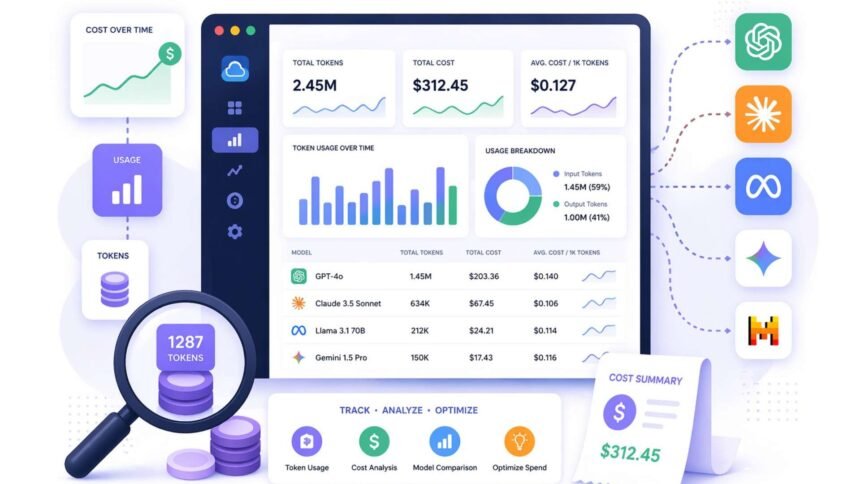
The same agent shows up on two separate invoices. Agent 365 governance is a per-seat charge on your Microsoft 365 bill, while the agent’s actual execution — Copilot Studio messages or Microsoft Foundry consumption — lands as metered usage on a completely separate Azure bill. Miss this and your clean $15-per-seat number becomes a four-figure surprise a month later.
This is the gap the incumbents leave wide open. Microsoft’s pricing page quotes the headline seat price; the licensing FAQ explains the per-user rule; almost nobody draws the line that connects the per-seat governance charge to the consumption charge it does not include. SAMexpert is the rare source that says it directly: “The same agent appears on two separate invoices: Agent 365 governance on the M365 bill (per-seat) and execution costs on the Azure bill (consumption).”
Here is why the split exists. Agent 365 is a control plane. It buys you the registry, Entra Agent ID, Purview data protection, Defender threat detection, and the observability dashboards, the apparatus for seeing and governing agents. It buys you exactly zero tokens of execution. To actually build and run an agent past the thin free tier, you go to Copilot Studio (message packs) or Microsoft Foundry (consumption), and both meter independently on Azure.
The organizational danger is that these two bills usually belong to two different teams. The per-seat M365 governance spend sits with the productivity or IT-licensing budget owner. The Azure consumption sits with the platform or cloud-FinOps owner. SAMexpert warns that “budget owners on each side may not see the other’s spend without deliberate cross-team coordination.” The agent that looked like a $15 line in a procurement review is quietly burning Foundry consumption in a cost center the procurement reviewer never opened.
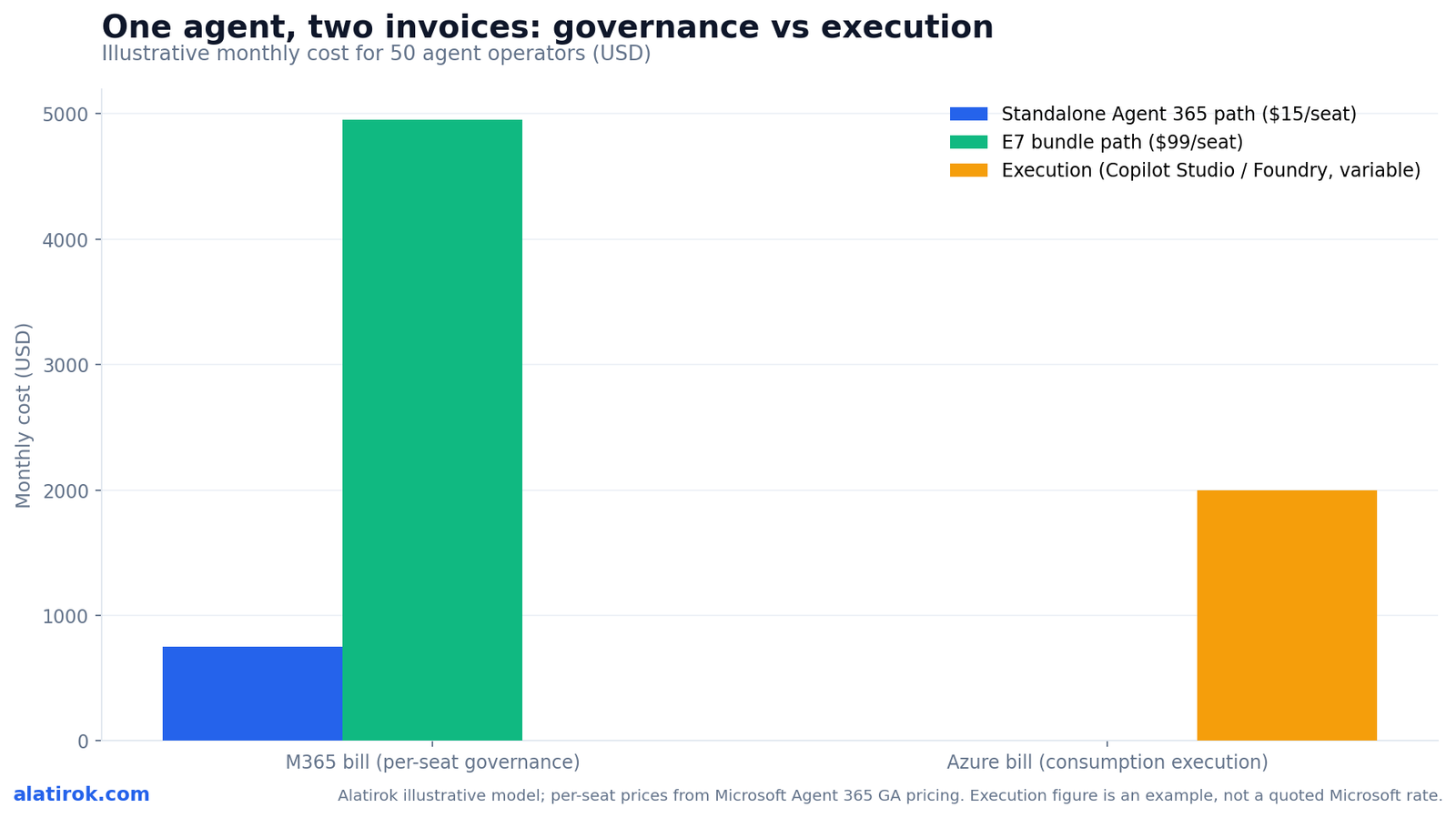
Agent 365’s $15 (or E7’s $99) per seat covers governance, not execution. Every message the agent sends and every token it burns is billed separately as Azure consumption — to a different budget owner.
Is Agent 365 included in a Microsoft 365 Copilot license?
No. Agent 365 is not included in the $30 Microsoft 365 Copilot add-on, nor in Microsoft 365 E3 or E5. The only bundle that includes Agent 365 is the new E7 suite at $99 per user per month; otherwise you buy it standalone at $15. Copilot and Agent 365 solve different problems, so they are priced apart.
It is an easy assumption to make, because Copilot Studio is where many people build agents. But the Copilot license gives you the AI assistant and the building surface; Agent 365 gives you the governance, security, and observability control plane that watches over agents regardless of where they were built. Microsoft’s licensing FAQ confirms “Agent 365 is not included in M365 E3/E5 licenses” and is available either standalone or “as part of Microsoft 365 E7.”
So the four-way decision is concrete. If you have E3/E5 and want governance, add standalone Agent 365 at $15. If you have Copilot and want governance, you still add standalone Agent 365 at $15, because Copilot does not include it. If you are buying E5 + Copilot + Entra Suite + Agent 365 fresh, E7 at $99 saves about 15% over buying the four separately. If you only have a base M365 plan and no Copilot, Agent 365 still works, it has no hard product prerequisites, though Microsoft recommends Entra P1/P2 or Entra Suite plus Purview DLP to use it fully.
Pros
Cons
Do I need Agent 365? A decision flowchart
Work it from the human, not the agent. Start by asking whether a licensed user owns, sponsors, manages, or is acted-for by the agent — if yes, that human’s Agent 365 license covers it and you never license the agent. Then decide standalone versus bundle by what you already own.
Walk the questions in order. (1) Is there a licensed human who owns, sponsors, manages, or whom the agent acts on behalf of? If yes, you license that human, not the agent, and one license covers all of their agents. (2) Do you already run E3 or E5? Then add standalone Agent 365 at $15 per operator. (3) Are you buying E5 + Copilot + Entra Suite + Agent 365 fresh? Then E7 at $99 is the discounted path. (4) Is the agent a fully autonomous identity with its own mailbox and credentials? That is Frontier preview, not GA pricing, hold it for a future budget cycle.
The reason this framing beats the incumbents is that it refuses to count agents. Every confused buyer starts by asking “how many agents do I have?” and gets lost. The correct first question is “which licensed humans operate agents?” That number is your seat count. Everything else, registry size, agent count, framework choice, is irrelevant to the governance bill.
And remember that finishing this flowchart only sizes Invoice #1. The moment you answer “yes, I need Agent 365,” open a second worksheet for Invoice #2: the Copilot Studio or Foundry execution consumption on Azure. The flowchart tells you who to license; it does not tell you what the agents will cost to actually run.
Q1: Does a licensed human own, sponsor, manage, or get acted-for by the agent?
If yes (the GA default for on-behalf-of agents), you license that human. One Agent 365 or E7 license covers every agent associated with them. The agent needs no license of its own. If the agent is a standalone autonomous identity, see Q4.Q2: Do you already run Microsoft 365 E3 or E5?
Add Agent 365 standalone at $15 per operator per month. It has no hard prerequisites, though Microsoft recommends Entra P1/P2 or Entra Suite plus Purview DLP for full functionality. This keeps your existing agreement and cost centers untouched.Q3: Are you buying E5 + Copilot + Entra Suite + Agent 365 together, from scratch?
Then Microsoft 365 E7 at $99/user/mo bundles all four at roughly a 15% discount versus the ~$117 a-la-carte total. If you do not want all four, skip E7 and buy standalone.Q4: Is the agent a fully autonomous identity with its own mailbox and credentials?
These agentic users remain in Frontier preview and are not part of GA per-user pricing. The ‘you only license the human’ rule does not yet have a GA answer for them — budget for a likely per-identity charge when they reach GA.Q5: Did you remember Invoice #2?
Agent 365 covers governance, not execution. After sizing seats, separately model Copilot Studio message packs or Microsoft Foundry consumption on the Azure bill. Assign an owner who sees both invoices, or the per-seat number you just approved will not survive contact with production.Does Agent 365 govern agents built outside Copilot Studio?
Yes. Agent 365 governs agents built on any stack — Microsoft Agent Framework, the M365 Agents SDK, the OpenAI Agents SDK, the Claude Code SDK, and LangChain — not just Copilot Studio agents. The Agent 365 SDK extends any of them with governed identity, observability, and policy, and you do not have to migrate frameworks.
This matters for licensing because it kills the idea that you need to be “all-Microsoft” to pay for Agent 365 and benefit. The control plane is framework-agnostic by design. Microsoft’s developer docs ship the Agent 365 SDK as NuGet and PyPI packages (prefixed Microsoft.Agents.A365 / microsoft-agents-a365) that wrap an existing agent, built on the M365 Agents SDK, Microsoft Agent Framework, OpenAI Agents SDK, LangChain, or Claude Code SDK, with OpenTelemetry observability, Teams/Outlook/Word notifications, and governed MCP access.
The registry reach extends past Microsoft’s own platforms too. At GA, Agent 365’s registry and sync inventory agents across Microsoft Foundry, AWS Bedrock, and Google’s Gemini Enterprise Agent Platform, and the ecosystem integration covers third-party SaaS agents from partners like Zendesk, n8n, and Kore.ai. Discovery even surfaces shadow agents from tools like OpenClaw, GitHub Copilot CLI, and Claude Code.
The licensing consequence is clean: the per-user rule does not care which SDK your developers chose. Whether an agent was built in LangChain or Copilot Studio, if a licensed human owns or sponsors it, that human’s Agent 365 license governs it. The framework is a build-time decision; the license is a human-identity decision. They are orthogonal, and that is exactly why the per-seat model holds up across a heterogeneous agent estate.
Framework choice and licensing are orthogonal. Build in LangChain, Claude Code SDK, OpenAI Agents SDK, or Copilot Studio — if a licensed human owns or sponsors the agent, one Agent 365 seat governs itThe bottom line on AI agents and Microsoft 365 licensing
License the human, not the agent — then budget for two invoices, not one
AI agents do not need their own Microsoft 365 license. You license the human — the user, owner, sponsor, or manager the agent acts for — at $15 per seat standalone or inside the $99 E7 bundle, and that one seat covers all of that person’s agents. The whole model collapses to a single discipline: count operators, not bots.
If you take three things from this into a procurement meeting, take these. First, the billable unit is a licensed human; agent count is irrelevant to the governance bill. Second, standalone Agent 365 at $15 is the right answer for most E3/E5 shops; E7 at $99 only makes sense if you wanted E5, Copilot, and Entra Suite anyway. Third, and most overlooked, the per-seat governance charge is Invoice #1 of two, the Copilot Studio or Foundry execution consumption on Azure is Invoice #2, and they usually belong to different budget owners.
Get one person to own both invoices and the economics are predictable. Let the two bills drift into separate cost centers and you will approve a tidy per-seat number that has nothing to do with what your agents actually cost to run.
Builder’s take
I run agents in production at Cyntr and Loomfeed, so the per-seat-versus-consumption split is not abstract to me. Here is what I would tell a fellow buyer before they sign anything:
- Stop counting agents. The unit Microsoft bills is the human. If 40 people each spin up six agents, you are buying 40 Agent 365 seats, not 240. Headcount-based math is the only math that survives an audit.
- Agent 365 is a governance toll, not an execution budget. It buys you the registry, Entra Agent ID, Purview, and Defender coverage. It buys you zero tokens. Treat the $15 (or the $99 E7) as the price of being allowed to see your agents, full stop.
- The real overrun lives on the Azure bill. Copilot Studio messages and Foundry consumption are metered separately and land in a different cost center. I have watched teams approve a clean per-seat number and get blindsided four weeks later by execution spend nobody modeled.
- Buy E7 only when you already wanted E5 + Copilot + Entra Suite. If you are an E3 shop, the $99 bundle is a forced re-platform, not a discount. The honest move is standalone Agent 365 at $15 layered onto what you already own.
- Watch the Frontier preview line. Autonomous agents with their own identity and mailbox are not in GA pricing yet. The day they ship, the ‘you only license the human’ rule gets an asterisk. Budget for it now.
Frequently asked questions
No. Agents are never licensed individually. You license the human the agent acts for — the user, owner, sponsor, or manager — and a single Agent 365 license covers every agent associated with that person.
Agent 365 is $15 per user per month as a standalone license (billed annually), or it is included in the Microsoft 365 E7 bundle at $99 per user per month. Both reached general availability on May 1, 2026.
No. One Agent 365 (or E7) license held by a user covers all agents that user owns, sponsors, manages, or that act on their behalf. Agent count does not change your seat count at GA.
No. Agent 365 is not included in the $30 Copilot add-on or in M365 E3/E5. It is only bundled in Microsoft 365 E7 at $99/user/mo; otherwise you buy it standalone at $15/user/mo.
The $15 standalone buys only Agent 365 governance and layers onto licenses you already own. The $99 E7 bundle combines Microsoft 365 E5, Copilot, Entra Suite, and Agent 365 — about a 15% discount, but only worth it if you wanted all four.
No. Agent 365 covers governance — registry, identity, security, compliance, observability — on a per-seat M365 bill. The agent’s actual execution (Copilot Studio messages or Microsoft Foundry consumption) is billed separately as Azure consumption. The same agent appears on two invoices.
Primary sources
- Microsoft Agent 365, now generally available — Microsoft Security Blog
- Microsoft Agent 365 overview — Microsoft Learn
- Microsoft Agent 365 Licensing FAQs — Microsoft
- Agent 365 Licensing: What It Covers and Costs — SAMexpert
- Microsoft Agent 365: The Control Plane for Agents — Microsoft
- Microsoft Agent 365 SDK and CLI — Microsoft Learn
Last updated: June 2, 2026. Related: Governance.