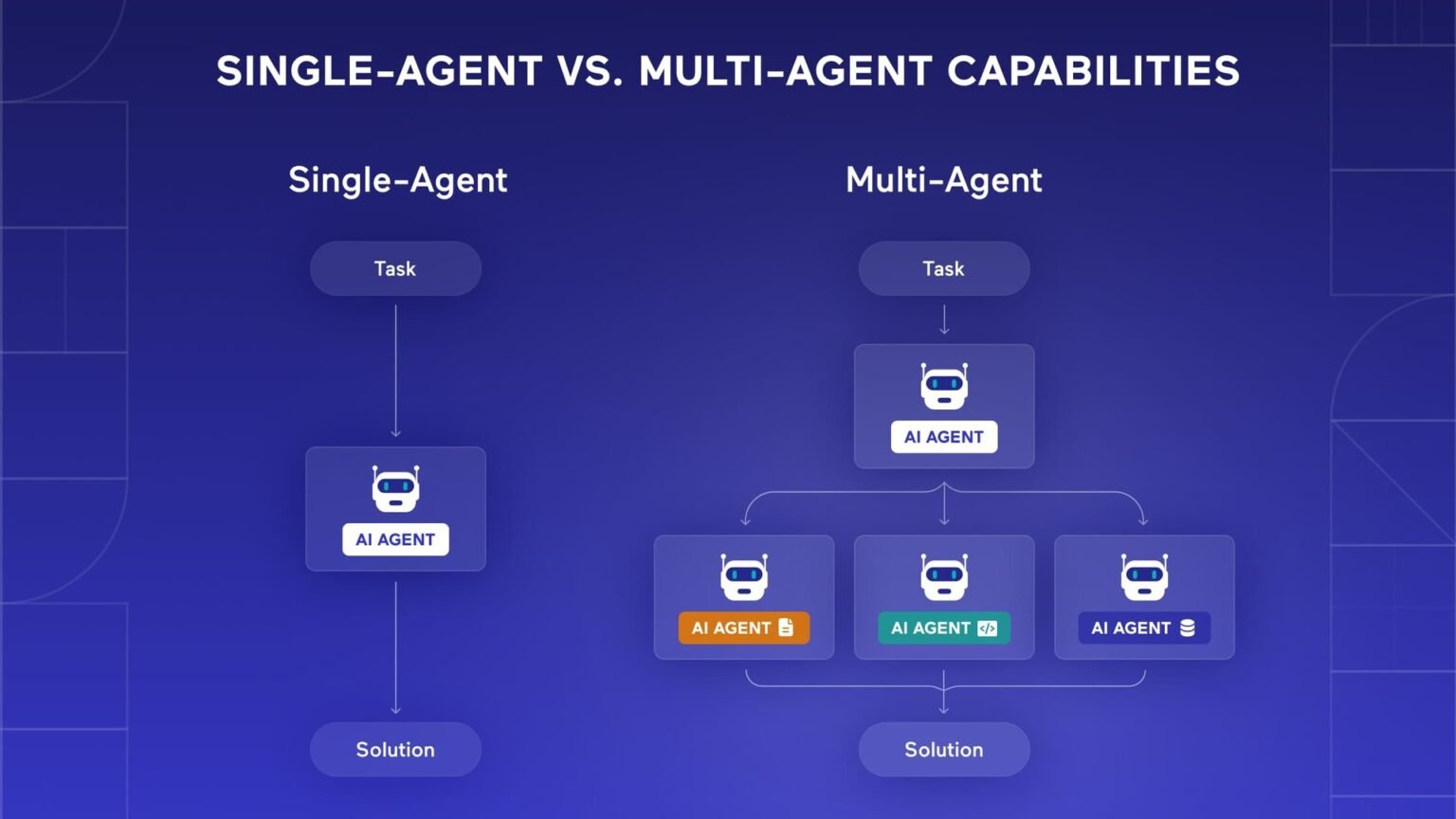

The case against multi-agent frameworks isn’t that they’re useless — it’s that most production workloads don’t need them. I’ll say the quiet part out loud: most teams using a multi-agent framework in 2026 are overengineering. Tools like CrewAI, AutoGen, and LangGraph are real, useful, and increasingly mature. I’m not arguing they are bad software. I’m arguing that for many production workloads, a single capable agent with strong tools, memory, and observability is simpler, cheaper to reason about, and often just as effective. If you want the pro-multi-agent case first, read our earlier pieces on CrewAI and LangGraph. This piece is the counterweight.
My contrarian take: most agent swarms are architecture theater
Default architecture: one capable agent
I think most production teams should default to one agent, not many. The reason is not ideological. It is operational. Every time you split a task across planner, researcher, executor, verifier, and manager agents, you create more prompts to maintain, more state handoffs to inspect, more tool permissions to constrain, and more traces to debug when something goes wrong.
That tradeoff can be worth it. I’ll get to the cases where it is. But the default industry narrative has run ahead of the evidence. Frameworks such as CrewAI package role-based collaboration as a first-class abstraction. Microsoft’s AutoGen supports multi-agent conversations and orchestration patterns. LangGraph takes a more primitive approach, exposing graph-based control flow, persistence, and human-in-the-loop patterns that can express single-agent and multi-agent systems alike. Those are meaningful contributions. None of them change the basic engineering question: does your workload actually benefit from multiple autonomous decision-makers?
In my reporting and in the systems I see teams describe publicly, the answer is often no. A lot of enterprise tasks are not open-ended simulations of teamwork. They are structured workflows with a few tools, a retrieval layer, some business rules, and a need for auditability. In those environments, adding more agents can feel sophisticated while making the system less legible.
 LangGraph documentation page illustrating graph-based agent orchestration” class=”wp-image-3883″/>
⚠️ Opinion. My default recommendation in 2026 is simple: start with a single agent plus tools, retrieval, memory, and guardrails. Add more agents only after you can name the failure mode that extra coordination will fix.
“A lot of enterprise tasks are not open-ended simulations of teamwork. They are structured workflows with a few tools, a retrieval layer, some business rules, and a need for auditability.”
alatirok opinion
The hidden tax of multi-agent design
The strongest argument against a multi-agent framework is not that it fails dramatically. It is that it quietly taxes every layer of the stack. Prompt count goes up. Token usage often goes up because agents summarize work for one another. Latency goes up because tasks that could have been one tool call become a chain of deliberation. Evaluation gets harder because you are no longer measuring one model-plus-tools loop; you are measuring interactions between several semi-independent loops.
Debugging is where the pain becomes obvious. If a single agent produces a bad answer, I can usually inspect the prompt, retrieved context, tool outputs, and final response. In a multi-agent setup, I also need to inspect the routing decision, the intermediate summaries, the role instructions, the handoff format, and whether one agent amplified another agent’s mistake. LangGraph’s documentation is candid about durable execution, interrupts, and stateful workflows because these are real engineering concerns, not cosmetic features. The fact that those primitives matter so much is also evidence that orchestration complexity is the main event.
Security and governance get harder too. If one agent can call a CRM, another can draft outbound messages, and a third can approve or critique, you now have to reason about least privilege across several actors. Microsoft’s AutoGen documentation includes agent orchestration and tool use patterns, but the burden of safe composition still falls on the builder. More agents means more places where permissions, data boundaries, or escalation logic can drift.
Pros
Cons
📌 What gets worse first. In practice, the first things to break are usually traceability and latency, not raw model quality.
| Design choice | Single agent + tools | Multi-agent framework |
|---|---|---|
| Prompt maintenance | One main system prompt plus tool instructions | Several role prompts and handoff contracts |
| Latency | Usually one loop with tool calls | Often multiple conversational turns between agents |
| Debugging | Inspect one trace | Inspect routing, handoffs, summaries, and traces |
| Permissions | Centralized tool policy | Per-agent tool policy and coordination rules |
| Evaluation | Task-level evals are straightforward | Need task and interaction-level evals |
CrewAI and AutoGen are useful, but they can make the wrong thing easy
LangGraph is the better primitive
I want to be fair here. CrewAI exists because role-based collaboration is intuitive. Teams understand the metaphor immediately: assign a researcher, writer, analyst, or reviewer and let them coordinate. AutoGen similarly gives developers a framework for agentic conversations, tool use, and orchestration. These frameworks lower the barrier to trying multi-agent patterns. That is a real benefit.
My objection is that they can also lower the barrier to adopting multi-agent patterns before a team has earned the complexity. If the framework’s core abstraction is a set of collaborating agents, builders tend to model the problem that way. A support workflow that should have been one agent with retrieval and a ticketing tool becomes a support agent, policy agent, escalation agent, and QA agent. A coding workflow that should have been one coding agent with test execution becomes a planner, implementer, reviewer, and debugger. The architecture starts to mirror an org chart instead of the actual computational needs of the task.
That is why I increasingly prefer the way LangGraph is positioned. Its graph abstraction does not force me to romanticize collaboration. I can build a single-agent loop with checkpoints, human approval, and deterministic branches, or I can build a multi-agent system if the task truly demands it. In other words, LangGraph gives me lower-level control. For many teams, that is healthier than starting from a crew metaphor and working backward.
“The architecture starts to mirror an org chart instead of the actual computational needs of the task.”
alatirok opinion
What a single capable agent can already do
A lot of the value people attribute to multi-agent systems actually comes from capabilities that do not require multiple agents at all. Tool calling lets one agent search, retrieve, execute code, query internal systems, and write back to business software. Structured outputs make downstream automation reliable. Memory and persistence let the system resume work. Human-in-the-loop checkpoints handle approvals. Evaluation frameworks and traces tell you where the system failed. None of that requires a committee.
OpenAI’s Responses API documentation, Anthropic’s tool use documentation, and LangGraph’s persistence and workflow docs all point in the same direction: the frontier of production agent engineering is not just clever prompting. It is robust tool use, state, and control flow. Once you have those pieces, one agent can often plan internally, call the right tool, inspect the result, and continue until the task is done.
I keep coming back to this because it changes the build order. If your single agent cannot reliably use the CRM, search your knowledge base, execute a SQL query, or ask for approval before taking an action, adding more agents will not save you. It will just distribute the failure across more nodes.
📌 Practical default. One agent with strong tools, retrieval, and state is often enough for support triage, internal knowledge work, coding assistance, and many back-office automations.
{
 "pattern": "single-agent-with-tools",
 "loop": [
 "read user goal",
 "retrieve relevant context",
 "choose tool",
 "execute tool",
 "inspect result",
 "ask for approval if needed",
 "return answer or continue"
 ],
 "requirements": [
 "durable state",
 "tool permissions",
 "structured outputs",
 "observability"
 ]
}
Where multi-agent actually helps
I am not arguing that multi-agent is useless. I am arguing that it is narrower than the hype suggests. The best case is a role-based pipeline where decomposition is natural, interfaces are explicit, and each stage benefits from a distinct prompt, tool set, or approval boundary.
Think about a bounded research workflow: one agent gathers sources, another extracts claims into a schema, and a final step produces a draft for human review. Or a software delivery pipeline where one node plans tasks, another writes code, and a deterministic test-and-check stage gates progress. In these cases, the gain is not magical emergent collaboration. It is separation of concerns.
This is also where LangGraph’s graph model shines. You can represent the workflow as nodes and edges, persist state, branch on conditions, and insert human approval where needed. If you choose to label some nodes as agents, fine. The key is that the system remains legible. I am much more comfortable with multi-step, role-based pipelines than with free-form agent societies debating their way toward an answer.
📌 Where I would use it. Use multi-agent patterns when the task has clear sub-roles, explicit interfaces, and measurable gains from decomposition.
| Workload | My view | Why |
|---|---|---|
| Customer support with retrieval | Usually single agent | Main challenge is policy grounding and tool access |
| Internal ops automation | Usually single agent | Auditability and permissions matter more than collaboration |
| Structured research pipeline | Sometimes multi-agent | Distinct stages can benefit from specialized prompts |
| Code generation with gated review | Sometimes multi-agent or graph workflow | Planning, execution, and testing can be separated cleanly |
| Open-ended brainstorming | Maybe multi-agent | Diversity of perspectives can help, but ROI is hard to prove |
The real bottlenecks are boring, and that is the point
Complexity is not capability
When teams tell me their agent system is underperforming, the root cause is rarely, “we needed more agents.” It is usually one of the boring things: weak retrieval, stale documentation, poor tool schemas, missing retries, no approval step for risky actions, or no trace data to understand failures. Those are infrastructure problems. A multi-agent framework can sit on top of them, but it cannot make them disappear.
That is why I think the center of gravity in agent engineering has shifted toward infrastructure: observability, evaluation, state management, policy controls, and reliable tool execution. If you solve those, a single agent becomes surprisingly capable. If you do not solve them, a multi-agent system becomes surprisingly fragile.
This is also why I resist the idea that multi-agent is the mature architecture and single-agent is the toy. In many production settings, the opposite is true. The mature architecture is the one with the fewest moving parts needed to meet the SLA, pass the audit, and recover cleanly from failure.
“The mature architecture is the one with the fewest moving parts needed to meet the SLA, pass the audit, and recover cleanly from failure.”
alatirok opinion
My rule of thumb for 2026
Here is the rule I would give most builders: if you cannot explain in one sentence why a second agent exists, do not add it. “Specialization” is not enough. “It feels more human” is definitely not enough. I want a concrete answer such as: this stage needs a different tool permission boundary; this branch needs a different optimization target; this review step benefits from an isolated prompt and deterministic gate.
If you are evaluating frameworks today, I would treat CrewAI and AutoGen as useful ways to prototype and learn multi-agent patterns, not as proof that your production system should be multi-agent. I would treat LangGraph as the more durable abstraction because it lets you model workflows directly, whether they involve one agent or several. And I would spend more time on evals, traces, and tool reliability than on inventing new agent roles.
I could be wrong. This take fails if frontier models keep improving at coordination in ways that are robust, cheap, and easy to inspect; if multi-agent frameworks dramatically reduce orchestration overhead while improving observability and safety; or if production evidence shows that decomposed agent teams consistently outperform single-agent systems on mainstream enterprise workloads, not just on demos and bounded pipelines.
Frequently asked questions
A multi-agent framework is software for building systems where multiple AI agents coordinate, converse, or hand work to one another. Examples include CrewAI and Microsoft AutoGen. If you want a lower-level orchestration model rather than a crew metaphor, LangGraph provides graph-based primitives for agent workflows.
It can be used to build multi-agent systems, but it is broader than that. The LangGraph docs describe it as a framework for building stateful, controllable agent workflows. In practice, that means you can use it for a single-agent loop, a graph of deterministic steps, or a multi-agent architecture.
It makes the most sense when the task decomposes cleanly into distinct roles or stages with explicit interfaces, separate tool permissions, or approval boundaries. Microsoft’s AutoGen documentation and the LangGraph docs both show orchestration patterns that are useful when decomposition is real rather than cosmetic.
Because more agents also mean more prompts, more state handoffs, more latency, and more debugging overhead. For many workloads, a single agent with strong tool use and durable state is simpler to operate. LangGraph’s emphasis on persistence, interrupts, and workflow control in its documentation is a good reminder that orchestration complexity is a core engineering concern.
Primary sources
- CrewAI official site — CrewAI
- Microsoft AutoGen documentation — Microsoft
- LangGraph documentation — LangChain
- OpenAI Responses API — OpenAI
- Anthropic tool use documentation — Anthropic
Last updated: May 20, 2026. Related: Agent Infrastructure.