
India AI startups 2026 is no longer one market story but three at once: venture-backed sovereign labs, compute-heavy pivots, and government language infrastructure. With total India AI funding at $10.1B in FY26, 3,200+ active AI startups, and a policy push through the IndiaAI Mission, the country’s AI stack is sorting itself into distinct tiers led by Sarvam, Krutrim, and Bhashini.
A $10.1B market is splitting into three tiers
$10.1B
India AI funding in FY26
Per AI Funding Tracker India
3,200+
Active AI startups
Third-largest globally after the U.S. and China
$3.94B
Q1 FY26 deeptech funding
Across 238 deals
The most useful way to read India AI startups 2026 is not as a single race to build a national champion, but as a three-tier landscape with different economics and different endgames. Market data cited by AI Funding Tracker puts total India AI funding in FY26 at $10.1B, with Q1 FY26 alone at $3.94B across 238 deeptech deals, and the country now has 3,200+ active AI startups. That scale makes India the world’s third-largest AI startup base after the U.S. and China, but it does not mean every lab is playing the same game.
Tier 1 is the sovereign-builder camp, where Sarvam has emerged as the clearest private-sector standard-bearer. Tier 2 is the compute-first camp, where Krutrim’s shift toward cloud services shows how hard frontier-model economics can get even with large capital commitments. Tier 3 is the public-utility layer, where Bhashini offers government-backed APIs for speech, translation, and voice across Indian languages. Read together, those tiers explain more about the direction of India AI startups 2026 than any single funding headline.
That framing matters because the strategic question is no longer whether India wants domestic AI capacity. It clearly does. The question is which layer will create durable advantage: proprietary frontier models, infrastructure and cloud capacity, or public digital rails that everyone else can build on.
FY26 India AI funding reached $10.1B, with 3,200+ active AI startups and $3.94B invested in Q1 FY26 across 238 deeptech deals.
| Tier | Representative | Core strategy | What it means |
|---|---|---|---|
| Tier 1 | Sarvam | Build sovereign multilingual models | Private lab aiming for frontier-grade Indian-language capability |
| Tier 2 | Krutrim | Shift from model ambition toward cloud services | Compute and infra may prove more durable than app-led model bets |
| Tier 3 | Bhashini | Government-backed language APIs | Public-good infrastructure that complements private labs |
Sarvam is the clearest sovereign-builder bet
$53M
Sarvam Series A
Backed by Lightspeed, Peak XV, and Khosla Ventures
22
Official Indian languages supported
Claimed by Sarvam
Most credible sovereign-model contender: Sarvam
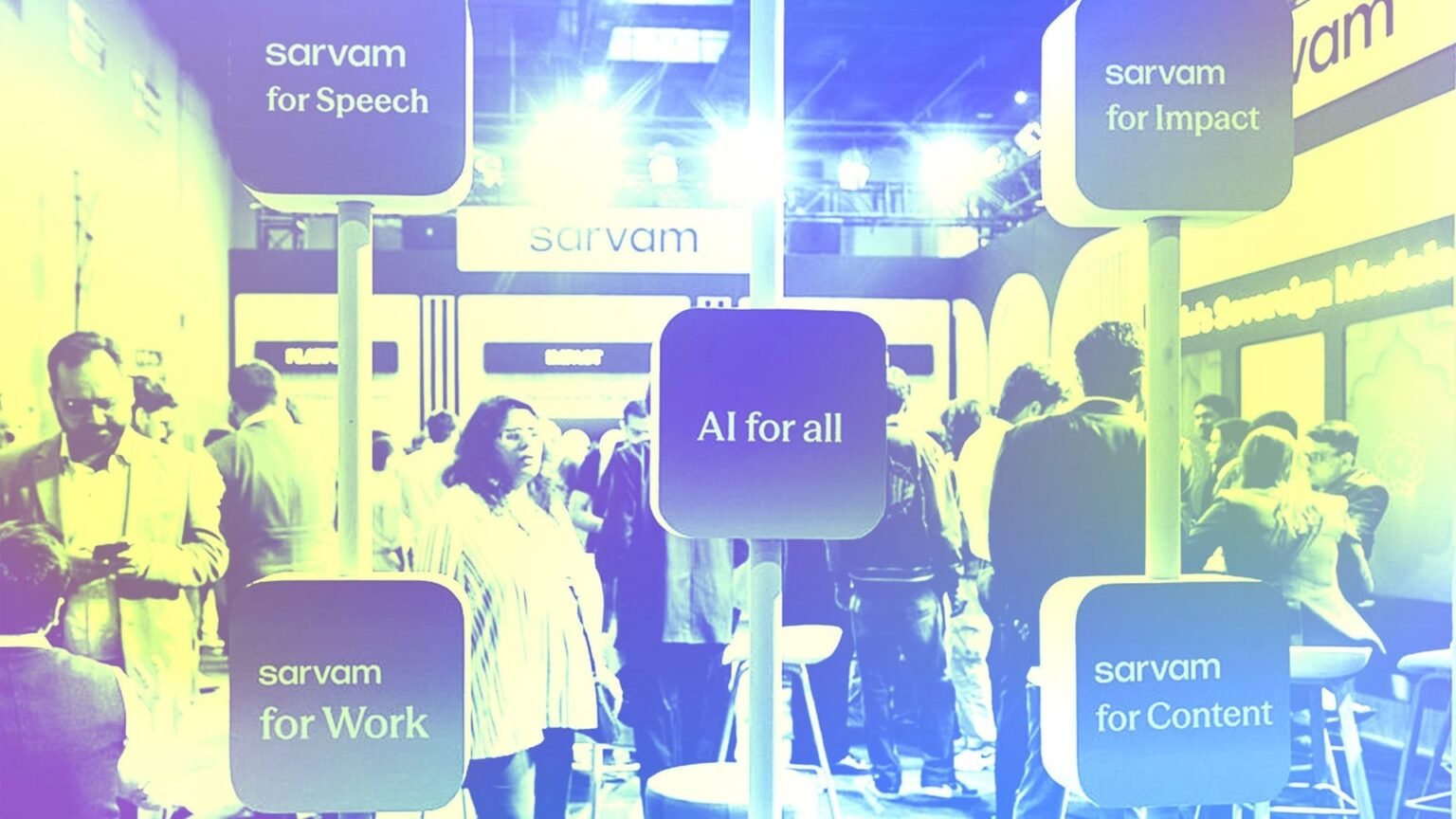
Sarvam has become the strongest case for a private Indian lab trying to build serious domestic model capacity rather than only wrapping existing open models. The company says it supports all 22 official Indian languages, and at the India AI Impact Summit in February 2026 it released two new models: Sarvam-30B, a 30B-parameter MoE model with a 32K context window trained on roughly 16T tokens, and Sarvam-105B, a 105B-parameter model with a 128K context window that the company describes as competitive with DeepSeek R1.
The funding backdrop helps explain why Sarvam is getting outsized attention in India AI startups 2026. The company has raised a $53M Series A from Lightspeed, Peak XV, and Khosla Ventures. In a market where many teams still rely on fine-tuning imported base models, Sarvam’s pitch is that multilingual Indian-language performance can be a moat, not just a localization layer.
Sarvam is also not taking a purist stance on model development. Its Hugging Face page includes OpenHathi, an open-source effort that teaches Indian-language skills to existing LLMs using a Llama-based approach. That makes Sarvam interesting for two reasons at once: it is trying to push toward frontier-grade sovereign models while also acknowledging that fine-tuning open-source foundations remains the practical path for many Indian deployments.
“Supports all 22 official Indian languages.”
Sarvam AI website
What makes Sarvam different from a simple fine-tuning shop?
Sarvam is pursuing both ends of the stack. It has released larger proprietary models such as Sarvam-30B and Sarvam-105B, while also maintaining OpenHathi, a Llama-based open-source path for Indian-language capability. That dual strategy matters because Indian customers may want sovereign performance, but many deployments will still optimize for cost and compatibility with open ecosystems.
Krutrim’s shift to cloud is the reality check
$1B
Krutrim valuation in 2024
India’s first AI unicorn
₹2,000 crore
Bhavish Aggarwal personal investment
Toward AI compute infrastructure
Cautionary but not terminal: Krutrim
If Sarvam represents the upside case, Krutrim is the reality check. The company became India’s first generative AI unicorn at a $1B valuation in 2024 and raised $50M from Matrix Partners. Founder Bhavish Aggarwal also personally committed ₹2,000 crore, described by TechCrunch as backing what he called India’s biggest AI supercomputer on NVIDIA GB200 GPUs. That is an unusually large domestic capital signal for an Indian AI company.
Yet the 2026 story is not about brute-force spending alone. TechCrunch reported on May 5 that Krutrim had made more than 200 layoffs, pulled the Kruti AI assistant app in April 2026, and was shifting toward cloud services. That does not make Krutrim a write-off. It does make it the clearest example in India AI startups 2026 of how quickly model ambition can run into commercial and operational constraints.
The more charitable reading is that Krutrim is moving toward the part of the stack where demand may be steadier: infrastructure, enterprise services, and compute access. The less charitable reading is that even a celebrity founder, a unicorn valuation, and a major GPU buildout were not enough to guarantee durable traction on the model-and-assistant side. Either way, Krutrim now looks less like a direct Sarvam analogue and more like a company testing whether cloud can be the more defensible business.
Krutrim’s 2026 pivot shows that capital and compute do not automatically translate into durable model leadership.
“India’s first genAI unicorn shifts to cloud services as AI model ambitions face reality.”
TechCrunch, May 5, 2026
Why does Krutrim matter even after the cloud pivot?
Krutrim still matters because it tested the upper bound of what domestic capital, founder branding, and compute ambition could do in India. Its move toward cloud services may end up being strategically rational if infrastructure demand proves easier to monetize than frontier-model competition.
Bhashini is not a rival lab. It is the public utility layer
The third tier is easy to misread if you look only for venture-style competition. Bhashini is not trying to be India’s answer to OpenAI or Anthropic. It is a government-backed language infrastructure layer offering free APIs for speech-to-text, translation, and voice synthesis across Indian languages. That makes it complementary to private labs, not directly competitive with them.
Bhashini sits inside a broader policy push under the IndiaAI Mission, which carries a ₹10,372 crore allocation, roughly $1.2B. That is a different sovereignty playbook from the one Europe has emphasized around regulation and enforcement. India’s bet is more direct: fund compute, fund ecosystem capacity, and fund public digital rails that reduce the cost of building for local languages.
In practical terms, Bhashini may end up being one of the most consequential pieces of India AI startups 2026 precisely because it lowers the floor for everyone else. Startups do not all need to build speech and translation stacks from scratch if government APIs can handle baseline language access. That can free private capital for higher-value layers such as domain workflows, enterprise integrations, and model specialization.
Sarvam ⭐ Editor’s Pick
Best for: Teams betting on Indian-language model capability and sovereign AI infrastructure
What works
Watch out for
Krutrim
Best for: Observers tracking India’s infrastructure-first AI path
What works
Watch out for
Bhashini
Best for: Developers and institutions needing language APIs across Indian languages
What works
Watch out for
IndiaAI Mission’s ₹10,372 crore allocation gives India a direct-funding sovereignty strategy rather than a regulation-first one.
The real thesis is frugal AI by necessity
The most important takeaway from India AI startups 2026 is that India is building an AI ecosystem under much tighter capital constraints than the leading U.S. labs. That gap forces a different style of innovation. Rest of World framed this as a frugal AI story, and that description fits: Indian labs are trying to do more with less through mixture-of-experts architectures, selective frontier bets, open-source adaptation, and public support for infrastructure.
Sarvam’s model releases are the strongest evidence that this is not just a branding exercise. A 105B model with a 128K context window, positioned as competitive with DeepSeek R1, is notable in any market. It is more notable in India, where the funding base is far smaller than what top U.S. and Chinese labs can deploy. Krutrim’s pivot reinforces the same point from the opposite direction: the model layer is brutally capital-intensive, and not every well-funded entrant will want to stay there.
That is why the three-tier landscape matters. Sovereign builders can chase differentiated model quality. Compute-first players can monetize infrastructure. Government utilities can reduce the cost of language access for everyone else. Put together, those layers make Indian AI look less like a copy of Silicon Valley and more like an ecosystem optimized around scarcity, multilingual demand, and public-private coordination.
Why does frugal AI matter beyond India’s domestic market?
If Indian labs can prove that multilingual, frontier-adjacent systems can be built with far less capital than U.S. incumbents spend, that playbook could travel to other emerging markets. The lesson would not be that smaller labs beat hyperscalers everywhere. It would be that targeted architectures, local-language focus, and public infrastructure can create viable alternatives in under-served markets.
The 22-language moat is the hardest thing for outsiders to copy
One reason Sarvam stands out is that its 22-language coverage is not a cosmetic localization claim. India’s language diversity creates a real product and data challenge, and that can become a moat if a lab can deliver quality across speech, text, and reasoning tasks in multiple Indian languages. U.S. frontier labs have broad multilingual capabilities, but none are known for a product strategy centered on all 22 official Indian languages as a core market promise.
That is where the private and public tiers can reinforce each other. Bhashini can expand baseline language infrastructure and access. Sarvam can push quality higher for enterprise and sovereign use cases. OpenHathi shows that some of this work will still happen through fine-tuning existing open-source models rather than replacing them outright. For India AI startups 2026, the language layer is not a side quest. It is the market.
The open question is whether Indian frontier-grade models will actually displace Llama- and DeepSeek-based workflows for Indian-language tasks, or whether most builders will keep fine-tuning open-source foundations because the economics remain better. That question is still unresolved. What is clearer now is that India’s strongest differentiator is not trying to outspend the U.S. It is building for linguistic complexity that outsiders have not treated as a first-order product problem.
What happens next
Bottom line: India is building a layered AI market
The next phase will test whether the three tiers stay complementary or start to collide. Sarvam has momentum, funding, and a clear multilingual thesis. Krutrim is now a live test of whether cloud and compute services can become the more durable business in India’s AI market. Bhashini and the IndiaAI Mission give the state a direct role in shaping the economics of language access and domestic capacity.
For investors, the lesson from India AI startups 2026 is that the market should not be judged only by whether one company becomes an Indian OpenAI. The more durable outcome may be a layered ecosystem where sovereign labs, infrastructure providers, and public APIs each own a different part of the value chain. For developers, the practical question is simpler: when Indian-language quality matters, do domestic models start outperforming imported open-source defaults enough to justify switching?
That answer will determine whether India’s AI market becomes mostly a fine-tuning economy built on global open models, or whether a homegrown frontier layer can claim real share in production workflows. Sarvam has the strongest early case. Krutrim has shown how unforgiving the path can be. Bhashini ensures the state will remain part of the stack either way.
Frequently asked questions
Sarvam has emerged as one of the clearest sovereign-model bets because it says it supports all 22 official Indian languages, released Sarvam-30B and Sarvam-105B, and raised a $53M Series A. Its public model work is also visible on Hugging Face.
The reporting cited here says Krutrim shifted toward cloud services after layoffs and the withdrawal of the Kruti AI assistant app, not that it exited AI altogether. See TechCrunch’s May 5, 2026 report and the company’s site at Krutrim.
Bhashini is a government-backed language infrastructure platform offering APIs for speech-to-text, translation, and voice synthesis. It complements private labs rather than competing with them directly. The platform is available at bhashini.gov.in, and the broader policy context is the IndiaAI Mission.
Primary sources
- Rest of World: India’s frugal AI push with Sarvam and Krutrim — Rest of World
- TechCrunch: Krutrim shifts to cloud services — TechCrunch
- Sarvam AI — Sarvam
- Sarvam on Hugging Face — Hugging Face
- Krutrim — Krutrim
- Bhashini — Government of India
- IndiaAI Mission — Government of India
- AI Funding Tracker India — AI Funding Tracker
Last updated: May 26, 2026. Related: Capital.