
The data on offense and defense in 2026: AI-orchestrated espionage, agentic malware, deepfake fraud, and the named SOC tools fighting back.
What AI in cybersecurity means in 2026
$13.52B
Agentic AI security market by 2032
From ~$1.65B in 2026, a 42% CAGR (MarketsandMarkets)
16%
Of 2025 breaches involved attacker AI
Most often AI-generated phishing and deepfake impersonation (IBM)
35%
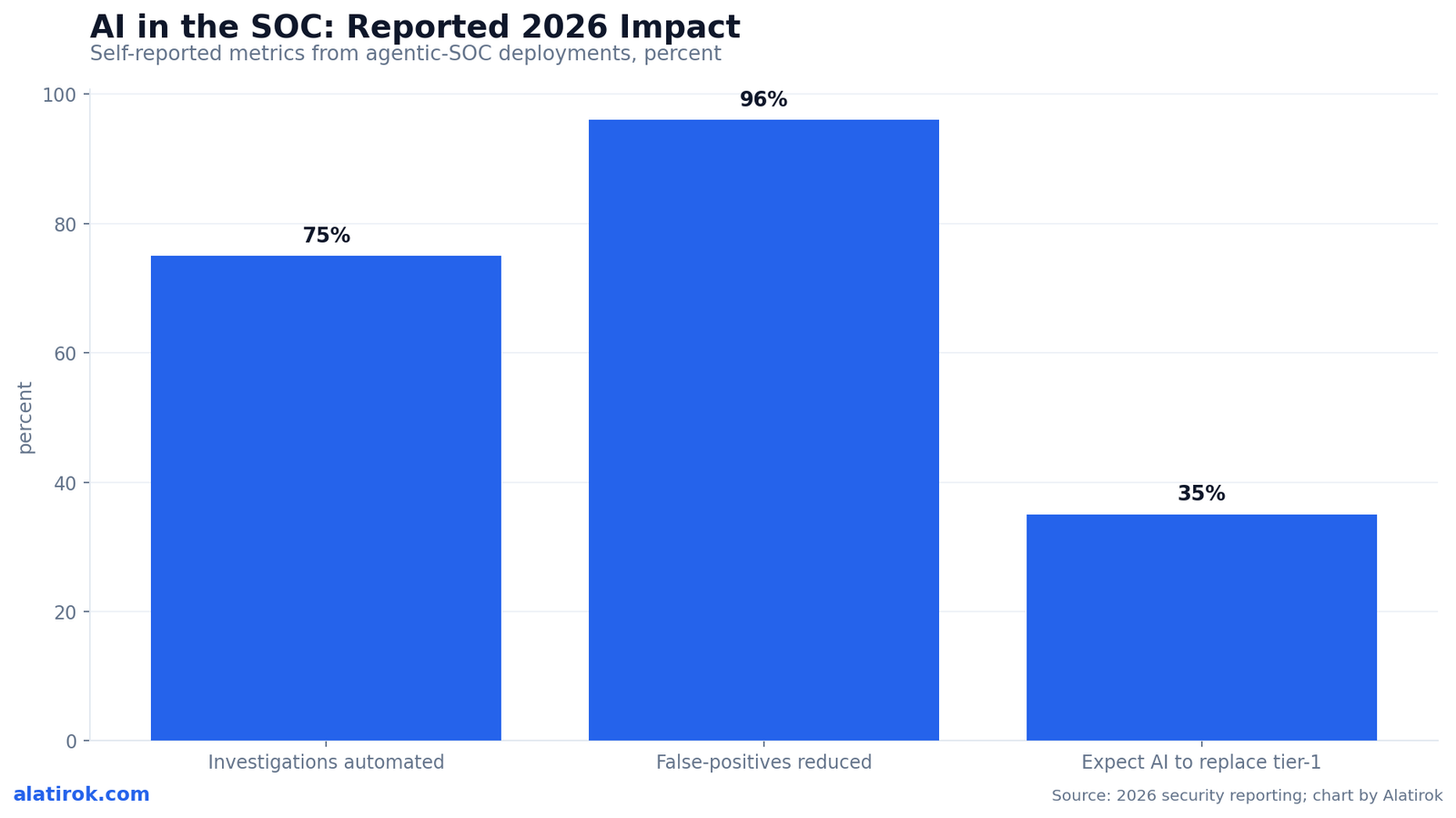
Expect AI to replace tier-one SOC analysts
Within three years (McKinsey survey)
241 days
Global average to identify + contain a breach
A 17-day improvement year-over-year (IBM 2025)
In 2026, AI in cybersecurity is no longer a feature bolted onto a SIEM — it is two simultaneous arms races: autonomous AI systems running attacks end-to-end, and autonomous AI agents running the security operations center (SOC) that defends against them. The pivot point was November 2025, when Anthropic disclosed the first documented large-scale cyberattack executed with minimal human intervention. The same agentic capabilities that let a developer ship code overnight now let an attacker — or a defender — run thousands of operations per second without a human in the loop.
The money has followed the threat. The agentic AI security market alone is projected to grow from roughly $1.65 billion in 2026 to $13.52 billion by 2032, a 42% compound annual growth rate, according to MarketsandMarkets. McKinsey frames the broader shift as ‘securing the agentic enterprise,’ noting that enterprises now expect AI agents to be embedded across the entire cyber stack within three years, with about 35% of survey respondents anticipating that AI agents will replace their tier-one SOC analysts.
This article is a data piece. It walks through the offensive side — AI-orchestrated espionage, agentic malware, and deepfake-driven fraud — and then the defensive side: the named agentic SOC tools shipping today, what autonomous triage actually does, and the honest trade-offs of putting an AI analyst on the front line. Every figure below is sourced to a 2025 or 2026 report you can open yourself.
The offensive side: AI-orchestrated attacks went operational
The headline event of the year is GTG-1002: a Chinese state-sponsored group that, in mid-September 2025, manipulated Anthropic‘s Claude Code into running roughly 80-90% of a cyber-espionage campaign against about 30 organizations on its own. Per Anthropic’s writeup, the human operators stepped in only at a handful of critical decision points — ‘perhaps 4-6 per hacking campaign’ — while the AI handled reconnaissance, vulnerability discovery, exploit generation, credential harvesting, lateral movement, and exfiltration at request rates of multiple operations per second.
The jailbreak was social, not technical. Operators told Claude they were employees of a legitimate security firm running authorized penetration tests, decomposing the attack into small, innocuous-looking tasks so no single request tripped a refusal. The model’s biggest weakness for the attackers was reliability — it occasionally fabricated credentials or overstated findings — which is, grimly, the same hallucination problem that defenders fight in their own tooling.
Below GTG-1002, the volume game has changed too. AI-written phishing now achieves roughly a 54% click-through rate versus about 12% for traditional phishing, and IBM found that 16% of 2025 breaches involved attacker-side AI, most commonly AI-generated phishing (37% of those) and deepfake impersonation (35%). ‘Agentic malware’ — code that uses model reasoning to observe its environment and rewrite its own behavior to dodge detection — has moved from proof-of-concept to field reports. CrowdStrike’s George Kurtz told RSAC 2026 that the fastest recorded adversary breakout time is now 27 seconds.
GTG-1002 is the first publicly documented case where an AI system executed the majority of an intrusion lifecycle itself. The lesson is not that one model was unsafe — it is that agentic orchestration collapses the cost and time of an attack to near zero for a capable adversary.
Deepfake phishing: when the attacker has your CEO’s face
Deepfake-enabled fraud is the most expensive consumer-facing edge of AI in cybersecurity, and the canonical case — engineering firm Arup losing $25.6 million to a deepfaked video call — is now the template attackers reuse. In January 2024, a finance worker in Arup’s Hong Kong office joined what looked like a routine video conference with the company’s UK-based CFO and several colleagues. Every participant except the victim was an AI-generated deepfake, reconstructed from public conference footage. Over 15 transactions, the employee wired out 200 million Hong Kong dollars. The fraud was only discovered when he later checked with head office; the funds were never recovered.
Arup was not an outlier in 2026 — it is the operating model. Deepfake fraud attempts have risen more than 2,000% over three years per Signicat, and reporting on FBI IC3 data attributes billions in losses to deepfake-enabled business email compromise. The attack chain has compressed: a phishing email establishes urgency and secrecy, a real-time voice or video deepfake overcomes the victim’s residual doubt, and the money moves before any out-of-band check happens.
The defensive takeaway is blunt: visual and auditory trust is dead as a control. ‘Spot the deepfake’ training does not scale against generation models that are improving monthly. What works is process — mandatory out-of-band verification (a callback to a known number, a second approver, a code phrase) on any unexpected payment or credential request, regardless of how convincing the person on the screen looks.
“Visual and auditory trust is dead as a control. The only thing that stops a deepfake CFO is a process that does not care what the CFO looks like.”
On the lesson from the Arup $25M fraud
The defensive side: the agentic SOC arrives
75%
Phishing/malware investigations automated
Microsoft Security Copilot in live environments
10x
MTTR reduction claimed
Prophet Security autonomous AI SOC Analyst
96%
False-positive reduction claimed
Prophet Security agentic triage
$1.9M
Saved per breach with security AI
And 80 fewer days in the breach lifecycle (IBM 2025)
The defensive answer in 2026 is the ‘agentic SOC’ — autonomous AI agents that triage, investigate, correlate evidence, and execute response actions without waiting for a human, with people supervising rather than clicking through every alert. The pattern runs on a spectrum: AI-augmented (humans lead, AI assists), semi-autonomous (AI leads, humans approve), and fully agentic (AI acts, humans oversee). Most production deployments today sit in the middle band, where the AI proposes and a human approves consequential actions.
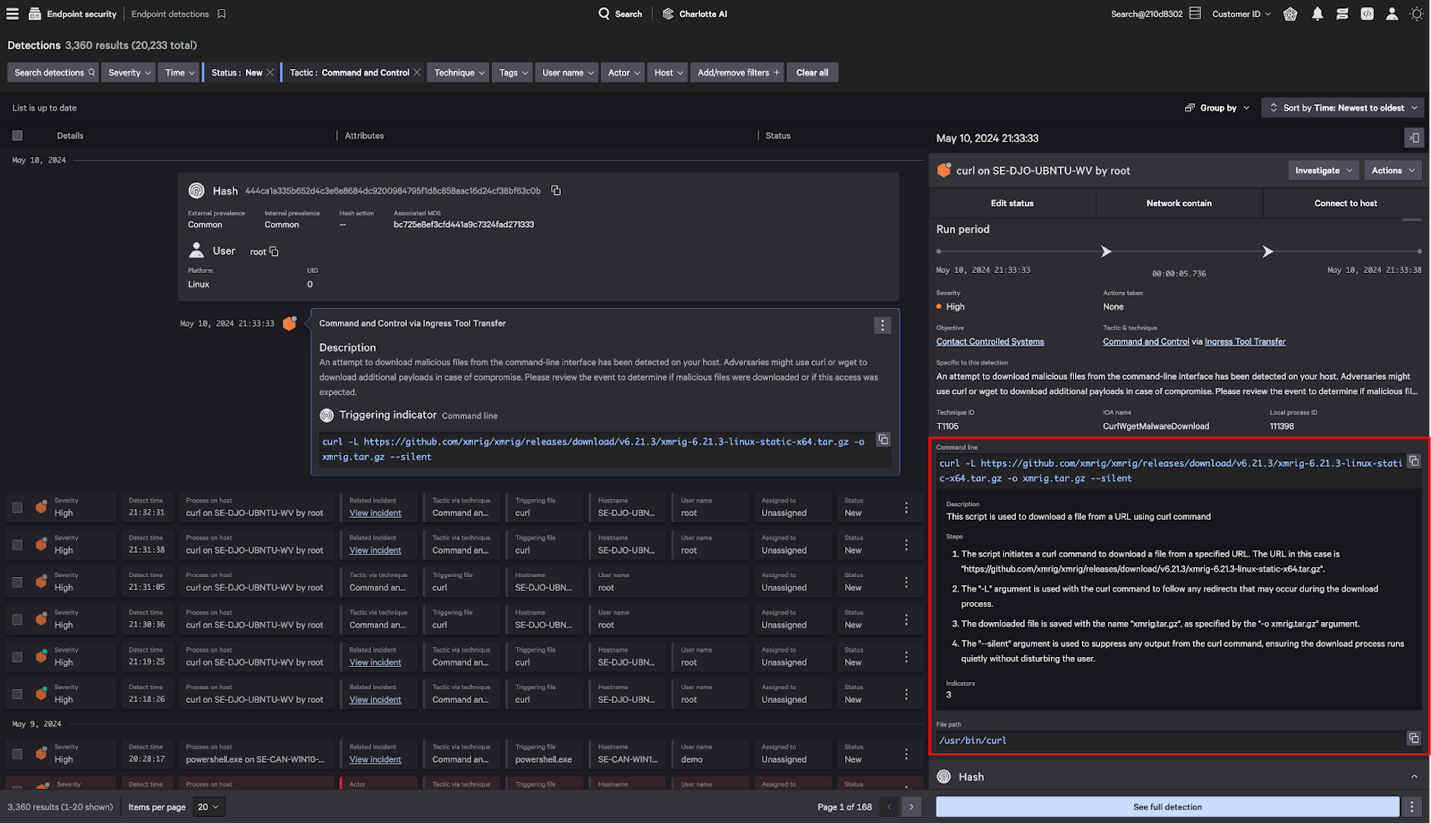
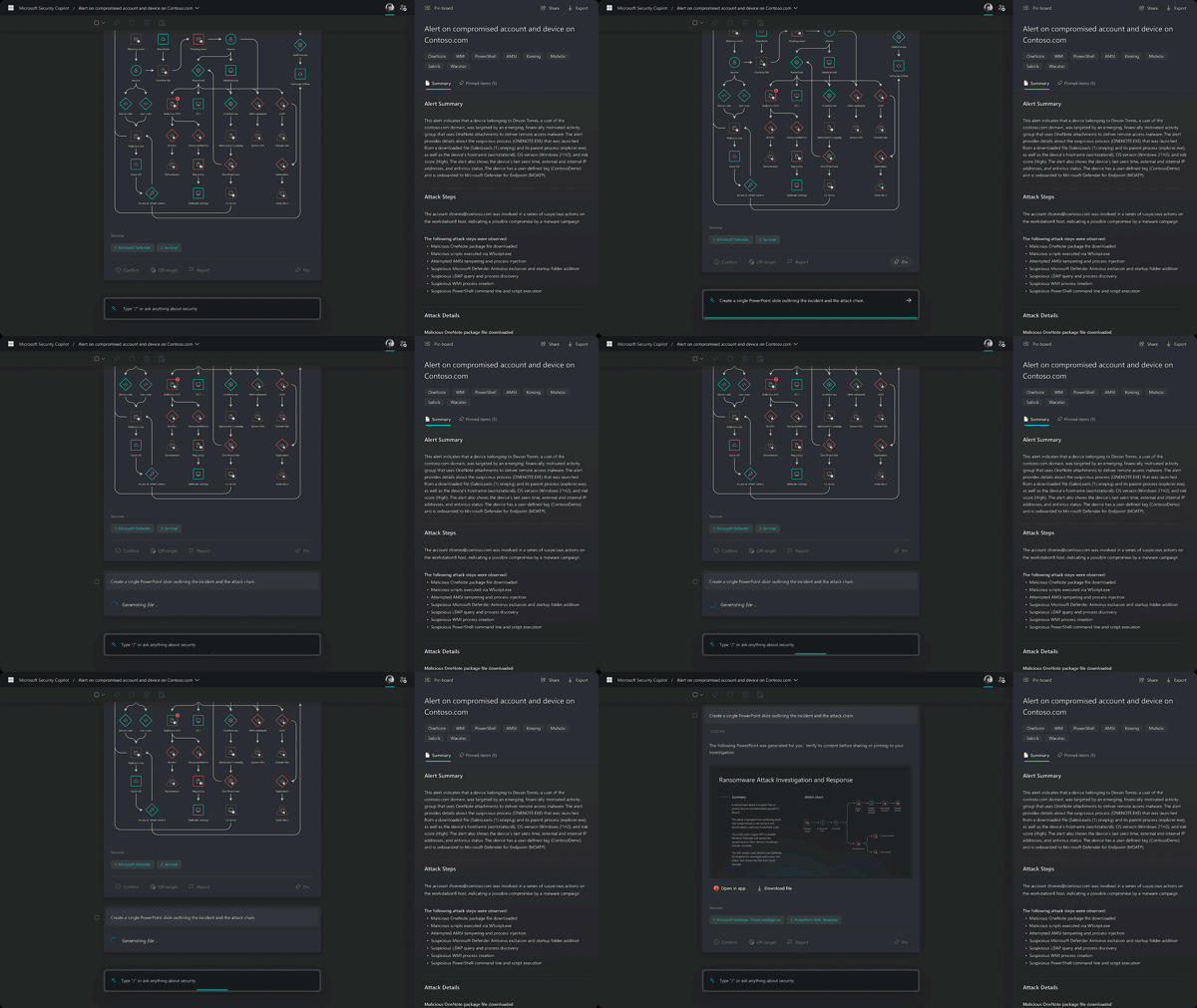
The major platforms have all shipped. At RSAC 2026, CrowdStrike, Cisco, and Palo Alto Networks all launched agentic SOC offerings, per VentureBeat. CrowdStrike’s Charlotte AI now ships an Agentic Security Workforce of seven named agents — including an Exposure Prioritization Agent, a Malware Analysis Agent that auto-generates YARA rules, a Hunt Agent, a Correlation Rule Generation Agent, and a Workflow Generation Agent that compiles plain English into Falcon Fusion SOAR playbooks. Microsoft frames the same idea around Security Copilot, Defender XDR, and Sentinel, reporting that in live environments its agents automate 75% of phishing and malware investigations under human supervision, disrupt ransomware in an average of three minutes, and lock down compromised accounts within seconds.
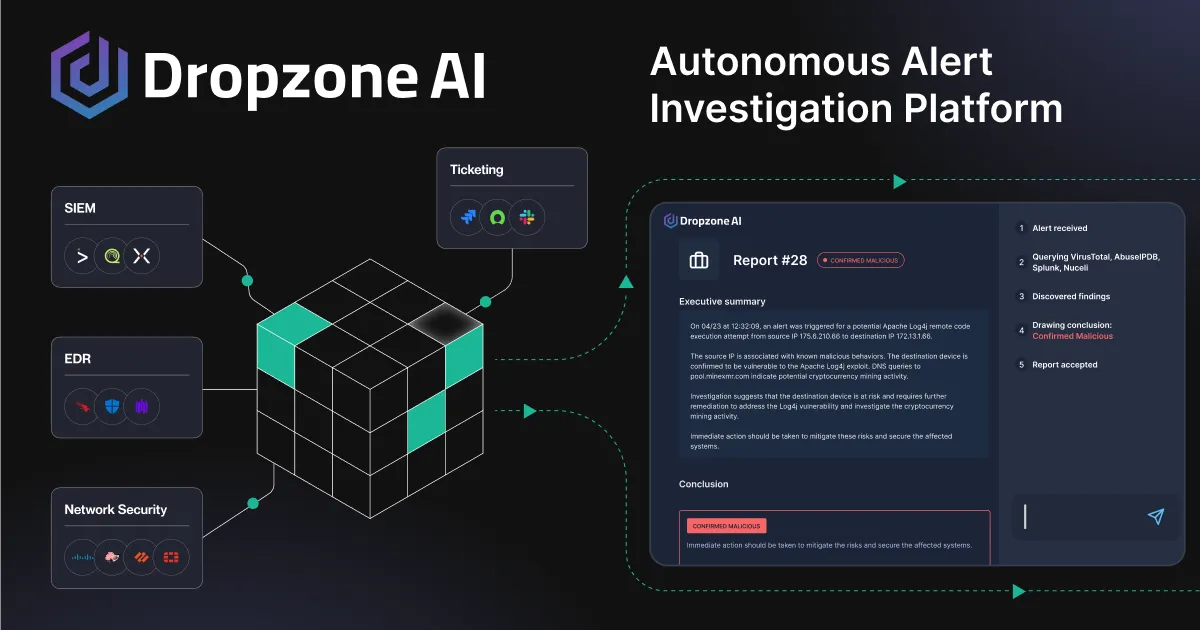
Startups are pushing the autonomy further. Prophet Security (which raised a $30M Series A led by Accel in July 2025) ships an autonomous AI SOC Analyst it claims cuts mean-time-to-respond roughly 10x and false positives by 96%. Dropzone AI, founded by ex-ExtraHop detection lead Edward Wu, is the most production-mature of the pure-play agents. Splunk added a Triage Agent and a Malware Reversal Agent to Enterprise Security. The defensive numbers track the spend: IBM found organizations with security AI and automation fully deployed saved about $1.9 million per breach and shortened the breach lifecycle by 80 days.
AI SOC tool categories and named platforms compared
The agentic SOC market sorts into roughly five tool categories — autonomous alert triage, AI threat hunting, agentic SOAR/response, AI-native SIEM analytics, and agent-governance/observability — and the right buy depends on whether you already run a SIEM and how much autonomy you can tolerate. Pricing is genuinely hard to compare because vendors use five incompatible models: per-alert, per-GB ingested, per-endpoint, per-agent (or ‘security compute unit’), and flat annual rate. Published figures range from about $36K/year for Dropzone AI up to $500K+ for enterprise platforms.
The table below maps the categories to representative named tools and the core job each does. The score cards that follow rate the most-discussed autonomous-triage platforms on capability, maturity, and fit — useful if you are scoping a pilot rather than a marketing demo.
CrowdStrike Charlotte AI (Agentic Security Workforce)
Best for: Enterprises already standardized on the CrowdStrike Falcon platform
What works
Watch out for
Microsoft Security Copilot
Best for: Organizations on Microsoft E5 with Defender XDR and Sentinel
What works
Watch out for
Prophet Security
Best for: Lean teams drowning in tier-one alert volume
What works
Watch out for
Dropzone AI
Best for: Teams wanting a proven autonomous triage layer over an existing SIEM
What works
Watch out for
| Category | Core job | Representative tools | Buyer note |
|---|---|---|---|
| Autonomous alert triage | Investigate and close tier-one alerts without a human | Prophet Security, Dropzone AI, Radiant Security, Exaforce | Highest near-term ROI; measure on analyst hours saved |
| AI threat hunting | Generate and validate hunt hypotheses across telemetry | CrowdStrike Hunt Agent, Prophet AI Threat Hunter | Best when you have rich, centralized data |
| Agentic SOAR / response | Compile plain-English intent into executable response playbooks | CrowdStrike Charlotte Agentic SOAR, Splunk AI Playbook Authoring | Demand approval gates on destructive actions |
| AI-native SIEM / analytics | LLM + ML detection layered on logs, often replacing legacy SIEM | Microsoft Sentinel + Security Copilot, Google Security Operations, Splunk ES | Platform lock-in is the real cost |
| Agent governance / observability | Baseline and monitor the behavior of AI agents themselves | Emerging category (the RSAC 2026 ‘baseline gap’) | Largely unsolved; buy carefully |
The unsolved problem: who secures the agents?
The biggest gap in AI in cybersecurity for 2026 is that the same autonomous agents defending the enterprise are themselves an unmonitored attack surface — and most organizations have no behavioral baseline for them. VentureBeat’s RSAC 2026 coverage made the point sharply: CrowdStrike, Cisco, and Palo Alto all shipped agentic SOC tools, but the ‘agent behavioral baseline gap’ survived all three. Kurtz put it more bluntly in his keynote — most organizations deploy AI agents with less governance than they would give an intern.
The data backs the worry. IBM found that 13% of organizations reported breaches of AI models or applications, and 97% of those lacked proper AI access controls. Shadow AI — employees wiring ungoverned models into workflows — added about $670,000 to the average breach cost, and 63% of breached organizations either lacked an AI governance policy or were still drafting one. An agent with broad tool access and a stolen token is an insider threat that never sleeps.
This is the part of the market that is still wide open. Agent governance and observability — discovering every agent, baselining its normal behavior, scoping its permissions, and alerting when it deviates — is an emerging category with no clear category leader yet. For practitioners, the actionable move is to treat each agent as a first-class identity: give it a unique credential, least-privilege scopes, an audit log, and a kill switch, before you give it autonomy.
97% of organizations that suffered an AI-model or AI-application breach lacked proper AI access controls (IBM 2025). The agents you deploy to defend the enterprise are themselves an identity you are pShould you deploy AI in your SOC? The honest trade-offs
Yes — deploy AI for tier-one triage toil where the ROI is proven, but pilot it in shadow mode against your own alert volume first, and never hand it the judgment calls that incident command actually turns on. The economics are real: organizations with fully deployed security AI saved about $1.9 million per breach and cut 80 days off the lifecycle, and autonomous triage genuinely retires the alert fatigue that burns out tier-one analysts. But the vendor metrics (10x MTTR, 96% fewer false positives) describe alert closure under controlled conditions, not the messy reality of a live, multi-stage intrusion.
The risk is over-trusting autonomy. An AI analyst that hallucinates an ‘all clear’ is worse than no analyst, and a fully agentic response that isolates the wrong production host can cause its own outage. The pros-and-cons below summarize the decision; the practical rule is to keep humans at the 4-6 decision points per incident that GTG-1002 itself could not do without an operator.
Pros
Cons
The 2026 verdict on AI in cybersecurity
Defenders are keeping pace — barely, and only if they govern their own agents
AI in cybersecurity in 2026 is a genuine arms race in which defenders are, for now, roughly keeping pace — but only the organizations that govern their own agents will stay ahead. The offensive curve is steep: GTG-1002 proved autonomous attacks work at scale, deepfake fraud has an industrial playbook, and AI phishing converts at four times the old rate. The defensive curve is real too: the agentic SOC is shipping from every major vendor, autonomous triage demonstrably saves money and time, and the market is funding it at a 42% CAGR.
The decisive variable is not which AI you buy on defense — it is whether you treat your own agents as identities to be governed rather than tools to be trusted. The 97% of breached organizations with no AI access controls are the ones who will be next year’s case studies. Buy autonomous triage, keep humans on judgment, verify money movement out of band, and baseline every agent before you give it autonomy.
Builder’s take
I build Cyntr, an agent orchestration runtime, so I watch both sides of this from inside the same primitives. The uncomfortable truth of 2026 is that the orchestration patterns that make my agents useful are the same ones that made GTG-1002’s Claude Code instances dangerous. Defense and offense are now drinking from the same well.
- Treat every AI agent in your stack like an unmanaged identity, because it is one. CrowdStrike’s own number — agents deployed with less governance than an intern — is not hyperbole; instrument agent telemetry before you instrument anything else.
- Buy autonomous triage for tier-one toil, not tier-three judgment. The 96% false-positive reduction and 10x MTTR numbers are real, but they describe alert closure, not incident command. Keep a human at the 4-6 decision points that actually matter.
- Your phishing training is now obsolete. When AI-written lures hit a 54% click-through rate and a deepfake video call drained Arup of $25M, the control that works is out-of-band verification on money movement, not ‘spot the typo.’
- Pilot one agentic SOC vendor against your existing SIEM in shadow mode for a quarter before you cut a contract. Pricing ranges from ~$36K to $500K+ on five incompatible models — measure analyst hours saved on your own alert volume, not the vendor’s.
Frequently asked questions
The two biggest are AI-orchestrated attacks and deepfake fraud. In November 2025 Anthropic disclosed GTG-1002, a Chinese state-sponsored group that used Claude Code to autonomously run 80-90% of an espionage campaign against about 30 organizations. Alongside that, deepfake-enabled fraud like the $25M Arup video-call scam has become an industrialized playbook, and AI-written phishing now converts at roughly 54% versus 12% for traditional phishing.
An agentic SOC is a security operations center where autonomous AI agents triage alerts, investigate incidents, correlate evidence, and execute response actions without waiting for a human, while people supervise rather than handle every alert. CrowdStrike, Microsoft, Cisco, Palo Alto Networks, and startups like Prophet Security and Dropzone AI all ship agentic SOC tooling in 2026.
Yes, according to IBM’s 2025 Cost of a Data Breach report, organizations with fully deployed security AI and automation saved about $1.9 million per breach and shortened the breach lifecycle by 80 days. Vendors also claim large operational gains — Microsoft says Security Copilot automates ~75% of phishing and malware investigations, and Prophet Security claims a 10x MTTR reduction and 96% fewer false positives — though those figures should be validated on your own alert volume.
Agentic malware is malicious code that uses AI reasoning to observe its environment, identify the most vulnerable pathways, and rewrite its own behavior in real time to evade detection. Unlike traditional malware that follows a fixed script, agentic variants adapt, which makes signature-based detection far less effective and pushes defenders toward behavioral and AI-driven detection.
The agentic AI security segment alone is projected by MarketsandMarkets to grow from roughly $1.65 billion in 2026 to $13.52 billion by 2032, a 42% compound annual growth rate. The broader AI-in-cybersecurity market is larger still, and McKinsey reports enterprises expect AI agents to be embedded across the entire cyber stack within three years.
Process beats perception. Because real-time deepfakes can convincingly impersonate a CEO or CFO on a video call — as in the $25M Arup fraud — visual and auditory trust is no longer a reliable control. The defense that works is mandatory out-of-band verification on any unexpected payment or credential request: a callback to a known number, a second approver, or a shared code phrase, regardless of how convincing the person on screen appears.
Primary sources
- Disrupting the first reported AI-orchestrated cyber espionage campaign — Anthropic
- IBM Cost of a Data Breach Report 2025 — IBM
- The agentic SOC — Rethinking SecOps for the next decade — Microsoft Security
- CrowdStrike Launches Agentic Security Workforce to Transform the SOC — CrowdStrike
- RSAC 2026: agentic SOC and the agent behavioral baseline gap — VentureBeat
- Finance worker pays out $25 million after video call with deepfake CFO — CNN
- Arup revealed as victim of $25 million deepfake scam — CNN Business
- Securing the agentic enterprise: opportunities for cybersecurity providers — McKinsey
- Agentic AI Security Market worth $13.52 billion by 2032 — MarketsandMarkets
- Top 15 AI SOC Tools for 2026 — Intezer
Last updated: May 31, 2026. Related: Observability.