
A publisher-neutral TCO model for 2026 with three named paths, year-one and ongoing breakdowns, and the hidden token cost that quietly outgrows the build.
How much does it cost to build an AI agent in 2026?
In 2026, the cost to build an AI agent ranges from about $240 per year on a no-code builder to $550,000+ for a fully loaded in-house team in its first year, with most agency builds landing between $25,000 and $200,000 for the build alone. But the headline build number is the least useful figure in the entire decision, because it ignores the cost that quietly grows larger than the build itself: usage-based token spend. So how much does it cost to build an AI agent? It depends almost entirely on which build path you choose.
Search the question “how much does it cost to build an AI agent” and the entire first page is development agencies anchoring numbers to their own service tiers, with ranges so wide ($5K to $500K+) they tell you nothing. None of them give you a vendor-neutral way to compare paths, and none of them model the recurring spend that turns a $55,000 build into a six-figure annual obligation.
This article fixes that. We model three named paths, the only three that matter, with real 2026 pricing: a no-code builder, an agency or freelancer build, and a loaded in-house team. For each, we separate the one-time build from ongoing operations, token spend, and maintenance, then give you a single decision rule. The goal is the honest total cost of ownership your CFO is actually asking about when they ask how much an AI agent costs.
What are the three paths to build an AI agent, and what does each cost?
There are three real paths to an AI agent in 2026: a no-code builder ($240-$6,000/year all-in for low volume), an agency or freelancer build ($15,000-$200,000+ one-time plus ops), and a loaded in-house team ($400,000-$550,000 in year one). They are not interchangeable; each buys a different mix of speed, control, and ongoing exposure.
The no-code path uses platforms like MindStudio, Relevance AI, Dust, or Retell. You assemble the agent in a visual builder and pay a subscription plus usage. MindStudio runs a free tier (1,000 runs/month), a Starter plan near $20/month, a Pro plan near $60/month with API access, and an Unlimited plan at $500/month, per its 2026 pricing. Voice-first platforms like Retell price per minute (from $0.07+/minute), and team tools like Dust start near $29/user/month. Time to a working agent: hours to days.
The agency or freelancer path buys you a custom codebase. Per DestiLabs’ breakdown of 50+ projects, a freelancer Tier-2 task agent runs $15,000-$40,000, an agency runs $30,000-$80,000, and multi-agent or enterprise builds run $80,000-$500,000+. Time to production: 12-16 weeks for a well-scoped MVP, longer for complex systems.
The in-house path means hiring. A senior ML engineer costs $150,000-$220,000/year in total compensation at typical US rates, and FAANG-level packages now reach $320,000-$550,000. Most agent projects need two to three engineers plus a lead, and prototype-to-production stretches 6-12 months. That is why a loaded first-year in-house cost lands at $400,000-$550,000 before the agent serves a single real user at scale.
When an agency says “$50K to build your AI agent,” that is the visible subtotal. Hypersense’s 2026 TCO model recommends adding 30-40% to any vendor quote for true year-one cost, and that still excludes ongoing token spend, which we cover next.
| Path | Build / entry cost | Time to live | Best when |
|---|---|---|---|
| No-code builder | $0-$500/mo subscription + usage | Hours to days | Validating ROI, low-to-mid volume, non-differentiated workflow |
| Freelancer | $15,000-$40,000 one-time | 4-10 weeks | Defined scope, light integrations, limited internal eng |
| Agency | $30,000-$200,000+ one-time | 12-16+ weeks | Production-grade single agent, real integrations, compliance |
| In-house team | $400,000-$550,000 loaded year one | 6-12 months | Durable, differentiated capability run at volume for years |
What is the AI agent total cost of ownership in 2026 across the three paths?
Year-one AI agent total cost of ownership in 2026 runs roughly $240-$60,000 for a no-code path, $50,000-$300,000+ for an agency build (build plus ops plus hidden costs), and $450,000-$650,000+ for an in-house team once you layer operations and token spend onto loaded salaries. The build is only one of four cost layers, and for high-volume agents it is rarely the biggest.
The four layers of AI agent TCO are: (1) the build or subscription, (2) infrastructure and operations, (3) usage-based token spend, and (4) annual maintenance. Operations alone runs $500-$2,000/month for a simple agent and $4,000-$50,000+/month for an enterprise multi-agent system, per DestiLabs’ tiered figures. Maintenance adds another 15-30% of the build cost every year.
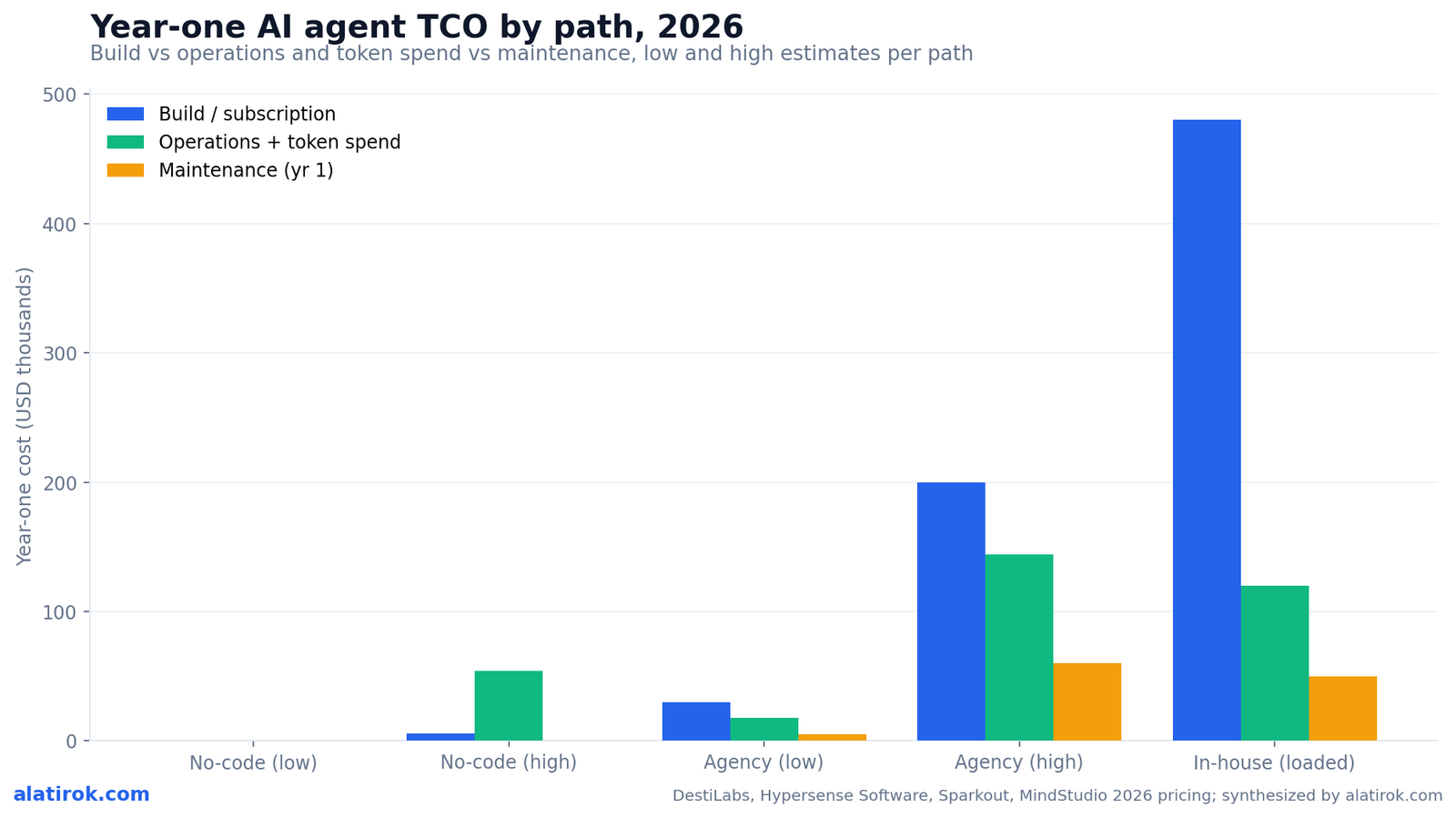
Hypersense’s worked mid-range example makes the gap concrete: an $80,000 build plus $12,000 infrastructure plus $15,000 integration is a $107,000 visible subtotal, but a 30% hidden-cost buffer pushes true year-one TCO to roughly $139,100. The chart below stacks the year-one layers for all three paths so you can see where the money actually goes.
Note the asymmetry. On the no-code path the subscription is trivial and the variable cost is usage. On the agency path the build dominates year one but maintenance compounds. On the in-house path, salaries swamp everything, which is exactly why in-house only pays off at scale and over multiple years.
Why does token spend often exceed the build cost of an AI agent?
Token spend often exceeds the build because an agent consumes 5-30x more tokens per task than a simple chatbot, and that cost recurs with every single run, while the build is paid once. Gartner’s March 2026 analysis pegs agentic workloads at 5-30x the token consumption of standard chat, because one user request triggers planning, tool selection, execution, verification, and response generation, not a single completion.
This is the dominant hidden cost the agency lead-gen articles never model. According to the FinOps Foundation’s 2026 State of FinOps report, AI is the fastest-growing new spend category, and 73% of respondents reported AI costs exceeded original budget projections. Vantage and other 2026 FinOps sources note that for teams running coding or research agents, the AI bill can become the second-largest line item on the engineering ledger after salaries within 90 days.
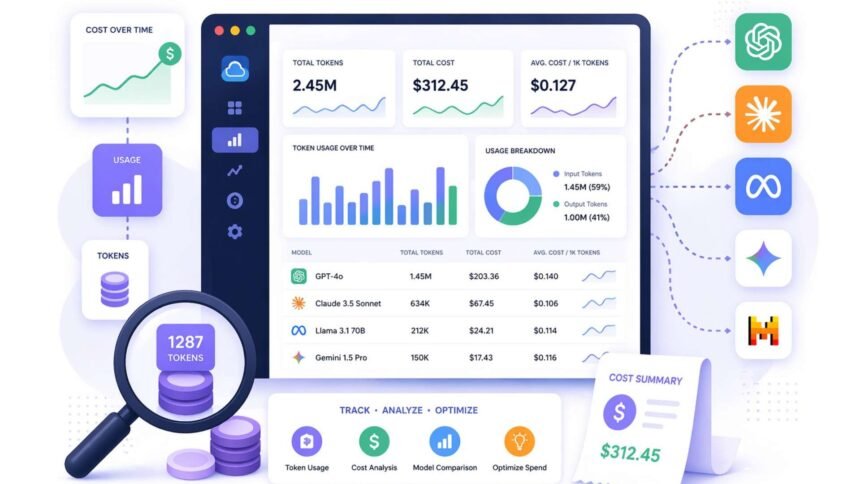
Do the arithmetic on a busy agent. At Claude Sonnet pricing of roughly $3 per million input and $15 per million output tokens (early-2026 list pricing), an agent that burns 50,000 tokens per task across its planning loop, serving 10,000 tasks a day, can run well into five figures a month. Over a year that recurring spend can dwarf a $55,000 one-time build, which is precisely why the build number alone is misleading.
Per a March 2026 Gartner survey of 353 data and AI leaders, only 44% of organizations have adopted financial guardrails or AI FinOps practices. Agent sessions running without a per-session cost ceiling are the single most common cause of a runaway AI bill in 2026.
“The build is a one-time number. The token bill is a recurring number that compounds with usage, and on a high-traffic agent it can pass the original build budget inside two quarters.”
Surya Koritala, founder of Cyntr and Loomfeed
Cost to build an AI agent in-house vs agency vs no-code: a direct comparison
For the same task agent, no-code costs the least and ships fastest, an agency build costs more upfront but gives you a custom codebase, and in-house costs the most and takes the longest but is the only path that fully owns the capability. The right choice depends almost entirely on volume, differentiation, and how long you will run the agent.
The pros and cons below assume a mid-complexity (Tier-2) task-execution agent, the most common real-world build. Notice that the in-house disadvantages are not just cost; they are time and risk. An MIT report cited across 2026 build-vs-buy guidance found that 95% of in-house AI initiatives fail to reach production, which makes the loaded salary spend a bet, not a guarantee.
The break-even logic is the part the lead-gen articles skip entirely. Buying or going no-code typically shows measurable ROI in 1-6 months; building in-house typically takes 12-24 months to show ROI but scales without rising vendor fees. The two curves converge around year two to three, so the only honest question is whether you are committing to this agent as a multi-year capability or testing a hypothesis.
Pros
Cons
What is the annual maintenance and operating cost of an AI agent?
15-30%
of build cost, per year
Typical annual maintenance for a production AI agent (Hypersense, DestiLabs 2026)
$38.4K-$156K
annual operating cost
Enterprise agent ops range across multiple 2026 TCO guides
5-30x
more tokens per task
Agentic workloads vs simple chat (Gartner, March 2026)
73%
over original budget
Share of teams whose AI costs exceeded projections (FinOps Foundation 2026)
Annual maintenance for an AI agent runs 15-30% of the original build cost every year, and ongoing operating cost (infrastructure plus token spend) ranges from roughly $6,000/year for a simple agent to $600,000+/year for an enterprise multi-agent system. These are recurring, not one-time, and they are the reason year-two TCO can rival year one.
Multiple 2026 guides converge on the same enterprise figures: an agent’s operating cost lands at $38,400-$156,000/year, and year-one TCO (build plus first-year operations) for a serious build lands at $108,000-$306,000. On the in-house path, maintenance is bundled into the same salaries that built the agent, so it hides inside headcount rather than appearing as a line item, which makes it easy to under-count.
Maintenance is not optional upkeep; agents degrade. Models get deprecated and re-priced, prompts drift as the underlying model updates, integrations break when partner APIs change, and accuracy must be re-tuned against real traffic. Budget for it from day one, because an agent you do not maintain in 2026 quietly stops earning its build cost back.
Build vs buy AI agent cost: a simple decision rule
The build is the down payment, not the price
Use this rule: start no-code to validate ROI; move to an agency build when the workflow proves valuable but you lack a permanent AI team; build in-house only when the agent is a durable, differentiated capability you will run at high volume for multiple years. Anything else is paying for control or prestige you will not use.
Concretely: if your agent handles low-to-moderate volume and the logic is not your competitive moat, the no-code or agency path wins on every dimension that matters, including time to value. The first-page agencies will quote you a six-figure build, but the honest answer for most teams is that a $60/month no-code agent or a $40,000 freelancer build clears the bar.
Reserve the in-house path for the narrow case where it pays: very high task volume (so per-task savings compound), a workflow that is genuinely your differentiation, and a multi-year commitment that outlasts the 12-24 month ROI ramp. And whichever path you pick, instrument token spend and set a per-session cost ceiling on day one. The most expensive AI agent in 2026 is not the one you over-built; it is the one whose token bill no one was watching.
Builder’s take
I have shipped agents on all three of these paths, and the number that actually matters is almost never the one on the invoice. As founder of Cyntr and Loomfeed, here is what I tell anyone pricing an agent build in 2026:
- The build is a one-time number; the token bill is a recurring number that compounds with usage. I have watched inference spend pass the original build budget inside two quarters on a single high-traffic agent. Model the per-task cost before you model the project cost.
- No-code is not a toy, it is a hypothesis test. Spend $60/month proving the workflow has ROI before you spend $250K proving you can hire a team. If the cheap version has no business value, the expensive version will not either.
- In-house only wins when the agent is a durable, differentiated capability you will run for years at volume. For everything else, the 95% in-house failure rate is the real price tag, and it is paid in dead months, not dollars.
- Whatever path you pick, put a per-session cost ceiling and token observability in on day one. The teams that get burned in 2026 are not the ones who chose wrong, they are the ones who never instrumented spend at all.
Frequently asked questions
The build cost ranges from about $240/year on a no-code builder to $400,000-$550,000 in loaded year-one cost for an in-house team, with most agency builds landing at $25,000-$200,000 for a single production agent. But the build is only one of four cost layers; ongoing token spend, infrastructure, and maintenance often add as much or more over the agent’s life.
A no-code builder is the cheapest entry point. MindStudio offers a free tier (1,000 runs/month) and paid plans from roughly $20/month, and voice platforms like Retell charge from about $0.07/minute. For low-to-moderate volume, no-code can run a useful agent for a few hundred to a few thousand dollars a year before usage-based costs scale up.
Yes, usually far more in year one. A loaded in-house team (2-3 engineers plus a lead at $150,000-$220,000 each in total compensation) runs $400,000-$550,000 in the first year and takes 6-12 months to reach production. An agency build of the same agent typically costs $30,000-$200,000. In-house only pays off at high volume over multiple years, where per-task savings compound.
Because agentic workloads consume 5-30x more tokens per task than a simple chatbot (Gartner, March 2026), since each request triggers planning, tool calls, verification, and generation. That cost recurs with every run, so on a high-traffic agent the annual token bill can exceed a one-time build budget. The FinOps Foundation found 73% of teams exceeded their original AI budget in 2026.
Annual maintenance typically runs 15-30% of the original build cost every year, covering model updates, prompt drift, broken integrations, and accuracy re-tuning. On top of that, infrastructure and token operating costs range from roughly $6,000/year for a simple agent to $600,000+/year for an enterprise multi-agent system.
Buy or go no-code first to validate ROI (measurable returns typically appear in 1-6 months), then move to a custom agency build when the workflow proves valuable. Build fully in-house only when the agent is a durable, differentiated capability you will run at high volume for multiple years, since in-house ROI takes 12-24 months and 95% of in-house AI initiatives fail to reach production.
Primary sources
- AI Agent Development Cost 2026 (Real Numbers From 50+ Projects) — DestiLabs
- AI Agent Development Cost 2026: The Hidden TCO Breakdown — Hypersense Software
- No-Code AI Agent Builders: 2026 Comparison Guide & Pricing — MindStudio
- 7 Best AI Agent Builders in 2026 (Pricing & Tradeoffs) — Retell AI
- AI Cost Observability: Measuring and Justifying Token Spend in 2026 — Vantage
- Build vs Buy AI Agents: Real Costs, ROI Timelines & Decision Framework (2026) — ServicesGround
- AI Agent Development Cost in 2026 – Pricing, MVP, ROI & Budget Guide — Sparkout Tech
- AI Agent Development Cost $5K to $180K+ (2026) — ProductCrafters
Last updated: June 2, 2026. Related: Capital.