
Two headline numbers keep getting confused. Here is the reconciled scoreboard: live rollbacks, projected cancellations, and abandonment, each measuring a different point in the funnel.
What is the AI agent rollback rate in 2026?
The AI agent rollback rate 2026 is 74%: nearly three in four enterprises have rolled back or shut down a live, in-production AI agent after deployment, according to Sinch’s global survey of 2,527 senior decision-makers across 10 countries and six industries (published May 13, 2026). That figure measures a specific, often-misread event, an agent that went live in production and was then pulled or disabled, not a pilot that never shipped and not a project killed on a roadmap.
This number gets quoted constantly, and almost always alongside a second one, Gartner’s prediction that over 40% of agentic AI projects will be canceled by the end of 2027. The two live in separate articles, they get averaged into one vague ‘most AI agents fail’ headline, and that average is wrong. They measure different things at different points in the funnel: one is a live pullback after launch, the other is a project killed before it reaches steady state.
This article builds the single scoreboard nobody else has assembled, with every stage tied to a real, sourced figure. We reconcile the rollback rate, the cancellation forecast, and the broader abandonment data into one funnel, then explain the why behind each, including the counterintuitive finding that the most mature, best-governed organizations roll back the most.
Rollback = a live agent pulled back after go-live (74%, Sinch, observed). Cancellation = a project killed, often before steady-state (40%+ by 2027, Gartner, forecast). Abandonment = giving up on most AI initiatives entirely (42%, S&P Global, observed). Different events, different funnel stages, different sources.
Rollback vs cancellation vs abandonment: the AI agent funnel scoreboard
Read top to bottom, the 2026 agentic AI funnel runs: ~82% of enterprises have adopted or are piloting agents, 62% have at least one agent live in production, 74% of enterprises have rolled back a live agent at least once, Gartner forecasts 40%+ of agentic projects will be canceled by end of 2027, and S&P Global finds 42% of companies have abandoned most of their AI initiatives. Each percentage has a different denominator and measures a different decision, which is exactly why stacking them into one number is misleading.
The chart below plots each real figure as its own stage. Critically, these are not subsets of a single cohort, the rollback rate is share of enterprises (most of whom kept investing), the cancellation rate is share of projects, and the abandonment rate is share of companies giving up broadly. The side table makes the source, sample, and exact ‘what it measures’ explicit so you never conflate them again.
The Sinch percentage of enterprises rolling back AI agents is striking precisely because it sits next to a 98% figure: despite the rollbacks, 98% of surveyed enterprises say they are increasing AI communications investment in 2026. Rollback is not retreat from the category. It is iteration inside it.
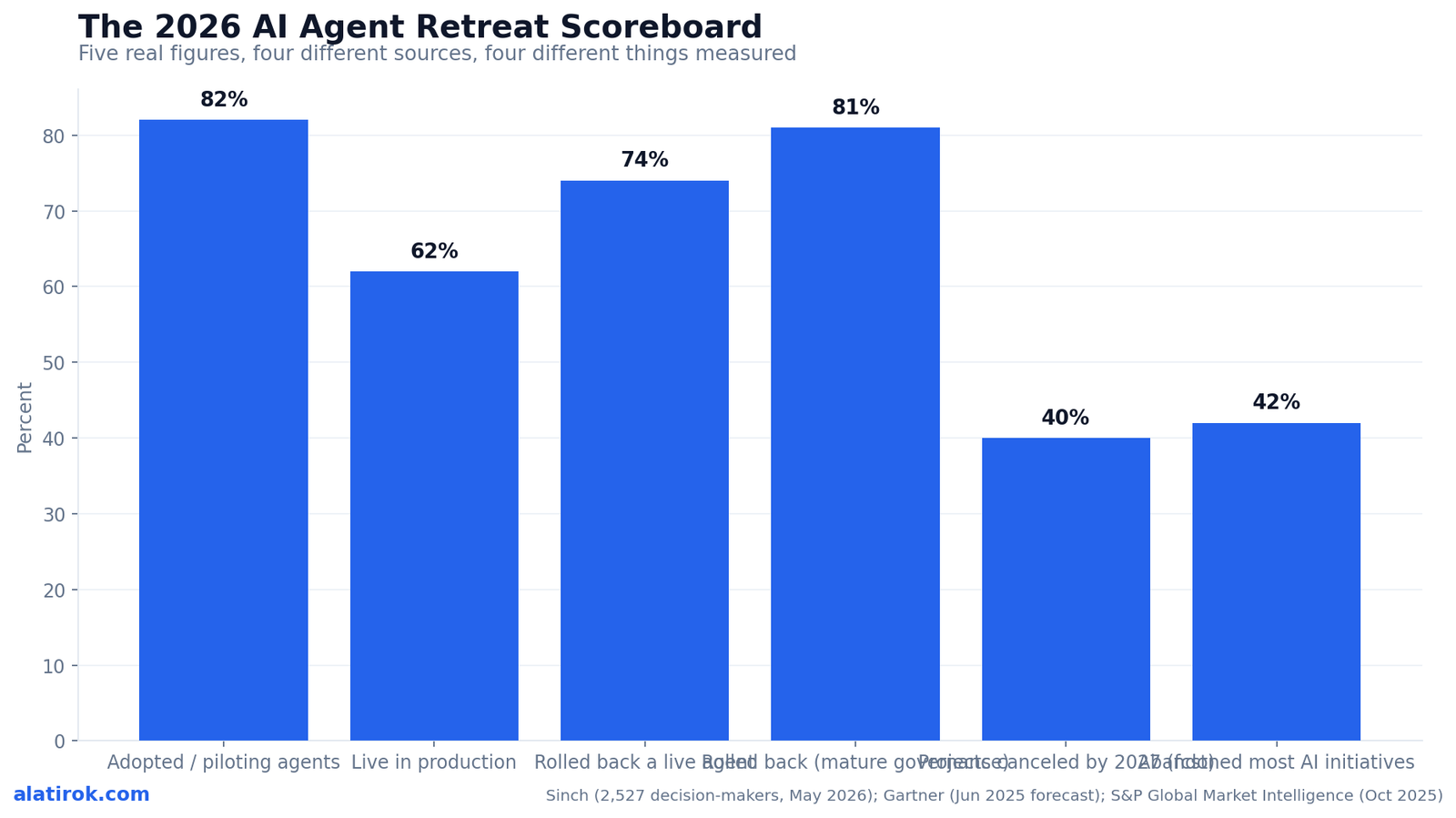
74% (enterprises), 40% (projects), and 42% (companies) have different denominators. Averaging them to claim ‘over half of AI agents fail’ is a category error that buries the real story: rollback is common AND investment is rising.
| Metric | Figure | Source | Sample | What it actually measures |
|---|---|---|---|---|
| AI agent rollback rate | 74% | Sinch (May 2026) | 2,527 senior decision-makers, 10 countries, 6 industries | Share of enterprises that pulled or shut down a LIVE, in-production agent at least once |
| Rollback, mature-governance orgs | 81% | Sinch (May 2026) | Subset with fully mature guardrails | Same event, but among the best-governed firms, higher because they detect failures faster |
| Agents live in production | 62% | Sinch (May 2026) | Same survey | Share with at least one customer-comms agent in production (not stuck in pilot) |
| Projects canceled by 2027 | 40%+ | Gartner (Jun 25, 2025) | Forecast | Share of agentic AI PROJECTS predicted to be canceled due to cost, value, or risk |
| Abandoned most AI initiatives | 42% | S&P Global (2025) | 1,000+ enterprises, NA + Europe | Share of COMPANIES that scrapped most AI initiatives, up from 17% in 2024 |
| Genuinely agentic vendors | ~130 | Gartner | Of thousands of self-described vendors | The ‘agent washing’ denominator, most ‘agents’ are rebranded chatbots/RPA |
Why are enterprises rolling back AI agents?
Enterprises are rolling back AI agents mainly because of governance failures discovered only after go-live: 31% cited customer data exposure as the leading cause, 22% cited hallucination or brand risk, and 16% cited an inability to diagnose what went wrong, according to the Sinch data reported by Customer Experience Dive. These are not model-quality problems in the abstract; they are control-plane problems that surface the moment real customers and real data hit the agent.
Gartner’s cancellation forecast points at a parallel set of drivers for projects that get killed rather than rolled back: escalating costs, unclear business value, and inadequate risk controls. The common thread across both datasets is that the failure mode is rarely ‘the model is too dumb’, it is ‘we could not run, price, govern, or trust this thing in production‘.
Sinch’s own framing reinforces it: 84% of AI engineering teams report spending at least half their time on safety infrastructure rather than improving the customer experience, and communications-infrastructure satisfaction was the single strongest predictor of successful deployment, stronger than either investment levels or guardrail maturity. The agents that survive are the ones sitting on infrastructure that can observe, constrain, and reverse them.
Pros
Cons
Why do mature-governance organizations roll back AI agents MORE (81%)?
The most counterintuitive finding in the 2026 data is that organizations with fully mature governance frameworks roll back agents MORE often, 81% versus the 74% baseline, because better monitoring surfaces failures faster, not because their agents are worse. Sinch CPO Daniel Morris put it directly: ‘The most advanced organizations aren’t failing less; they’re seeing failures sooner. Higher rollback rates reflect better monitoring and control, not weaker performance.’
This is the detail that nearly every repost buries, and it inverts the naive reading of the headline. If you assumed mature governance means fewer rollbacks, the data says the opposite: governance is a detection system, and detection systems that work generate more ‘pull it back’ events, not fewer. A team that never rolls back an agent may simply lack the instrumentation to know it should.
Gartner’s Greg Carlucci made the same point from the analyst side, noting that certain issues won’t be discovered until the tool is live, so rollbacks signify organizational learning rather than incompetence. The practical implication for buyers: when evaluating your own program, a zero-rollback record is a red flag for blind spots, not a gold star.
“The most advanced organizations aren’t failing less; they’re seeing failures sooner. Higher rollback rates reflect better monitoring and control, not weaker performance.”
Daniel Morris, Chief Product Officer, Sinch
How does agent washing drive the AI agent abandonment rate 2026?
~130
Genuinely agentic vendors
Of thousands self-described, per Gartner, the agent washing denominator
42%
Abandoned most AI initiatives
S&P Global 2025, up from 17% in 2024
46%
Of POCs scrapped pre-production
Average org, S&P Global Market Intelligence
31%
Cited data exposure for rollback
Leading single cause, Sinch via CX Dive
Agent washing, vendors rebranding chatbots, RPA, and assistants as ‘agents’ without real agentic capability, is a primary upstream cause of the AI agent abandonment rate 2026: Gartner estimates only about 130 of the thousands of self-described agentic vendors are genuinely agentic. When the market is that diluted, a large share of rollbacks and cancellations are simply organizations discovering, after go-live, that they bought automation dressed up as autonomy.
This connects the rollback and cancellation funnels to the broader abandonment data. S&P Global Market Intelligence found that 42% of companies abandoned most of their AI initiatives in 2025, up sharply from 17% in 2024, and that the average organization scrapped 46% of its proof-of-concept projects before production. A washed ‘agent’ that cannot actually plan, use tools, or recover from error is exactly the kind of deployment that gets pulled, killed, or abandoned once expectations meet reality.
The agent washing statistics matter because they reframe the whole scoreboard: a meaningful fraction of the 74% rollback and 40% cancellation figures are not indictments of agentic AI, they are indictments of mislabeled products. The genuinely agentic ~130 are not the ones generating most of the failures.
Will 40% of agentic AI projects really be canceled by 2027?
Gartner’s forecast that over 40% of agentic AI projects will be canceled by the end of 2027 is a prediction about projects, not a measured rollback rate, and it sits at a different funnel stage than the Sinch 74%. Cancellation kills a project, often before it ever reaches stable production or shortly after, while rollback pulls back something that already went live. A single enterprise can roll back an agent (counted in the 74%), keep iterating, and still have a separate project canceled (counted in the 40%).
Gartner’s stated drivers are escalating costs, unclear business value, and inadequate risk controls, the same governance-and-economics cluster behind live rollbacks. The agency’s own analysts describe most current agentic projects as early-stage experiments or proofs of concept driven by hype and frequently misapplied, which is why the cancellation rate is forecast to be so high.
Yet the same Gartner research is bullish on the trajectory: it projects that 40% of enterprise applications will feature task-specific AI agents by the end of 2026, up from less than 5% in 2025, and that 33% of enterprise software will include agentic AI by 2028. The cancellation wave and the embedding wave are happening simultaneously, which is precisely why a clean scoreboard matters more than a single scary percentage.
Two Gartner numbers, one company, no contradiction: 40%+ of agentic projects canceled by 2027 AND 40% of enterprise apps embedding task-specific agents by 2026. The market is winnowing bad projects anWhat should enterprises do about the AI agent rollback rate 2026?
The 74% rollback rate is a governance signal, not a death sentence for AI agents
The practical takeaway from the AI agent rollback rate 2026 is to treat rollback as a designed capability, not a failure event: scope agents narrowly, verify the vendor is genuinely agentic before signing, instrument for fast detection, and make sure you can reverse any agent to a human path within minutes. The 74% is not a reason to avoid agents; it is a map of where deployments break.
Concretely, the data points to four moves. First, run the agent washing test, ask a vendor to demonstrate planning, tool use, and error recovery on your data before purchase, because only ~130 of thousands are real. Second, treat data-boundary controls as launch-blocking, given 31% of rollbacks trace to data exposure. Third, invest in observability you can act on, since 16% rolled back because they could not diagnose the failure. Fourth, benchmark your own rollback rate as a health metric, a zero-rollback program likely has blind spots, as the 81% mature-governance figure implies.
The reconciled scoreboard, 74% rollback, 81% among mature orgs, 40%+ projects canceled by 2027, 42% companies abandoning most AI, ~130 real vendors, tells a single coherent story when you stop averaging it: agentic AI works, mislabeled and under-governed deployments do not, and the organizations winning are the ones that can pull an agent back as confidently as they push it live.
Builder’s take
I run two agentic products, so I read the Sinch 74% the way an operator does, not the way a doomer does. Here is what the scoreboard actually tells me:
- The 74% rollback and the 40% cancellation are not the same number twice. One is a live pullback after launch; the other is a project killed before or after it ships. Stop averaging them.
- The counterintuitive 81% among mature-governance orgs is the most important line in the whole dataset. It means good teams are catching failures faster, not building worse agents. Rollback is a control, not a verdict.
- Agent washing is the quiet cost driver. If only ~130 of thousands of self-described vendors are genuinely agentic, most rollbacks are buying a chatbot and discovering it after go-live.
- On Cyntr I treat rollback capability as a feature I ship on day one, not a failure I patch later. If you cannot cleanly pull an agent back to a human path in minutes, you are not ready to launch it.
- The investment line (98% still increasing spend) is the tell. Nobody is abandoning agents as a category. They are abandoning specific, badly-scoped, badly-governed deployments and reloading.
Frequently asked questions
74% of enterprises have rolled back or shut down a live, in-production AI agent at least once, according to Sinch’s May 2026 survey of 2,527 senior decision-makers across 10 countries and six industries. The rate rises to 81% among organizations with mature governance frameworks because better monitoring detects failures faster.
Sinch reports 74% of enterprises have rolled back a live AI agent post-launch. This is distinct from Gartner’s separate forecast that over 40% of agentic AI projects will be canceled by 2027, and from S&P Global’s finding that 42% of companies abandoned most of their AI initiatives in 2025, three different metrics measuring different things.
Organizations with mature governance roll back agents at 81%, above the 74% baseline, because robust monitoring surfaces failures faster. As Sinch CPO Daniel Morris put it, the most advanced organizations aren’t failing less, they’re seeing failures sooner. Higher rollback reflects better detection and control, not worse agents.
No. Gartner forecasts over 40% of agentic AI projects will be canceled by end of 2027 due to cost, unclear value, or weak risk controls, a prediction about projects. The Sinch 74% is an observed rollback rate for live agents. Cancellation kills a project; rollback pulls back something already in production. They sit at different funnel stages.
Agent washing is vendors rebranding chatbots, RPA, and assistants as ‘agents’ without genuine agentic capability. Gartner estimates only about 130 of thousands of self-described agentic vendors are real. Many rollbacks and cancellations happen when organizations discover after go-live that they bought mislabeled automation, not autonomy.
No. Despite a 74% rollback rate, 98% of surveyed enterprises say they are increasing AI communications investment in 2026. S&P Global’s 42% abandonment figure refers to companies scrapping most of their broader AI initiatives, not to the agent category specifically. The dominant pattern is iteration, narrow re-scoping and relaunching, rather than exit.
Primary sources
- Sinch research reveals 74% of enterprises have rolled back live AI customer communications agents — PR Newswire / Sinch
- Why three-quarters of enterprises have rolled back AI agents — Customer Experience Dive
- AI customer service bots get rolled back at 74% of firms — The Register
- Gartner Predicts Over 40% of Agentic AI Projects Will Be Canceled by End of 2027 — Gartner
- Generative AI shows rapid growth but yields mixed results — S&P Global Market Intelligence
- Gartner: 40% of agentic AI projects will fail, making humans indispensable (agent washing) — MarTech
- Gartner Predicts 40% of Enterprise Apps Will Feature Task-Specific AI Agents by 2026 — Gartner
Last updated: June 3, 2026. Related: Capital.