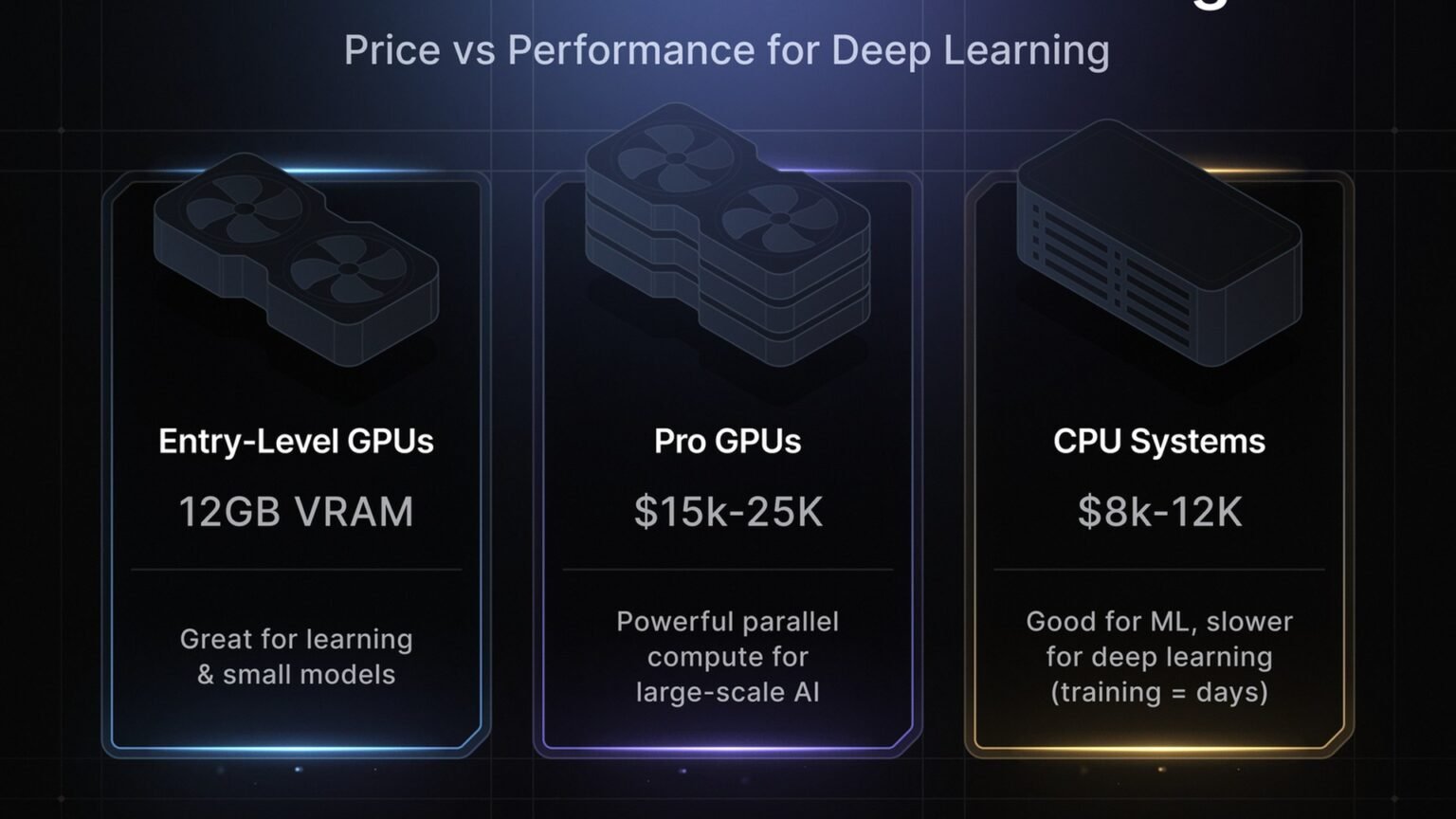

Choosing AI training hardware in 2026 means choosing an ecosystem, not just a chip. NVIDIA Blackwell B200, AMD Instinct MI355X, Cerebras WSE-3, Groq’s LPU-based systems, and SambaNova’s SN40L all target large-model workloads, but they do so with very different assumptions about software, scaling, memory, and buyer control. This comparison focuses on what vendors and public sources have actually disclosed: performance claims, adoption signals, and where each platform fits best.
The market in one view
4 TB/s
WSE-3 memory bandwidth
Cerebras public spec
230B
Llama 3.1 model size Groq says it runs
Groq public product claim
For buyers evaluating AI training hardware 2026, the first split is between general-purpose accelerator platforms and vertically integrated systems. NVIDIA and AMD sell GPUs into broad OEM and cloud channels. Cerebras, Groq, and SambaNova sell more opinionated systems and services, with hardware tightly coupled to their software stacks and deployment models.
That distinction matters because the practical buying criteria are different. If you need the widest model, framework, and cloud support, NVIDIA still sets the pace. If you want a second source with growing ROCm maturity, AMD is the obvious contender. If your team values architecture-level differentiation over standardization, Cerebras, Groq, and SambaNova each offer a clearer point of view on how AI infrastructure should be built.
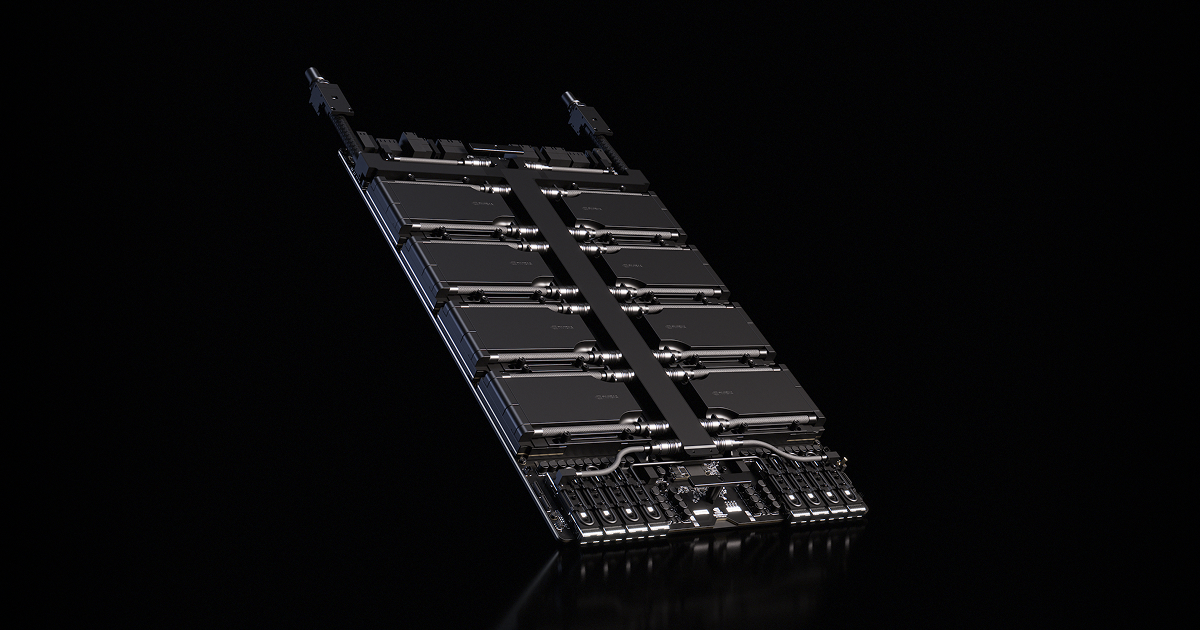
This comparison uses only publicly disclosed specifications, company announcements, and verifiable deployment signals. Where list pricing is not public, the article says so rather than estimating.
NVIDIA B200: best overall for frontier-scale training
NVIDIA’s Blackwell B200 is the default answer for buyers building large training clusters in 2026 because it combines raw performance claims with the deepest software and networking ecosystem. NVIDIA says one B200 delivers up to 20 petaflops of FP4 AI performance and includes 192 GB of HBM3e memory with 8 TB/s of memory bandwidth. For training buyers, the more important point is not a single-chip number but the surrounding stack: NVLink, NVSwitch, Quantum and Spectrum networking, CUDA, TensorRT, and broad support across hyperscalers and server OEMs.
NVIDIA’s strategic position remains unusually strong because it sells a complete system architecture rather than a standalone GPU. The company’s DGX B200 and GB200 NVL72 systems give enterprises and cloud providers a reference design for scaling. Public cloud support is also extensive. NVIDIA has announced Blackwell availability or planned support with major providers including AWS, Google Cloud, Microsoft Azure, and Oracle Cloud Infrastructure through various product announcements and partner pages.
The weakness is familiar: public list pricing for B200 systems is limited, and buyers often encounter long qualification cycles, premium system costs, and dependence on NVIDIA’s preferred architectures. Still, if the question is which platform offers the least execution risk for large-scale model training, B200 remains the safest answer.
NVIDIA B200 ⭐ Editor’s Pick
Best for: Hyperscalers, frontier labs, and enterprises standardizing on CUDA and NVLink clusters
What works
Watch out for
Best overall if you need the broadest ecosystem, the most mature large-scale training stack, and the easiest path to talent, tooling, and cloud availability.
“Blackwell is less a chip launch than a full-stack control point for AI infrastructure.”
Editorial assessment based on NVIDIA product and platform disclosures
| Publicly disclosed NVIDIA B200 data points | Value |
|---|---|
| HBM3e memory | 192 GB |
| Memory bandwidth | 8 TB/s |
| Dense FP4 AI performance | Up to 20 PFLOPS |
AMD MI355X: best challenger for GPU buyers who want leverage
AMD’s Instinct line has become the clearest GPU alternative to NVIDIA for training buyers that want supply diversity, pricing leverage, or a more open software posture. The company’s current public flagship page is the AMD Instinct MI350X, part of the MI350 series, which AMD positions for generative AI and high-performance computing. AMD has publicly discussed the MI350 series and its CDNA-based roadmap, while the MI355X appears in partner and roadmap discussions as a liquid-cooled variant in the same family. For this reason, buyers should treat MI355X as part of AMD’s broader MI350-series platform story rather than a fully separate ecosystem.
AMD’s strategic advantage is straightforward: it offers a credible second source for large GPU clusters while continuing to invest in ROCm. ROCm has improved materially, and AMD has highlighted support for major frameworks and open model ecosystems. The company has also secured visible deployments and partnerships, including with Microsoft Azure, Oracle Cloud Infrastructure, and major OEMs through public announcements around Instinct systems.
The trade-off is software maturity and operational familiarity. NVIDIA still has the stronger default position for many teams, especially where custom kernels, third-party libraries, and deeply optimized training stacks matter. AMD is most compelling when procurement strategy matters almost as much as peak performance, or when buyers are willing to invest in ROCm optimization to reduce long-term dependence on CUDA.
AMD MI355X
Best for: Enterprises and cloud buyers seeking a second-source accelerator strategy
What works
Watch out for
AMD does not publish broad public list pricing for MI355X systems. Most enterprise purchases are negotiated through OEMs, cloud providers, or direct sales channels.
Cerebras WSE-3: best architecture bet for buyers who want something fundamentally different
Cerebras does not compete by shipping a conventional GPU. Its Wafer-Scale Engine 3 is a single giant processor built on a full wafer, and the company says WSE-3 delivers 4 trillion transistors, 900,000 AI-optimized cores, and 4 PB/s of fabric bandwidth. Cerebras also says the chip provides 44 GB of on-chip SRAM and 4 TB/s of memory bandwidth. That architecture is designed to reduce the complexity of distributing work across many smaller processors.
The company’s pitch is that wafer-scale computing can simplify large-model training and inference by keeping more of the workload on one device and reducing communication overhead. Cerebras has also leaned into managed access through Cerebras Inference and cloud partnerships. Public deployment signals include work with G42 and the launch of large Cerebras-powered supercomputers announced by the company.
This is the most distinctive option in the field, but it is also the least interchangeable with mainstream GPU infrastructure. Buyers are not just choosing a chip; they are choosing Cerebras’s way of building and operating AI systems. That can be a feature if your team wants architectural differentiation, but it raises switching costs and narrows the pool of engineers already familiar with the stack.
Cerebras WSE-3
Best for: Research groups and enterprises open to a purpose-built wafer-scale system
What works
Watch out for
Best for teams willing to adopt a non-GPU architecture in exchange for a simpler scaling story and a more opinionated system design.
| Publicly disclosed WSE-3 data points | Value |
|---|---|
| AI cores | 900,000 |
| On-chip SRAM | 44 GB |
| Memory bandwidth | 4 TB/s |
Groq LPU: best for ultra-low-latency inference, not general training
Groq belongs in this comparison because buyers often evaluate it alongside training hardware budgets, even though its strongest public position is inference. On its main site and developer docs, Groq emphasizes deterministic, low-latency token generation on its LPU-based systems. The company publicly highlights support for models including large open-weight families and has promoted throughput and latency benchmarks through its own product materials.
That makes Groq strategically important in 2026 for a simple reason: many AI infrastructure decisions are now made around total model lifecycle cost, not training alone. If your organization trains or fine-tunes elsewhere but needs fast interactive inference, Groq can be a better fit than buying more general-purpose accelerators. The company’s cloud-first access model also lowers the barrier to evaluation compared with procuring a full on-prem cluster.
Still, Groq is not the first recommendation for teams whose primary requirement is broad, flexible model training. Its value is clearest when low latency, predictable serving behavior, and operational simplicity matter more than owning a universal accelerator platform. In a strict training-only ranking, Groq sits outside the top tier.
Groq LPU
Best for: Teams optimizing interactive inference and token latency rather than broad training flexibility
What works
Watch out for
Groq is included because buyers cross-shop it against training budgets, but its strongest public differentiation is inference rather than general frontier-model training.
SambaNova SN40L: best for buyers who want a full-stack AI system, not a chip project
SambaNova’s positioning has long centered on integrated AI systems rather than merchant accelerators. The company’s current platform messaging around SambaNova and its developer documentation emphasizes full-stack model serving and enterprise AI deployment. Public references to the SN40L platform place it within that broader systems strategy rather than as a standalone component sold into a broad OEM market.
That matters because SambaNova is competing on operational packaging. Enterprises that do not want to assemble their own accelerator, networking, orchestration, and model-serving stack may find the integrated approach attractive. The company has also publicized customer and government deployments over time, reinforcing its enterprise and sovereign AI pitch.
The limitation is that SambaNova is harder to evaluate as a pure chip-versus-chip purchase. Public pricing is not broadly posted, and the company’s value proposition depends heavily on the surrounding software and managed experience. For buyers who want maximum control and a large external ecosystem, that can feel constraining. For buyers who want a vendor to deliver an opinionated AI factory, it can be the point.
SambaNova SN40L
Best for: Enterprises and sovereign AI projects seeking integrated deployment over hardware modularity
What works
Watch out for
Best for enterprises that prefer an integrated AI platform and are less interested in assembling a heterogeneous hardware stack themselves.
Which should you pick
Best overall: NVIDIA B200
The right answer depends on whether you are optimizing for ecosystem breadth, procurement leverage, architectural differentiation, inference latency, or turnkey deployment. There is no single winner across all those axes. NVIDIA remains the broadest and safest choice. AMD is the strongest alternative for buyers who want a real GPU second source. Cerebras is the boldest architectural departure. Groq is the specialist for low-latency serving. SambaNova is the integrated platform bet.
One practical way to decide is to start from organizational constraints rather than benchmark headlines. If your team already runs CUDA-heavy workflows and hires from the mainstream ML infrastructure market, B200 is the easiest fit. If procurement wants leverage and engineering is willing to invest in ROCm, AMD deserves a serious pilot. If your bottleneck is distributed systems complexity, Cerebras is worth evaluating. If your product lives or dies on response speed, Groq should be in the mix. If you want a vendor to deliver more of the stack, SambaNova is the cleaner conversation.
Pros
Cons
| Use case | Best fit | Why |
|---|---|---|
| Frontier-scale training with lowest execution risk | NVIDIA B200 | Best ecosystem, cloud support, and system-level maturity |
| GPU alternative with procurement leverage | AMD MI355X | Most credible non-NVIDIA GPU path with ROCm momentum |
| Architecture-level differentiation for large models | Cerebras WSE-3 | Wafer-scale design offers a distinct scaling model |
| Ultra-low-latency interactive inference | Groq LPU | Strongest public positioning around deterministic low-latency serving |
| Turnkey enterprise or sovereign AI deployment | SambaNova SN40L | Integrated platform approach reduces assembly burden |
Frequently asked questions
It is the safest answer for broad large-scale training, but not every vendor publishes directly comparable numbers. NVIDIA’s B200 page provides public Blackwell specifications and system context. Cerebras, AMD, Groq, and SambaNova each emphasize different architectures or workload priorities, so buyers should compare within the context of their actual training stack.
Broad public list pricing is not generally posted on AMD’s official accelerator pages. Buyers usually work through OEMs, cloud providers, or AMD sales channels. The best starting point is AMD’s Instinct product page and the ROCm documentation for software readiness.
Groq is often cross-shopped in AI infrastructure decisions, but its strongest public differentiation is inference. Groq’s developer docs and product site focus on low-latency model serving rather than broad frontier-model training.
Cerebras uses a wafer-scale processor rather than a conventional GPU. The company’s WSE-3 page describes a single processor with 900,000 AI cores, 44 GB of on-chip SRAM, and 4 TB/s of memory bandwidth, which is a very different scaling philosophy from distributed GPU clusters.
Primary sources
- NVIDIA Blackwell B200 — NVIDIA
- NVIDIA DGX B200 — NVIDIA
- NVIDIA GB200 NVL72 — NVIDIA
- AMD Instinct accelerators — AMD
- AMD ROCm documentation — AMD
- Cerebras WSE-3 — Cerebras
- Cerebras Inference — Cerebras
- Groq — Groq
- Groq model docs — Groq
- SambaNova — SambaNova
- SambaNova documentation — SambaNova
Last updated: May 21, 2026. Related: Agent Infrastructure.